WASHINGTON (AP) — A top Federal Reserve official said Monday that an interest rate hike could be appropriate if inflation remains persistently above the central bank's 2% target, the latest sign that some policymakers are moving away from a bias toward reducing borrowing costs.
Beth Hammack, president of the Federal Reserve Bank of Cleveland, said in an interview with The Associated Press that her general preference is for the Fed keep its benchmark interest rate unchanged “for quite some time."
And she also said the Fed might have to cut its rate if higher gas prices caused the economy to slow and unemployment to rise. But if inflation remained elevated, a rate hike could be needed, she said.
“I can foresee scenarios where we would need to reduce rates ... if the labor market deteriorates significantly,” Hammack said. "Or I could see where we might need to raise rates if inflation stays persistently above our target.”
Hammack's comments suggest a growing concern among at least some policymakers that inflation, which was elevated before the Iran war, may require rate hikes to tame further. Rate increases by the Fed would be a sharp shift from late last year, when the central bank cut its key rate three times. Rate hikes could lift borrowing costs for consumers and businesses, including for mortgages, auto loans, and credit cards.
Other Fed officials have recently opened the door to rate hikes, including Austan Goolsbee, president of the Chicago Fed. And minutes of the Fed's meeting in late January said that several of the 19 officials on the rate-setting committee supported altering the post-meeting statement to reflect the possibility of “upward adjustments” to rates.
A rate hike would almost certainly prompt President Donald Trump to lash out at the Fed, which he has harshly criticized for not cutting rates further. He has called for the central bank's key rate to be lowered to 1%, down from its current level of about 3.6%.
The government will update two inflation measures this week, though only one will likely reflect the impact of the jump in gas prices since the Iran war began Feb. 28. Gas prices averaged $4.12 a gallon nationwide Monday, according to AAA, up 80 cents from a month earlier.
On Friday, the government will issue the March inflation report, providing a first read on the impact of higher gas and energy prices. Economists forecast that annual inflation will worsen significantly, jumping to 3.1% from 2.4% in February, according to a survey by data provider FactSet. On a monthly basis, they expect consumer prices rose 0.8% in March from February, which would be the biggest increase in almost four years.
The Commerce Department will report the Fed's preferred inflation gauge for February on Thursday, though that won't incorporate any impact from the Iran conflict.
Hammack said that the Cleveland Fed's own estimates show inflation could reach 3.5% in April, which would be the highest since 2024. Inflation spiked to 9.1% in June 2022 before slowly declining.
“Inflation has been running above our target for more than five years now,” Hammack said, and a further increase would mean it is “moving in the wrong direction, away from our 2% objective.”
The Federal Reserve is required by Congress to seek low inflation and maximum employment, and higher gas prices could threaten both those mandates, creating a challenging situation for Fed officials.
Consumers may react to higher gas prices by cutting back on their spending elsewhere in the economy, Hammack said, which could lead to weaker growth and layoffs, which the Fed would need to respond to with rate cuts.
How the war impacts the economy will depend on how long it lasts and how high it lifts gas prices and other costs, Hammack said. Now in its sixth week, the conflict has already lasted longer than she expected when the Fed last met March 17-18, Hammack said.
Hammack said rising gas prices stemming from the Iran war are “the No. 1 thing” she hears about from people in her district, which covers Ohio and parts of Pennsylvania, West Virginia, and Kentucky.
“We know that causes a lot of pain personally, as it eats up a bigger and bigger share of people’s paychecks. So it’s important for us to stay focused on it,” she added.
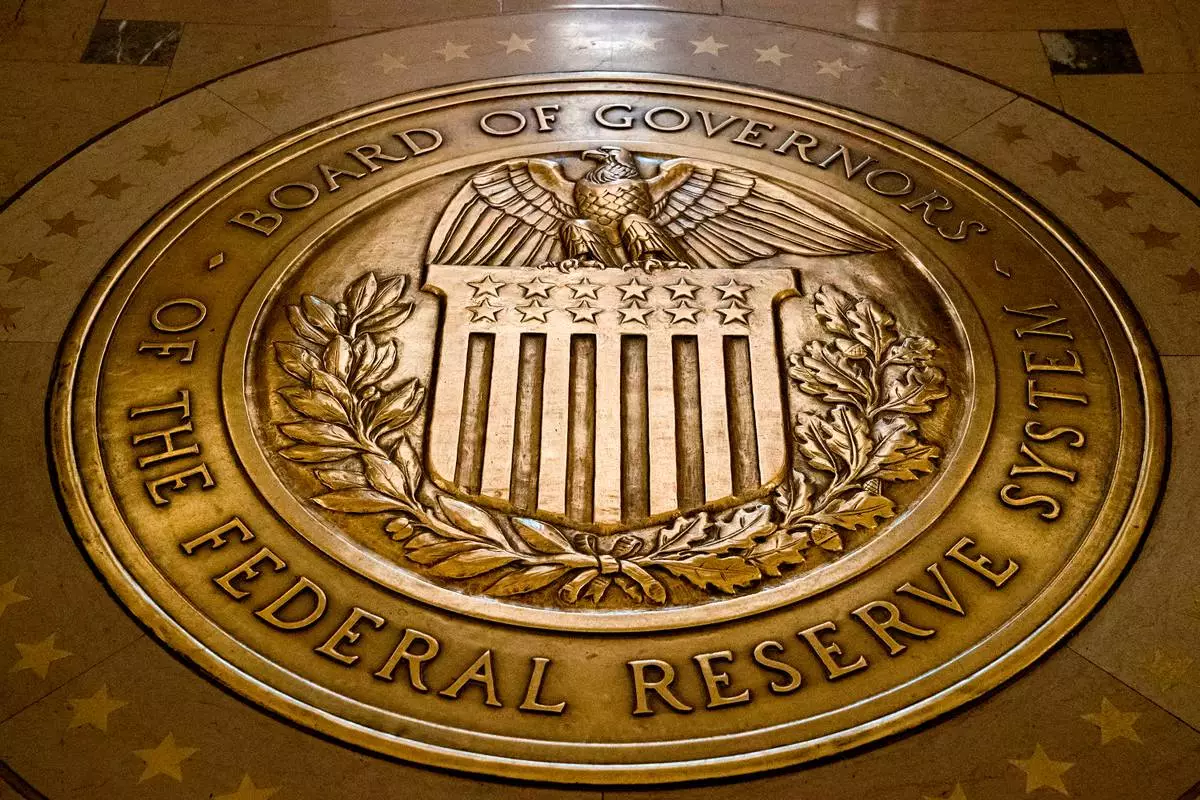
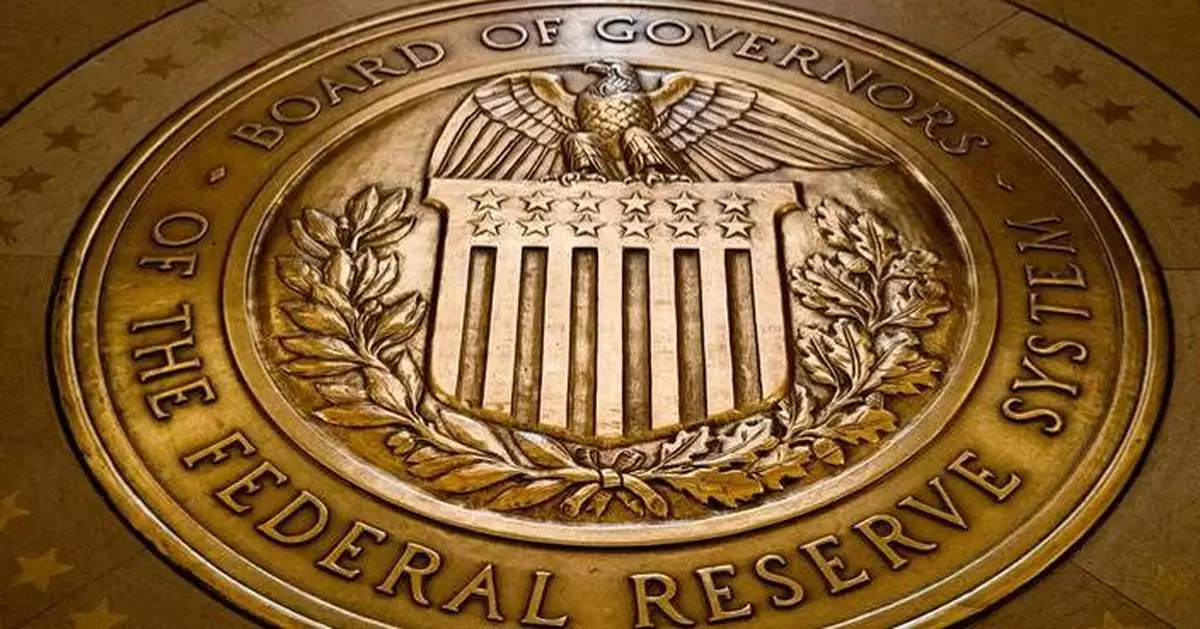
FILE- In this Feb. 5, 2018, file photo, the seal of the Board of Governors of the United States Federal Reserve System is displayed in the ground at the Marriner S. Eccles Federal Reserve Board Building in Washington. (AP Photo/Andrew Harnik, File)
TEHRAN, Iran (AP) — Iran on Monday rejected a 45-day ceasefire proposal and said it wants a permanent end to the war, while President Donald Trump appeared to widen his threat from civilian targets to the whole Islamic Republic and his ultimatum ticked closer.
“The entire country can be taken out in one night, and that night might be tomorrow night,” Trump told a news conference at the White House. He has called his Tuesday 8 p.m. deadline for Iran to make a deal final.
The U.S. stepped up threats against Iran to open the Strait of Hormuz or face a barrage of attacks on civilian targets. “Today will be the largest volume of strikes since day one,” Defense Secretary Pete Hegseth said. “Tomorrow, even more than today.”
Israel piled on pressure by attacking a major gas field that is Iran’s biggest source of domestic energy.
Tehran conveyed its 10-point response through Pakistan, a key mediator, including proposals on reconstruction and the lifting of sanctions, Iran’s state-run IRNA news agency said.
“We only accept an end of the war with guarantees that we won’t be attacked again," Mojtaba Ferdousi Pour, head of Iran’s diplomatic mission in Cairo, told The Associated Press. He said Iran no longer trusts the Trump administration after the U.S. bombed the Islamic Republic twice during previous rounds of talks.
And yet a regional official involved in talks said efforts had not collapsed. “We are still talking to both sides,” he said, speaking on condition of anonymity to discuss closed-door diplomacy.
Iranian and Omani officials were working on a mechanism for administrating the strait, through which a fifth of the world’s oil is shipped in peacetime. Iran’s grip on it has shaken the world economy. Tehran has refused to let U.S. and Israeli vessels through after they started the war on Feb. 28.
Israel struck a key petrochemical plant in the South Pars natural gas field and killed two paramilitary Revolutionary Guard commanders, including its intelligence chief.
The gas field attack aimed at eliminating a major source of revenue for Iran, Israel said. The field, the world’s largest, is shared with Qatar. It is critical to electricity production for Iran's 93 million population, but the strike appeared to be separate from Trump’s threats.
An earlier Israeli attack on the field in March prompted Iran to target energy infrastructure in other Middle East countries, a major escalation.
Trump has warned Iran that the U.S. could set the country “back to the stone ages," including targeting power plants and bridges.
Earlier Monday, Trump addressed an Easter event on the White House lawn and suggested that future attacks could go further. "If I had my choice, what would I like to do? Take the oil,” he said, suggesting it could be done easily, but “unfortunately the American people would like to see us come home.”
Asked if Tuesday at 8 p.m. Washington time was his final deadline, Trump replied simply, “Yeah."
Egyptian, Pakistani and Turkish mediators had sent Iranian Foreign Minister Abbas Araghchi and U.S. Mideast envoy Steve Witkoff a proposal calling for the ceasefire and the strait's reopening, two Mideast officials told the AP. The officials spoke on condition of anonymity to discuss the private negotiations.
Iran’s foreign ministry spokesman Esmail Baghaei earlier told journalists that “negotiations are entirely incompatible with ultimatums, crimes and threats of war crimes.”
Former Iranian foreign minister Ali Akbar Velayatir urged Arab countries to discourage Trump from striking power plants, warning the entire region would go “dark” if that happens.
“Any attack on civilian infrastructure is a violation of international law and a very clear one,” United Nations spokesperson Stephane Dujarric later told journalists.
Brent crude oil, the international standard, rose to $109 in early Monday spot trading, about 50% higher than when the war started, then wavered. U.S. stocks mostly held steady.
Explosions boomed in Tehran, and low-flying jets could be heard for hours.
The head of intelligence for Iran’s paramilitary Revolutionary Guard, Maj. Gen. Majid Khademi, was killed, according to Iranian state media and Israel’s defense minister. Israel said it also killed the leader of the Revolutionary Guard’s undercover unit in its expeditionary Quds Force, Asghar Bakeri.
“We will continue to hunt them down one by one,” Israeli Defense Minister Israel Katz said of top officials.
New Supreme Leader Mojtaba Khamenei, who still has not been seen or heard in public, issued a rare statement expressing condolences over the death of the Revolutionary Guard’s intelligence chief.
Israeli strikes have killed dozens of top Iranian leaders, including Khamenei’s father.
Israel’s military also said it struck three Tehran airports overnight — Bahram, Mehrabad and Azmayesh — hitting dozens of helicopters and aircraft it said belonged to the Iranian Air Force.
A Tehran resident said “constantly there is the sound of bombs, air defenses, drones," speaking on condition of anonymity for her safety. Another resident said he takes sleeping pills to get through nightly bombardments, and said people worry about power, gas and water cuts. “Stop this war,” he said.
Separately, Kuwait, the United Arab Emirates and Saudi Arabia activated air defenses to intercept Iranian missiles and drones. Tehran has kept up pressure on Gulf neighbors.
In Israel, Iranian missiles hit the northern city of Haifa, where four people from one family were found dead in the rubble of a residential building.
Smoke rose near Tehran’s Azadi Square after an airstrike hit the grounds of the Sharif University of Technology. Multiple countries have sanctioned the university for its work with the military, particularly on Iran’s ballistic missile program.
Authorities and Iranian state media reported at least 29 people killed across the country by strikes.
In Lebanon, where Israel has launched air attacks and a ground invasion that it says target the Iran-linked Hezbollah militia, an airstrike hit an apartment in Ain Saadeh, a predominately Christian town east of Beirut. It killed an official in the Lebanese Forces, a Christian political party strongly opposed to Hezbollah, his wife and another woman.
More than 1,900 people have been killed in Iran since the war began, but the government has not updated the toll for days.
More than 1,400 people have been killed in Lebanon and more than 1 million people have been displaced. Eleven Israeli soldiers have died there.
In Gulf Arab states and the occupied West Bank, more than two dozen people have died, while 23 have been reported dead in Israel and 13 U.S. service members have been killed.
Weissert reported from Washington and Magdy from Cairo. Munir Ahmed in Islamabad, Isabel DeBre in Ain Saadeh, Lebanon, Edith M. Lederer at the United Nations, Amir-Hussein Radjy in Cairo and Josh Boak and Michelle L. Price in Washington contributed to this story.
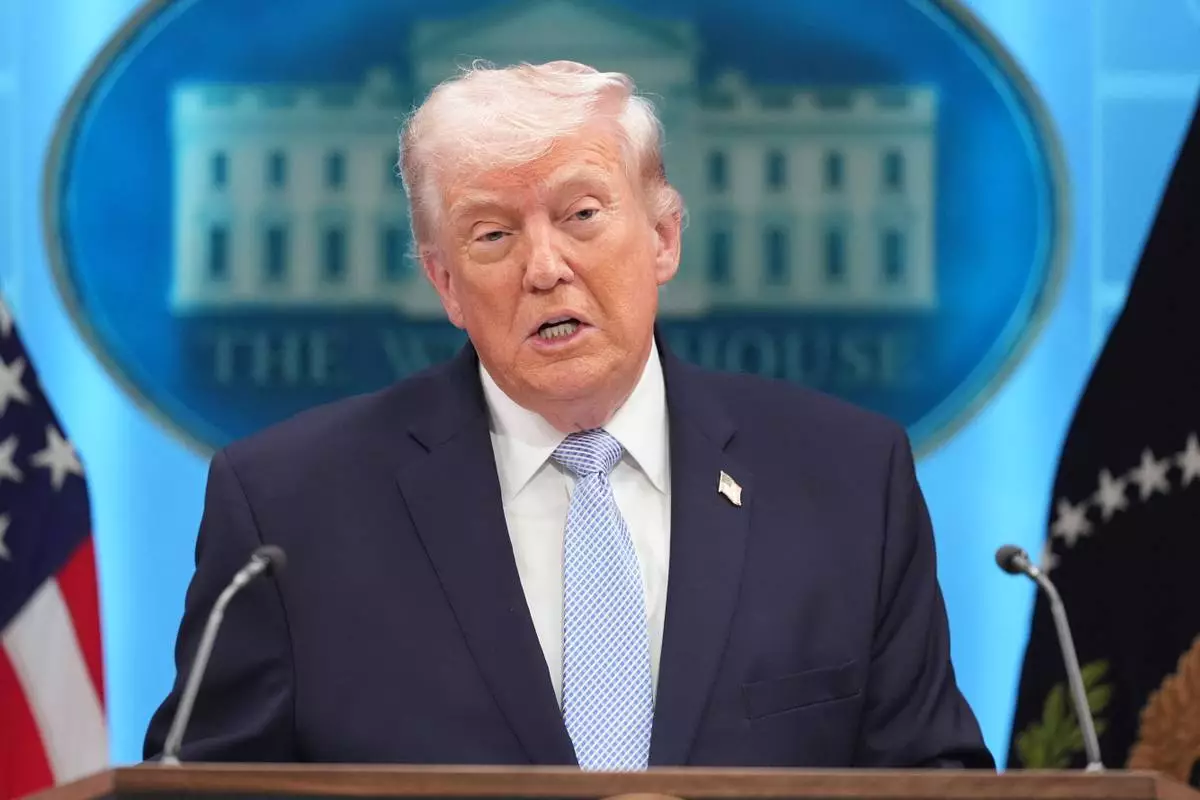
President Donald Trump speaks with reporters in the James Brady Press Briefing Room at the White House, Monday, April 6, 2026, in Washington. (AP Photo/Mark Schiefelbein)
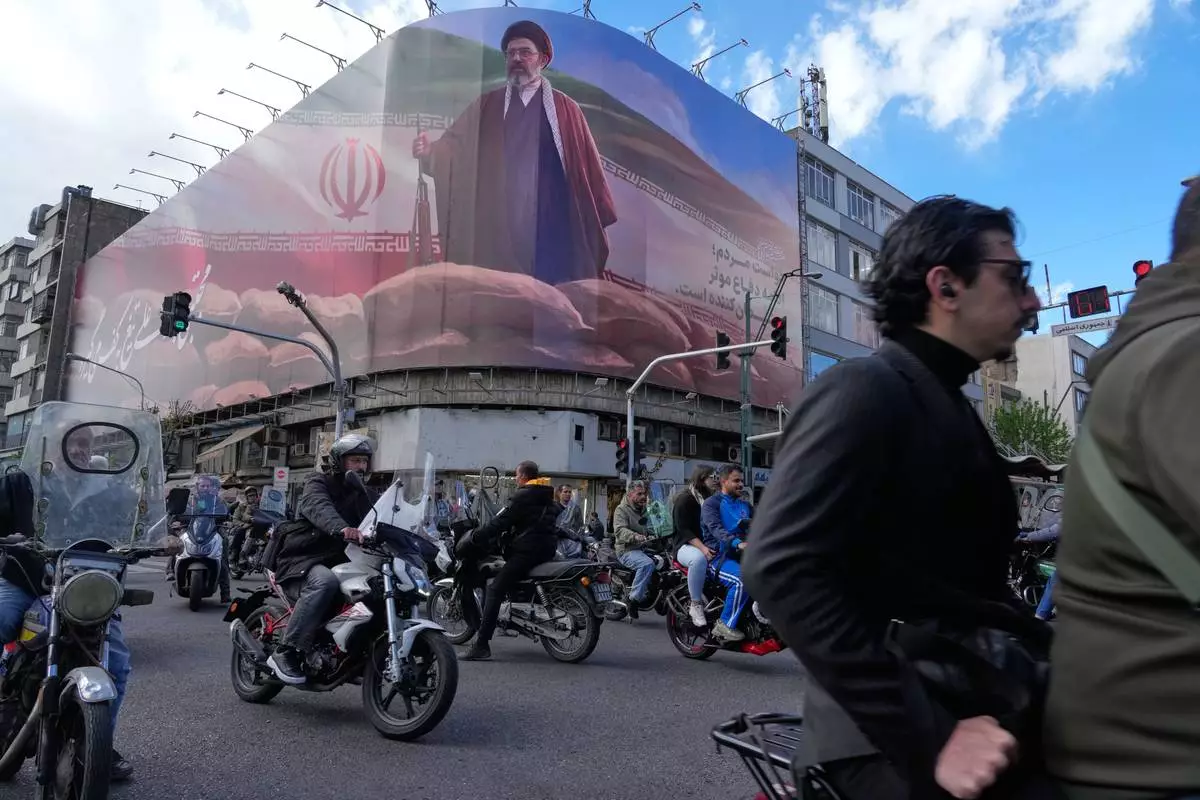
People drive their motorbikes past a billboard that shows a graphic depicting Iran's Supreme Leader Ayatollah Mojtaba Khamenei in downtown Tehran, Iran, Monday, April 6, 2026. (AP Photo/Vahid Salemi)
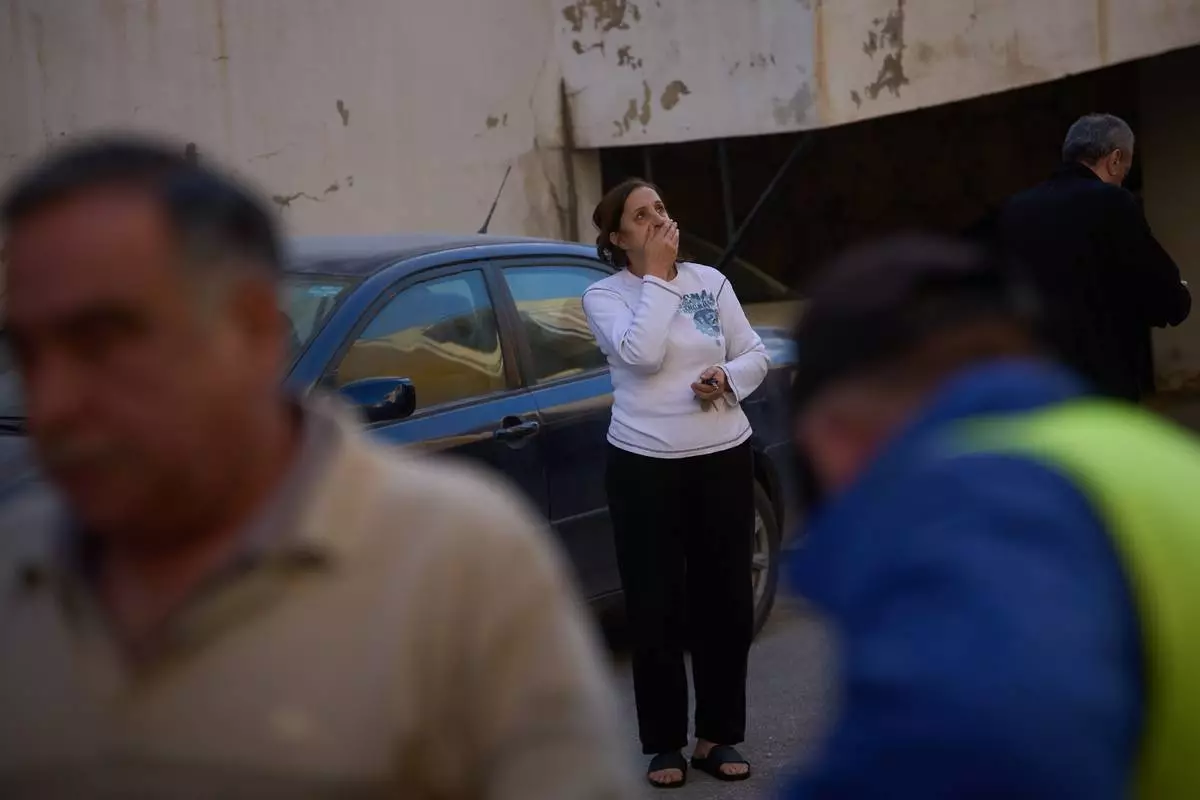
Nadine Naameh reacts as she looks at the damage to her home following an Israeli strike in the village of Ain Saadeh in the mountains east of Beirut, Lebanon, Monday, April 6, 2026. (AP Photo/Emilio Morenatti)
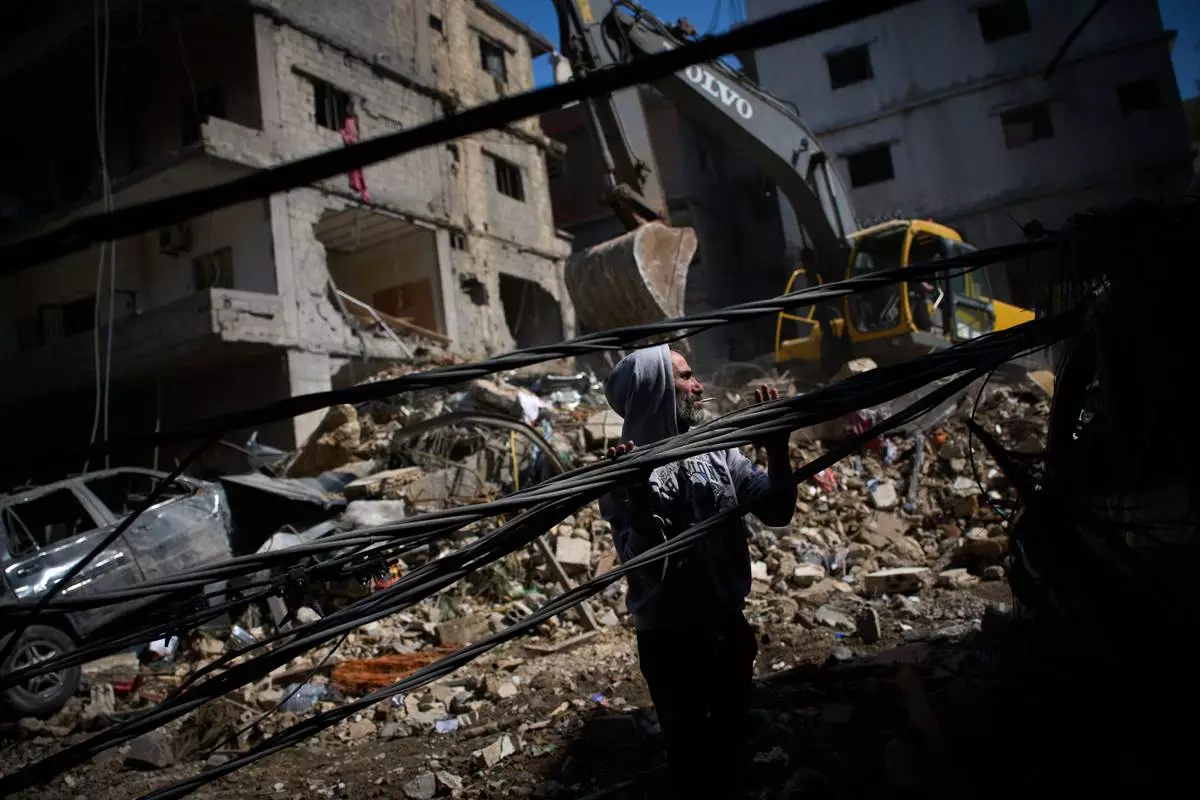
A man works at the site of Sunday's Israeli strike on a building in Beirut's Jnah neighborhood, Lebanon, Monday, April 6, 2026. (AP Photo/Emilio Morenatti)
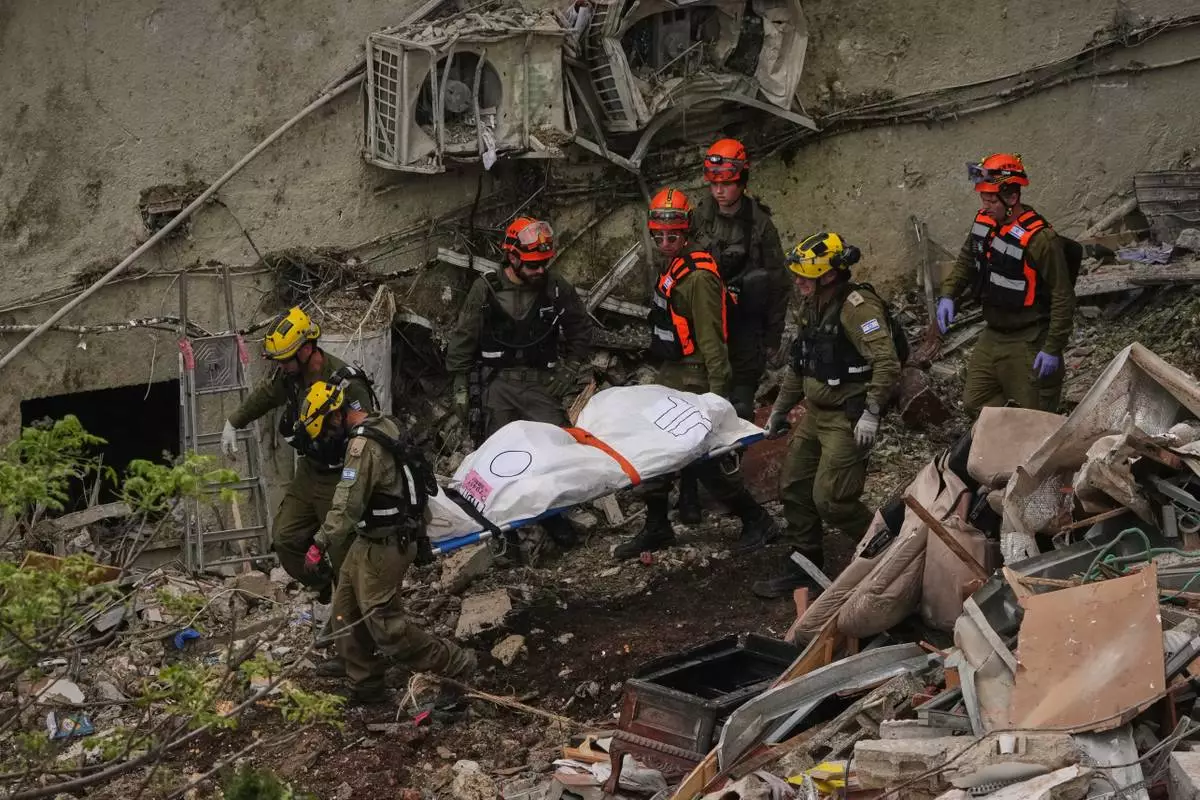
Rescue workers and military personnel carry a body of a victim from the rubble of a residential building a day after it was struck by an Iranian missile in Haifa, Israel, Monday, April 6, 2026. (AP Photo/Ariel Schalit)
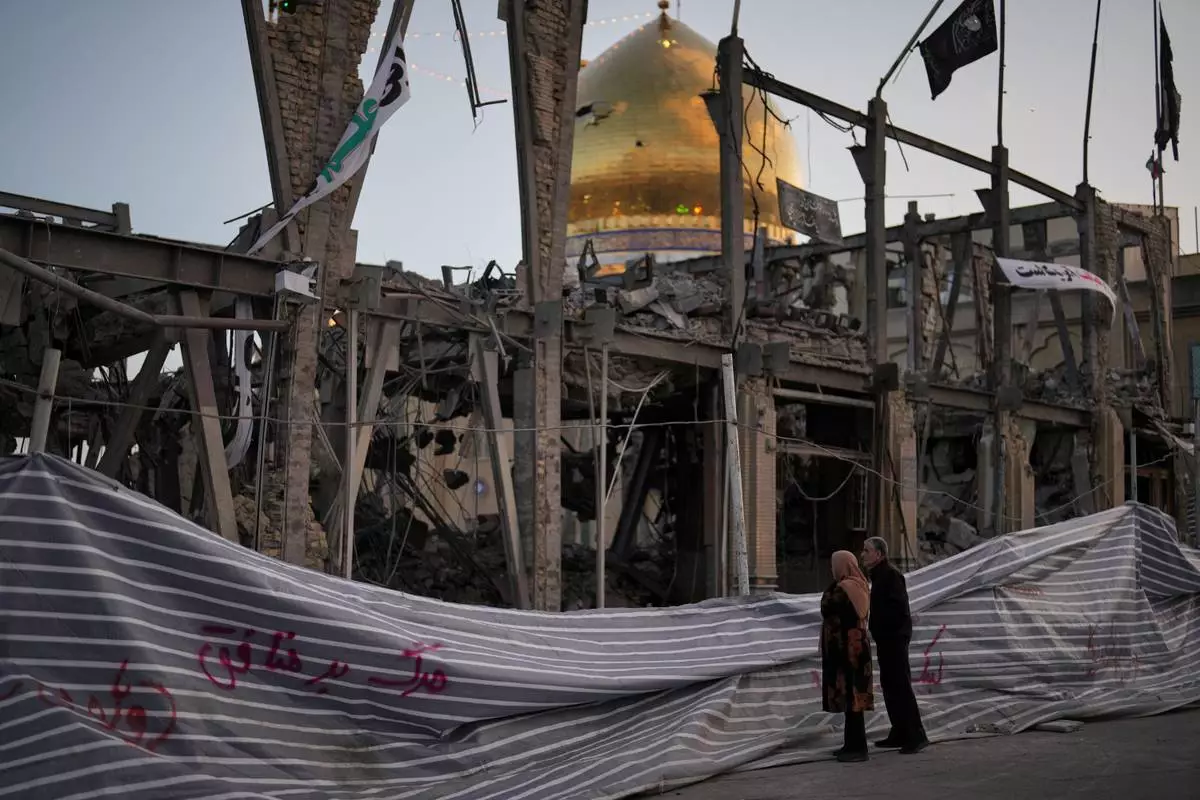
Pedestrians look at a destroyed building within the Grand Hosseiniyeh, with the mosque visible in the background, which officials at the site say was hit by U.S.-Israeli airstrikes Tuesday, in Zanjan, Iran, Saturday, April 4, 2026. (AP Photo/Francisco Seco)
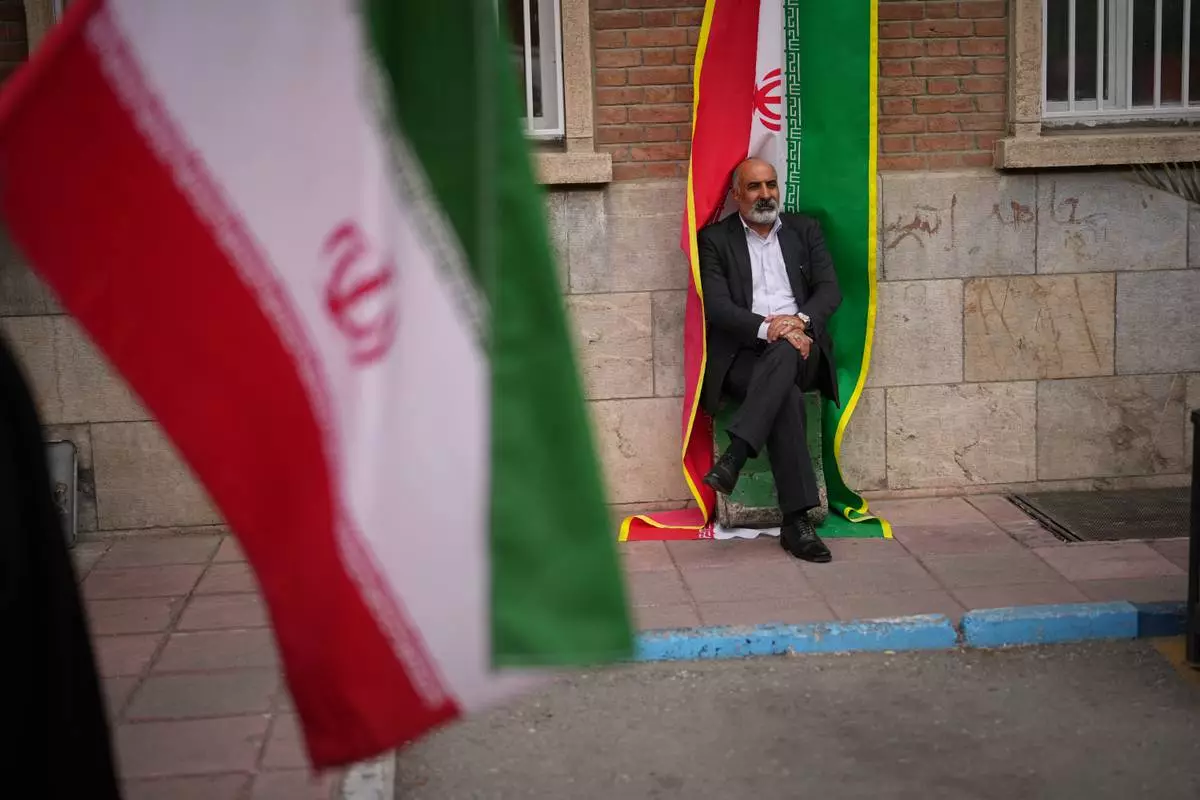
A man sits beside an Iranian flag banner during a government-sponsored protest attended by medical workers against the U.S.-Israeli military campaign outside Imam Khomeini Hospital in Tehran, Iran, Monday, April 6, 2026. (AP Photo/Francisco Seco)
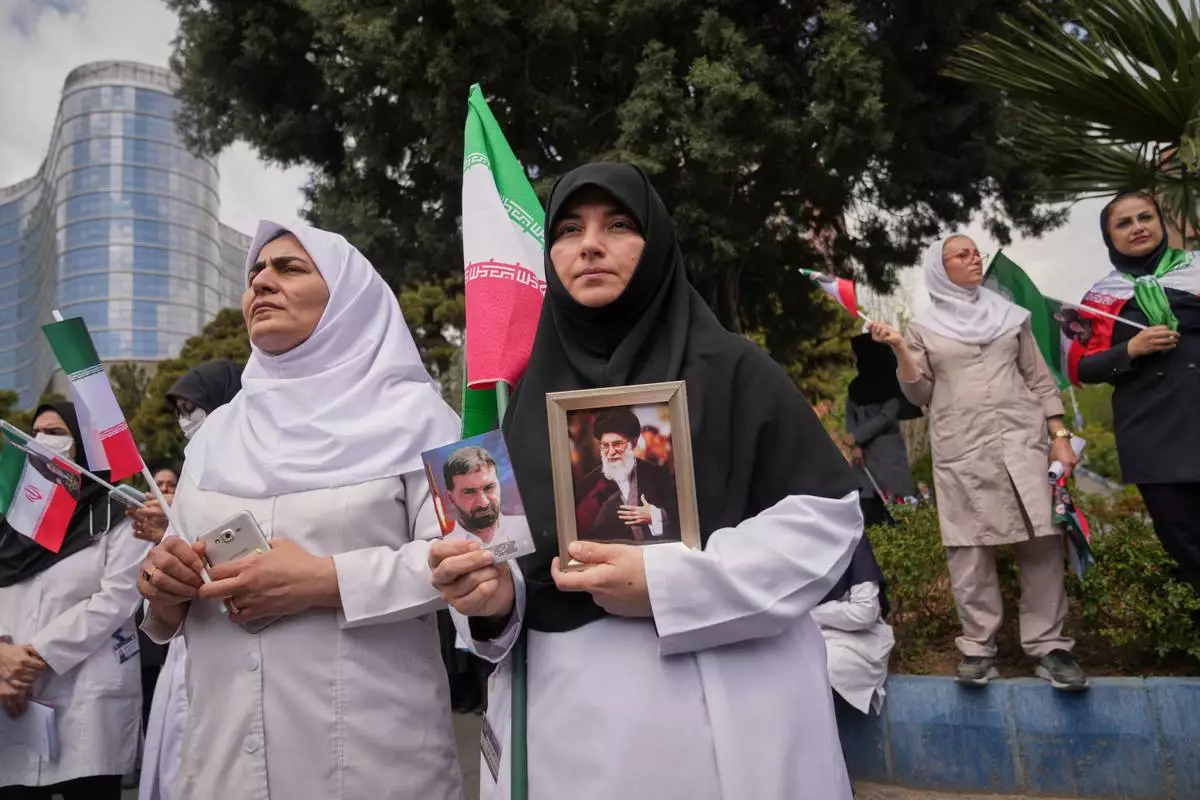
Medical workers attend a government-sponsored protest against the U.S.-Israeli military campaign outside Imam Khomeini Hospital in Tehran, Iran, Monday, April 6, 2026. (AP Photo/Francisco Seco)
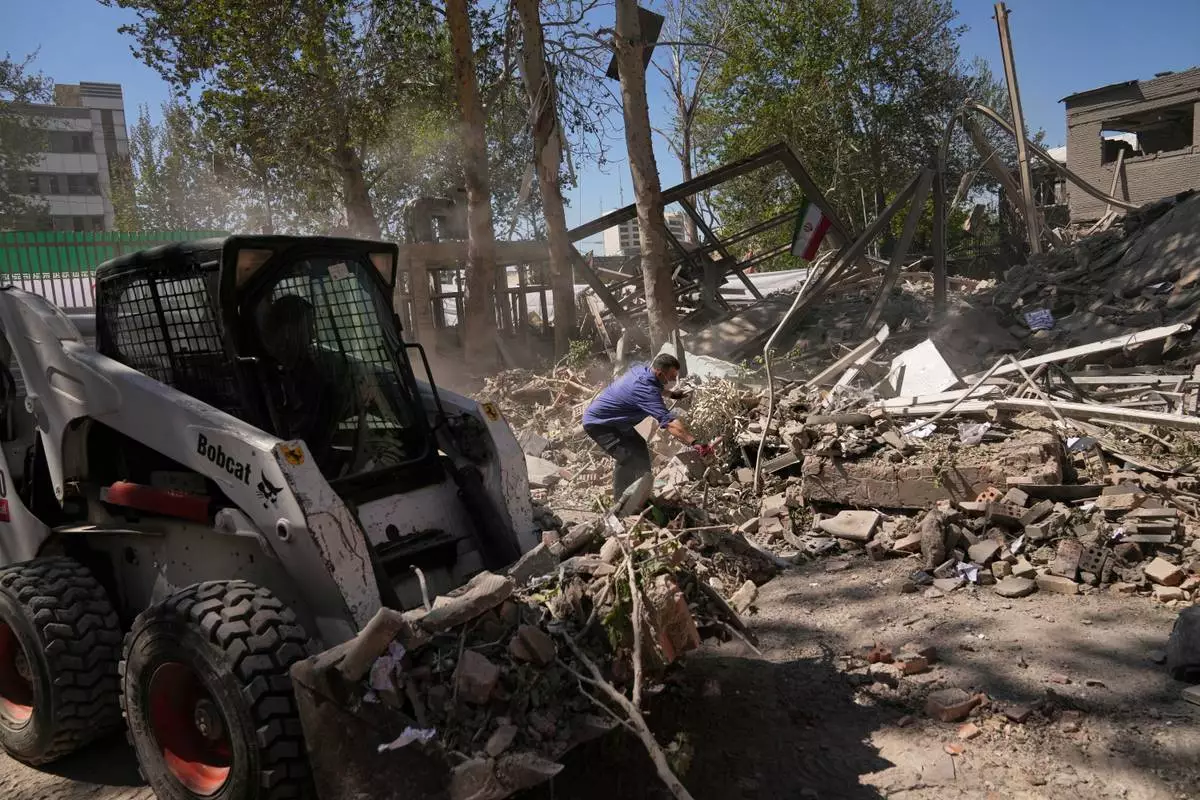
Workers remove debris at Tehran's Sharif University of Technology complex that Iranian authorities say was hit early Monday by a U.S.-Israeli strike, in Tehran, Iran, Monday, April 6, 2026. (AP Photo/Francisco Seco)
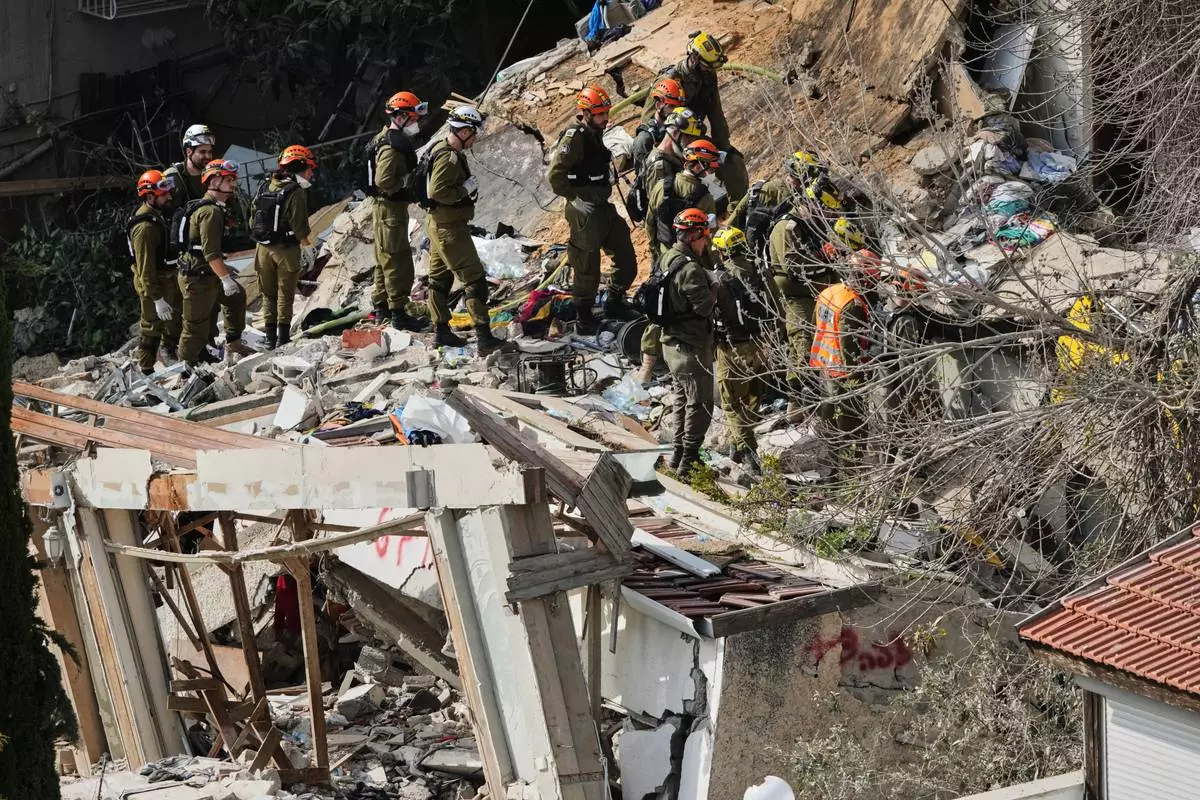
Israeli rescue teams search for missing people amid the rubble of a residential building a day after it was struck by an Iranian missile in Haifa, Israel, Monday, April 6, 2026. (AP Photo/Ariel Schalit)
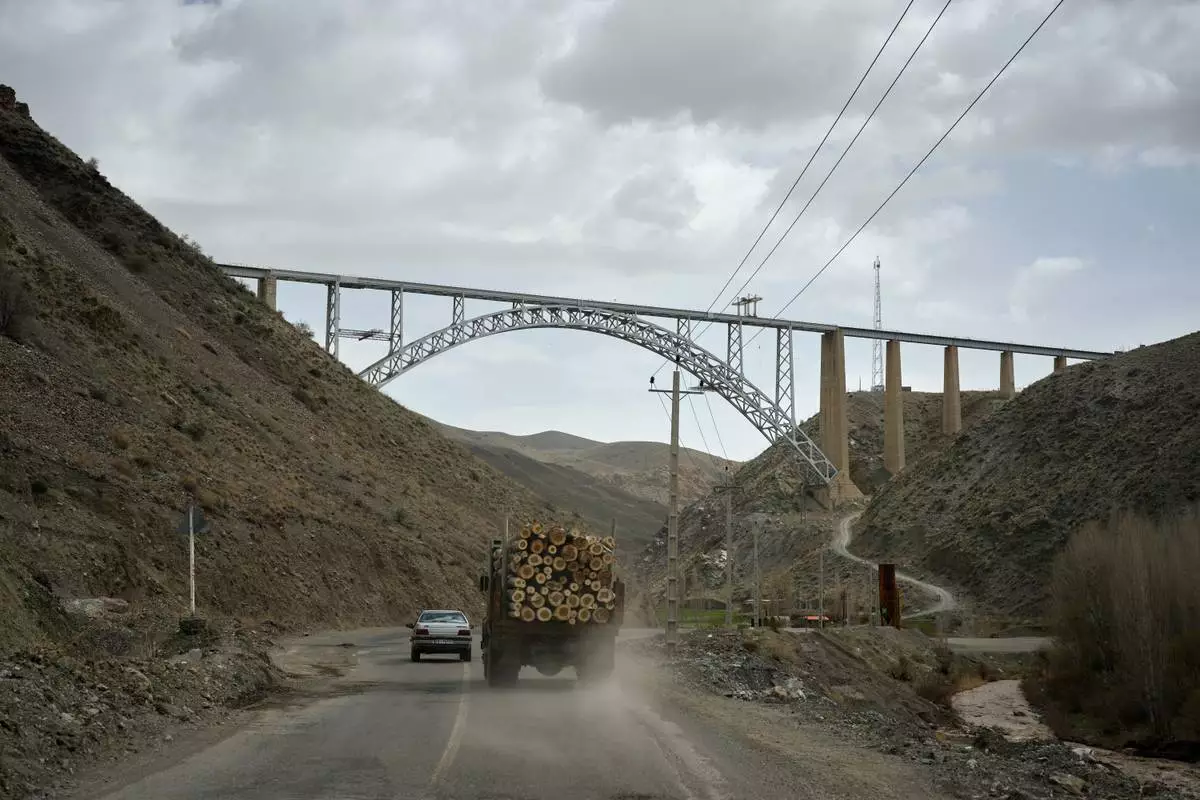
A truck loaded with logs and other vehicles drive along a road toward Tehran near the Turkish border on the outskirts of Razi, northwestern Iran, Saturday, April 4, 2026. (AP Photo/Francisco Seco)
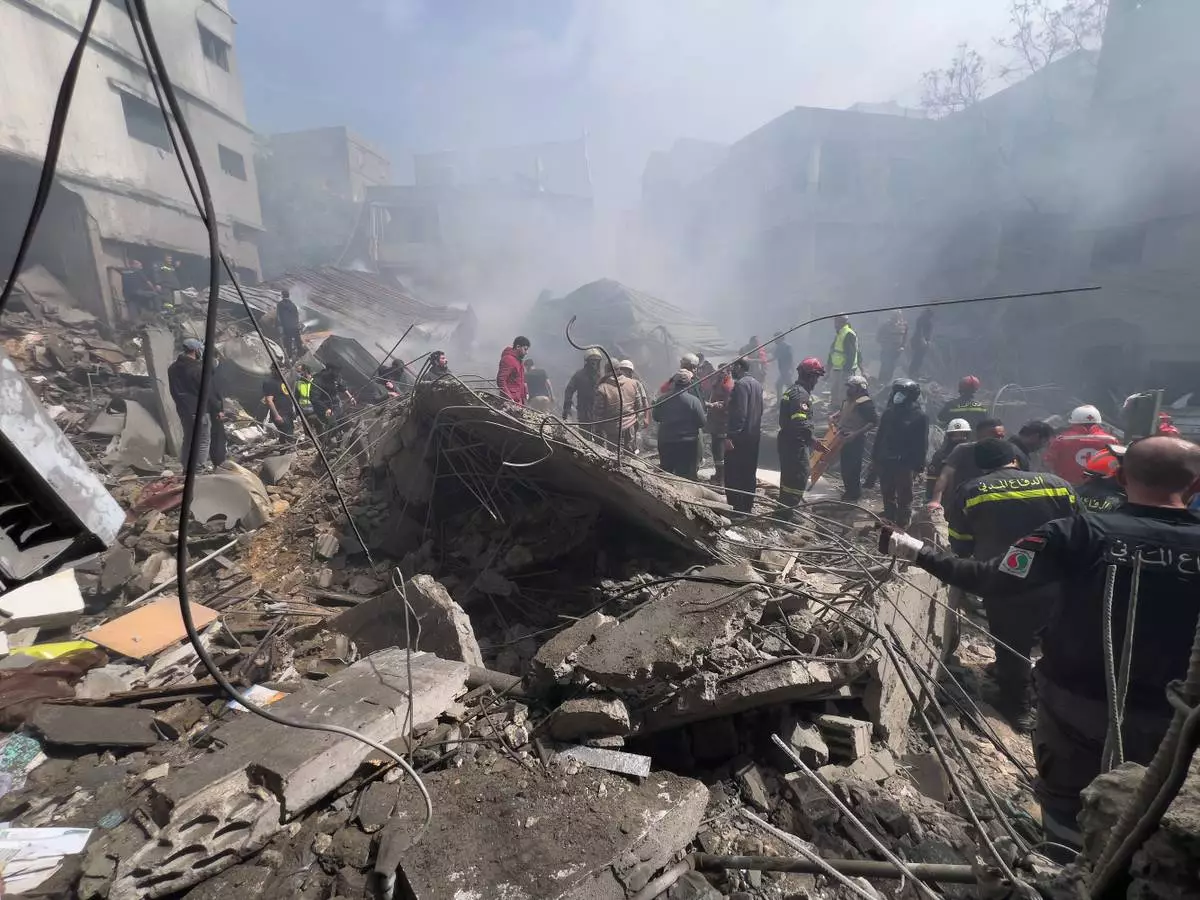
Rescue workers search for victims at the site of an Israeli airstrike that hit a crowded neighbourhood south of Beirut, Lebanon, Sunday, April 5, 2026. (AP Photo/Hussein Malla)
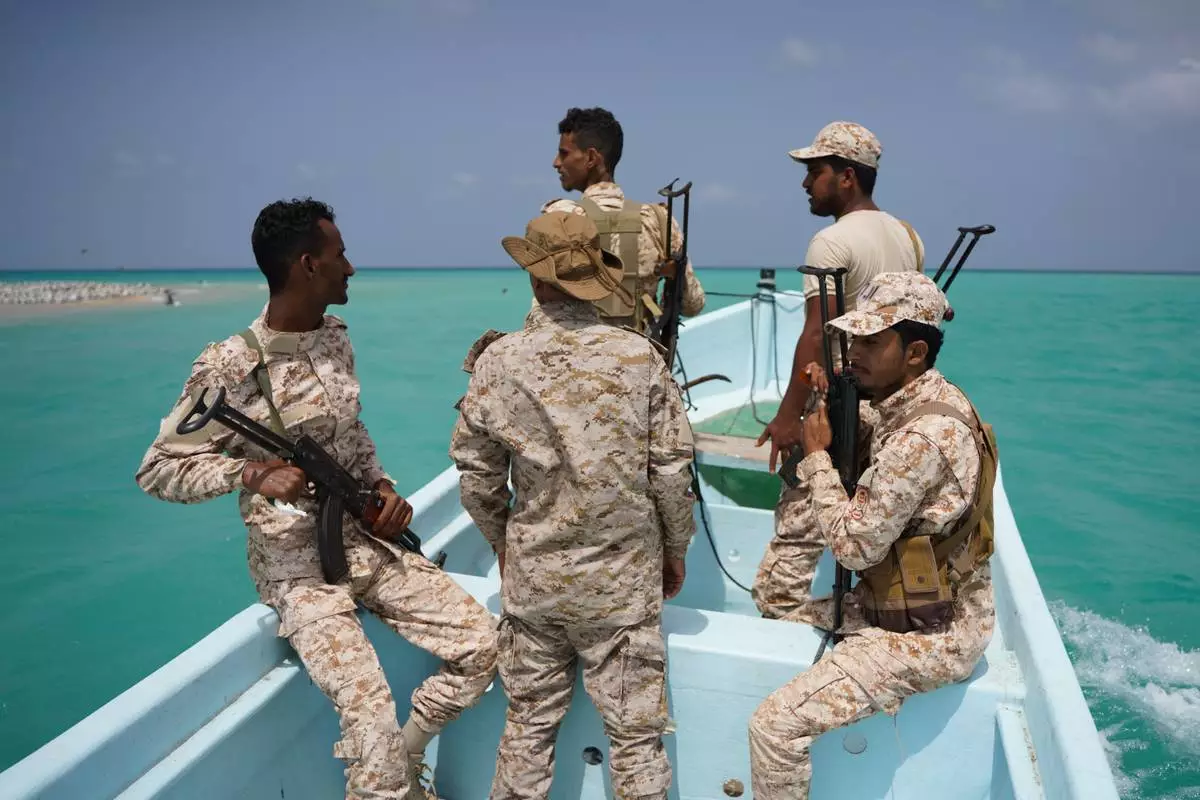
Yemeni soldiers patrol the strategic Bab el-Mandeb Strait, Yemen, Sunday, April 5, 2026. (AP Photo/Abdulnasser Alseddik)
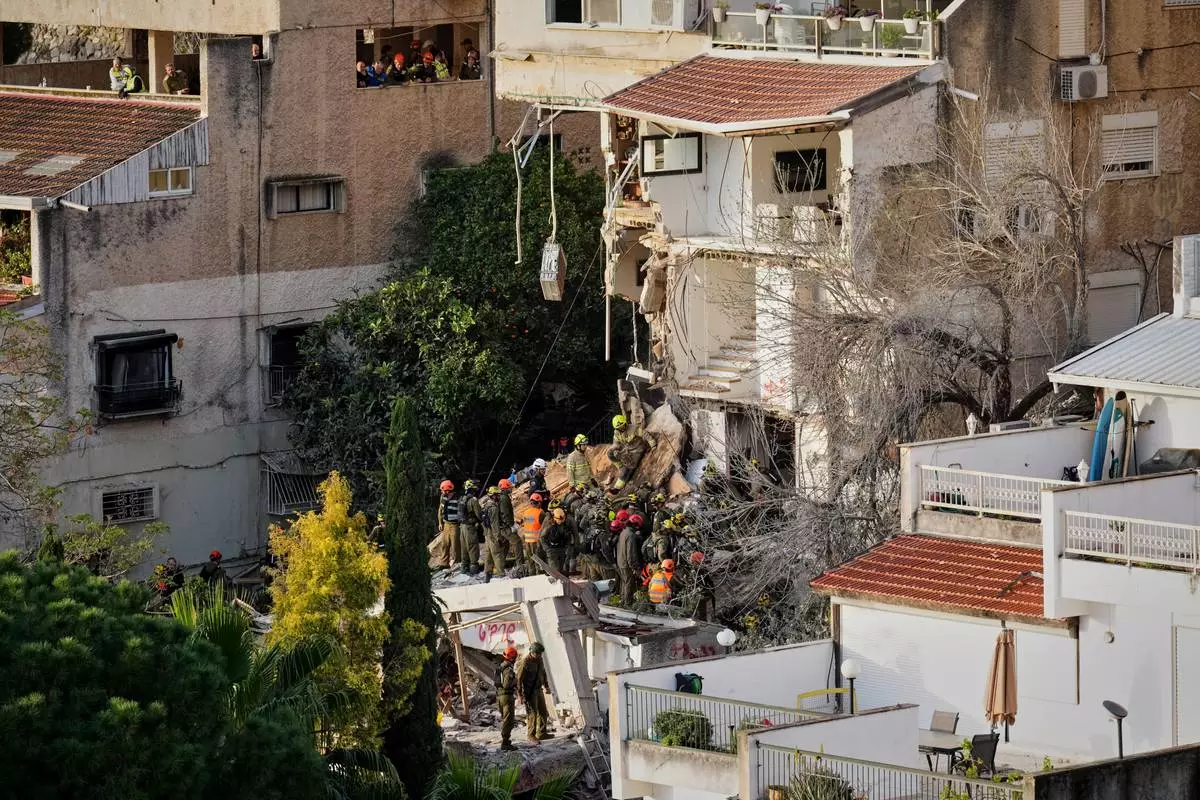
Israeli rescue teams search for missing people amid the rubble of a residential building a day after it was struck by an Iranian missile in Haifa, Israel, Monday, April 6, 2026. (AP Photo/Ariel Schalit)