Ottawa Charge coach Carla MacLeod is taking an indefinite leave as she continues to receive treatment in her battle with breast cancer, the team announced on Monday.
“She remains in good spirits and is focused on her health and recovery,” the team said. “The entire organization fully supports Carla. And her family asks that her privacy be respected.”
MacLeod first revealed being diagnosed with cancer a week into the PWHL season in late November. Despite traveling to her native Alberta to receive treatments, she previously missed only one Charge game and continued her duties as coach of Czechia’s national women’s hockey team.
At 13-11-1 (including a PWHL-leading seven OT wins), the Charge have five games left and sit fifth in a tightly contested race for the league’s fourth and final playoff berth.
MacLeod was so intent on coaching, she scheduled radiation treatments to ensure they wouldn’t interfere with her being behind Czechia’s bench at the Milan Cortina Olympics in February. Czechia finished third in Pool A play before being knocked out by Pool B champion Sweden in the quarterfinals.
Upon arriving at the Milan Cortina Games, the ever-upbeat MacLeod said cancer wasn’t going to alter her approach in coaching the Czechs at a second consecutive Olympics.
“At the end of the day, I’m in an industry that’s about playing hockey. That’s a pretty good gig. And I’ve had it my whole life,” MacLeod said. “I’m pretty lucky.”
The 43-year-old MacLeod is from Spruce Grove, Alberta, and won two Olympic gold medals as a defender on Canada's national team.
Assistant coach Haley Irwin takes over as interim head coach during MacLeod’s absence.
AP women’s hockey: https://apnews.com/hub/womens-hockey

FILE - Ottawa Charge head coach Carla MacLeod looks on during a training camp in Ottawa, Wednesday, Nov. 12, 2025. (Sean Kilpatrick/The Canadian Press via AP, File)
PARIS--(BUSINESS WIRE)--Apr 7, 2026--
Europe is navigating a period of intense turbulence, where geopolitical crises, pressure on critical raw materials, and climate‑related shocks are reinforcing one another. This polycrisis is no longer cyclical: it is structurally reshaping the continent’s value chains and testing its industrial competitiveness.
This press release features multimedia. View the full release here: https://www.businesswire.com/news/home/20260406787383/en/
In this context, Ardabelle is releasing Greening the Arteries of Industry, a groundbreaking study that quantifies for the first time the economic gap between a Europe that endures and a Europe that invests. Conducted under the scientific supervision of economist Xavier Jaravel, this work represents the first attempt to model, in an integrated way, industrial resilience, ecological transition, and European competitiveness through 2035 - 2050.
The study was presented under the high patronage of Roland Lescure, Minister for the Economy, Finance and Industrial, Energy and Digital Sovereignty, and Agnès Pannier‑Runacher, Minister for Ecological Transition and Territorial Cohesion, reflecting the strategic importance of these issues for France and for Europe.
The conclusion is unequivocal: a €7 trillion differential by 2050, nearly twice the current GDP of Germany.
The study shows that the inaction scenario - with GDP stagnating at €20 trillion in 2050 - exposes the continent to compounding climate damages, supply chain disruptions, and strategic dependencies. By contrast, a coordinated trajectory of green transition and industrial resilience would lift GDP to €27 trillion, driven by innovation, energy security, and the reconfiguration of supply chains.
Investing 2% of GDP per year between 2025 and 2030 would be enough to trigger this trajectory, with a 218% return on investment. Every euro invested generates €3.18 in benefits, including €2.50 from avoided climate damages alone.
Ardabelle: an architect of Europe’s value chains
Ardabelle positions itself as one of the few investment funds capable of combining macroeconomic analysis, micro‑level value chain expertise, financial acumen, and operational experience. This integrated approach enables the firm to support Europe’s SMEs and mid‑caps - 99% of European companies - as they transition toward more resilient, circular, and competitive business models.
Virginie Morgon, co-founder of Ardabelle declares: “This is not an ideological debate, but a battle for resilience and competitiveness. Europe’s value chains must be fundamentally rethought, and it is SMEs and mid-cap companies that hold the keys. Ardabelle is betting on a Europe that rebuilds, accelerates, and regains control of its industrial destiny.”
Eric Hazan, co‑founder of Ardabelle, states: “Europe is facing a €7 trillion bet. This is not a slogan - it is an economic choice. We are at a decisive moment for Europe’s industrial sovereignty. Either we invest now to build resilient value chains, or we accept structural decline. At Ardabelle, we believe resilience has become the new competitiveness - and we intend to be its architects.”
The full study is available here: https://ardabelle.com/articles/greening-arteries
About Ardabelle
Ardabelle Capital is a pioneering private equity firm focused on accelerating the transition to a sustainable, resilient economy. The firm is led by a world-class team of partners who bring together a rare blend of expertise from private equity, industry, and sustainability, combining decades of experience in transforming businesses and driving value across global markets. Ardabelle targets mid-market industrial, services, and technology businesses poised for international growth. With a unique value chain-driven strategy and a strong ecosystem of corporate partners, industry experts, and sustainability strategists, Ardabelle invests to drive long-term sustainable value.
For more information, visit ardabelle.com
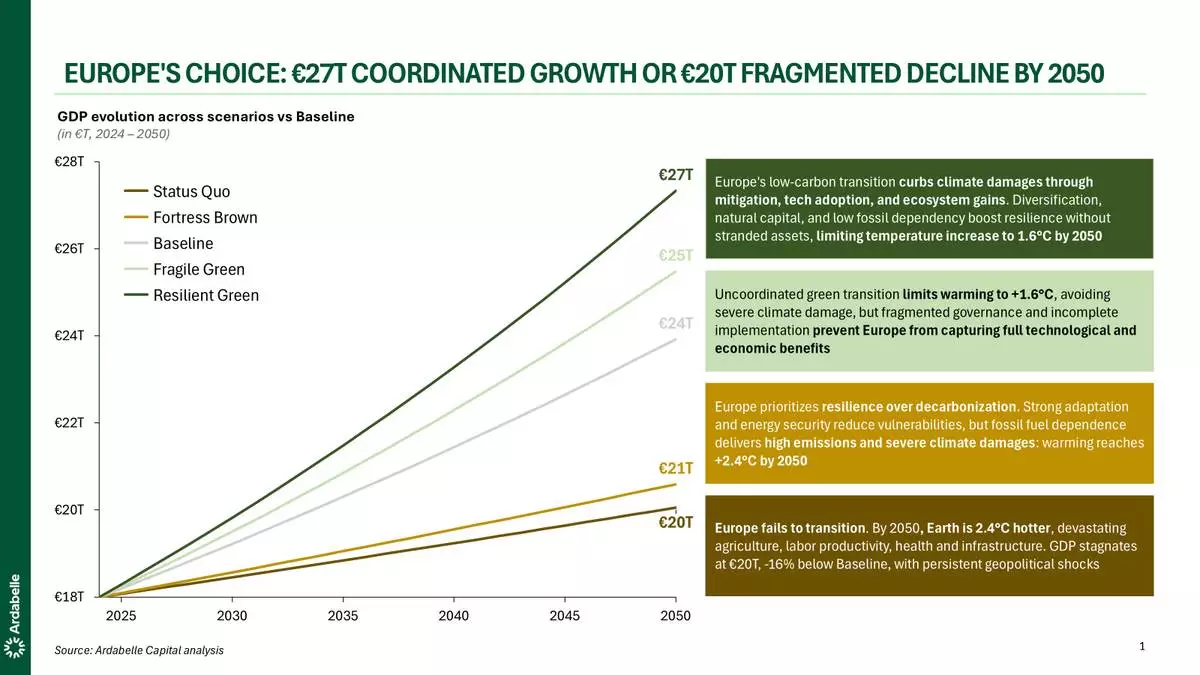
Europe's Choice: €27T Coordinated Growth or €20T Fragmented Decline by 2050