AUGUSTA, Ga. (AP) — Patrick Reed has played golf all around the world, often out of choice, now out of necessity.
Necessity so that he can start playing closer to home again.
One of the early and polarizing defectors to LIV Golf a few years ago, the 2018 Masters champion made the similarly difficult decision to leave the lucrative, Saudi-backed tour earlier this year and return to the PGA Tour. But under the terms of his reinstatement, Reed cannot play in its events until after Aug. 25, which means most of this season will be spent on the European tour.
Where he already has won twice ahead of his return to Augusta National this week.
“Everyone kind of gets to be a creature of habit, and wants to eat what they're comfortable with and go," Reed said after a practice round Monday, “but I like checking out all the local places and really experiencing the culture."
Pimento cheese sandwich, anyone?
The truth is as much as Reed enjoyed playing in Dubai and Qatar, where he packed wins around a playoff loss in Bahrain — 1,200 miles (7,500 km) from home, wife Justine and their two kids — there are few things Reed loves more than walking among the Georgia pines.
It's not exactly home; that's The Woodlands, Texas. But it sure feels like it.
Reed played college golf down the road at Georgia, and he recalls practice rounds spent at Augusta Country Club, where certain holes offer a teasing glimpse through the trees of the par-5 13th hole of its much more famous neighbor.
“There's just something so special about this place, the traditions behind it, and then on top of it, it's the one major that stays in the same place,” Reed said. “All the way back from when I played my first time ever here, even when we played in November that one (COVID) year, and any time I’ve come back and played it, it’s always in perfect shape. It’s one of those golf courses that you can’t hit just one golf shot. You have to play golf kind of old-school way. You have to hit shots, different shapes, different flights.”
Indeed, the Masters has been one of the few constants on Reed's ever-changing global calendar.
When he resigned from the PGA Tour, Reed effectively said farewell to familiar, high-profile places like Pebble Beach and Bay Hill for LIV events in far-flung corners of the world. But his status as a former Masters champion meant that, despite the deep rift that once appeared to threaten the game itself, Reed was always welcomed back to Augusta National.
He tied for fourth a few years ago. He was third last year.
"I feel like it’s the best test of golf we play all year round," Reed said. “For a guy that’s played just about everywhere in the world — just about — it’s one of those places that I say, hands down, it’s the best test of golf and best golf course I’ve ever played.”
Reed acknowledged Monday that LIV had presented him with a contract earlier this year to remain one of its biggest stars. But when he talked with his family, “I felt like the best decision for us was to come back and join the PGA Tour.”
Even when he left, Reed said, he always considered the PGA Tour to be the best barometer of golf greatness.
“I’ve played now every tour. I’ve played on every single one of them,” Reed said. "That’s the place that I feel like is best for us to go and compete against the top guys year in and year out, week in and week out, but at the same time, to be able to spend more time closer to home makes it a lot easier to spend time with the kids.
“My daughter is now 11. My little man's 8. It seems like time has flown," the 35-year-old Reed said. "I definitely want to watch them grow up and be home a little bit more, yet still at the same time to play against the best guys.”
Reed will be able to do that this week. And again on a weekly basis soon enough. But until his PGA Tour return this fall, Reed is building out a DP World Tour schedule that includes a few weeks spent on the road followed by a few spent at home.
It's a work-life balance that seems to work at this point in his life.
“You not only sharpen your game, but you get a lot of family time," Reed said. “Those travels overseas, it’s going to be a lot this year, but at the same time, I can’t wait to obviously go out there and compete, but at the same time, come home and see the family.”
AP golf: https://apnews.com/hub/golf

FILE - Patrick Reed, of the United States, hits a shot from a bunker on the first hole during the third round of the Dubai Desert Classic golf tournament in Dubai, United Arab Emirates, Jan. 24, 2026. (AP Photo, File)
NEW YORK (AP) — Catchers were far more successful than batters through Major League Baseball's first full week of challenges to robot umpires, led by the Detroit Tigers and Dillon Dingler.
The overall success rate in the Automated Ball-Strike System was 55.2% (299 of 542), with fielding teams winning 59.7% of challenges (175 of 293), including 60.4% by catchers (169 of 280).
“I like it a little more. I was pretty staunch against it, which I still may be to some degree,” New York Yankees manager Aaron Boone said.
There were just 13 challenges by pitchers, who won six. Batters were successful on 49.8% (124 of 249).
“I think it’s fun. It’s its own game inside the game, almost," Tampa Bay catcher Hunter Feduccia said.
Success rate was up from 49.5% last year at Triple-A, where defense won 53.7% and batters 49.5%
Detroit won the highest percentage of calls at 75% (15 of 20) while Arizona was at 71%, and Baltimore and Cincinnati both 67%.
Minnesota called for the most challenges with 32, winning 20 for a 63% success rate. Texas had the fewest, winning 4 of 10.
Cleveland was the least successful at 32%, with Washington at 38% and St. Louis and Texas at 40%
Detroit catchers were 8-0, with seven wins by Dingler.
ABS' impact could be seen when Atlanta played at Arizona last Thursday. The Braves were ahead 2-1 when the Diamondbacks' Ryne Nelson threw a 3-2 curveball on the upper, outside corner to Ozzie Albies that was called a strike by Malachi Moore. Albies challenged and headed toward first even before ABS showed the pitch missed the strike zone by 1.1 inches. The walk started an eight-run rally in a 17-2 romp.
“In some of these games, it’s had a more of a swinging effect on outcomes of at-bats and how things change than maybe even you thought,” Miami manager Clayton McCullough said.
Logan O’Hoppe of the Los Angeles Angels had the most victories, successful on 10 of 12. The Marlins’ Agustín Ramírez won 7 of 9 and the Los Angeles Dodgers’ Will Smith 8 of 11.
Seattle’s Cal Raleigh won 4 of 9 and the Athletics’ Shea Langeliers 3 of 9.
Among batters, Mark Vientos of the New York Mets and Iván Herrera both went 3-0. Mike Trout of the Los Angeles Angels was 3-1 along with Philadelphia's Kyle Schwarber and Tampa Bay's Jake Fraley.
Colorado's Hunter Goodman and Washington's Luis García Jr. were both 0 for 3.
Boone said Yankees staff and players daily review challenges made and opportunities missed.
Players still are getting used to ABS. Washington's Jorbit Vivas tapped his helmet signaling for an appeal on March 31 when the Nationals already had exhausted their two challenges.
Among umpires, Mike Estabrook had 11 of 12 calls overturned (91.7%), Andy Fletcher had 15 of 17 (88.2%), Ron Kulpa and Paul Clemons each 7 of 9 (77.8%) and Chris Segal 10 of 13 (76.9%), according to taptochallenge.com.
Will Little had just 1 of 10 calls reversed while Erich Bacchus was perfect with no overturned calls in five challenges. Others with low overturn rates with at least five challenges included Emil Jiménez (1 of 5), Jordan Baker (2 of 8), Ryan Additon and Nick Mahrley (both 2 of 7) and David Rackley (3 of 10).
Offense again lagged through the first 139 games of the 2,430-game season.
The .234 big league batting average is down from .239 through 12 days last year (including the two games in Japan), when it finished at .245. The average usually increases as the weather warms. The full-season low of .237 was set in 1968.
Runs per game averaged 8.8, up from 8.7, and stolen bases dropped to 1.4 per game from 1.6
Average fastball velocity is 94.6 mph, up from 94.1 mph through the first full week last year. The final figure increased in each of the last five seasons to a record 94.5 mph in 2025. It was 91.9 mph when MLB first started tracking in 2008.
“I wish I was facing the same pitching as I did my rookie year back when guys were throwing 88-mile-an-hour sinkers over the plate," said 33-year-old Cleveland catcher Austin Hedges. “That pitch doesn’t exist anymore.”
The average time of a nine-inning game is 2 hours, 43 minutes, up from 2:37 at this point last year, when it finished at 2:38.
Pitch clock violations averaged 0.17 per game, down from 0.22 through 139 games last year.
MLB's average crowd of 31,725 through 138 dates was up 1.5% over 31,255 for the same period last year.
AP Sports Writers Dan Gelston and Steve Megargee, and AP freelance writer Tom Withers contributed to this report.
AP MLB: https://apnews.com/MLB
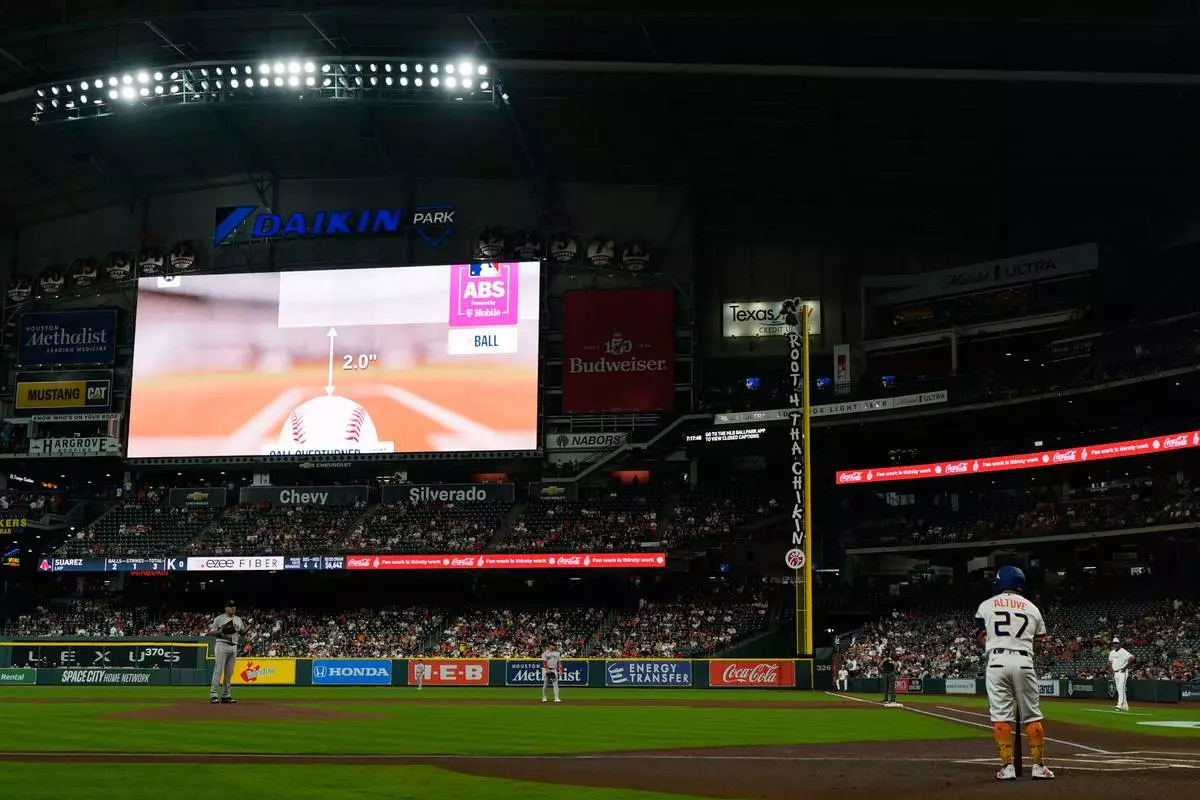
Houston Astros' Jose Altuve (27) watches a replay of the Automated Ball-Strike Challenge System (ABS) during the first inning of a baseball game against the Boston Red Sox in Houston, Monday, March 30, 2026. (AP Photo/Ashley Landis)
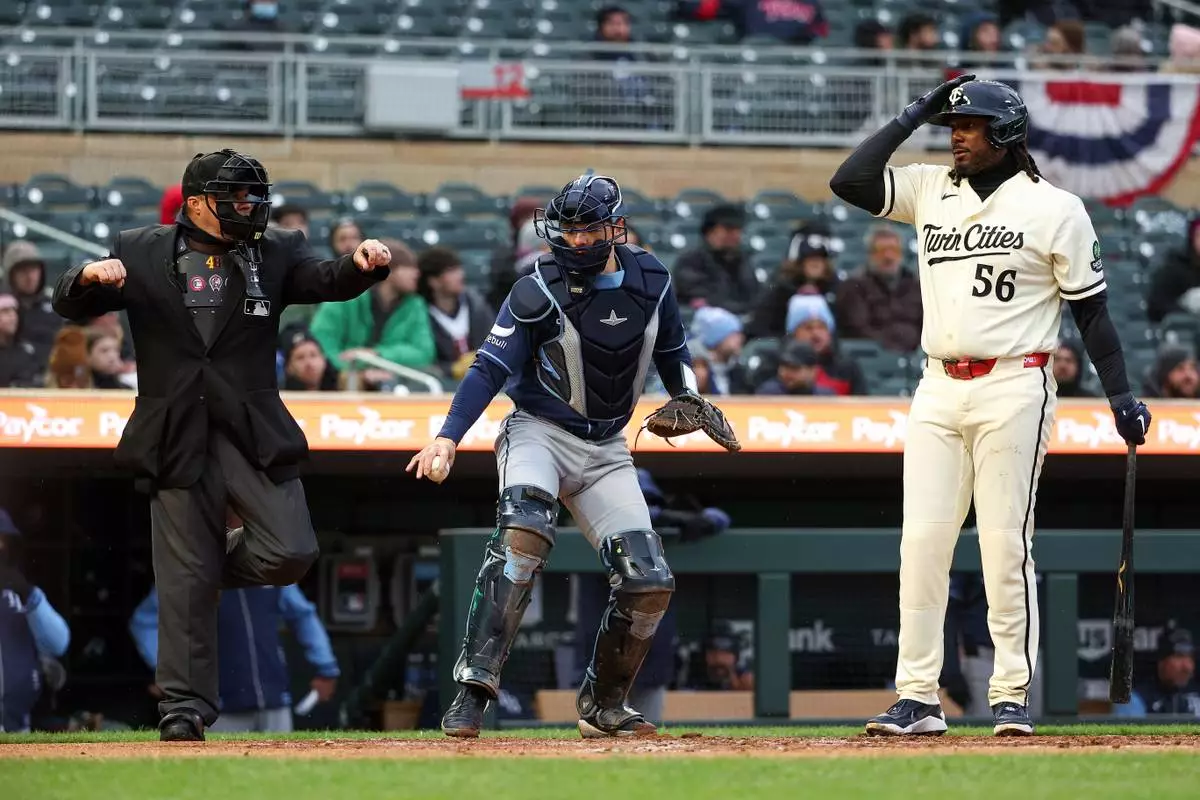
Minnesota Twins' Josh Bell, right, signals for an ABS challenge on a called third strike, which was upheld, during the first inning of baseball game against the Tampa Bay Rays, Saturday, April 4, 2026, in Minneapolis. (AP Photo/Matt Krohn)
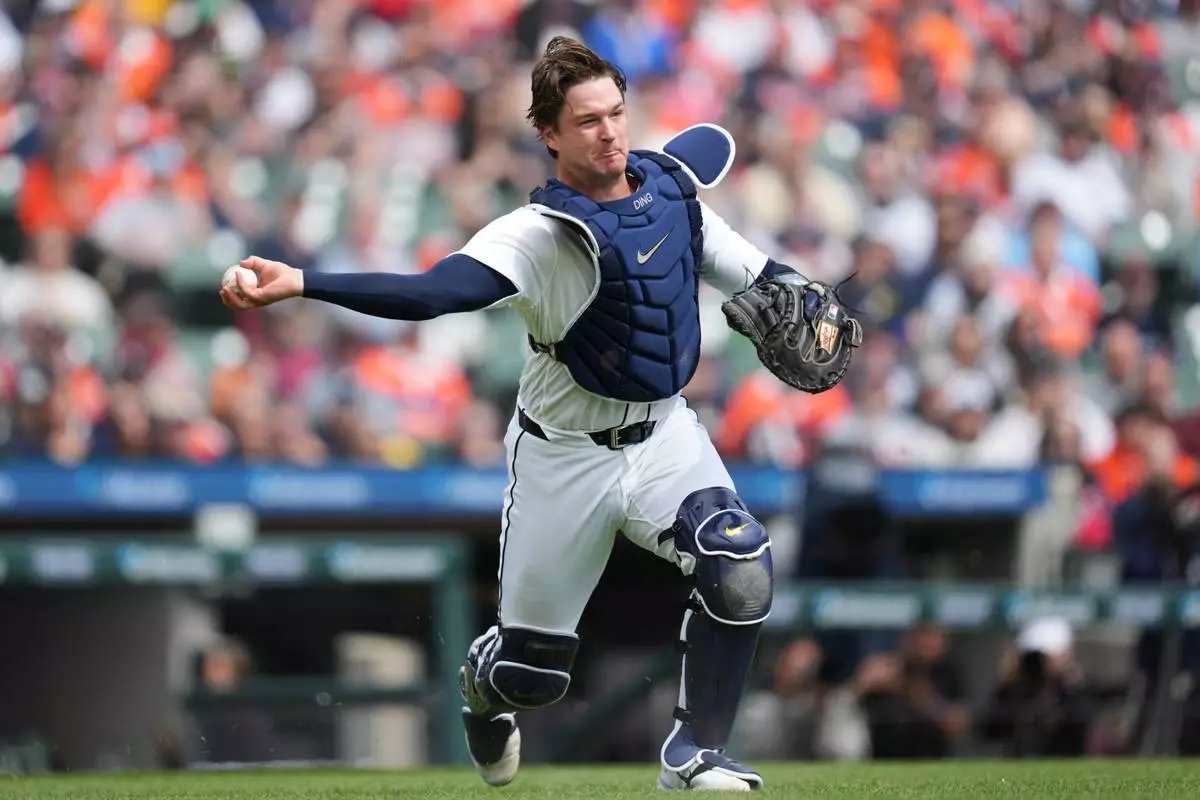
Detroit Tigers catcher Dillon Dingler throws to first base for an out on a St. Louis Cardinals' Victor Scott II bunt in the first inning of a baseball game Saturday, April 4, 2026, in Detroit. (AP Photo/Paul Sancya)