KAWASAKI, Japan--(BUSINESS WIRE)--Apr 7, 2026--
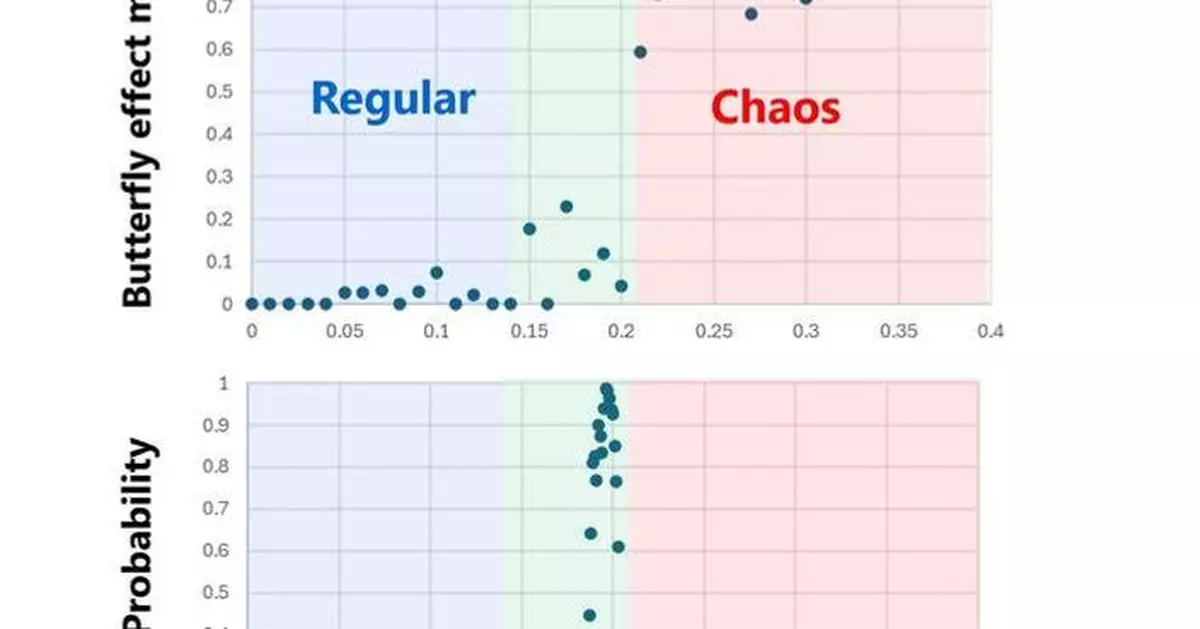
Toshiba Corporation has developed a breakthrough algorithm that dramatically boosts the performance of the Simulated Bifurcation Machine (SBM), its proprietary quantum‑inspired combinatorial optimization computer. The new algorithm significantly improves the probability of obtaining an optimal solution or a known best solution within a limited number of trials—referred to as the success probability, a key benchmark for evaluating combinatorial optimization technologies.
This press release features multimedia. View the full release here: https://www.businesswire.com/news/home/20260407918434/en/
The SBM is designed to solve large‑scale combinatorial optimization problems in a wide range of fields, including new drug discovery, delivery route optimization, and investment portfolio design. While previous algorithms could find optimal or known best solutions with a sufficiently large number of trials, large‑scale problems often trapped the search process in local optima, significantly lowering success probability under practical constraints that limit the number of trials.
Toshiba has overcome this challenge by developing a third‑generation simulated bifurcation (SB) algorithm. This ground-breaking advance builds on the original SB algorithm, announced in April 2019 *1, and the second‑generation SB algorithm, released in February 2021 *2, which delivered major boosts to computational speed and accuracy.
The new algorithm expands the bifurcation parameter that triggers the bifurcation phenomena *3 —a defining feature of the SB algorithm—from a single global parameter to individual parameters assigned to each position variable *4. These bifurcation parameters are independently controlled according to the values of the corresponding position variables, enabling a more adaptive and effective solution search.
With the introduction of this advanced control mechanism, the algorithm exhibits either regular or chaotic behavior *5, depending on conditions. Crucially, Toshiba discovered that by effectively harnessing chaos at the edge of chaos —the boundary between regular dynamics and chaotic motion—the algorithm can escape local optima far more efficiently. As a result, the success probability of reaching the global optimum increases dramatically, approaching 100%.
The SBM based on the new algorithm is therefore much faster. It delivers a time to solution (TTS) required to obtain an optimal or known best solution that is approximately 100 times faster than the SBM based on the second‑generation algorithm. These advances are expected to accelerate the practical applications of combinatorial optimization across a broad range of challenges.
The research results were published in the April 6, 2026 issue of Physical Review Applied, a peer‑reviewed journal of the American Physical Society *6.
Note:
*1 https://advances.sciencemag.org/content/5/4/eaav2372
*2 https://advances.sciencemag.org/content/7/6/eabe7953
*3 In nonlinear dynamical systems, a phenomenon in which changes in system parameters (bifurcation parameters) cause the number of stable points to change from one to multiple.
*4 In the SB algorithm, the equations of motion of a classical dynamical system consisting of many oscillators are solved. A position variable represents the position of each oscillator, and these position variables correspond to the decision variables (discrete variables) of the combinatorial optimization problem.
*5 In nonlinear dynamical systems, a phenomenon in which even slight differences in initial conditions cause the subsequent trajectories of motion to diverge significantly, resulting in disordered (chaotic) behavior. This sensitivity of chaos to initial conditions is known as the butterfly effect, and the upper panel of Figure 1 provides a quantitative evaluation of this effect.
*6 https://doi.org/10.1103/2qd9-x6v8
About Toshiba
For over 150 years, guided by its corporate philosophy, “Committed to People, Committed to the Future.,” Toshiba Group has contributed to society through its business activities. Today, the Group continues to enhance its management structure, streamline operations, and invest in forward‑looking businesses in the energy, digital infrastructure, and electronic devices domains.
Annual sales in fiscal year 2025 were 3.5 trillion yen, with 95,000 employees worldwide. Find out more on our website or follow us on LinkedIn.
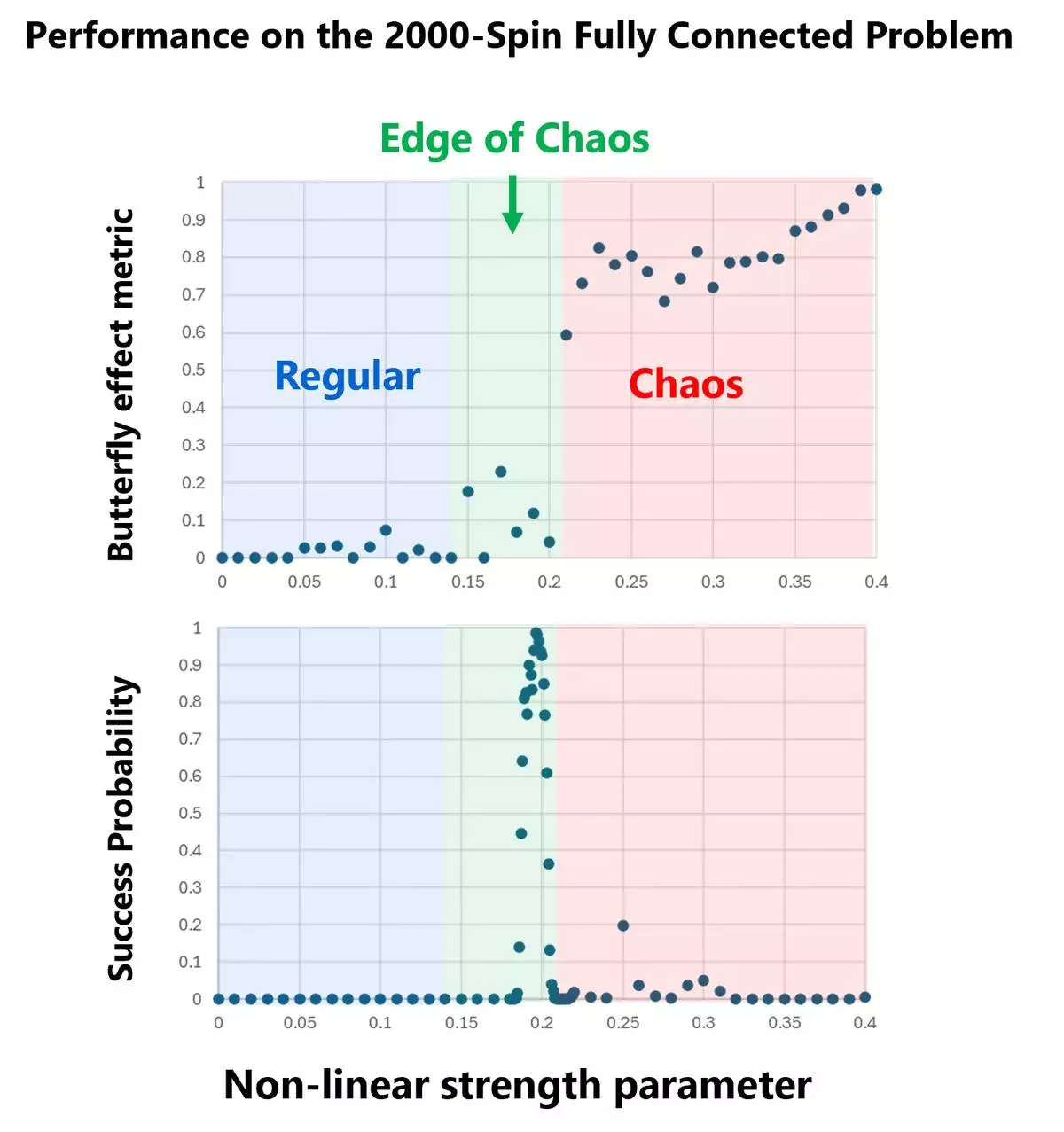
Figure 1: Results demonstrating that the newly developed third‑generation SB algorithm can find the known best solution with nearly 100% probability at the edge of chaos for a fully connected 2,000‑spin Ising problem.
DUBAI, United Arab Emirates (AP) — The King Fahd Causeway, a key bridge linking Saudi Arabia and the island of Bahrain, reopened Tuesday morning after closing for hours over possible threats from Iran.
The King Fahd Causeway Authority made the announcement in a post on X, saying the only route by road between Bahrain and the Arabian Peninsula reopened. Bahrain’s airport has been closed over the Iranian attacks for weeks.
The hourslong closure came after a ballistic missile attack from Iran targeted Saudi Arabia and may have done damage to energy infrastructure there. The kingdom has not elaborated on damage from that attack.
THIS IS A BREAKING NEWS UPDATE. AP’s earlier story follows below.
DUBAI, United Arab Emirates (AP) — Saudi Arabia closed the only road linking it to Bahrain on Tuesday after Iran fired missiles at its oil-rich Eastern Province. Tehran's latest strikes came as Iranian officials urged youths to form human chains around power plants to protect them, as the latest deadline set by U.S. President Donald Trump for Iran to reopen the Strait of Hormuz drew closer.
Trump has threatened to bomb all of Iran's power plants and bridges if Iran does not meet his Tuesday 8 p.m. EDT deadline to allow shipping traffic to fully resume through the strategic waterway, through which a fifth of the world's oil transits in peacetime.
“The entire country can be taken out in one night,” Trump said.
Israel's military warned Iranians in Farsi to avoid taking trains throughout the day, likely telegraphing intended strikes on the rail network.
“Your presence puts your life at risk,” the warning posted on X read.
France joined a growing chorus of international voices calling for restraint, with Foreign Minister Jean-Noël Barrot saying attacks targeting civilian and energy infrastructure “are barred by the rules of war, international law.”
“They would without doubt trigger a new phase of escalation, of reprisals, that would drag the region and the world economy into a vicious circle that would be very worrying and, most of all, very damaging to our own interests,” the minister said on France Info television.
Iran choked off shipping through the strait after Israel and the U.S. attacked on Feb. 28, starting the war. On Monday, Tehran rejected a 45-day ceasefire proposal and said it wants a permanent end to the war.
Early Tuesday, Tehran launched seven ballistic missiles at Saudi Arabia, which authorities said rained debris on the ground near energy facilities as they were intercepted. Defense Ministry spokesman Maj. Gen. Turki al-Malki said the damage was being assessed.
In the meantime, Saudi Arabia said it was closing the King Fahd Causeway, a bridge that links Saudi Arabia to the island kingdom of Bahrain over the threat of more Iranian attacks targeting the Eastern Province.
The 25-kilometer (15.5 mile) bridge is the only connection by road for Bahrain, home to the U.S. Navy’s 5th Fleet, to the Arabian Peninsula.
Elsewhere, activists reported a new wave of strikes on Tehran, for which Israel later claimed responsibility. Nine people were killed in the city of Shahriar and six more in Pardis in other airstrikes, Iranian media reported.
Iran also fired on Israel, with reports of incoming missiles in Tel Aviv and Eilat.
Iran's attacks on the energy infrastructure of its Gulf Arab neighbors, coupled with its stranglehold on the Strait of Hormuz, has sent oil prices skyrocketing and is causing global economic problems.
In early spot trading, Brent crude, the international standard, was above $111 per barrel, up more than 50% since the start of the war.
Under growing pressure at home as consumers feel the pinch, Trump has demanded that Iran open the Strait of Hormuz to all shipping traffic or see power plants and bridges wiped out. The threat to hit civilian infrastructure has sparked widespread warnings about possible war crimes.
New Zealand Prime Minister Christopher Luxon on Tuesday urged Trump not to follow through, saying the “focus needs to be on not seeing this conflict expand any further.”
“Any of those actions including bombing bridges and reservoirs and civilian infrastructure would be unacceptable,” Luxon told Radio New Zealand.
Iran sought to up the ante, calling on “all young people, athletes, artists, students and university students and their professors” to form human chains around power plants ahead of the threatened strikes.
“Power plants that are our national assets and capital, regardless of any taste or political viewpoint, belong to the future of Iran and to the Iranian youth,” Alireza Rahimi, identified by Iranian state television as the secretary of the Supreme Council of Youth and Adolescents, said as he issued the video call in a newscast.
Iran has formed human chains in the past around its nuclear sites at times of heightened tensions with the West.
Later, a Revolutionary Guard general urged parents to send their children to man checkpoints, which have been repeatedly targeted in airstrikes.
U.N. Secretary-General António Guterres warned the U.S. that attacks on civilian infrastructure are banned under international law, according to his spokesperson. Trump, speaking with reporters, said he’s “not at all” concerned about committing war crimes with such attacks.
As the deadline neared, efforts were still underway to reach a negotiated solution. Even though Iran has rejected the latest proposal from the U.S., officials involved in the diplomacy say that talks are still ongoing.
More than 1,900 people have been killed in Iran since the war began, but the government has not updated the toll for days.
More than 1,400 people have been killed in Lebanon and more than 1 million people have been displaced. Eleven Israeli soldiers have died there.
In Gulf Arab states and the occupied West Bank, more than two dozen people have died, while 23 have been reported dead in Israel and 13 U.S. service members have been killed.
Japan said Tuesday that one of its citizens who had been detained in Iran since January had been released on bail. Chief Cabinet Secretary Minoru Kihara told reporters in Tokyo that Japan is demanding his full release from Iranian authorities.
Rising reported from Bangkok and Magdy reported from Cairo. Mari Yamaguchi in Tokyo, John Leicester in Paris and Rod McGuirk in Melbourne, Australia, contributed to this report.
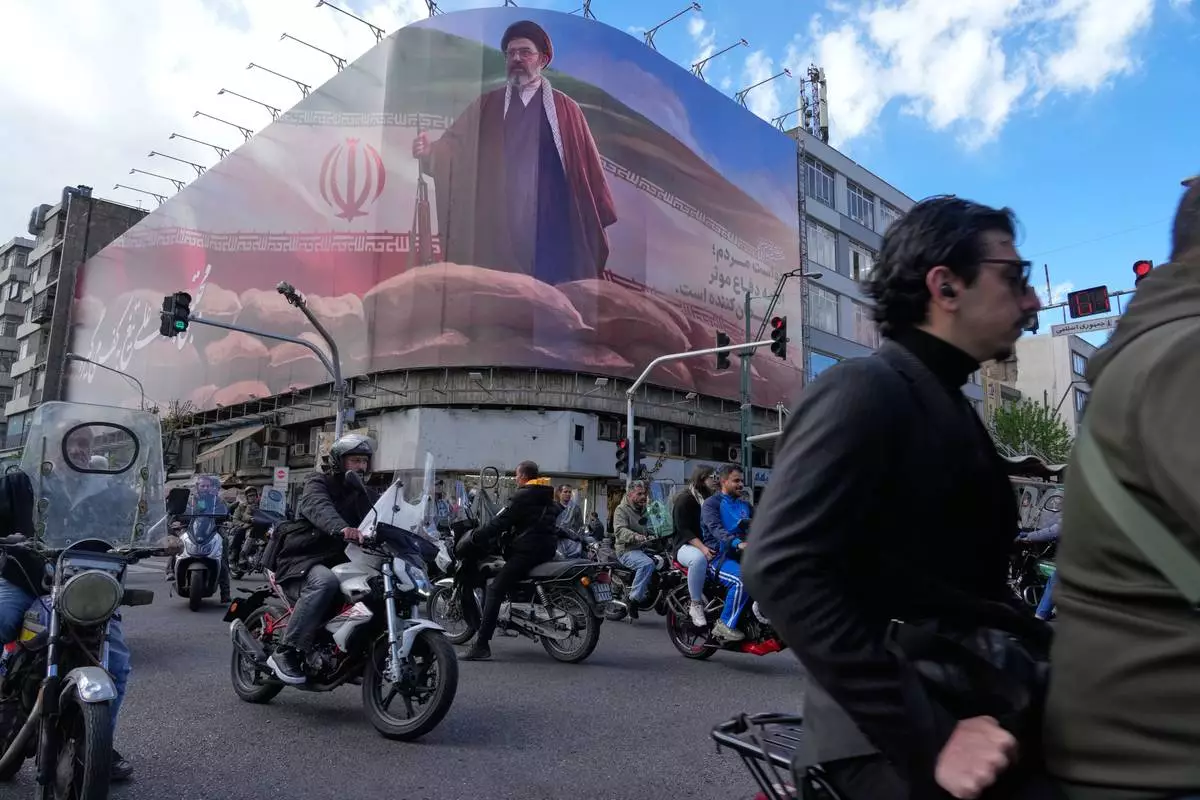
People drive their motorbikes past a billboard that shows a graphic depicting Iran's Supreme Leader Ayatollah Mojtaba Khamenei in downtown Tehran, Iran, Monday, April 6, 2026. (AP Photo/Vahid Salemi)
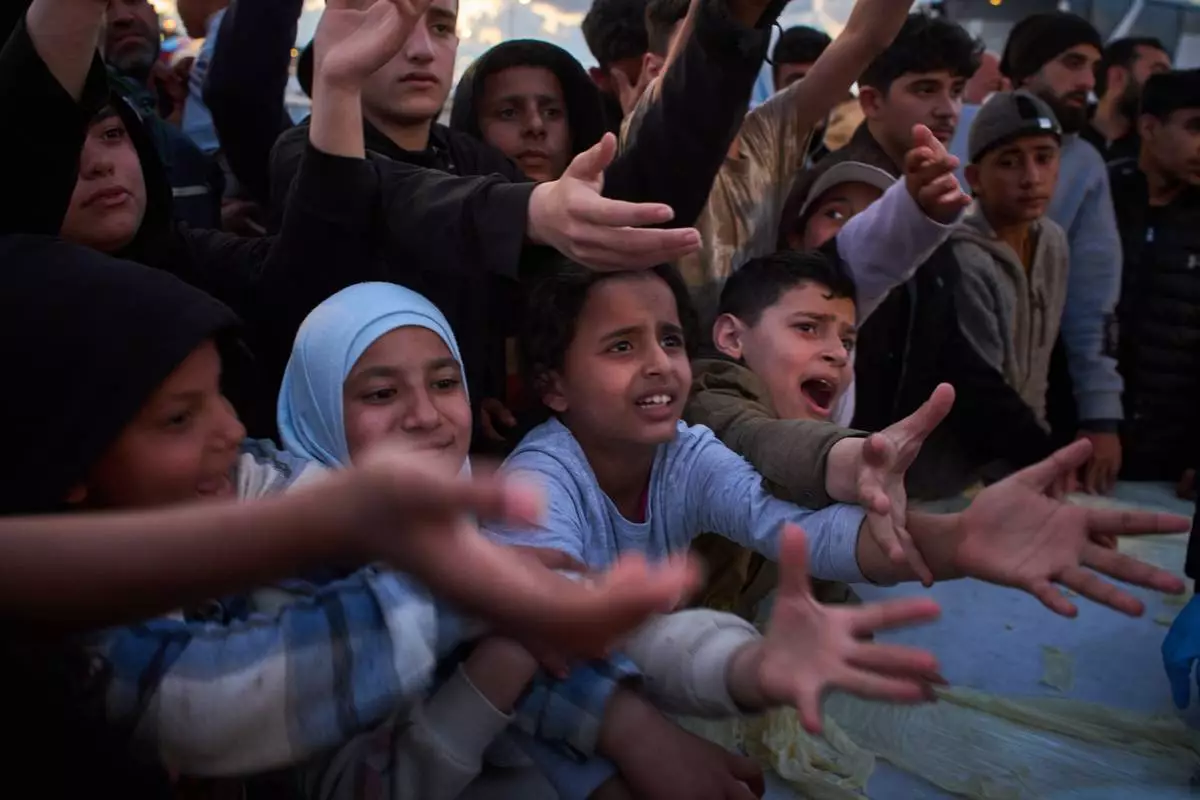
Displaced people wait to receive donated food beside the tents they use as shelters after fleeing Israeli bombardment in southern Lebanon, in Beirut, Lebanon, Monday, April 6, 2026. (AP Photo/Emilio Morenatti)
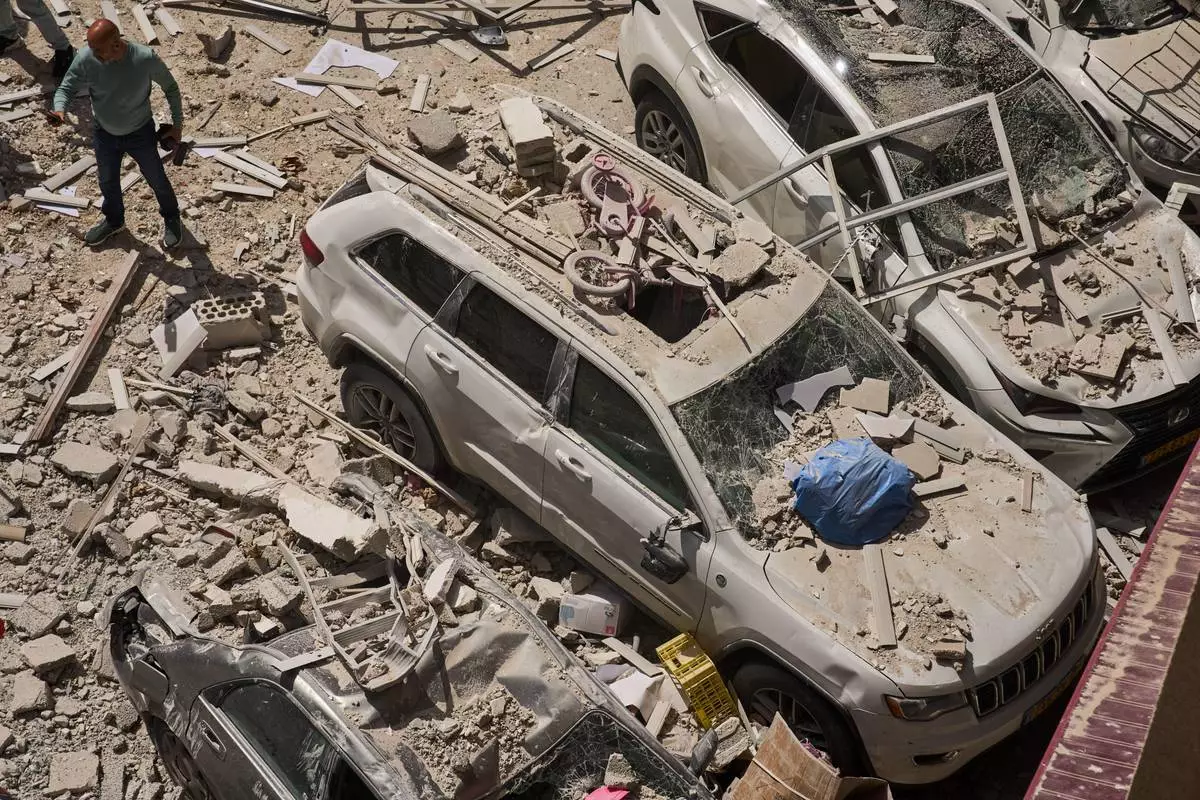
A man inspects the damage to cars and an apartment building struck by an Iranian missile in Ramat Gan, Israel, Monday, April 6, 2026. (AP Photo/Oded Balilty)