|
PANAMA CITY, Panama, April 7, 2026 /PRNewswire/ -- Recently, HTX officially released its 2026 Digital Asset Trends White Paper (the "White Paper"). The report was jointly published with leading industry platforms and media including BlockBeats, ChainCatcher, Foresight News, HTX Learn, HTX Research, Odaily, PANews, RootData, and TechFlow. Against a backdrop of market consolidation and cautious sentiment, this report provides a timely re-evaluation of the digital asset landscape. By offering a systematic framework and forward-looking analysis, it aims to help investors find clarity and maintain a strategic foothold throughout this evolving cycle.
The White Paper identifies ten pivotal trends poised to reshape the digital asset landscape in 2026, arguing that digital assets are completing their historic transition into a recognized asset class. The market is moving beyond a purely price cycle-driven paradigm into a new era defined by structural trends, gradually evolving from a high-volatility innovation sector into a core component of global asset allocation frameworks. Amidst a broader reconfiguration of global liquidity, HTX is anchoring its strategy across four core pillars - Stability, Transparency, Institutionalization, and AI Enablement. Through the dual engine of technology and mechanism, it strives to serve as the trusted infrastructure layer for trading and wealth generation, supporting long-term capital in the burgeoning era of on-chain finance.
Full Report: https://square.htx.com/wp-content/uploads/2026/04/2026-Digital-Asset-Trends-White-Paper-en.pdf
A New Macro Paradigm: From Digital Gold Consolidation to Record Stablecoin Expansion
The White Paper projects that 2026 will mark a rebalancing phase in global monetary policy, with interest rate differentials between the U.S. Federal Reserve and emerging markets no longer moving in sync. In this complex macro environment, Bitcoin (BTC) is expected to solidify its role as digital gold. No longer a fringe innovation experiment, Bitcoin and other core crypto assets are becoming structurally embedded in global asset allocation models, forming hedging portfolios alongside U.S. Treasuries and gold, with pricing power increasingly shifting toward long-term capital. At the same time, Ethereum (ETH) is positioned to emerge as a core yield-bearing asset. Supported by its mature staking and DeFi infrastructure, Ethereum is establishing itself as the on-chain treasury bond, evolving into a cash flow-driven growth asset.
In terms of liquidity, stablecoins are set to reach new highs in the market size. Their role has expanded beyond trading instruments into foundational infrastructure for global cross-border payments and settlement. As HTX notes, "In 2026, the market is no longer asking whether digital assets have value, but rather what allocation percentage they deserve." With total stablecoin market capitalization surpassing $300 billion, a USD-based on-chain settlement system is already taking shape. Through deep liquidity provisioning, HTX is positioning itself as a key venue for global macro capital to gauge market dynamics.
Institutionalization and Asset Tokenization: RWA Acceleration and Derivatives Expansion
In 2026, institutional participation is undergoing a fundamental transformation. Institutional capital will continue to increase its share of the market, while retail-driven volatility is expected to moderate. The White Paper identifies three primary pathways for institutional engagement: direct asset allocation, yield-enhancement strategies (via staking and RWA), and infrastructure investment (including equity stakes in exchanges and custodians). The entry of long-term capital is driving more rational market behavior and gradually compressing volatility. Meanwhile, RWAs are entering a rapid expansion phase. The tokenization of U.S. Treasuries and fixed-income instruments is introducing stable yield sources into on-chain ecosystems. According to the report, the global RWA market size has exceeded $340 billion, with assets ranging from government bonds and gold to commodities such as electricity and soybeans being digitized on-chain.
As institutional participation grows, on-chain derivatives trading is poised for significant expansion. Perpetual futures contracts and options are increasingly migrating on-chain, featuring more mature pricing mechanisms. In response, HTX has comprehensively upgraded its institutional services, offering robust API infrastructure, customized risk management solutions, and deep integration with leading global custodians. It effectively serves as a compliant gateway, enabling professional capital to access on-chain markets and capture structural premiums amid macro volatility.
Infrastructure Evolution and the Rise of the Agent Economy: Dual Engines of zkEVM and AI Agents
In 2026, the upgrade of digital asset infrastructure is proceeding on two parallel tracks, pushing the industry into the 10-Gigabit L1 and automation era.
At the infrastructure level, Ethereum is addressing approximately 80% of proof bottlenecks through protocol-level integration of zkEVM, entering the 10-Gigabit L1 era. With its combination of performance and security, Ethereum is consolidating ecosystem-wide liquidity, effectively ending the Ethereum killer narrative. In this context, modular blockchain architecture is becoming the dominant paradigm. As base-layer protocols become commoditized, value is shifting toward "fat applications," with customized L2s driven by super dApps and AI agent economies emerging as the new core of the ecosystem.
Simultaneously, AI Agents are becoming primary executors on-chain. These autonomous agents are increasingly replacing humans in trading, yield management, and risk control. As of March 2026, AI agent-generated economic output (aGDP) has already reached hundreds of millions of dollars. Market interaction is shifting from manual execution to intent-driven models, marking the rise of the AI agent economy.
Keeping pace with this frontier, HTX has introduced HTX AI Skills, enabling users to input natural language commands for market analysis, strategy generation, and assisted execution. This intent-driven trading paradigm significantly lowers barriers to entry, allowing retail users to access professional-grade, AI-powered on-chain financial services.
Embracing 2026: Transparency and Regulatory Clarity as HTX's Strategic Foundations
In an era of structural divergence, competition among platforms is shifting from traffic acquisition to trust-building. Transparent competition is emerging as the defining differentiator. HTX emphasizes in the White Paper that transparency is no longer an additional advantage but a baseline for survival. The platform has taken the lead in institutionalizing Proof of Reserves (PoR) disclosures, leveraging technology to ensure verifiable and transparent asset structures. At the same time, as regulatory frameworks become clearer globally, gray areas are expected to shrink further. In a more defined regulatory landscape, HTX's compliance-first operations strategy is demonstrating strong resilience against systemic risks.
HTX reaffirms its commitment to global users: security and transparency are the foundation of platform development. Looking ahead, the platform will focus on three strategic priorities: enhancing institutional services, integrating on-chain assets with yield products, and advancing compliant global expansion.
As the White Paper concludes, the digital asset market is transitioning from broad-based rallies to survival-of-the-fittest dynamics, marking an era for professionals and long-term builders. With its four strategic pillars of stability, transparency, institutionalization, and AI enablement, HTX aims not only to facilitate trading, but to serve as a foundational builder of on-chain financial infrastructure. In the narrative of global liquidity reconfiguration, HTX stands ready to partner with global participants in shaping the next golden decade of digital assets.
About HTX
Founded in 2013, HTX (formerly Huobi) has evolved from a virtual asset exchange into a comprehensive ecosystem of blockchain businesses that span digital asset trading, financial derivatives, research, investments, incubation, and other businesses.
As a world-leading gateway to Web3, HTX harbors global capabilities that enable it to provide users with safe and reliable services. Adhering to the growth strategy of "Global Expansion, Thriving Ecosystem, Wealth Effect, Security & Compliance," HTX is dedicated to providing quality services and values to virtual asset enthusiasts worldwide.
To learn more about HTX, please visit https://www.htx.com/ or HTX Square , and follow HTX on X, Telegram, and Discord.
PANAMA CITY, Panama, April 7, 2026 /PRNewswire/ -- Recently, HTX officially released its 2026 Digital Asset Trends White Paper (the "White Paper"). The report was jointly published with leading industry platforms and media including BlockBeats, ChainCatcher, Foresight News, HTX Learn, HTX Research, Odaily, PANews, RootData, and TechFlow. Against a backdrop of market consolidation and cautious sentiment, this report provides a timely re-evaluation of the digital asset landscape. By offering a systematic framework and forward-looking analysis, it aims to help investors find clarity and maintain a strategic foothold throughout this evolving cycle.
The White Paper identifies ten pivotal trends poised to reshape the digital asset landscape in 2026, arguing that digital assets are completing their historic transition into a recognized asset class. The market is moving beyond a purely price cycle-driven paradigm into a new era defined by structural trends, gradually evolving from a high-volatility innovation sector into a core component of global asset allocation frameworks. Amidst a broader reconfiguration of global liquidity, HTX is anchoring its strategy across four core pillars - Stability, Transparency, Institutionalization, and AI Enablement. Through the dual engine of technology and mechanism, it strives to serve as the trusted infrastructure layer for trading and wealth generation, supporting long-term capital in the burgeoning era of on-chain finance.
Full Report: https://square.htx.com/wp-content/uploads/2026/04/2026-Digital-Asset-Trends-White-Paper-en.pdf
A New Macro Paradigm: From Digital Gold Consolidation to Record Stablecoin Expansion
The White Paper projects that 2026 will mark a rebalancing phase in global monetary policy, with interest rate differentials between the U.S. Federal Reserve and emerging markets no longer moving in sync. In this complex macro environment, Bitcoin (BTC) is expected to solidify its role as digital gold. No longer a fringe innovation experiment, Bitcoin and other core crypto assets are becoming structurally embedded in global asset allocation models, forming hedging portfolios alongside U.S. Treasuries and gold, with pricing power increasingly shifting toward long-term capital. At the same time, Ethereum (ETH) is positioned to emerge as a core yield-bearing asset. Supported by its mature staking and DeFi infrastructure, Ethereum is establishing itself as the on-chain treasury bond, evolving into a cash flow-driven growth asset.
In terms of liquidity, stablecoins are set to reach new highs in the market size. Their role has expanded beyond trading instruments into foundational infrastructure for global cross-border payments and settlement. As HTX notes, "In 2026, the market is no longer asking whether digital assets have value, but rather what allocation percentage they deserve." With total stablecoin market capitalization surpassing $300 billion, a USD-based on-chain settlement system is already taking shape. Through deep liquidity provisioning, HTX is positioning itself as a key venue for global macro capital to gauge market dynamics.
Institutionalization and Asset Tokenization: RWA Acceleration and Derivatives Expansion
In 2026, institutional participation is undergoing a fundamental transformation. Institutional capital will continue to increase its share of the market, while retail-driven volatility is expected to moderate. The White Paper identifies three primary pathways for institutional engagement: direct asset allocation, yield-enhancement strategies (via staking and RWA), and infrastructure investment (including equity stakes in exchanges and custodians). The entry of long-term capital is driving more rational market behavior and gradually compressing volatility. Meanwhile, RWAs are entering a rapid expansion phase. The tokenization of U.S. Treasuries and fixed-income instruments is introducing stable yield sources into on-chain ecosystems. According to the report, the global RWA market size has exceeded $340 billion, with assets ranging from government bonds and gold to commodities such as electricity and soybeans being digitized on-chain.
As institutional participation grows, on-chain derivatives trading is poised for significant expansion. Perpetual futures contracts and options are increasingly migrating on-chain, featuring more mature pricing mechanisms. In response, HTX has comprehensively upgraded its institutional services, offering robust API infrastructure, customized risk management solutions, and deep integration with leading global custodians. It effectively serves as a compliant gateway, enabling professional capital to access on-chain markets and capture structural premiums amid macro volatility.
Infrastructure Evolution and the Rise of the Agent Economy: Dual Engines of zkEVM and AI Agents
In 2026, the upgrade of digital asset infrastructure is proceeding on two parallel tracks, pushing the industry into the 10-Gigabit L1 and automation era.
At the infrastructure level, Ethereum is addressing approximately 80% of proof bottlenecks through protocol-level integration of zkEVM, entering the 10-Gigabit L1 era. With its combination of performance and security, Ethereum is consolidating ecosystem-wide liquidity, effectively ending the Ethereum killer narrative. In this context, modular blockchain architecture is becoming the dominant paradigm. As base-layer protocols become commoditized, value is shifting toward "fat applications," with customized L2s driven by super dApps and AI agent economies emerging as the new core of the ecosystem.
Simultaneously, AI Agents are becoming primary executors on-chain. These autonomous agents are increasingly replacing humans in trading, yield management, and risk control. As of March 2026, AI agent-generated economic output (aGDP) has already reached hundreds of millions of dollars. Market interaction is shifting from manual execution to intent-driven models, marking the rise of the AI agent economy.
Keeping pace with this frontier, HTX has introduced HTX AI Skills, enabling users to input natural language commands for market analysis, strategy generation, and assisted execution. This intent-driven trading paradigm significantly lowers barriers to entry, allowing retail users to access professional-grade, AI-powered on-chain financial services.
Embracing 2026: Transparency and Regulatory Clarity as HTX's Strategic Foundations
In an era of structural divergence, competition among platforms is shifting from traffic acquisition to trust-building. Transparent competition is emerging as the defining differentiator. HTX emphasizes in the White Paper that transparency is no longer an additional advantage but a baseline for survival. The platform has taken the lead in institutionalizing Proof of Reserves (PoR) disclosures, leveraging technology to ensure verifiable and transparent asset structures. At the same time, as regulatory frameworks become clearer globally, gray areas are expected to shrink further. In a more defined regulatory landscape, HTX's compliance-first operations strategy is demonstrating strong resilience against systemic risks.
HTX reaffirms its commitment to global users: security and transparency are the foundation of platform development. Looking ahead, the platform will focus on three strategic priorities: enhancing institutional services, integrating on-chain assets with yield products, and advancing compliant global expansion.
As the White Paper concludes, the digital asset market is transitioning from broad-based rallies to survival-of-the-fittest dynamics, marking an era for professionals and long-term builders. With its four strategic pillars of stability, transparency, institutionalization, and AI enablement, HTX aims not only to facilitate trading, but to serve as a foundational builder of on-chain financial infrastructure. In the narrative of global liquidity reconfiguration, HTX stands ready to partner with global participants in shaping the next golden decade of digital assets.
About HTX
Founded in 2013, HTX (formerly Huobi) has evolved from a virtual asset exchange into a comprehensive ecosystem of blockchain businesses that span digital asset trading, financial derivatives, research, investments, incubation, and other businesses.
As a world-leading gateway to Web3, HTX harbors global capabilities that enable it to provide users with safe and reliable services. Adhering to the growth strategy of "Global Expansion, Thriving Ecosystem, Wealth Effect, Security & Compliance," HTX is dedicated to providing quality services and values to virtual asset enthusiasts worldwide.
To learn more about HTX, please visit https://www.htx.com/ or HTX Square , and follow HTX on X, Telegram, and Discord.
** This press release is distributed by PR Newswire through automated distribution system, for which the client assumes full responsibility. **
HTX Releases "2026 Digital Asset Trends White Paper": Regime Shift of Global Liquidity Defines a New Era of On-Chain Finance
|
- First universal autonomous navigation support system to receive TA, accelerating commercialization
- Validation from DNV over three years, expected to contribute to IMO autonomous navigation standards
- "HD Hyundai will advance the commercialization of autonomous navigation technology while leading the development of international standards"
SEOUL, South Korea, April 6, 2026 /PRNewswire/ -- Avikus, the autonomous navigation subsidiary of HD Hyundai led by CEOs Kang Jae-ho and Lim Do-hyeong, is stepping up efforts to commercialize its vessel autonomy technologies.
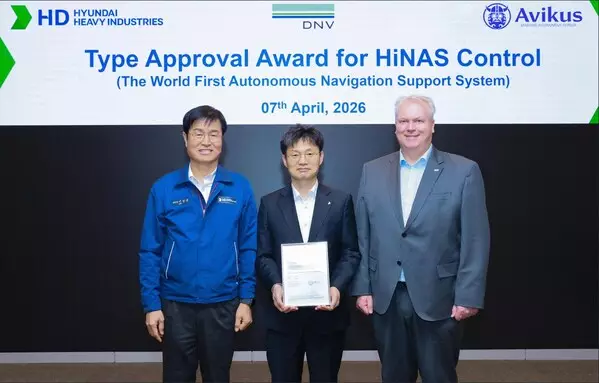
HD Hyundai said Tuesday that Avikus recently obtained Type Approval (TA) from DNV, the Norwegian classification society, for its Autonomous Navigation Support System, HiNAS Control.
HiNAS Control, which received the TA, is an integrated autonomous navigation support system that combines perception, decision-making and control functions, enabling it to detect nearby vessels and obstacles, assess navigation conditions and maneuver to avoid collisions.
The approval marks the first time a mass-produced autonomous navigation support system designed for use across multiple vessel types, rather than a specific ship or project, has received international certification. With the TA, HiNAS Control can be installed without additional verification, improving deployment efficiency and is expected to enhance confidence among global shipowners.
Avikus worked with DNV for more than three years to define safety requirements for its autonomous navigation support system and establish a verification framework. Under its guidelines, DNV systematically evaluated the system's collision avoidance capabilities, which are rooted in the International Regulations for Preventing Collisions at Sea (COLREGS), by comprehensively verifying the system alarms, navigational information display, and ship control performance.
At a time when international standards for autonomous navigation have not yet been fully established, this case of third-party verification by DNV is expected to be highly beneficial for the establishment of future regulations. With discussions underway at the International Maritime Organization (IMO) on the non-mandatory Maritime Autonomous Surface Ships (MASS) Code, the approval and its framework could also inform the development of more detailed technical standards. The approval is expected to enable Avikus to respond more effectively to evolving global regulations, while positioning HiNAS Control as a standard technology in the autonomous navigation market.
"HiNAS Control's Type Approval is a major milestone, marking it as one of the first systems to bring autonomous navigation technology beyond the conceptual stage and into commercialization," Vidar Dolonen, Korea and Japan Region Manager of DNV, said.
"This Type Approval demonstrates that Avikus' autonomous navigation technology has achieved global standards of safety and reliability," Lim Do-hyeong, CEO of Avikus, said. "Building on synergies with HD Hyundai Group, we will continue to advance commercialization and lead the development of international standards."
HiNAS Control has been applied as a standard specification on vessels built by HD Hyundai since 2023 and has surpassed 500 cumulative orders to date.
- First universal autonomous navigation support system to receive TA, accelerating commercialization
- Validation from DNV over three years, expected to contribute to IMO autonomous navigation standards
- "HD Hyundai will advance the commercialization of autonomous navigation technology while leading the development of international standards"
SEOUL, South Korea, April 6, 2026 /PRNewswire/ -- Avikus, the autonomous navigation subsidiary of HD Hyundai led by CEOs Kang Jae-ho and Lim Do-hyeong, is stepping up efforts to commercialize its vessel autonomy technologies.
HD Hyundai said Tuesday that Avikus recently obtained Type Approval (TA) from DNV, the Norwegian classification society, for its Autonomous Navigation Support System, HiNAS Control.
HiNAS Control, which received the TA, is an integrated autonomous navigation support system that combines perception, decision-making and control functions, enabling it to detect nearby vessels and obstacles, assess navigation conditions and maneuver to avoid collisions.
The approval marks the first time a mass-produced autonomous navigation support system designed for use across multiple vessel types, rather than a specific ship or project, has received international certification. With the TA, HiNAS Control can be installed without additional verification, improving deployment efficiency and is expected to enhance confidence among global shipowners.
Avikus worked with DNV for more than three years to define safety requirements for its autonomous navigation support system and establish a verification framework. Under its guidelines, DNV systematically evaluated the system's collision avoidance capabilities, which are rooted in the International Regulations for Preventing Collisions at Sea (COLREGS), by comprehensively verifying the system alarms, navigational information display, and ship control performance.
At a time when international standards for autonomous navigation have not yet been fully established, this case of third-party verification by DNV is expected to be highly beneficial for the establishment of future regulations. With discussions underway at the International Maritime Organization (IMO) on the non-mandatory Maritime Autonomous Surface Ships (MASS) Code, the approval and its framework could also inform the development of more detailed technical standards. The approval is expected to enable Avikus to respond more effectively to evolving global regulations, while positioning HiNAS Control as a standard technology in the autonomous navigation market.
"HiNAS Control's Type Approval is a major milestone, marking it as one of the first systems to bring autonomous navigation technology beyond the conceptual stage and into commercialization," Vidar Dolonen, Korea and Japan Region Manager of DNV, said.
"This Type Approval demonstrates that Avikus' autonomous navigation technology has achieved global standards of safety and reliability," Lim Do-hyeong, CEO of Avikus, said. "Building on synergies with HD Hyundai Group, we will continue to advance commercialization and lead the development of international standards."
HiNAS Control has been applied as a standard specification on vessels built by HD Hyundai since 2023 and has surpassed 500 cumulative orders to date.
** This press release is distributed by PR Newswire through automated distribution system, for which the client assumes full responsibility. **
HD Hyundai Avikus Spearheads Global Standards of Autonomous Navigation Support