Industry experts say Chinese liquid cooling firms are well-positioned to capture the momentum of surging demand, leveraging cost advantages and rapid iteration to stay ahead in a fast-moving market.
Since the start of 2026, demand for AI computing power has grown exponentially, opening new space across the supply chain. Liquid cooling has quickly become one of the hottest tracks, with many manufacturers running at full capacity and expanding production to meet soaring demand.
Immersion cooling, where servers and other heat-generating components are submerged in insulated coolant, has emerged as a key solution to overheated operation. By reducing interference from heat, humidity and dust, it extends the lifespan of high-value intelligent computing servers while saving space compared with traditional air cooling.
"Liquid cooling eliminates the need for air convection, allowing tighter equipment spacing and higher cabinet density. At the same computing scale, a liquid-cooled data center requires only about 30 percent of the floor space of a traditional air-cooled one," said Jing Lei, head of liquid cooling business at a refrigeration company in Hangzhou City, east China's Zhejiang Province.
According to industry insiders, two mainstream technologies -- immersion cooling and cold-plate cooling -- are now widely used in scenarios such as AI servers, intelligent computing centers and energy storage.
Multiple listed companies have stepped up investment in capacity, research and development, and thermal management solutions, aiming to consolidate their market leadership and sharpen their competitive edge.
"In the first quarter, our liquid cooling output exceeded the total production of six months of last year, reflecting surging market demand. The strongest demand is for two areas: distributed computing liquid cooling solutions and cold-plate components. In particular, our new cold-plate production line, completed in March, has been running at full capacity ever since," said Long Feng, production director of another refrigeration company in Hangzhou.
Against this backdrop, cooling fluid manufacturers are ramping up production to meet the surging demand for liquid cooling solutions. One company has already begun mass production of a domestically developed high-performance coolant designed for big data centers, which is just one-quarter the price of imported ones.
"AI computing data centers are defined by rapid iteration, with computing power rising three- to five-fold each year, which requires us to keep pace with that speed," said Shan Xiaojun, head of liquid cooling business at a smart manufacturing enterprise in south China's Guangdong Province.
Industry observers have noted that liquid cooling supply chain in China is fully self-reliant and controllable, with cost advantages and faster delivery. Combined with the world's largest internet application market and a wealth of AI deployment scenarios, Chinese firms are gaining valuable expertise in ultra-large-scale cluster operations, positioning themselves strongly for future growth.
According to estimates by China Galaxy Securities, the liquid cooling market for AI computing centers is projected to reach 20 billion yuan (about 2.9 billion U.S. dollars) by 2026.
The server and cloud computing segment is expected to contribute 80-100 billion yuan, while traditional industries will add another 20 billion yuan. Altogether, China's liquid cooling server market is forecast to surpass 300 billion yuan, underscoring the sector's strong growth potential.
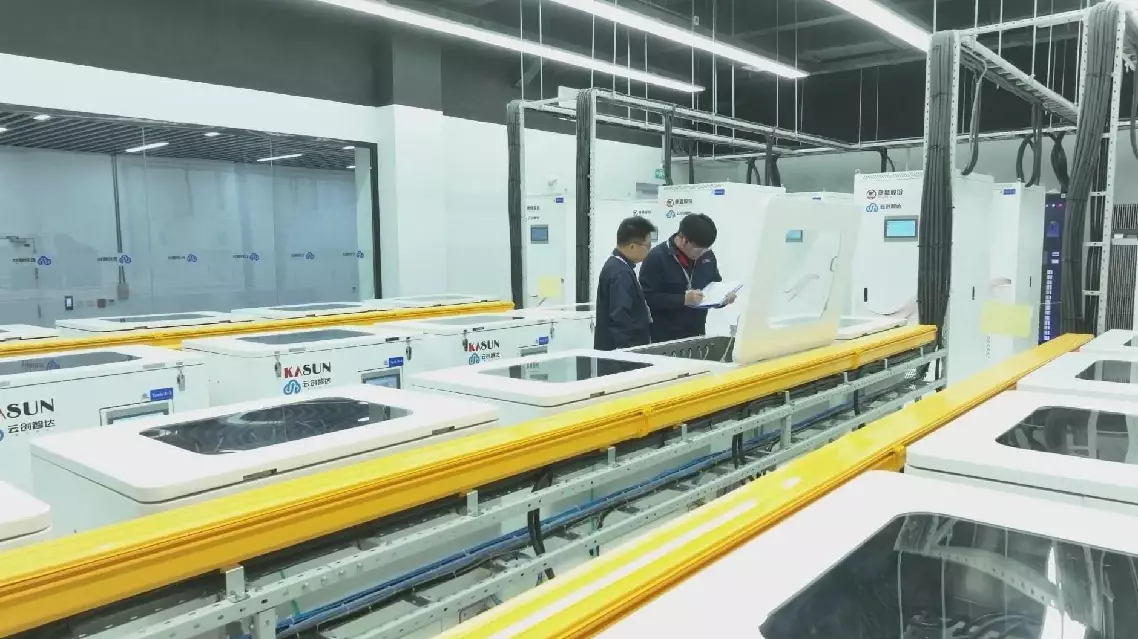
China's liquid cooling firms seize AI boom with competitive edge