U.S. President Donald Trump threatened on Tuesday morning that Iran's " whole civilization will die tonight," the deadline he set for Iran to make a deal and reopen the Strait of Hormuz, marking a possible sharp escalation in the U.S.-Israeli war with Iran.
"A whole civilization will die tonight, never to be brought back again. I don't want that to happen, but it probably will," Trump wrote in a post on his social media platform Truth Social.
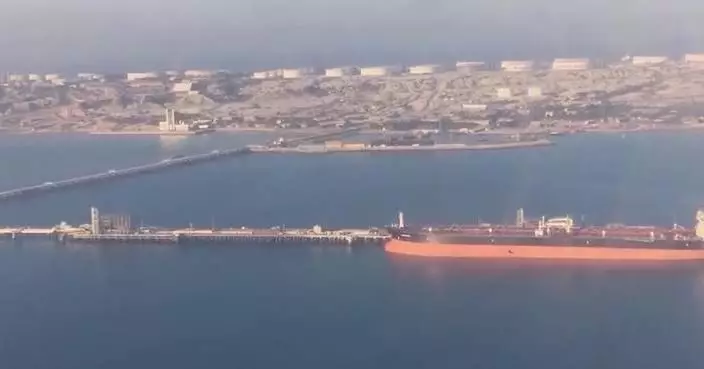
Several explosions were heard in Iran's Kharg Island on Tuesday, following multiple attacks by the United States and Israel, according to Iran's Mehr News Agency.
At least two people were killed and three others injured as a railway bridge in Iran's central province of Isfahan was attacked Tuesday by the United States and Israel, the official Islamic Republic News Agency (IRNA) reported.
The bridge is located in Yahyaabad Village in Kashan County, the IRNA quoted Akbar Salehi, Isfahan's deputy governor for political and security affairs, as saying.
According to the IRNA, an area near Kashan's train station was also targeted with three projectiles at around 13:00 local time (0930 GMT), damaging a number of nearby residential units as well as cars.
The United States and Israel on Tuesday launched an attack on a bridge near the Iranian city of Qom, south of Tehran, according to the Islamic Republic of Iran Broadcasting (IRIB).
The Israel Defense Forces (IDF) issued a statement on Tuesday, saying that it had carried out large-scale attacks on Iran, targeting dozens of infrastructure facilities in multiple regions within the country.
Citing U.S. officials, U.S. media reported on Tuesday that the U.S. forces had attacked military targets on the Kharg Island, Iran's main oil export terminal.
The Islamic Revolutionary Guard Corps of Iran warned its neighboring countries in a statement on Tuesday that "restraint has ended," saying that it will strike the infrastructures of the United States and its allies and threatening to cut off the oil and gas supply to them in the region for years to come.

Trump threatens Iran's "whole civilization will die tonight" as war escalates
A small forestry town in southern Canada is edging toward oblivion as a decades-long tariff dispute with the United States drags on and the latest round of Trump tariffs deals a fresh blow to an already battered industry.
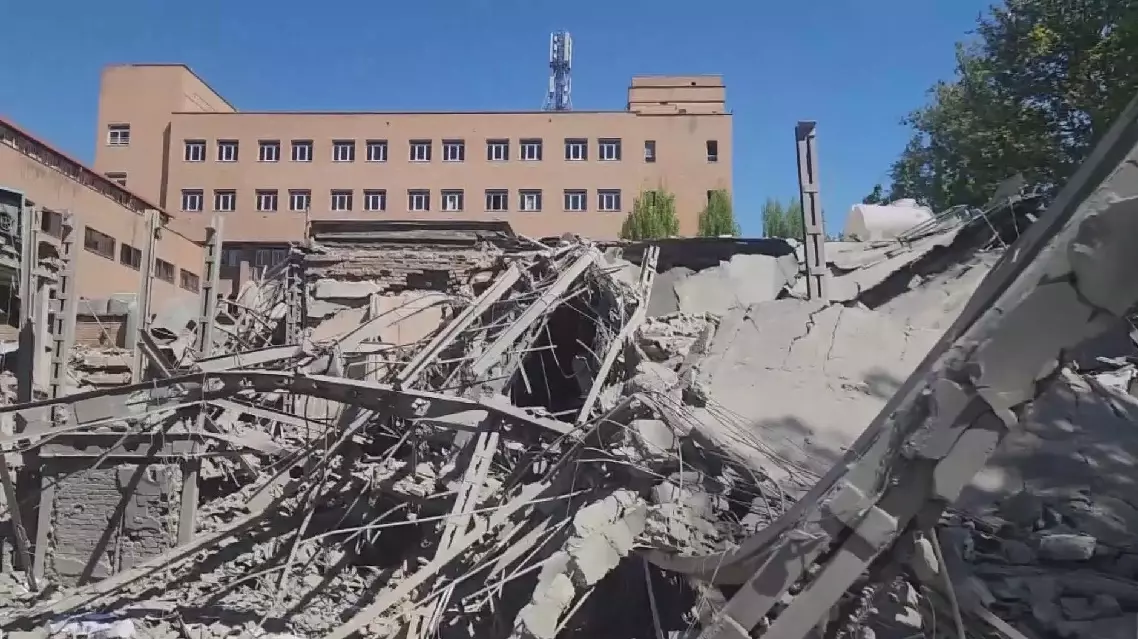
That latest blow has fallen on 100 Mile House, a district of roughly 2,000 people in south-central British Columbia (B.C.), where the sawmill shut permanently in December 2025 - the third in the region to close in recent years, costing 165 workers their jobs.
The closure came two months after the Trump administration added a 10 percent tariff on imported timber, citing national security concerns, on top of the countervailing duties the United States has imposed on Canadian softwood for years.
Maureen Pinkney, the mayor of 100 Mile House, said the shutdown has taken a toll on a small community where mill workers are an integral part.
"That's a real hard hit to very small communities where those people are an intricate part. And we had one mill worker leave and so did his wife who was a nurse. In the shortages of health care workers, that's a double hit which we really feel that," she said.
For workers in 100 Mile House, the mill closure brought steady work to an end.
"It's a direct hit against mill workers here for sure. And all of us went from one day working steady here, and to the next day, we're done," said Brundage, a forestry worker in 100 Mile House.
The softwood lumber dispute is among the longest-running and most costly trade conflicts between Canada and the United States.
It began in 1982, when Canadian softwood lumber exports accounted for more than a quarter of U.S. consumption. U.S. lumber producers argued that Canadian provincial governments gave forestry companies access to public timber at below-market prices, amounting to an unfair subsidy.
Canada has rejected that argument, saying its exporters benefit from efficient industry practices and resource management rather than government support.
Terry Kading, an associate professor of political studies at Thompson Rivers University, said the dispute reflects a recurring U.S. effort to protect domestic industries from Canadian competition.
"Once a sector in the United States, like the lumber industry, feels that Canada is doing something with its lumber, that's dumping or using different methods and things like that. The U.S. ended up defending its lumber industry in the States against Canada," Kading said.
That pattern has persisted for more than four decades, through five rounds of U.S. trade investigations, three bilateral agreements, none of which has delivered a lasting settlement.
The United States has imposed countervailing and anti-dumping duties on Canadian softwood lumber for nearly 20 years in total. The prolonged dispute has added to the pressure on British Columbia’s forestry industry.
According to the B.C. Forestry Council, more than 20 sawmills in the province have closed over the past three years, with tens of thousands of jobs lost.
The toll has drawn a response from Canadian Prime Minister Mark Carney, who in a video on Tuesday cast the softwood dispute as part of a wider pattern of U.S. trade pressure on Canada.
"Not the first time Americans have tried to use tariffs to break us," Carney said.
That pattern stretches back more than a century, to 1866, when the United States unilaterally cut trade ties with British North America, the predecessor of modern Canada.
Some Canadian scholars said the long history of trade disputes carries a lesson about trust in their southern neighbor.
"Canadians have certainly learned that they can trust the U.S. completely. Trust the U.S. to harm us or stab us in the back. So yes, we can trust that the U.S. to do that. I think that's a lesson for this generation of Canadians that we can't take the U.S. for granted. And we've gone from an era of implicit trust with the U.S. to needing to verify the trust," said Carlo Dade, the Director of International Policy and head of the New North America Initiative from the University of Calgary.
U.S. tariffs deepen toll of long-running Canada lumber dispute