Skip to Content Facebook Feature Image

Home Price Growth Rebalancing Before Spring Buying Season

News

Home Price Growth Rebalancing Before Spring Buying Season
News

News

Home Price Growth Rebalancing Before Spring Buying Season

2026-04-07 23:50 Last Updated At:04-08 00:00

IRVINE, Calif.--(BUSINESS WIRE)--Apr 7, 2026--

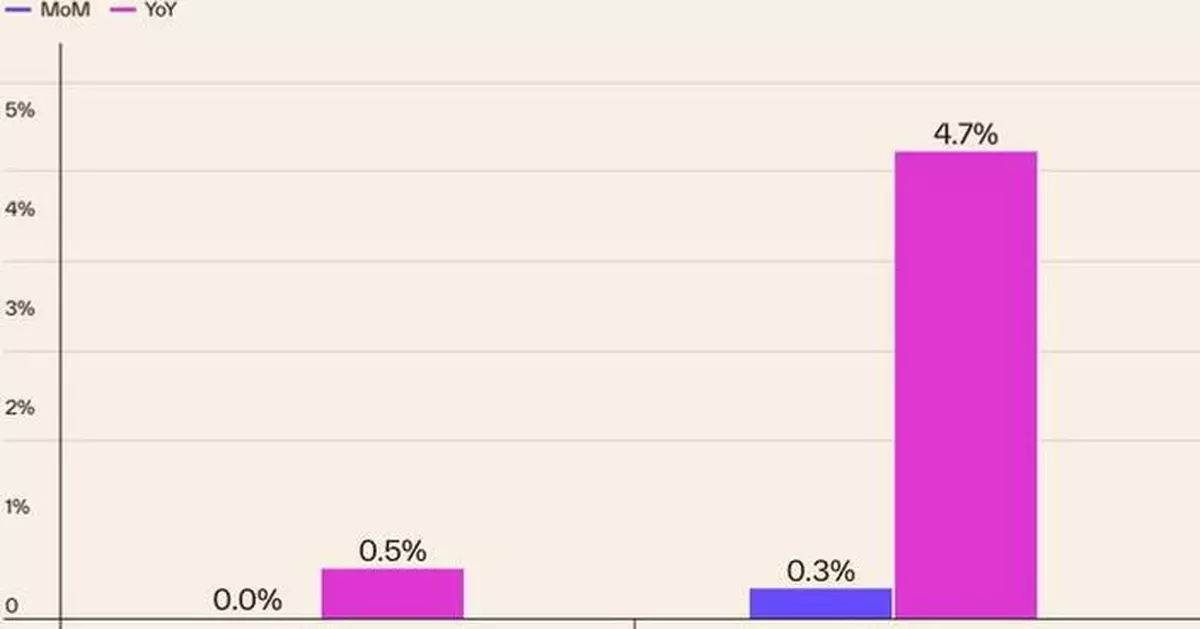
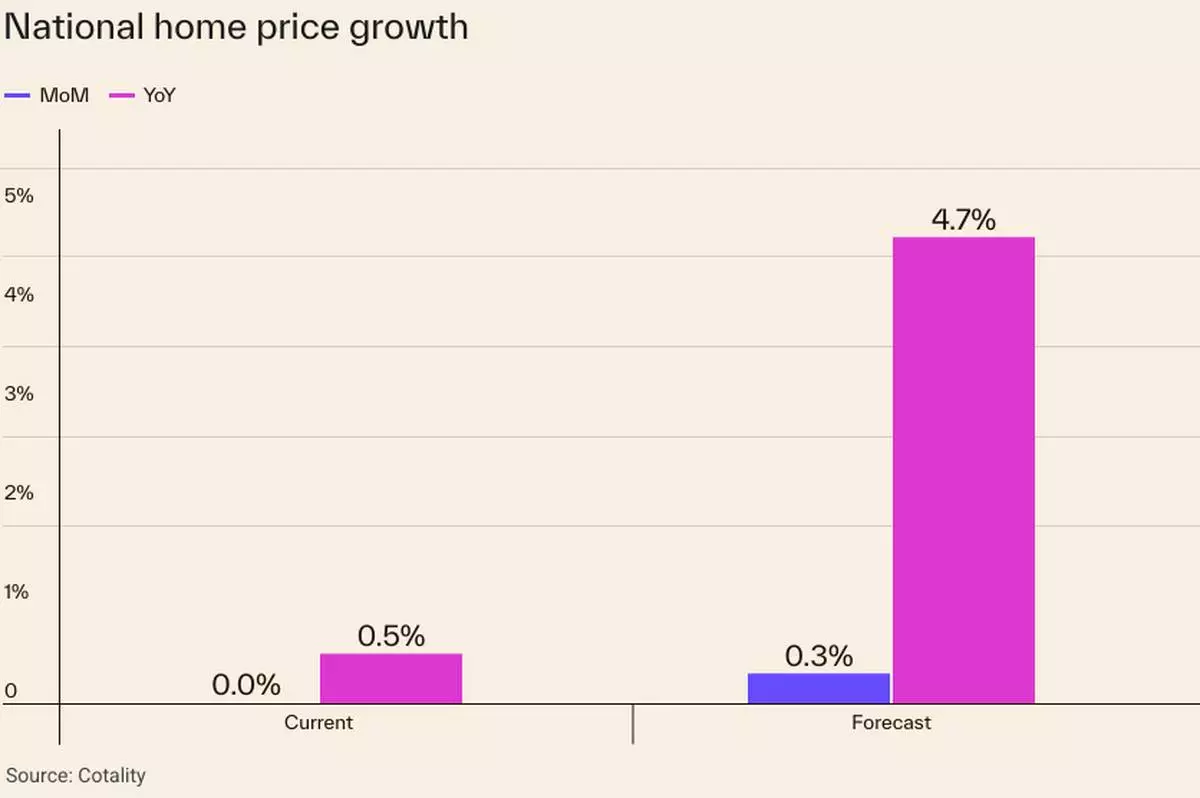
Cotality™, a leader in property information, analytics, and data‑enabled solutions, today released its Home Price Index™ with February 2026 data. Year-over-year home price growth slowed to 0.5% in February as the U.S. housing market continues to rebalance.

This press release features multimedia. View the full release here: https://www.businesswire.com/news/home/20260407344210/en/

The current market is divided, both nationally and within specific regions. The Midwest and Northeast, led by states like New Jersey (+5.93%) and Illinois (+4.83%), are showing stability, supported by relative affordability and employment in higher wage sectors, including biotech and medical research in Massachusetts and Pennsylvania, financial services and fintech in New York and New Jersey, and green infrastructure in other coastal states. In the Midwest, home price stability is supported by a resurgence of manufacturing as companies mitigate tariffs, CHIPS Act investments in states like Ohio and Michigan, and renewable energy growth in states like Iowa and Kansas. These states are also attracting businesses that are leaving the higher-cost coastal metros.

Meanwhile, slowing price growth continues in Washington, D.C. (-3.01%), Florida (-2.30%), and Montana (-1.52%), the three locations with the largest negative year-over-year changes.

“These diverse trends indicate an ongoing process of price discovery—one where sales and comparisons remain limited—and underscore a market that is rebalancing locally rather than correcting nationally,” said Cotality Chief Economist Dr. Selma Hepp. “Although the steady decrease in mortgage rates prior to the spring homebuying season raised hopes for a rebound in home prices and sales in 2026, the recent surge in rates has reduced demand in the housing market, shifting expectations for a broader recovery this year.”

Top Takeaways:

The next Cotality Home Price Index will be released on May 5, 2026, featuring data for March 2026. For ongoing housing trends and data, visit the Cotality Insights blog: www.cotality.com/insights.

Methodology

The Cotality HPI™ is built on industry-leading public record, servicing, and securities real-estate databases and incorporates more than 45 years of repeat-sales transactions for analyzing home price trends. Generally released on the first Tuesday of each month with an average five-week lag, the Cotality HPI is designed to provide an early indication of home price trends by market segment and for the Single-Family Combined tier, representing the most comprehensive set of properties, including all sales for single-family attached and single-family detached properties. The indices are fully revised with each release and employ techniques to signal turning points sooner. The Cotality HPI provides measures for multiple market segments, referred to as tiers, based on property type, price, time between sales, loan type (conforming vs. non-conforming) and distressed sales. Broad national coverage is available from the national level down to ZIP Code, including non-disclosure states.

Cotality HPI Forecasts™ are based on a two-stage, error-correction econometric model that combines the equilibrium home price—as a function of real disposable income per capita—with short-run fluctuations caused by market momentum, mean-reversion, and exogenous economic shocks like changes in the unemployment rate. With a 30-year forecast horizon, Cotality HPI Forecasts project Cotality HPI levels for two tiers — Single-Family Combined (both attached and detached) and Single-Family Combined Excluding Distressed Sales. As a companion to the Cotality HPI Forecasts, Stress-Testing Scenarios align with Comprehensive Capital Analysis and Review (CCAR) national scenarios to project five years of home prices under baseline, adverse and severely adverse scenarios at state, metropolitan areas and ZIP Code levels. The forecast accuracy represents a 95% statistical confidence interval with a +/- 2% margin of error for the index.

About Market Risk Indicators

Market Risk Indicators are a subscription-based analytics solution that provide monthly updates on the overall health of housing markets across the country. Cotality data scientists combine world-class analytics with detailed economic and housing data to help determine the likelihood of a housing bubble burst in 392 major metros and all 50 states. Market Risk Indicators is a multi-phase regression model that provides a probability score (from 1 to 100) on the likelihood of two scenarios per metro: a >10% price reduction and a ≤ 10% price reduction. The higher the score, the higher the risk of a price reduction.

About the Market Condition Indicators

As part of the Cotality HPI and HPI Forecasts offerings, Market Condition Indicators are available for all metropolitan areas and identify individual markets as overvalued, at value or undervalued. These indicators are derived from the long-term fundamental values, which are a function of real disposable income per capita. Markets are labeled as overvalued if the current home price indexes exceed their long-term values by greater than 10% and undervalued where the long-term values exceed the index levels by greater than 10%.

Source: Cotality

The data provided are for use only by the primary recipient or the primary recipient's publication or broadcast. This data may not be resold, republished or licensed to any other source, including publications and sources owned by the primary recipient's parent company without prior written permission from Cotality. Any Cotality data used for publication or broadcast, in whole or in part, must be sourced as coming from Cotality, a data and analytics company. For use with broadcast or web content, the citation must directly accompany first reference of the data. If the data are illustrated with maps, charts, graphs, or other visual elements, the Cotality logo must be included on screen or website. For questions, analysis or interpretation of the data, contact Charity Head at newsmedia@Cotality.com. Data provided may not be modified without the prior written permission of Cotality. Do not use the data in any unlawful manner. The data are compiled from public records, contributory databases and proprietary analytics, and its accuracy is dependent upon these sources.

About Cotality

Cotality accelerates data, insights, and workflows across the property ecosystem to enable industry professionals to surpass their ambitions and impact society. With billions of real-time data signals across the life cycle of a property, we unearth hidden risks and transformative opportunities for agents, lenders, carriers, and innovators. Get to know us at www.cotality.com.
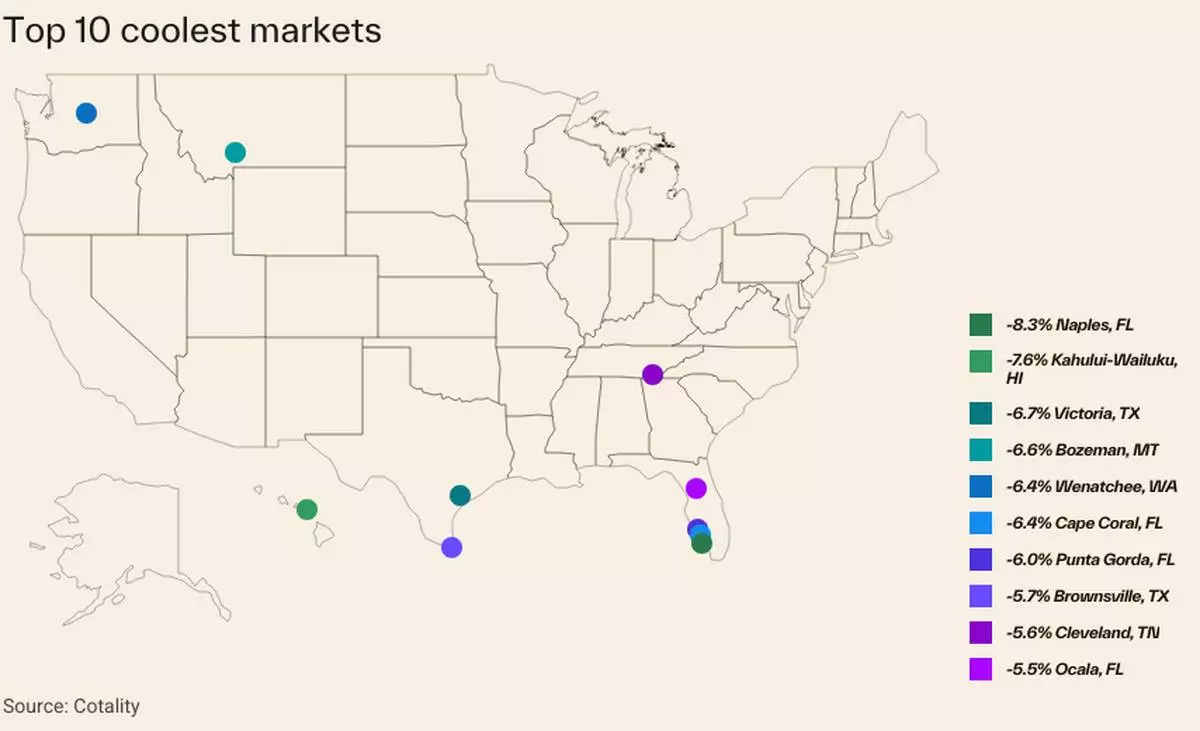
The coolest U.S. housing markets in February 2026 according to Cotality's Home Price Index.
The coolest U.S. housing markets in February 2026 according to Cotality's Home Price Index.

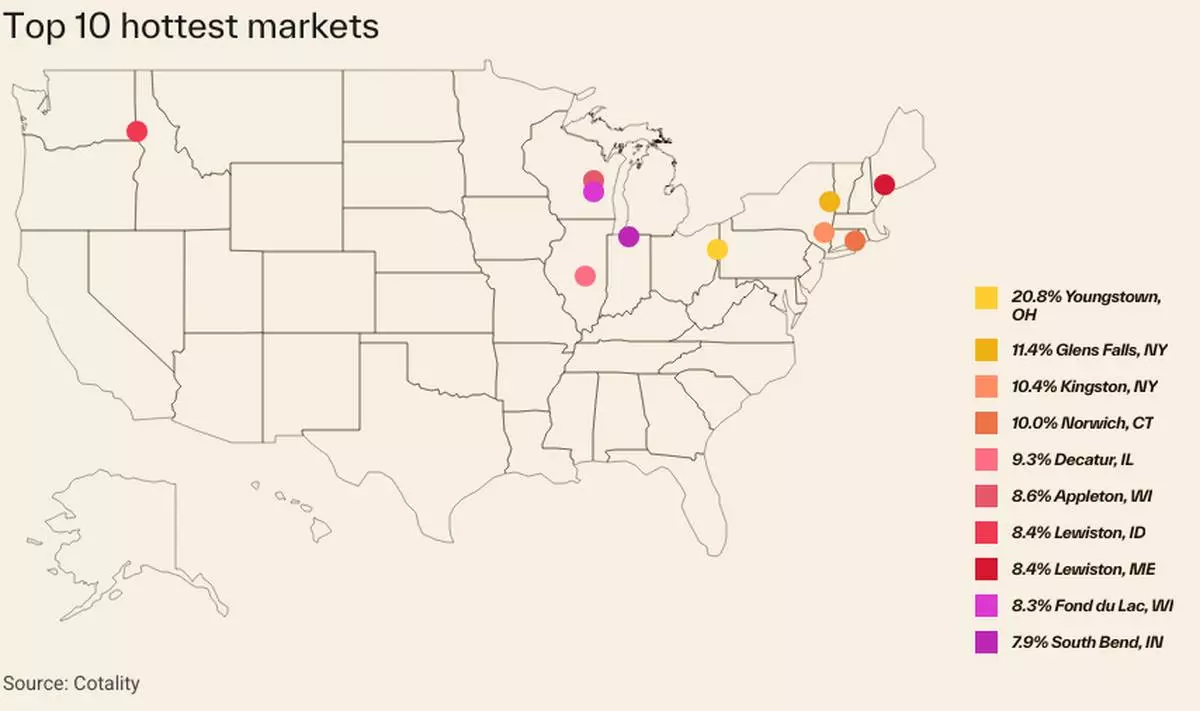
The hottest U.S. housing markets in February 2026 according to Cotality's Home Price Index.
The hottest U.S. housing markets in February 2026 according to Cotality's Home Price Index.

Cotality's National Home Price Index for February 2026 and the forecasted year-over-year growth in 2027.


Cotality's National Home Price Index for February 2026 and the forecasted year-over-year growth in 2027.

NEW YORK (AP) — Oil prices are rising, and U.S. stocks are falling Tuesday as the countdown ticks toward the latest deadline set by President Donald Trump to destroy Iranian power plants and bridges.

The S&P 500 fell 0.8% as Trump threatened that a “whole civilization will die tonight, never to be brought back again” if Iran does not meet his deadline at 8 p.m. Eastern time to open the Strait of Hormuz. Iranian officials, meanwhile, urged young people to form human chains to protect power plants that Trump has threatened to bomb.

The Dow Jones Industrial Average was down 355 points, or 0.8%, as of 11:30 a.m. Eastern time, and the Nasdaq composite was 1.2% lower.

The moves were tentative, much like they've been since the start of the war with Iran, because of deep uncertainty about when the fighting may end. During just the first hour of Tuesday's trading, the Dow careened between a gain of 74 points and a loss of 425.

The moves were sharper in the oil market, where prices have spiked because the war has snarled the production and transportation of crude in the Persian Gulf. Much of that oil exits the gulf through the Strait of Hormuz to reach customers around the world, but Iran has blocked it to enemies.

The price for a barrel of benchmark U.S. crude climbed 3.2% to $116.08. Brent crude, the international standard, added 0.9% to $110.75 and is well above its roughly $70 level from before the war in late February.

The worry in markets has been that a long-term disruption will keep oil prices high for a long time and send a painful wave of inflation crashing through the global economy. Iran on Monday rejected the latest ceasefire proposal and instead said it wants a permanent end to the war.

So far in the war, Trump has made a series of threats to blow up Iranian power plants if it doesn’t open the Strait of Hormuz, only to delay it several times. The possibility remains that Trump could back down again, among other scenarios, which is keeping uncertainty high.

A year ago, Trump ultimately backed off many of the stiff tariffs that he initially threatened to put on imports from other countries, though they ended up higher than from before his second term.

“Investors are likely to remain on edge and markets unable to establish trends, probably until there is a clear outcome later this evening: a deal, the U.S./Israeli strikes intensify, or Iran’s retaliation becomes escalatory instead of proportional,” according to Paul Christopher, head of global investment strategy at Wells Fargo Investment Institute.

On Wall Street, companies with big fuel bills fell to some of the sharpest losses as further gains in oil prices cranked up the pressure.

Norwegian Cruise Line Holding dropped 5%, and United Airlines sank 3.9%.

Companies whose customers may have the least room to absorb the recent jump in gasoline prices also struggled. Dollar Tree slid 4.9%, and Dollar General fell 2.7%.

The average price for a gallon of regular gasoline across the United States has leaped to $4.14, according to AAA. It was below $3 a couple days before the United States and Israel launched attacks to begin the war in late February.

Companies enmeshed in the cryptocurrency industry were also losers as the price of bitcoin sank. Coinbase Global dropped 4%, and Strategy fell 4.4%.

Stocks of health insurers helped limit the market’s losses after the Centers for Medicare & Medicaid Services said Medicare Advantage payments will likely see a net average increase of 2.48% in 2027. That was well ahead of what some investors expected, according to UBS analysts led by AJ Rice.

UnitedHealth Group jumped 8.7%, and Humana rose 6.2%.

Universal Music Group also helped to limit losses for global stock indexes after Bill Ackman’s Pershing Square Capital Management offered to buy the record label behind Taylor Swift and Bad Bunny in a cash-and-stock deal valued at approximately $64 billion.

The proposed purchase, which Pershing Square argued would clear uncertainty that’s weighed on UMG’s stock, would bring the company to Nevada and move its stock listing from Amsterdam to the New York Stock Exchange. UMG’s stock in Amsterdam jumped 12.3% but remains below what Pershing said its bid is worth. That could indicate investor doubt that the deal will happen.

In stock markets abroad, indexes fell across much of Europe. Asian stock indexes were stronger, with South Korea’s Kospi up 0.8% for one of the world’s bigger gains.

In the bond market, Treasury yields ticked higher ahead of Trump’s looming deadline. The yield on the 10-year Treasury rose to 4.36% from 4.34% late Monday, egged on in part by the rise in oil prices.

That's well above its 3.97% level from before the war, and the rise has pushed up rates for mortgages and other loans going to U.S. households and businesses, which slows the economy.

AP Business Writers Yuri Kageyama and Matt Ott contributed.

John Mauro works on the floor at the New York Stock Exchange in New York, Tuesday, April 7, 2026. (AP Photo/Seth Wenig)

John Mauro works on the floor at the New York Stock Exchange in New York, Tuesday, April 7, 2026. (AP Photo/Seth Wenig)

Ed Curran works on the floor at the New York Stock Exchange in New York, Tuesday, April 7, 2026. (AP Photo/Seth Wenig)

Ed Curran works on the floor at the New York Stock Exchange in New York, Tuesday, April 7, 2026. (AP Photo/Seth Wenig)

People work on the floor at the New York Stock Exchange in New York, Tuesday, March 31, 2026. (AP Photo/Seth Wenig)

People work on the floor at the New York Stock Exchange in New York, Tuesday, March 31, 2026. (AP Photo/Seth Wenig)

A general view shows the New York Stock Exchange, Friday, March 27, 2026, in New York. (AP Photo/Yuki Iwamura)

A general view shows the New York Stock Exchange, Friday, March 27, 2026, in New York. (AP Photo/Yuki Iwamura)

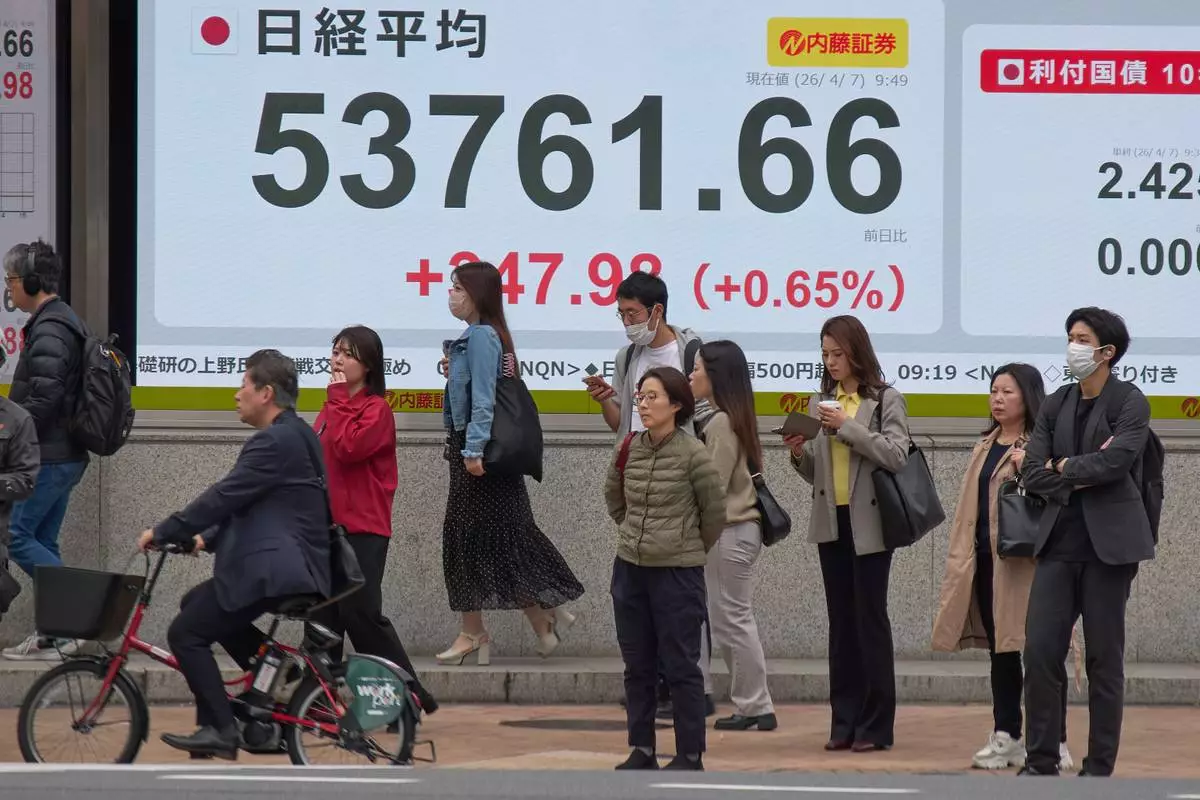
People stand in front of an electronic stock board showing Japan's Nikkei index at a securities firm Tuesday, April 7, 2026, in Tokyo. (AP Photo/Eugene Hoshiko)

People stand in front of an electronic stock board showing Japan's Nikkei index at a securities firm Tuesday, April 7, 2026, in Tokyo. (AP Photo/Eugene Hoshiko)

A person walks in front of an electronic stock board showing Japan's Nikkei index at a securities firm Tuesday, April 7, 2026, in Tokyo. (AP Photo/Eugene Hoshiko)

A person walks in front of an electronic stock board showing Japan's Nikkei index at a securities firm Tuesday, April 7, 2026, in Tokyo. (AP Photo/Eugene Hoshiko)

A person walks in front of an electronic stock board showing Japan's Nikkei index at a securities firm Tuesday, April 7, 2026, in Tokyo. (AP Photo/Eugene Hoshiko)

A person walks in front of an electronic stock board showing Japan's Nikkei index at a securities firm Tuesday, April 7, 2026, in Tokyo. (AP Photo/Eugene Hoshiko)

Recommended Articles