Skip to Content Facebook Feature Image

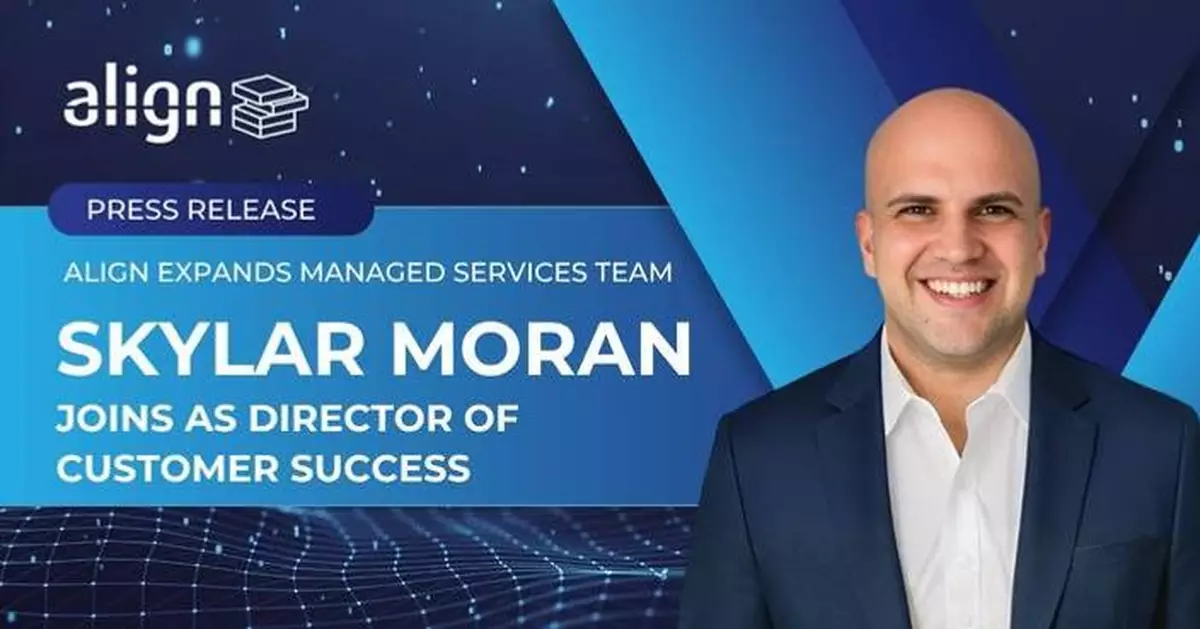
Align Expands Award-Winning Managed Services Practice with Appointment of Director of Customer Success

News

Align Expands Award-Winning Managed Services Practice with Appointment of Director of Customer Success
News

News

Align Expands Award-Winning Managed Services Practice with Appointment of Director of Customer Success

2026-04-08 00:48 Last Updated At:01:00

NEW YORK--(BUSINESS WIRE)--Apr 7, 2026--

Align, the premier global provider of technology infrastructure solutions and Managed IT Services, today announced the appointment of Skylar Moran as Director of Customer Success to lead client relationships across its growing Managed Services practice.

This press release features multimedia. View the full release here: https://www.businesswire.com/news/home/20260407473843/en/

As demand for managed services continues to accelerate across the financial sector, Align's practice has emerged as one of the industry's most recognized and fastest-growing offerings. Built on a foundation of proactive support, deep security expertise, and white-glove client engagement, the practice has earned the trust of some of the most demanding organizations in the alternative investment space. Skylar's appointment reflects Align's commitment to investing in the leadership talent needed to sustain that momentum and continue raising the bar for service excellence.

"Our Managed Services practice is built on the belief that great technology outcomes start with great client relationships. Skylar's deep background in customer success, cybersecurity-focused service delivery, and scaling high-performing teams makes him an exceptional addition to our leadership. He brings exactly the expertise our clients need as they navigate a rapidly evolving technology environment." — Vinod Paul, President of Align Managed Services

“Skylar is a natural fit for the team and the culture we've built. Our clients are sophisticated and fast-moving. They expect a partner who matches that energy at every level! Skylar brings the strategic perspective and client-first mindset that will help us continue delivering the exceptional service Align is known for.” — Chris Zadrima, Chief Operating Officer

Skylar brings over 10 years of experience spanning customer success, sales, SaaS strategy, and cybersecurity-focused service delivery. Most recently, he served as Senior Director of Customer Experience at Adlumin (acquired by N-able in 2024), where he built and scaled a 30+ person Customer Experience organization from the ground up. During Adlumin's $240M acquisition, Skylar played a key leadership role in guiding customer experience strategy and integration.

"Joining Align at this moment is incredibly exciting. The alternative investment sector demands a level of precision and strategic partnership that goes beyond traditional managed services. I'm looking forward to working alongside a talented team to deepen client relationships and ensure that every organization we support has the technology foundation and they need to operate with confidence." — Skylar Moran, Director of Customer Success, Align Managed Services

In his role as Director of Customer Success, Skylar leads Customer Relationship Management across Align's client base, driving retention, expansion, and lifecycle strategy. Skylar partners closely with sales on strategic account planning and executive engagement, bringing a proactive, high-touch approach to every client relationship. For emerging managers, that means efficient scaling support; for established firms, greater visibility into risk, infrastructure, and long-term growth.

About Align

Align is a premier global provider of technology infrastructure solutions. For over 37 years, leading firms worldwide have relied on Align to guide them through IT challenges, delivering complete, secure solutions for business change and growth. Align is headquartered in Dallas, Texas and has offices in New York City, London, Virginia, Arizona, New Jersey, Chicago, San Francisco, Salt Lake City & Portland. Learn more at www.align.com.
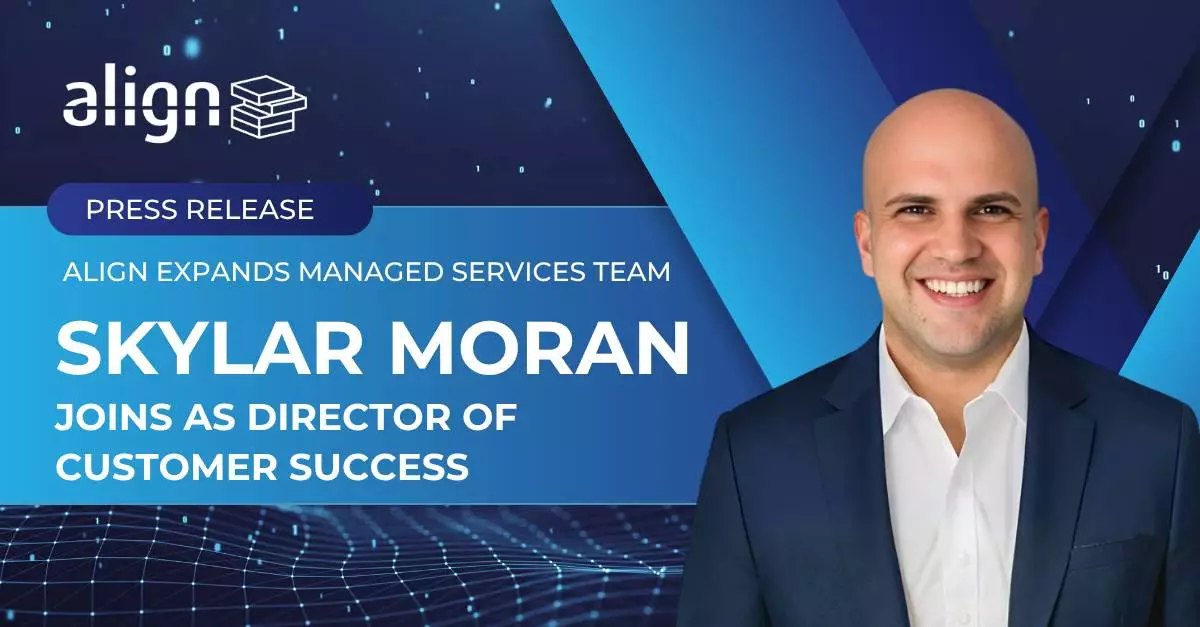
Align’s Growing Managed Services Practice Welcomes Skylar Moran as Director of Customer Success


Align’s Growing Managed Services Practice Welcomes Skylar Moran as Director of Customer Success

NEW YORK (AP) — The racial reckoning that followed George Floyd 's murder in 2020 carried hopes of new support for disproportionately underfunded, Black-led nonprofits. American companies stepped up donations to historically Black colleges and universities. Major climate funders pledged to give more toward minority groups. Large donors sought to narrow the racial wealth gap.

But new research released Tuesday shows that such financial gains for many Black-led nonprofits were short-lived, if they happened at all. A subset of large, Black-led nonprofits saw only temporary funding increases between 2020 and 2022, according to the analysis by nonprofit research service Candid and Black philanthropy group ABFE. Smaller organizations saw no significant change.

The pattern of disinvestment put many community groups at a greater disadvantage when President Donald Trump’s policies curtailed funding for diversity, equity and inclusion. The nonprofit sector's struggles deepened as the administration threatened a range of social service programs, left future grants uncertain by cutting agency staff and chilled racial justice funding through anti-DEI executive orders.

Black Voters Matter co-founder Cliff Albright noted these community nonprofits are the same ones now tasked with helping more and more low-income families deal with spiking healthcare costs and rising food prices.

“We're literally being asked to do more with less resources,” Albright told The Associated Press.

Small, Black-led nonprofits tended to have to rely on new rather than continuing funders, losing out on transformational relationships that sustain their longer-term goals and cushion them through challenging periods. These small organizations — those with annual expenses of $1 million or less — got just over one-third of their funding from continuing supporters, according to the report.

The dynamic rang true for a South Side Chicago group serving a predominantly Black neighborhood among the city's most impoverished. Asiaha Butler, the CEO of the Resident Association of Greater Englewood, cofounded the nonprofit more than 15 years ago to empower her neighbors to combat their area's negative narratives.

That mission had a handful of consistent backers. But summer 2020 brought more than two dozen new funders.

“All of a sudden, we were desirable for people to fund,” recalled Butler, adding the “spurt” became a “curse” as the quick infusion of capital tapered off.

“We started seeing this revenue and thinking we're gaining really great relationships with funders," she said. "And, really, those priorities shifted quickly.”

Foundations lacked relationships with Black organizations of any scale prior to 2020, according to ABFE CEO Susan Taylor Batten.

Black philanthropy professionals say that distance created a scramble when protestors demanded businesses and philanthropies address systemic racism.

Kia Croom, whose fundraising firm works with nonprofits in Black communities, said her clients received more funding than ever from corporations. Some hired additional development staff to meet the demand — and then underwent layoffs when funds disappeared.

“It was just a very transactional gift at best,” she said.

Positive Results Center CEO Kandee Lewis oversees a Los Angeles nonprofit assisting survivors of domestic violence and other harms. It was wonderful, she said, to receive checks from new supporters. But oftentimes, the support turned out to be a one-time donation rather than the beginning of a relationship.

Lewis felt the funding came only because her group was Black-led — not because funders understood its work.

"They were so busy trying to figure out who was who that they didn’t really take time to get to know people," she said.

Jaleesa Hall knows philanthropy is a relationship game.

She heads Raising A Village Foundation, which aims to advance educational equity through tutoring programs. She didn't have many high net worth members in her network when she founded the Washington, D.C. nonprofit more than six years ago.

That circle made it difficult to catch the attention of foundations, which she said “haven't really cracked” how to find potential grantees outside of their existing web of connections.

“Small, Black-led nonprofits simply aren't in those rooms to begin with," Hall said.

Most of their foundation grant dollars came from first-time funders, according to the report.

Cathleen Clerkin, the associate vice president of research at Candid, said the nonprofits' work is made even more challenging by the “song and dance” necessary to secure long-term investment every year.

“They're just constantly going on first dates with new funders and hoping that somebody will invest in them and understand them,” she said.

Small nonprofit leaders are so focused on day-to-day upkeep and financial viability that they don't have time to attend networking opportunities or money to fly out for national convenings.

T’Pring Westbrook, a nonresident fellow at the Urban Institute's Center on Nonprofits and Philanthropy, co-founded a consulting group that works with small nonprofits. The problem isn't that foundations don't want to support marginalized communities, she said, but that they do so through “trend funding.”

“Maybe during Black History Month there will be a funding campaign,” she said. “But the thing about a campaign is a campaign doesn't build sustainability.”

Small nonprofits say they face additional barriers, regardless of race, including grant eligibility requirements. And limited staff may prevent qualifying organizations from keeping up with foundations' required weekly or monthly reports on the status of projects they’ve funded.

“It ends up feeling like a burden,” Hall explained. “The juice isn't worth the squeeze."

Philanthropy has seen a sector-wide shift towards trust-based models that offer general operating support and multi-year grants, acknowledging nonprofits' expertise on how to best fulfill their missions. But Batten, the ABFE leader, said Black-led nonprofits generally have not reaped the benefits of those best practices.

The report showed Black-led nonprofits had significantly fewer continuing funders than their non-Black counterparts. Only one-third received general operating support, compared to just over half of other nonprofits.

“We are still seeing remnants of bad practice when it comes to investing in Black communities," Batten said. "There’s just no way for a foundation to move its mission for communities in this country, let alone Black nonprofits to move theirs, if we do not evolve this sector."

Butler, the Chicago neighborhood association leader, hears excuses now from supporters who gave at the height of the 2020 racial justice movement: “Priorities have shifted,” they tell her, or there are “new strategic goals."

“Little buzz words that just say perhaps this nonprofit -- grassroots, Black-led, very focused on the Black population -- is probably just not in peoples’ cards to continue to support,” she said.

That downturn delayed a nearly $7 million capital project building off their economic justice work after the post-George Floyd civil unrest. An 8,800-square-foot (817 square-meter) building would include a dine-in restaurant and another Black-owned business. One tenant would provide workforce development trainings. Her goal is to strengthen Englewood’s economic and social fabric through a thriving Black business district.

By 2023, she had secured a $1 million grant — her nonprofit's largest — to start the project. But she compared her search for additional funding to "pulling teeth.” Past philanthropic partners withheld support. Their prospects weren't good.

She's turning to public funding. The City of Chicago provided a $2.5 million grant and Butler said another $1.5 million state award is pending.

“Things shifted and so we didn’t want to start soliciting for a capital campaign,” she said. “The timing was off.”

Associated Press coverage of philanthropy and nonprofits receives support through the AP’s collaboration with The Conversation US, with funding from Lilly Endowment Inc. The AP is solely responsible for this content. For all of AP’s philanthropy coverage, visit https://apnews.com/hub/philanthropy.

Asiaha Butler, the co-founder of the Resident Association of Greater Englewood, poses for a photo outside her office in Chicago, Monday, April 6, 2026. (AP Photo/Nam Y. Huh)

Asiaha Butler, the co-founder of the Resident Association of Greater Englewood, poses for a photo outside her office in Chicago, Monday, April 6, 2026. (AP Photo/Nam Y. Huh)

Asiaha Butler, the co-founder of the Resident Association of Greater Englewood, poses for a photo outside her office in Chicago, Monday, April 6, 2026. (AP Photo/Nam Y. Huh)

Asiaha Butler, the co-founder of the Resident Association of Greater Englewood, poses for a photo outside her office in Chicago, Monday, April 6, 2026. (AP Photo/Nam Y. Huh)

Asiaha Butler, the co-founder of the Resident Association of Greater Englewood, poses for a photo outside her office in Chicago, Monday, April 6, 2026. (AP Photo/Nam Y. Huh)

Asiaha Butler, the co-founder of the Resident Association of Greater Englewood, poses for a photo outside her office in Chicago, Monday, April 6, 2026. (AP Photo/Nam Y. Huh)

Asiaha Butler, the co-founder of the Resident Association of Greater Englewood, poses for a photo outside her office in Chicago, Monday, April 6, 2026. (AP Photo/Nam Y. Huh)

Asiaha Butler, the co-founder of the Resident Association of Greater Englewood, poses for a photo outside her office in Chicago, Monday, April 6, 2026. (AP Photo/Nam Y. Huh)

Asiaha Butler, the co-founder of the Resident Association of Greater Englewood, looks to outside from her office in Chicago, Monday, April 6, 2026. (AP Photo/Nam Y. Huh)

Asiaha Butler, the co-founder of the Resident Association of Greater Englewood, looks to outside from her office in Chicago, Monday, April 6, 2026. (AP Photo/Nam Y. Huh)

Recommended Articles