SYDNEY and NEW YORK, April 8, 2026 /PRNewswire/ -- Lumonus, the company behind Lumonus AI, a platform for radiation oncology clinical workflow and automated treatment planning, today announced a collaboration with Memorial Sloan Kettering Cancer Center (MSK), one of the world's premier cancer centers and a leader in radiation therapy treatment planning research.
Through this relationship, Lumonus will license and co-develop MSK's ECHO mathematical optimization engine into the Lumonus platform and will invest in joint research focused on advancing automated radiation therapy treatment planning.
"Over the last twenty years, automated planning systems have demonstrated real clinical value — improving dosimetric quality, consistency and efficiency across multiple studies. But scaled adoption has remained elusive. The core challenge is that each plan must navigate complex, competing constraints that are specific to the individual patient, and there has been no robust way to consistently produce the optimal solution and confirm it meets the treating physician's clinical intent," said Tim Fox, Chief Product Officer at Lumonus.
"Our strategic collaboration with MSK represents a decisive step forward. The next generation of planning automation requires a mathematically principled solver capable of consistently delivering the optimal plan, working in concert with intelligent review tools that capture the nuanced clinical judgement of physicians in real-world practice. Together with MSK, we are building the infrastructure to move automation from promising results to scaled, routine deployment."
MSK's ECHO optimization engine uses constraint-based mathematical methods to compute radiation therapy treatment plans from first principles. Developed over nearly a decade of clinical use and supported by an extensive body of peer-reviewed research, ECHO represents one of the most rigorously validated approaches to automated treatment planning in radiation oncology
"Our goal in developing ECHO has always been to improve the quality, consistency, and efficiency of radiation therapy treatment planning," said Masoud Zarepisheh, PhD, Associate Attending and lead developer of ECHO at MSK. "Our collaboration with Lumonus creates an important opportunity to combine clinically validated optimization methods with modern workflow tools and help expand the adoption of automated treatment planning in radiation oncology."
About Lumonus
Lumonus is a healthcare technology company building Lumonus AI for radiation oncology. Built in partnership with leading cancer centers, the Lumonus AI platform is transforming cancer care through AI-native clinical workflows. The platform automates and orchestrates critical oncology tasks to improve quality, accelerate delivery and reduce administrative burden. Lumonus operates across the United States, Australia and Europe.
** This press release is distributed by PR Newswire through automated distribution system, for which the client assumes full responsibility. **

Lumonus launches strategic collaboration with leading global cancer center to advance radiation therapy treatment planning
- Consolidated revenues for the first nine months of 2026 reached AED 57.6 billion, an increase of 10.0 per cent YoY
- Consolidated net profit for the first nine months of 2026 reached AED 17.2 billion, up 45.9 per cent YoY
- Group subscriber base reached 254.8 million
- Group marks 50 years by taking the etisalat name forward into a new era of growth
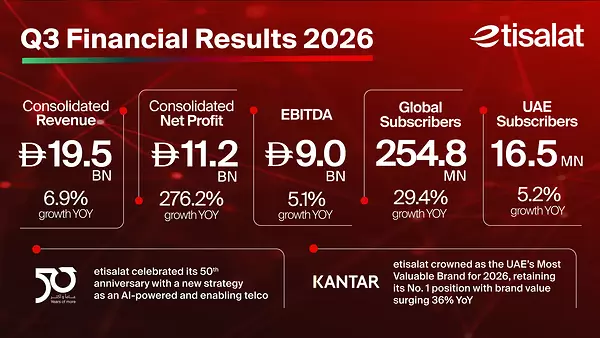
ABU DHABI, UAE, Oct. 28, 2026 /PRNewswire/ -- etisalat today announced its Q3 2026 consolidated financial results, reporting consolidated revenue of AED 19.5 billion, growing 6.9 per cent year-over-year (YoY). Consolidated revenues for the first nine months of 2026 reached AED 57.6 billion, up 10.0 per cent YoY. Consolidated net profit in Q3 reached 11.2 billion, while consolidated net profit for the first nine months of 2026 reached AED 17.2 billion, up 45.9 per cent YoY, reinforced by continued progress in building higher-value capabilities across connectivity, sovereign digital infrastructure and AI and by disciplined portfolio management.
In Q3, EBITDA rose by 5.1 per cent YoY, reaching AED 9.0 billion with a margin of 46.1 per cent. For the first nine months of 2026, EBITDA reached AED 26.7 billion, a growth of 10.3 per cent YoY, with a margin of 46.4 per cent.
etisalat's total subscriber base reached 254.8 million in Q3 2026, representing 29.4 per cent YoY growth. In the UAE, subscribers rose 5.2 per cent YoY to 16.5 million, driven by strong demand for advanced digital services and intelligent connectivity.
Financial Highlights
| | Q3 2025 | Q3 2026 | %Change | 9M 2025 | 9M 2026 | %Change |
| Consolidated Revenues | AED 18.2bn | AED 19.5bn | 6.9 % | AED 52.4bn | AED 57.6bn | 10.0 % |
| Consolidated Net Profit* | AED 3.0bn | AED 11.2bn | 276.2 % | AED 11.8bn | AED 17.2bn | 45.9 % |
| EBITDA | AED 8.5bn | AED 9.0bn | 5.1 % | AED 24.2bn | AED 26.7bn | 10.3 % |
| Earnings per Share | AED 0.34 | AED 1.29 | 276.2 % | AED 1.36 | AED 1.98 | 45.9 % |
| Total Group Subscribers | 197.0 million | 254.8 million | 29.4 % | 197.0 million | 254.8 million | 29.4 % |
| etisalat UAE Subscribers | 15.7 million | 16.5 million | 5.2 % | 15.7 million | 16.5 million | 5.2 % |
Q3 2025
Q3 2026
%Change
9M 2025
9M 2026
%Change
Consolidated Revenues
AED 18.2bn
AED 19.5bn
6.9 %
AED 52.4bn
AED 57.6bn
10.0 %
Consolidated Net Profit*
AED 3.0bn
AED 11.2bn
276.2 %
AED 11.8bn
AED 17.2bn
45.9 %
EBITDA
AED 8.5bn
AED 9.0bn
5.1 %
AED 24.2bn
AED 26.7bn
10.3 %
Earnings per Share
AED 0.34
AED 1.29
276.2 %
AED 1.36
AED 1.98
45.9 %
Total Group Subscribers
197.0 million
254.8 million
29.4 %
197.0 million
254.8 million
29.4 %
etisalat UAE Subscribers
15.7 million
16.5 million
5.2 %
15.7 million
16.5 million
5.2 %
- Net Profit adjusted for Vodafone gain in Q3 2026 is AED 3.2bn and EPS AED 0.37
- Net Profit adjusted for Vodafone gain in 9M 2026 is AED 9.2bn and EPS 1.06
The quarter also saw the completion of etisalat's sale of its entire stake in Vodafone Group, generating total consideration of AED 21.9 billion, including the final dividend and gain of approximately AED 8.0 billion. The transaction contributed to the group's financial performance during the quarter, providing additional financial flexibility.
As etisalat marks its 50th anniversary, it has set out a new vision to become a leading AI-powered and enabling telco and moved forward under the etisalat name, symbolising the central role of connectivity in the AI era. This ambition builds on the capabilities developed across digital services, cloud, cybersecurity, AI, infrastructure and fintech, bringing them into sharper focus around our strong telecommunications foundation with AI at its core.
Building on UAE's ambition to become a global hub for advanced technology and AI, etisalat plans to expand its international connectivity capacity to more than 500 terabits per second (Tbps) by 2030, an increase of over twenty-five times of the current capacity, in addition to developing diverse routes designed to enhance connectivity efficiency and reliability, delivering advanced, low-latency performance. This reiterates the importance of the digital infrastructure as a fundamental pillar for supporting emerging technologies and enabling a knowledge-based, innovation-driven economy.
Masood M. Sharif Mahmood, Group CEO of etisalat, said: "Our performance in Q3 2026 underscores the resilience of our business model and the discipline with which we are turning growth opportunities into tangible results. Consolidated revenue reached AED 19.5 billion, an increase of 6.9 per cent YoY, while EBITDA reached AED 9.0 billion, up 5.1 per cent, with an EBITDA margin of 46.1 per cent. These results reflect the strength of our core connectivity business and the discipline of our execution. Combined with our focus, these strengths underpin our confidence in our ability to excel and create long-term value to our stakeholders"
Masood added: "Over the past several years, etisalat has built an integrated portfolio of broad range of advanced capabilities across AI, cloud computing, cybersecurity, digital services, and fintech. Today, as AI is integrated more deeply into core enterprise and government operations, the foundational connectivity, compute, and secure infrastructure powering it become more critical. With the group firmly establishing itself as a key enabler, we will continue to provide the secure digital infrastructure and ultra-fast connectivity that power this wide-reaching transformation."
He continued: "This gives the etisalat brand, which means 'communications', a renewed purpose with a new and deeper meaning. Connectivity is no longer just about moving data, for us. It is about enabling the modern digital economy by building and operating the infrastructure and intelligent platforms that will define the future."
Masood concluded: "etisalat has proven its ability to create sustainable value and to translate technological progress into direct, tangible commercial and economic impact. Building on decades of strategic achievements, enduring customer relationships, strong operational efficiency and infrastructure designed for maximum readiness and reliability, we remain focused on enabling the networks of the future, anchoring the region's digital economies, and cementing the UAE's position at the heart of the global digital economy. As etisalat embarks on its next fifty years journey, we renew our commitment to build on the UAE leadership's forward-looking vision and to continue investing with full confidence to compete and lead on the global scale."
Contact
Nancy Sudheer
nsudheer@etisalat.ae
** This press release is distributed by PR Newswire through automated distribution system, for which the client assumes full responsibility. **
etisalat achieves record 9M 2026 performance as consolidated net profit rises 46% YoY to AED 17.2 billion
etisalat achieves record 9M 2026 performance as consolidated net profit rises 46% YoY to AED 17.2 billion