WARSAW, Poland (AP) — Poland is one of Europe’s most polluted countries, and a flagship national program to clean the air and curb household heating demand is losing momentum — threatening both public health and the country’s energy security as global conflicts, including the Iran war, destabilize fuel supplies.
European Union air quality standards were routinely breached in parts of Poland until the government launched a sweeping anti‑smog initiative in 2018. The program, known as “Clean Air,” offers grants to households and businesses to replace coal‑fired boilers, improve thermal insulation and cut domestic energy consumption. Coal‑based home heating is the largest source of air pollution in the country and the aim is to replace it with systems based on gas, wood pellets or electricity.
Environmentalists are now raising alarm bells that the program is puttering out, which not only slows down progress with smog but also keeps the country more dependent on volatile energy imports at a time of growing geopolitical risk.
About a million households in the country of nearly 38 million people have used the “Clean Air” program since 2018, according to Krzysztof Bolesta, Secretary of State at the Polish Ministry of Climate and Environment. Two and a half million coal-based heaters are still to be modernized.
Andrzej Guła, from NGO Polish Smog Alert, said Krakow went from 150 days of heavy smog per year to 30, exemplifying the impact of the program. “It’s still 30 days too much, but there is progress,” Gula said.
In 2024, at the peak of the scheme, more than a quarter million requests for financing were filed, but applications have rapidly decreased since.
At the end of that year, the government initiated a reform of the program to prevent misuse of funds and temporarily paused approving applications. Activists argue that the sudden interruption of the program caused a loss of trust among citizens.
During a press conference in Warsaw on March 31, environmentalists from Polish Smog Alert showed data which indicated the number of applications was five times lower in 2025 compared with the peak of the program. The slump was continuing into 2026.
The environmentalists said they worried progress on air pollution and reducing domestic energy consumption in Poland had reached a plateau.
Bolesta, representing the government, said the reform was needed to ensure only worthy projects receive financing and avoid wasting public funds.
“Poland has a unique situation in the European Union, as only Poland has such a high share of coal in individual heating,” Bolesta explains, stressing the government’s commitment to improving air quality. “However, I have no illusions: this will be very difficult and we will continue to lag behind other countries in the EU.”
But Piotr Siergiej, another environmentalist from the Polish Smog Alert, said the energy crisis caused by the Iran war should serve as a wake-up call to the Polish government about the urgency of fixing this program.
Lowering energy consumption builds energy security in Poland, Siergiej argued, because it reduces dependency on imported gas, coal and pellets (a more eco-friendly solid fuel produced from compressed wood waste).
“This program can become an epochal chance to energetically transform our buildings and homes, to make us more independent from those energy crises which we are facing now and whose future we can’t predict,” he said.
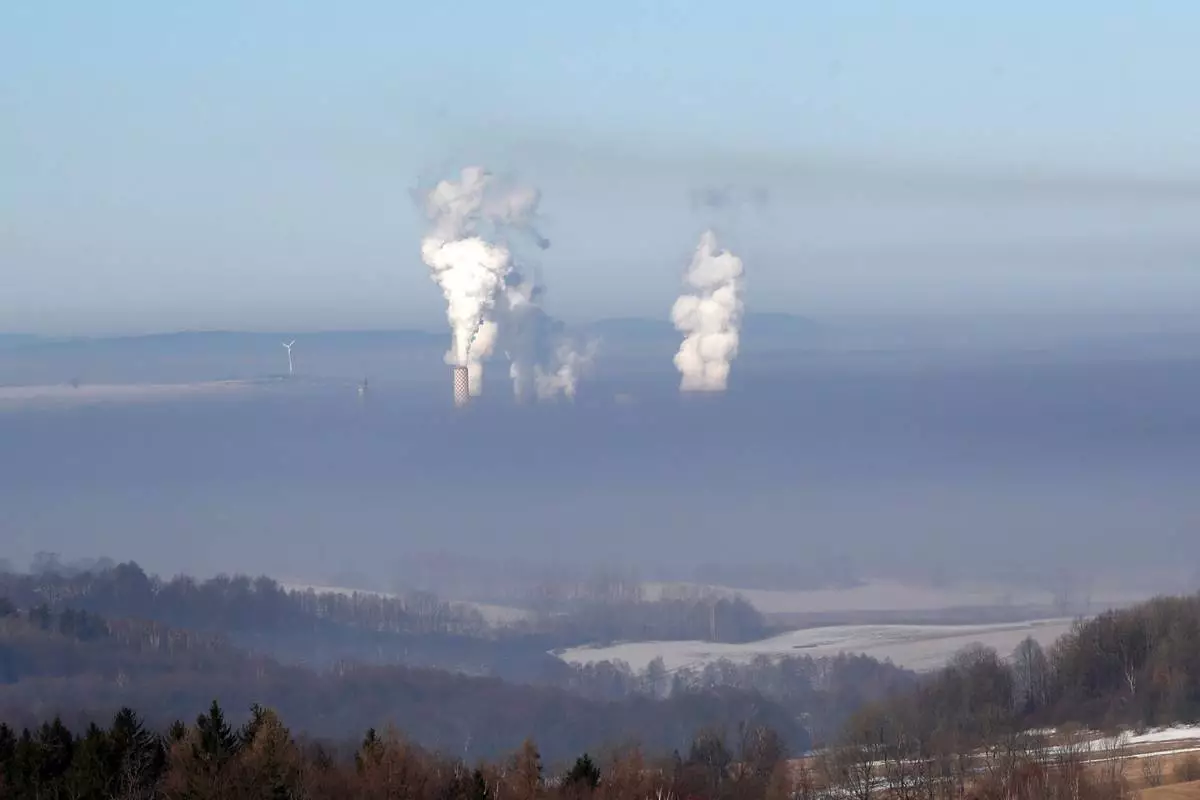
FILE - Smoke rises from chimneys of the coal-fired power plant in Bogatynia, Poland. The picture was taken from a hill near the town of Frydlant, Czech Republic, Tuesday, Feb. 14, 2017. (AP Photo/Petr David Josek, File)
Iran, the United States and Israel agreed to a two-week ceasefire on Tuesday, an 11th-hour deal that headed off U.S. President Donald Trump’s threat to unleash a bombing campaign that would destroy Iranian civilization. Hours after the announcement, Iran and Gulf Arab countries reported new attacks Wednesday, though it was not clear if the strikes would scuttle the deal.
All sides have presented vastly different versions of the terms. Iran said the deal would allow it to formalize its new practice of charging ships passing through the Strait of Hormuz. Trump said the U.S. would work with Iran to remove buried enriched uranium, though Iran did not confirm that.
Pakistan and others said fighting would pause in Lebanon, which Israel has invaded to fight Iran-backed Hezbollah militant group, but Israeli Prime Minister Benjamin Netanyahu said early Wednesday that the deal doesn’t cover fighting against Hezbollah. Israeli strikes hit several dense commercial and residential areas in central Beirut Wednesday afternoon without warning, killing dozens and wounding hundreds of people.
The ceasefire may formalize a system of charging fees in the Strait of Hormuz that Iran instituted — and give it a new source of revenue. Iranian attacks and threats deterred many commercial ships from passing through the waterway, through which 20% of all traded oil and natural gas passes in peacetime.
Here is the latest:
The president earlier this month said that he was considering withdrawing the U.S. from NATO as he grumbled about the lack of support from members of the alliance in his war of choice against Iran.
The criticism from Trump follows years of complaining that the alliance’s member countries aren’t paying enough for their own defense. Trump is set to host Secretary-General Mark Rutte for talks at the White House later this afternoon.
“It’s something the president has discussed, and I think it’s something the president will be discussing in a couple of hours with Secretary General Rutte,” said Leavitt, when asked if Trump is still considering leaving the 32-member alliance.
The United States demanded Wednesday that Iran immediately reopen the Strait of Hormuz after the Islamic Republic closed the waterway in response to Israeli attacks against the Hezbollah militant group in Lebanon. Iran’s move cast doubt over whether an already precarious ceasefire to end more than a month of war would hold.
The United States and Iran both claimed victory after reaching the agreement, and world leaders expressed relief, even as more drones and missiles hit Iran and Gulf Arab countries. Israel also intensified its attacks in Lebanon, hitting several commercial and residential areas in Beirut without warning. At least 112 people were killed and hundreds were wounded in one of the deadliest days in the latest Israel-Hezbollah war.
The fresh violence threatened to scuttle what U.S. Vice President JD Vance called a “fragile” deal.
Asked about Trump’s threat to annihilate Iranian civilization, Press Secretary Karoline Leavitt defended it as a “very strong threat that led to results.”
“I think it was a very, very strong threat from the president of the United States that led the Iranian regime to cave to their knees and ask for a ceasefire and agree to reopening the Strait of Hormuz,” Leavitt said at a press briefing on Wednesday.
She said any suggestion that Iran had the moral high ground was “insulting.”
Before a ceasefire was announced, Trump had threatened destruction in Iran if it did not reopen the strait, saying “a whole civilization will die tonight, never to be brought back again.”
Leavitt was asked about NATO allies offering to contribute to keeping the strait open, but said the alliance hasn’t done enough to support U.S. and Israel’s war in Iran.
“They were tested and they failed,” Levitt said, reading from a past Trump quote on NATO.
She added: “NATO turned their backs on the American people over the course of the last six weeks.”
Those comments came as Trump was meeting with NATO Secretary-General Mark Rutte at the White House later Wednesday.
Israel’s main airport will resume full operations as of midnight on Wednesday, after the Iran war stranded tens of thousands of people, including both Israelis abroad and tourists inside Israel.
Israel’s airspace has been open but severely limited during the war, limiting flights to once an hour and just 50 people per flight. Israel joins several other countries in the region in reopening its airspace as the ceasefire with Iran appeared to hold.
“His very tough rhetoric and his tough negotiating style is what has led to the result that you are all witnessing today,” said White House press secretary Karoline Leavitt, adding that Iran said they wanted a ceasefire because “they no longer could tolerate being bombed.”
Trump’s threats against Iran escalated over the past weeks, culminating in his Tuesday warning that a “whole civilization” could “die” in the lead up to an 8 p.m. deadline, which was later suspended after an agreement was reached.
“The world should take his word very seriously,” Leavitt said.
The White House confirmed that U.S. Vice President JD Vance will lead the U.S. negotiating team in talks with Iran aimed at finding a permanent end to war.
Vance will lead the delegation, which is also expected to include special envoy Steve Witkoff and Trump’s son-in-law Jared Kushner, for the talks that are expected to begin Friday in Islamabad, according to White House press secretary Karoline Leavitt.
“Vice President Vance has played a very significant and a key role in this since the very beginning,” Leavitt told reporters during a White House press briefing. “Of course, he’s the president’s right hand man. He is the vice president of the United States. He’s been involved in all of these discussions.”
Bahrain said it is reopening its airspace, the state news agency reported Wednesday evening, citing the country’s civil aviation authority.
Bahrain International Airport has begun gradually resuming flights, the agency said.
“We are ready to return to fighting at any time, our finger is on the trigger,” Netanyahu said in his first address to the country since the start of the ceasefire.
“Iran is weaker than ever, and Israel is stronger than it has ever been,” adding that the “deep friendship with the US has changed the face of the Middle East.”
He said the two wars with Iran in the past year have kept Iran from developing a nuclear weapon program and destroyed both existing missiles as well as Iran’s ability to produce missiles.
Netanyahu said he insisted any ceasefire with Iran not include Hezbollah, and cited Israel’s massive strikes across Lebanon on Wednesday for being the biggest attacks against the militant group since the beeper operation in 2024, when Israel engineered exploding pagers that injured hundreds of Hezbollah leaders.
White House press secretary Karoline Leavitt said that “the Iranians originally put forward a 10-point plan that was fundamentally unserious, unacceptable and completely discarded,” and that it was “literally thrown in the garbage by Trump.”
But, she said, Iranian authorities on Tuesday presented a new plan that will become a workable basis for negotiations to bring the Iran war to an end.
Leavitt said the new version of the Iranian plan can now “align with our own, 15-point proposal” for peace.
Iran closed the Strait of Hormuz again Wednesday in response to Israeli attacks against the Hezbollah militant group in Lebanon, casting doubt over whether an already precarious ceasefire to end more than a month of war will hold.
The United States and Iran both claimed victory after reaching the agreement, and world leaders expressed relief, even as more drones and missiles hit Iran and Gulf Arab countries. Israel also intensified its attacks in Lebanon, hitting several commercial and residential areas in Beirut without warning. At least 112 people were killed and hundreds were wounded in one of the deadliest days in the latest Israel-Hezbollah war.
The fresh violence threatened to scuttle what U.S. Vice President JD Vance called a “fragile” deal.
▶ Read more
Abbas Araghchi said in message to the United States that Israel’s war against Hezbollah in Lebanon must end as part of ceasefire agreement
Araghchi called insists it is part of the ceasefire agreement with the United States, contrary to what Israel has said.
“The world sees the massacres in Lebanon,” he said in a post on X, formerly Twitter. “The ball is in the U.S. court, and the world is watching whether it will act on its commitments.”
Israel’s military announced an easing of the guidelines for civilians, including a resumption of school in most of the country starting Thursday.
It will be the first time in more than a month that schools resume in most of Israel. Large gatherings are still limited in northern Israel and areas under threat from Hezbollah.
The United Nations urges all sides to abide by the two-week ceasefire announced by the United States and Iran and halt military action in Lebanon, U.N. deputy spokesman Farhan Haq told reporters Wednesday.
“Now is the time to pursue talks to resolve outstanding differences and work towards a permanent ceasefire and a long-term solution to the conflict,” he said. “There is no military solution to the conflict.”
Haq said U.N. peacekeepers in southern Lebanon near the border with Israel continue to be impacted by the fighting.
He noted an exchange of rocket and artillery fire near Al Tiri on Tuesday that injured six peacekeepers, damaged U.N. vehicles and left five soldiers with “acoustic trauma” to their hearing.
Netanyahu said Israel has achieved “tremendous results.”
“Iran is weaker than ever. Israel is stronger than ever,” Netanyahu said said. He said Israel struck Iran’s missile program and nuclear targets and set back Iran by many years.
The address comes at a time of public criticism over the inconclusive results of the war.
“Many shipowners will remain extremely cautious, fearing a sudden resumption of hostilities,” Alex Kuptsikevich, chief market analyst at FxPro, said in a Wednesday note.
He stressed that future escalation cannot be ruled out, “given the significant differences in the parties’ positions.” It could take months for the Strait of Hormuz to resume operations at full capacity, he said, which will continue to keep oil prices high.
Karin Ström, vice president of logistics and supply chain work at Proxima, reiterated that the “fragile political landscape has the potential to change within a matter of hours” and that many vessels may not choose to return immediately, as they seek “greater reassurances about the safety of their cargo and crews.”
Iranians who have been hoping for the Islamic Republic’s overthrow are expressing mixed feelings about the ceasefire, say several Tehran area residents contacted by The Associated Press, who spoke anonymously for their security.
Security forces shot thousands of anti-government protesters in January, prompting Trump’s initial promise to “help” Iranians.
A social media influencer in her forties said she felt “rage, despair” following the ceasefire. “This means that the blood of all those who were killed for freedom will be trampled on,” she said.
Iran’s spiraling economic problems have stoked growing calls for political change. “Everyone is still dissatisfied and prices are rising rapidly, and everyone knows this is because of the Islamic Republic,” said a resident of Karaj, just outside the capital.
—- Amir Hussein-Radjy
Pakistan’s Prime Minister Shehbaz Sharif said Wednesday he received a “warm and most cordial” phone call from Turkish President Recep Tayyip Erdogan, who praised Pakistan’s efforts aimed at ending the conflict in the region.
According to a statement from Sharif’s office, the two sides agreed to continue to work in pursuit of lasting peace in the region.
Sharif did not provide further details.
Turkey is among the regional countries that have played a role in securing a ceasefire between the United States and Iran and other parties.
The latest count for Wednesday includes widespread strikes across central Beirut that came without warning, also wounding at least 837, one of the deadliest days in this latest war between Israel and the Hezbollah militant group. It is not the final count.
More than 1,500 people have been killed in Lebanon during the past month, and over 1 million others have been displaced.
Hezbollah in a statement condemned Israel’s widespread attacks across the country, including neighborhoods in central Beirut without warning, and said it reserved its “natural and legal right to resist occupation and respond to its attacks.”
The militant group did not claim any attacks on Israel Wednesday after the U.S.-Iran ceasefire went into effect.
The semi-official Tasnim news agency, which is believed to be close to Iran’s paramilitary Revolutionary Guard, reported on the potential ceasefire pullout by Tehran, citing what it described as an informed source.
The source said Iran is reviewing the possibility of exiting the ceasefire framework, noting that a halt to fighting on all fronts — including against Lebanon’s “Islamic resistance” — had been accepted by the United States as part of a two-week truce proposal. The source added that, alongside this review, Iran’s armed forces are identifying targets in response to what were described as Israeli attacks on Lebanon earlier Wednesday.
Since this morning, Israel has carried out what the source described as “clear violations of the ceasefire” with attacks on Lebanon.
The source also said that if the United States is unable to restrain its “rabid dog” in the region, Iran would “exceptionally help it do so — by force,” Tasnim reported.
Israel’s Foreign Ministry said on X that Lebanon’s leadership had failed to disarm Hezbollah or prevent attacks on Israel, accusing them of criticizing Israeli strikes instead of taking action.
The ministry said Lebanese authorities had not enforced commitments to demilitarize southern Lebanon and warned Israel would act to remove the threat if they do not.
Lebanese President Joseph Aoun earlier called Israel’s attacks in central Beirut that killed dozens “barbaric.”
The country’s interior ministry said in a post on the social platform X that these strikes targeted oil facilities, three power and water desalination plants, resulting in “significant” material damage to generators, distilleries and fuel tanks.
Several fires also broke out at some locations, according to the ministry, which made no mention of whether there were casualties, but said that measures were taken to ensure the safety of workers and secure sites.
Arab League chief Ahmed Aboul Gheit condemned Israeli assaults on Lebanon, accusing Israel of “persistently seeking to sabotage” the ceasefire agreement between the U.S. and Iran.
Aboul Gheit said in a statement posted on the social platform X that the “barbaric” Israeli military’s attacks on Lebanon violate international law, adding that Israel “continues to play an obstructive role to any understandings that may contribute to restoring stability” in the region.
He also called for the international community to pressure Israel to immediately halt its attacks on Lebanon.
The president told The New York Post in a brief interview that in-person talks about the Iran ceasefire would happen “very soon,” but he did not appear to offer or confirm details about when and where.
Pakistan is expected to host talks.
“We’ll have Steve Witkoff, Jared Kushner, JD —maybe JD, I don’t know. There’s a question of safety, security,” Trump said.
Vance’s office has not commented on whether he would participate in talks.
Lebanon’s president, Joseph Aoun, called the simultaneous attacks on Beirut and other areas “barbaric,” accusing Israel of committing a new massacre in the country.
In a message Wednesday, Aoun said Israel holds full responsibility, saying the continued pursuit of aggressive policies “will only lead to further tension and instability at a time when everyone is most in need of de-escalation.”
Israel carried out dozens of airstrikes during rush hour Wednesday that hit multiple residential areas in Beirut and other parts of the country.
Entire buildings were destroyed in neighborhoods in Beirut, while in other parts of the city dust and debris covered entire residential areas. Hours after the strikes, rescue workers continued combing through debris looking for survivors while hospitals were overwhelmed with the wounded, appealing for blood donations.
The Iranian military praised the country’s resilience against the U.S. and Israel, saying this ultimately “forced them to accept Iran’s proposed conditions and surrender” after the three sides agreed to a two-week ceasefire.
The Iranian military’s Khatam al-Anbiya Central Headquarters said in a statement cited by Iranian state-TV on Wednesday that “extremely heavy losses and casualties” were inflicted, showing that Iran can “put any enemy in place” and “force them to surrender and retreat.”
“With distrust toward the American and Zionist enemies, we monitor all their movements in the region, and in the event of another mistake by them, we will respond in a more destructive and deadlier manner than before,” read the statement.
The Iranian military said it would “smartly” manage the Strait of Hormuz, insisted it poses no threat to regional countries, reaffirmed support for Iran’s so-called “Axis of Resistance” and urged anti-war protesters to remain in the streets opposing further escalation.
The president, in a brief telephone interview with PBS News Hour, said Wednesday that Lebanon was not included “because of Hezbollah. They were not included in the deal. That’ll get taken care of, too. It’s all right.”
When asked about Israel continuing its strikes in Lebanon, he said, “It’s part of the deal — everyone knows that. That’s a separate skirmish.”
Italian Foreign Minister Antonio Tajani expressed indignation on Wednesday after a group of Italian soldiers traveling from southern Lebanon toward Beirut was blocked by warning shots fired by the Israeli military.
The incident, which damaged an Italian vehicle, happened during a massive Israeli air attack on southern Lebanon. No injuries were reported, and the convoy was forced to turn back. Tajani said he would demand an explanation from the Israeli ambassador to Italy.
“To reiterate, the Italian soldiers in southern Lebanon are not to be touched,’’ Tajani said. “We are deeply concerned about the repercussions of the entire crisis.’’
Italian soldiers comprise the second-largest contingent in the U.N. peacekeeping force in southern Lebanon.
“I earnestly and sincerely urge all parties to exercise restraint and respect the ceasefire for two weeks, as agreed upon, so that diplomacy can take a lead role towards peaceful settlement of the conflict,” Prime Minister Shehbaz Sharif said in a post on the social platform X.
Sharif said violations of the ceasefire had been reported in a few places.
The appeal came hours after Sharif said Iran, the United States, and all parties had agreed to a two-week ceasefire, and that Pakistan is preparing to host talks between the two countries later this week.
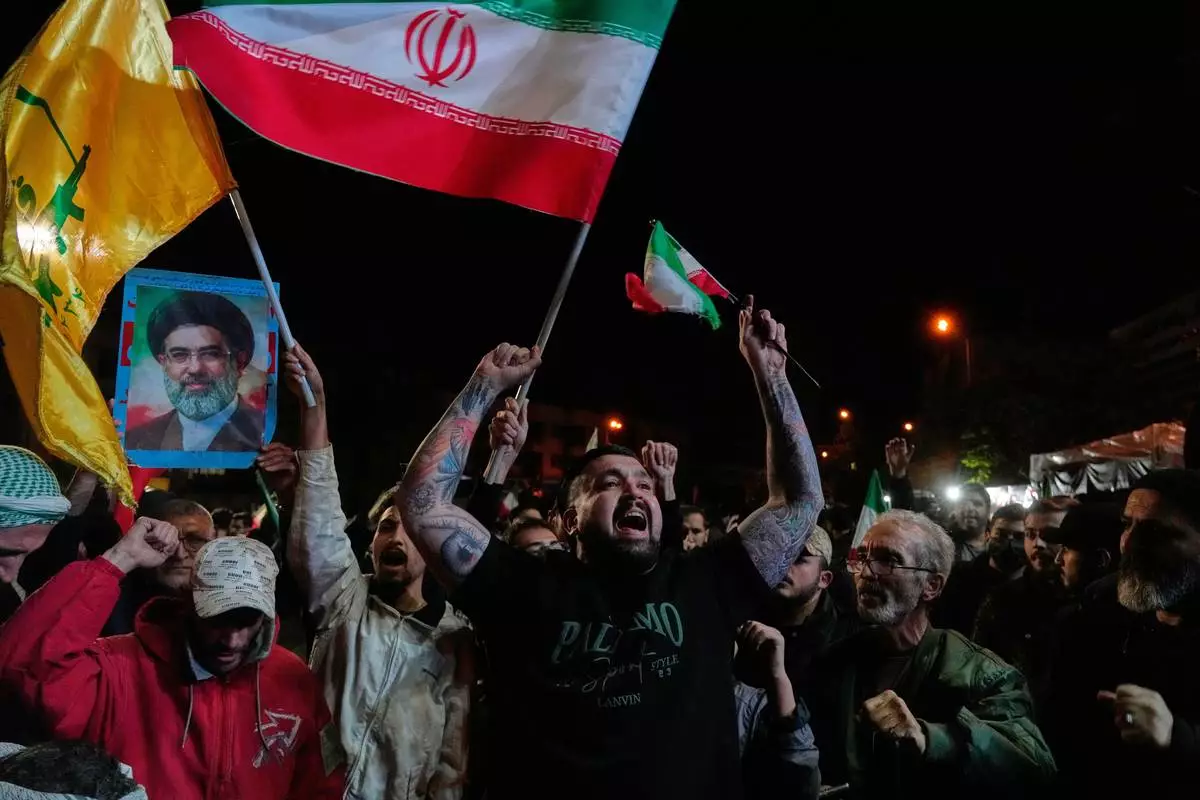
Pro-government demonstrators chant slogans as they hold Iranian flags and a poster of the Supreme Leader Ayatollah Mojtaba Khamenei in a gathering after announcement of a two-week ceasefire in the war with the United States and Israel, at the Enqelab-e-Eslami, or Islamic Revolution, Square, in Tehran, Iran, Wednesday, April 8, 2026. (AP Photo/Vahid Salemi)

Mourners carry the flag-draped bodies of three members of the Gershovich family, killed when an Iranian missile struck their building, during their funeral in Haifa, Israel, Tuesday, April 7, 2026. (AP Photo/Ariel Schalit)
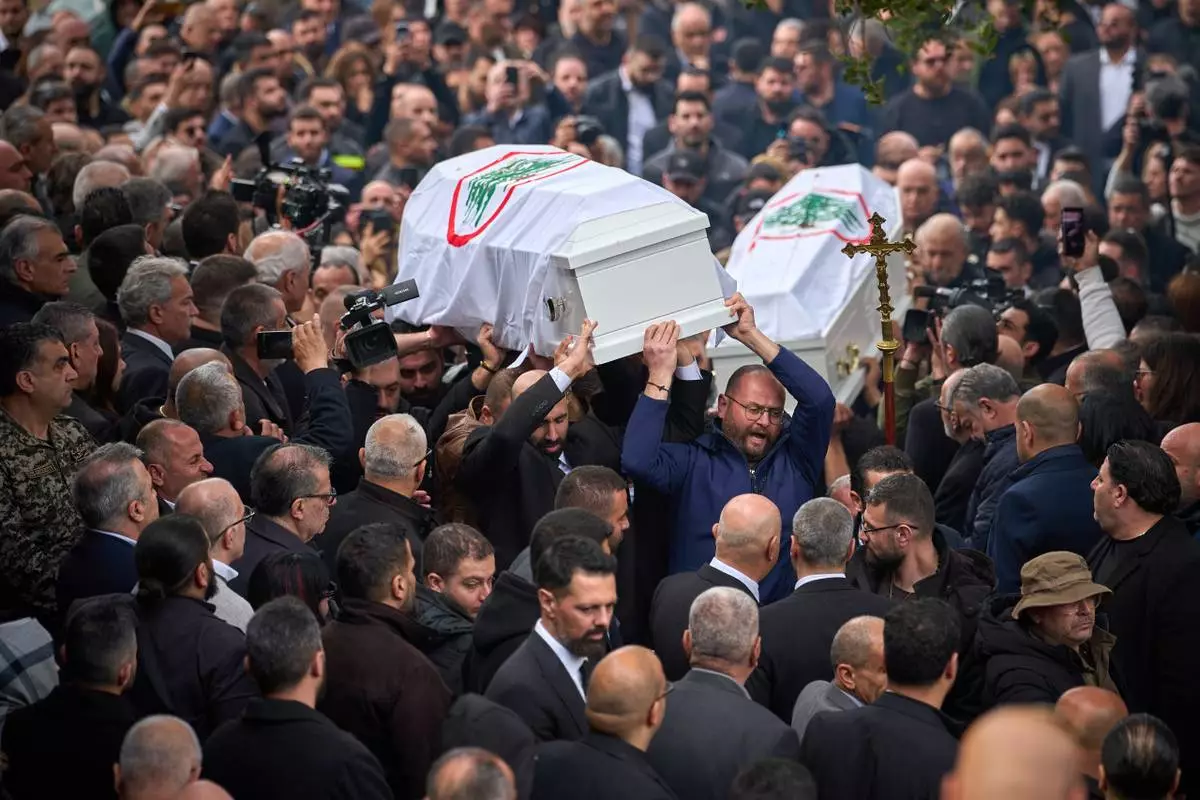
Men carry the coffins with the bodies of Pierre Mouawad, an official with the anti-Hezbollah Lebanese Forces party, and his wife during their funeral in Yahshush, Lebanon, Tuesday, April 7, 2026. (AP Photo/Emilio Morenatti)
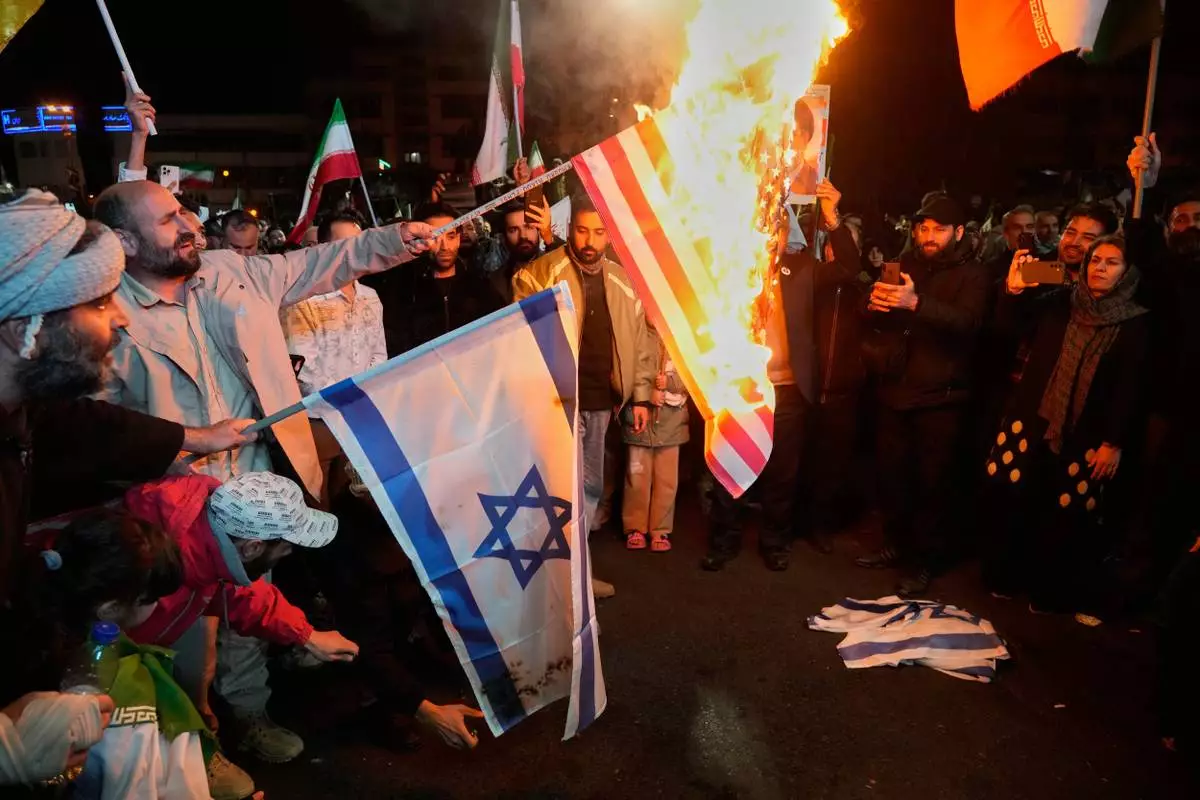
Iranian pro-government demonstrators burn the U.S. and Israeli flags during a gathering after announcement of a two-week ceasefire in the war with the United States and Israel, at the Enqelab-e-Eslami, or Islamic Revolution, Square, in Tehran, Iran, Wednesday, April 8, 2026. (AP Photo/Vahid Salemi)