WESTMINSTER, Colo.--(BUSINESS WIRE)--Apr 9, 2026--
Vantor, the leading provider of unified spatial intelligence, today announced plans to expand its industry-leading satellite constellation and create the first commercial space-based system combining accurate, high-resolution imaging with real-time global monitoring—empowering government and commercial customers to generate intelligence and power tactical operations at unprecedented speed and scale.
This press release features multimedia. View the full release here: https://www.businesswire.com/news/home/20260409236350/en/
For decades, space-based intelligence has forced a tradeoff: you could either see the world in high detail or monitor it continuously, but not both. This expansion to Vantor’s constellation, which already delivers the most accurate and high-resolution imagery on orbit, eliminates that tradeoff for the first time.
The new architecture introduces the addition of two satellite systems:
These new satellites build on the success of Vantor’s state-of-the-art Legion program, which doubled collection capacity, introduced dawn-to-dusk monitoring, and set a new benchmark for commercial imaging performance. Legion satellites are already supporting high-priority missions for customers around the world, delivering the scale, accuracy, and reliability required for operational missions.
With Legion, Vantor’s constellation can collect over 3.5 million square kilometers of highly accurate 30 cm-class imagery daily and revisit the same location on Earth up to 15 times per day. The expanded fleet will further increase this collection capacity while improving revisit rates five-fold, unlocking imaging of the same location on Earth as frequently as every 15 minutes.
These capabilities enable a continuously updated, real-time view of the world in 2D and 3D—allowing customers to detect change, maintain up-to-date maps, track activity, and predict emerging threats at machine speed.
Vantor expects to bring the first Pulse satellites online as soon as 2027, followed by the first two Vantage satellites as soon as 2029.
“Vantage and Pulse usher in a new era of space-based intelligence—it’s the first time that governments and businesses can get both detailed imaging and real-time monitoring from a single commercial system,” said Dan Smoot, Vantor CEO. “That fundamentally changes how intelligence is generated and used. Instead of choosing between accuracy and speed, customers can seamlessly collect, fuse, and deploy our multi-class intelligence within their sovereign systems, turning space-based data into a real-time operational capability.”
Fueling Tensorglobe, Vantor’s end-to-end platform for real-time intelligence
Modern defense and intelligence missions require real-time sovereign intelligence systems, where data is continuously collected and delivered directly into workflows customers fully own and control. Tensorglobe™, Vantor’s end-to-end spatial intelligence platform, already drives this cycle today—and Vantage and Pulse will further accelerate its capabilities.
Tensorglobe integrates data from space, air and ground to create a fused spatial foundation natively accessible to geospatial AI models. This unified system automates the full intelligence cycle within a customer’s sovereign environment, from collection to analysis and delivery.
Tensorglobe is powering a range of sovereign missions, including:
The expanded constellation enhances this system by increasing the frequency and freshness of the 2D and 3D spatial foundation that feeds Tensorglobe.
By combining accurate imaging, continuous monitoring, and sovereign deployment in a single system, Vantor is setting a new standard for space-based intelligence that empowers customers to move faster, operate with confidence, and maintain a real-time understanding of dynamic mission environments.
About Vantor
Vantor is forging the new frontier of spatial intelligence to unlock a more autonomous, interoperable world. We give decision makers and operators the power to build a unified intelligence picture, delivering the clarity they need to navigate what’s happening now and shape what’s coming next. We fuse data from our constellation, which includes the most capable imaging satellites on orbit, with real-time sensor feeds from space, air, and ground to create an AI-ready digital twin of Earth. Our spatial intelligence platform automates every part of the cycle—from tasking to collection to production—to update and analyze this foundation at the pace of change. Our products drive deeper mission-critical insights and connect the next generation of autonomous systems across the defense, intelligence, and commercial landscape. To learn more, visit www.vantor.com.
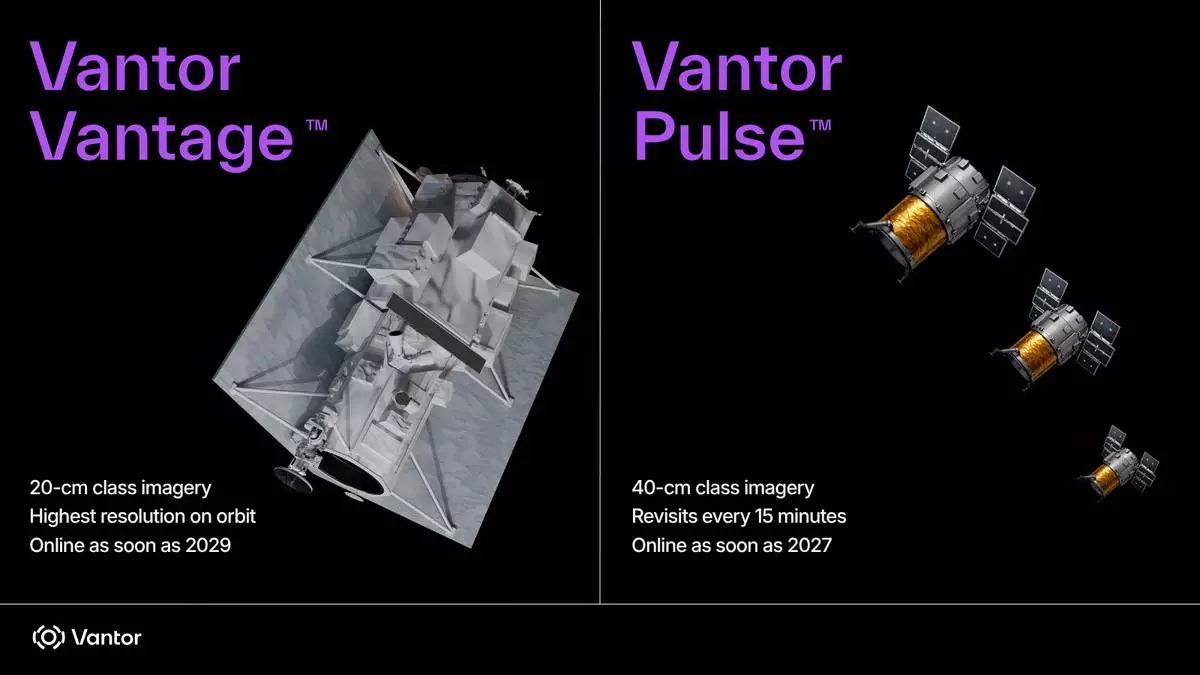
Vantor Vantage™ satellites will deliver next-generation 20 cm-class imaging capabilities. Vantor Pulse™ is a fleet of 40 cm-class satellites designed for persistent, high-frequency monitoring.
SANTA ANA, Calif. (AP) — A crack in a damaged chemical tank in Southern California has eliminated the risk of a catastrophic explosion but it's still not safe enough for the remaining 16,000 residents living closest to the aerospace plant to go home, officials said Tuesday.
Crews were spraying water to keep cooling the tank that overheated last week, prompting the evacuation of 50,000 people in the Orange County city of Garden Grove. Most returned home after a crack formed over the Memorial Day holiday weekend, relieving pressure inside.
The evacuation zone remained the same on Tuesday morning, said Orange County Fire Capt. Brian Yau.
Crews worked overnight to ensure two other nearby tanks were neutralized and would not be affected by the compromised tank, he said, adding that material from one of these two tanks was transferred to another that has a neutralizing agent.
“They are moving material over to ensure that all threats have been eliminated,” Yau said.
Those threats include the risk of a very small explosion and potential spill, officials said.
Exposure to methyl methacrylate — a highly flammable chemical used to make plastics — can cause serious respiratory problems, neurological problems and irritation to the skin, eyes and throat, according to the federal Environmental Protection Agency. The tank at the GKN Aerospace Transparency Systems plant contains 6,000 to 7,000 gallons (22,700 to 26,500 liters) of the chemical.
The interior cooled to 93 degrees F (33.9 degrees C), the county's fire division chief Craig Covey said Monday, down from 100 degrees (37.7 degrees C) a day earlier. The company said its technical specialists and the county fire authority have removed insulation from the tank to help cool it.
Health officials sought to reassure people who are returning to homes near the plant.
“There was no contamination. There were no fumes,” Orange County Health Director Regina Chinsio-Kwong said at Monday's news conference. “There was not a leak. So it should be, you should feel comfortable going home even if you’re across the street from that new zone line.”
The South Coast Air Quality Management District will monitor the air for several months and the EPA will be checking sewer and storm drains for spills, Orange County Supervisor Janet Nguyen said.
Garden Grove Unified School District said last week it was shutting a dozen schools through what was supposed to be the last day of the school year on Wednesday but later said only three would remain closed Tuesday. It was unclear if they would reopen before the school year ends this week.
At a parking lot at a large park in Fountain Valley, just southwest of Garden Grove, people sought refuge in an ad hoc shelter there or pitched tents outside. Other people gathered in the park to enjoy Memorial Day.
Kim Yen, a retiree who was still evacuated from her home two blocks from the plant, welcomed news that the worst was not expected.
“I am happy and many of us are happy,” she said Monday.
She said she's ready to go back but wants to be sure it’s safe first. She's also been worrying about the emergency workers, who she called “our heroes.”
As the tank heated up, the chemical converted from liquid to gas, ramping up the pressure and explosion risk, said Andrew Whelton, a Purdue University engineering professor who has studied environmental contamination. Some of the methyl methacrylate may already have hardened into a stable plastic similar to plexiglass, reducing the danger, he said.
The tank could eventually cool enough for crews to safely stabilize and drain the remaining material without triggering a spark or ignition, Whelton said.
However, he said there is still a risk of an explosion while the chemical remains hot and reactive. Temperatures need to fall closer to 60 to 70 degrees Fahrenheit (15.6 to 21.1 degrees C) before conditions are considered significantly safer, he said.
GKN Aerospace Transparency Systems makes cockpit windows, canopies and windshields for military and commercial aircraft. It employs about 16,000 people across 32 manufacturing sites in 12 countries, according to the company website.
“We apologize for the ongoing disruption this incident is causing and our priority remains its safe resolution, so that residents can return to their homes as quickly as possible,” the company said.
GKN Aerospace agreed in 2025 to pay state regulators more than $900,000 to settle violations involving recordkeeping, permitting issues and nitrogen oxide emissions, according to a report on the South Coast Air Quality Management District website.
——
This story has been corrected to attribute a quote to TJ McGovern, interim fire chief of the Orange County Fire Authority, not to division chief Craig Covey.
Willingham reported from Boston. Contributing were Associated Press journalists Jamie Stengle in Dallas; Ethan Swope in Garden Grove, California; and Christopher Weber in Los Angeles.
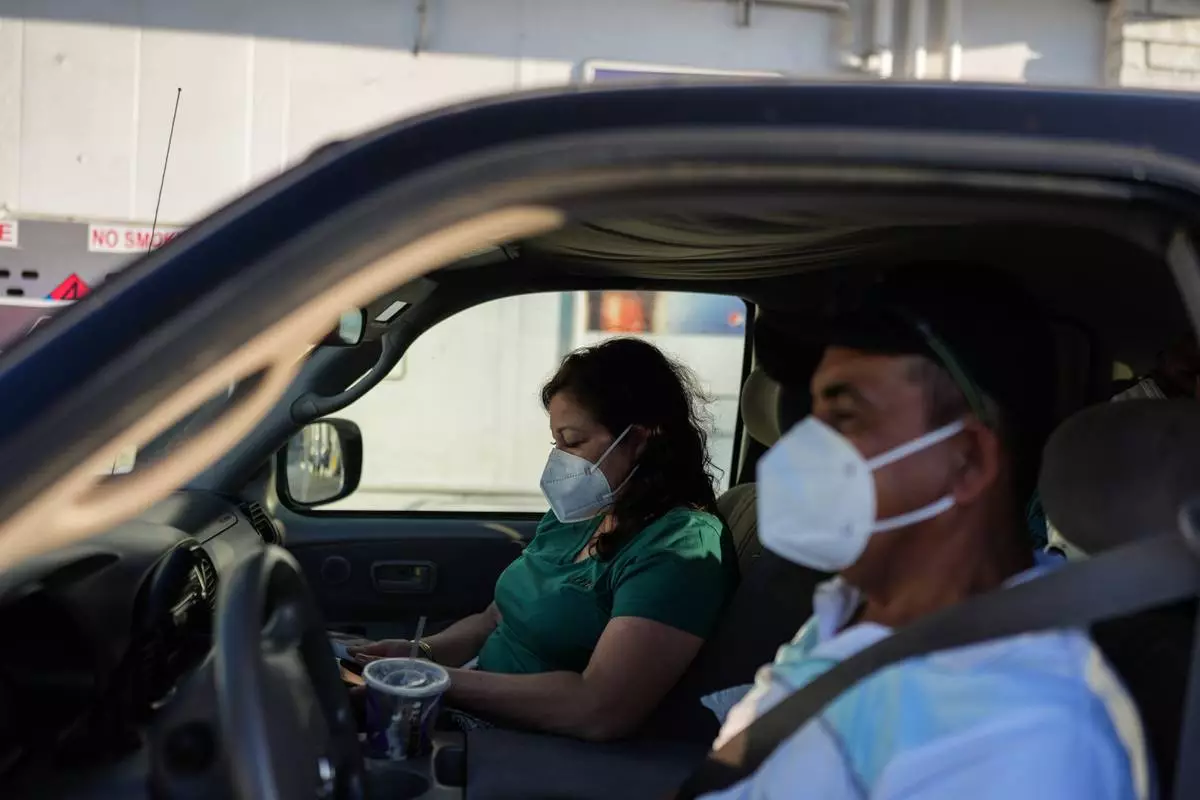
Two evacuees sit in their pickup truck at a gas station within the evacuation zone in Stanton, Calif., Monday, May 25, 2026. (AP Photo/Jae C. Hong)

An aerial view shows a police checkpoint enforcing a road closure at the evacuation zone boundary in Anaheim, Calif., Monday, May 25, 2026. (AP Photo/Jae C. Hong)
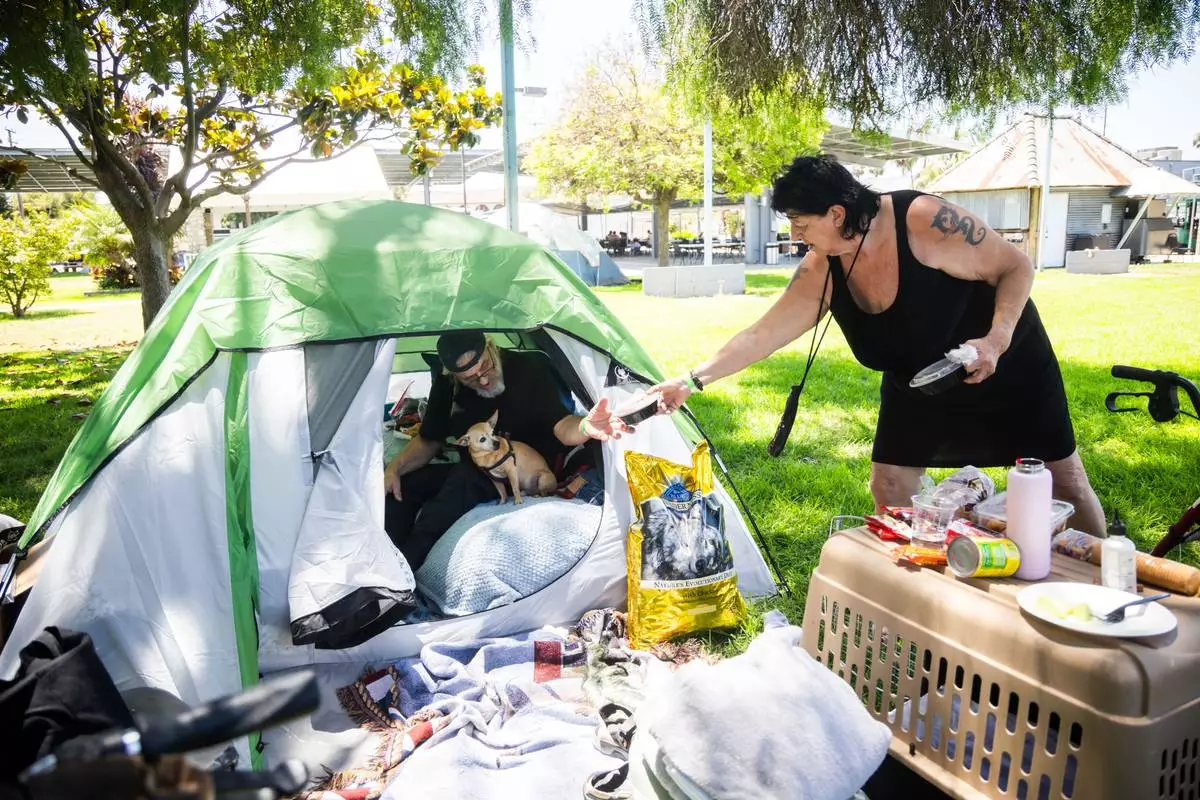
Jan De Jonge and fiancé Sher Stuckman set up a tent with their belonging and pet outside the Elks Lodge in Garden Grove, Calif., on Monday, May 25, 2026. (AP Photo/Ethan Swope)

An evacuation map is displayed at the incident command post at the Los Alamitos Race Course in Cypress, Calif., on Sunday, May 24, 2026. (AP Photo/Ethan Swope)
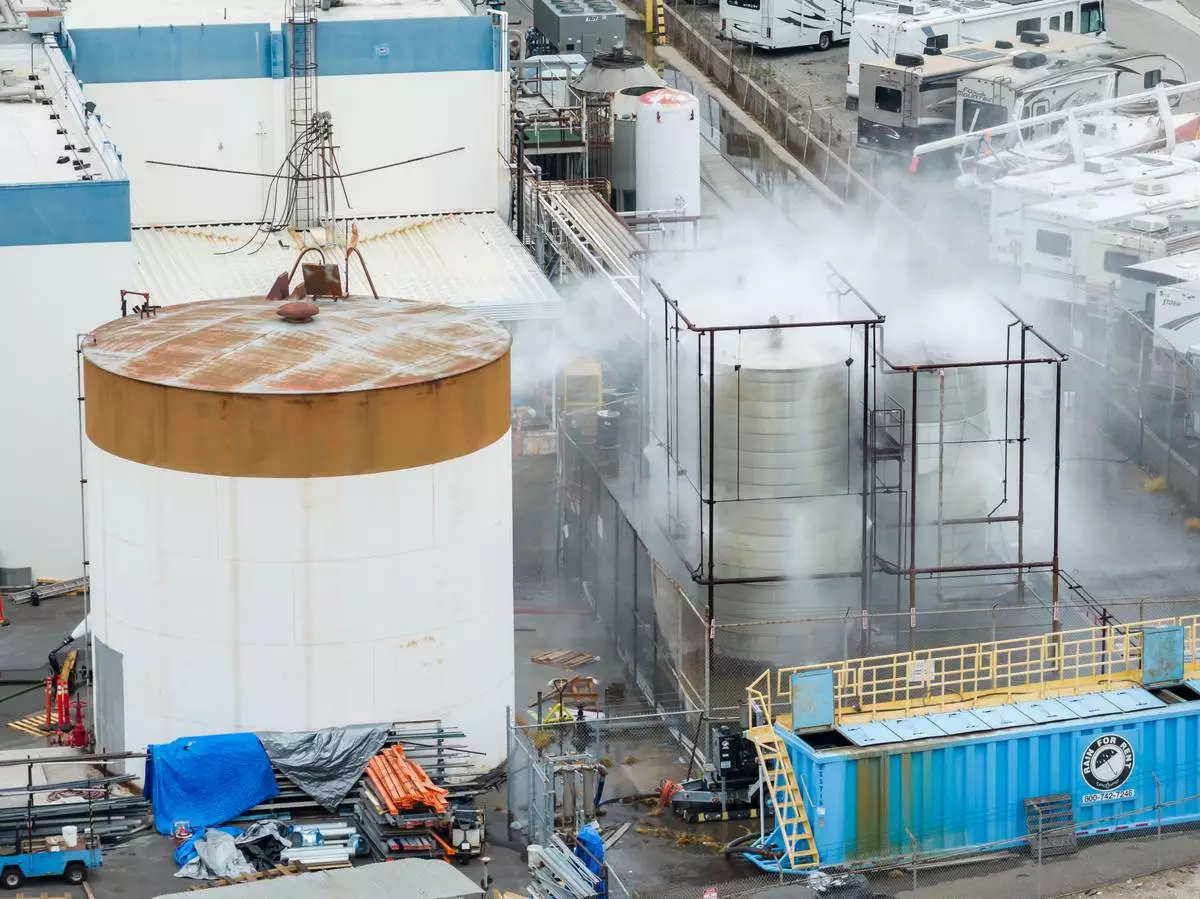
Water is sprayed on a damaged tank at GKN Aerospace in Garden Grove, Calif., on Sunday, May 24, 2026, after the tank containing a chemical used to make plastic parts overheated Thursday. (AP Photo/Ethan Swope)
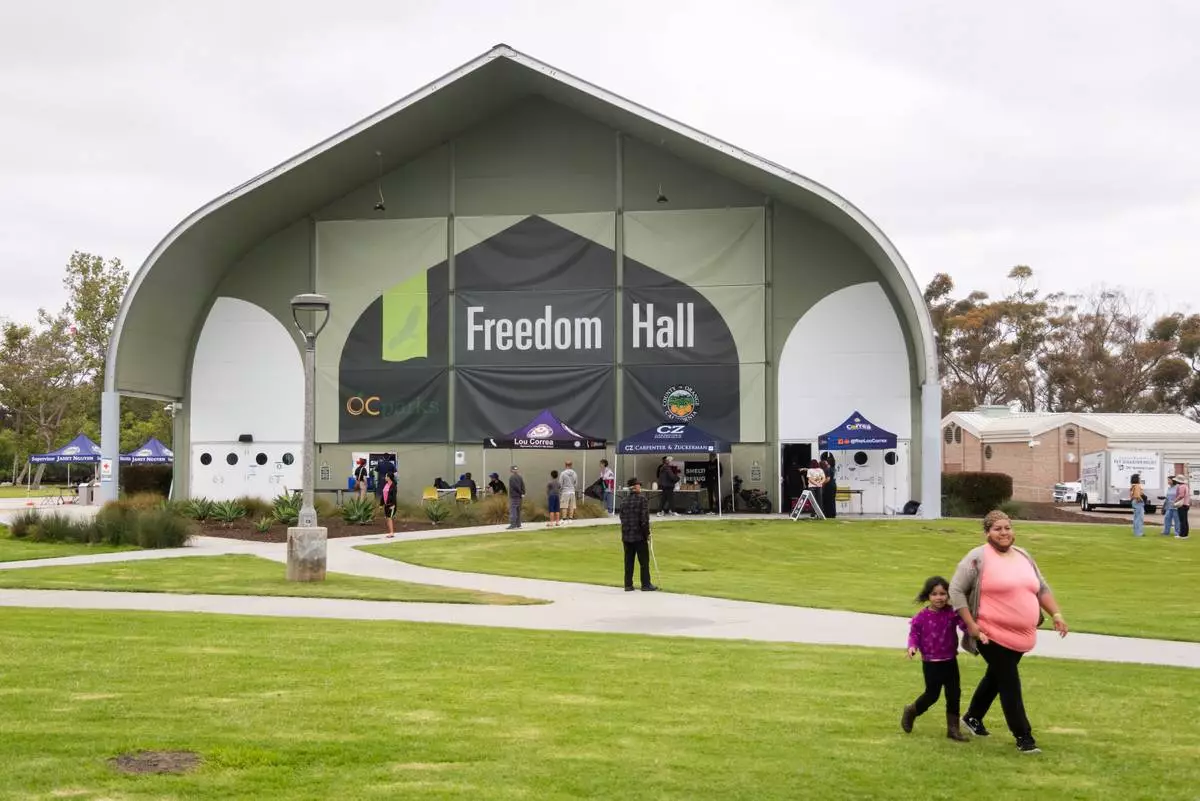
People walk outside Freedom Hall, an evacuation center in Fountain Valley, Calif., on Monday, May 25, 2026. (AP Photo/Ethan Swope)

An American Red Cross volunteer walks outside Freedom Hall, an evacuation center in Fountain Valley, Calif.,on Monday, May 25, 2026. (AP Photo/Ethan Swope)

People tend to their pets outside Freedom Hall, an evacuation center in Fountain Valley, Calif., on Monday, May 25, 2026. (AP Photo/Ethan Swope)