China has steadily improved its Antarctic aviation and ocean research capabilities in the polar region over the past decades.
China's research icebreaker Xuelong, or Snow Dragon, returned to Shanghai in east China on Thursday after a 160-day-long voyage as part of the country's 42nd Antarctic expedition.
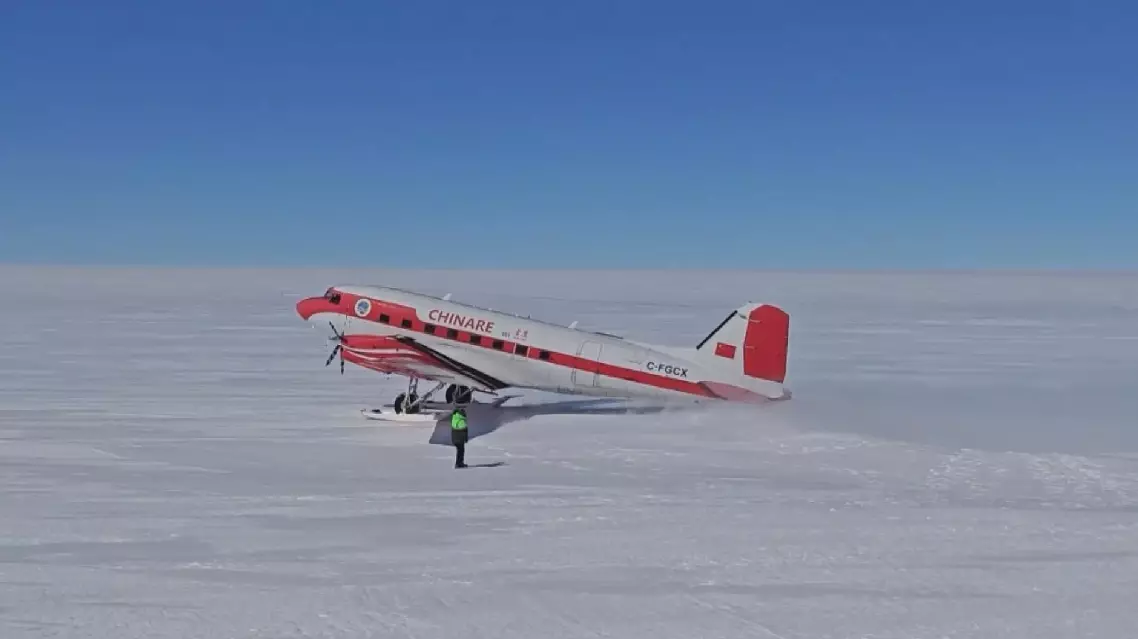
During the 42nd Antarctic expedition, China's "Snow Eagle 601" fixed-wing aircraft opened up a new intra-Antarctica transfer route, and the aviation operation team used the fixed-wing aircraft to conduct an aerial photography survey of penguin population in the Enderby Land for the first time, the expedition team said at a press briefing held in Shanghai following a welcoming ceremony for Xuelong.
The aircraft has flown around 335 hours, covering about 104,000 kilometers. From Nov. 7, 2025 to Feb. 23, 2026, the Zhongshan Skiway operated safely for 109 consecutive days.
"While completing the scheduled tasks, the expedition team has also deepened exchanges and mutual assistance in aviation with various stations at Queen Maud Land in East Antarctic through international cooperation. At the request of Russia, we completed an international humanitarian rescue mission, and assisted in transferring nine of its team members stranded at the Novolazarevskaya Station to Progress Station," said Zhu Biao, assistant leader of the expedition team.
The expedition team also piloted airspace operation rules in the Larsemann Hills where China's Zhongshan Station is located, contributing to improving international Antarctic aviation governance.
With a focus on the impacts of climate change on the ecosystem of the Southern Ocean, the expedition team carried out comprehensive investigations in the waters, enhancing China's research capability in Antarctic marine ecological protection and climate change.
The 42nd Antarctic expedition started on Nov. 1, 2025 as the two icebreakers, "Xuelong" and "Xuelong 2", set sail from Shanghai. Xuelong-2 is expected to return to Shanghai in late May.
The Xuelong icebreaker completed comprehensive investigations at 23 positions, and deployed three and collected another three sets of comprehensive subsurface buoys during its 18 days of operations in the Amundsen Sea. Meanwhile, it collected more than 4,500 environmental and biological samples and caught over 11,000 krill and over 140 fish.
The icebreaker also deployed a set of ecological subsurface buoy and recovered another in the Ross Sea, and deployed three sets of hydrological subsurface buoys.
"The 'Xuelong 2' operated in the waters near the Antarctic Peninsula for seven days, completing comprehensive investigations at 13 positions and deploying 15 sets of seabed seismographs. It also collected more than 5,500 environmental and biological samples," said Cao Shunan, assistant chief scientist of the expedition team.
Cao said that the mission has provided important scientific support for a deeper understanding of the structure and function of polar ecosystems and for assessing ecological risks caused by global warming.
China sees improvement in Antarctic aviation, ocean research capabilities