Skip to Content Facebook Feature Image

Japanese Prime Minister Takaichi thrilled by Deep Purple's visit to her office

ENT

Japanese Prime Minister Takaichi thrilled by Deep Purple's visit to her office
ENT

ENT

Japanese Prime Minister Takaichi thrilled by Deep Purple's visit to her office

2026-04-10 19:53 Last Updated At:20:00

TOKYO (AP) — Japanese Prime MinisterSanae Takaichi took a short — and happy — break on Friday as she hosted legendary British rock band Deep Purple in Tokyo as a longtime admirer.

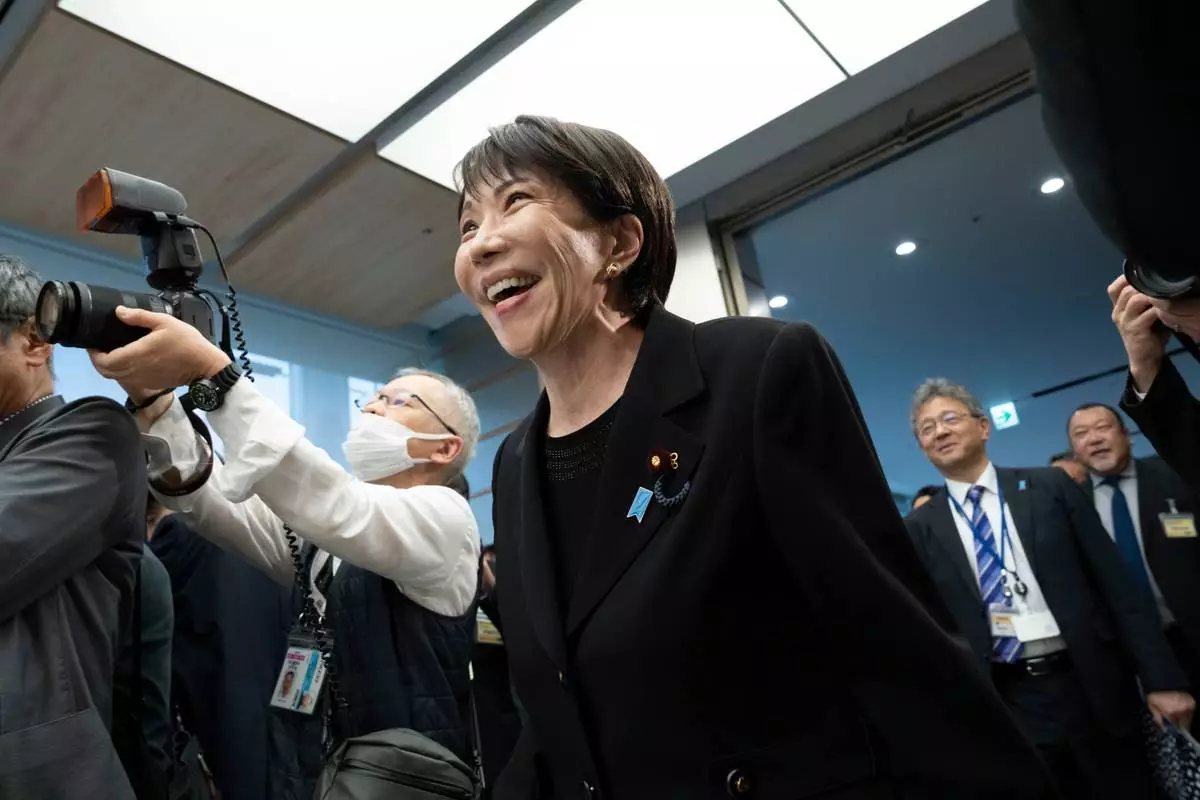
“Welcome to Japan ... Uh-oh, I can’t believe Deep Purple are here," Takaichi said as she walked into a guest room at the Prime Minister's Office with open arms and all smiles to welcome the band members. “I have always admired Deep Purple.”

More Images
Ian Gillanat, a member of British rock band Deep Purple leaves after a meeting with Japan's Prime Minister Sanae Takaichi at the Prime Minister's Office in Tokyo, Friday, April 10, 2026. (Yuichi Yamazaki/Pool Photo via AP)
Ian Gillanat, a member of British rock band Deep Purple leaves after a meeting with Japan's Prime Minister Sanae Takaichi at the Prime Minister's Office in Tokyo, Friday, April 10, 2026. (Yuichi Yamazaki/Pool Photo via AP)
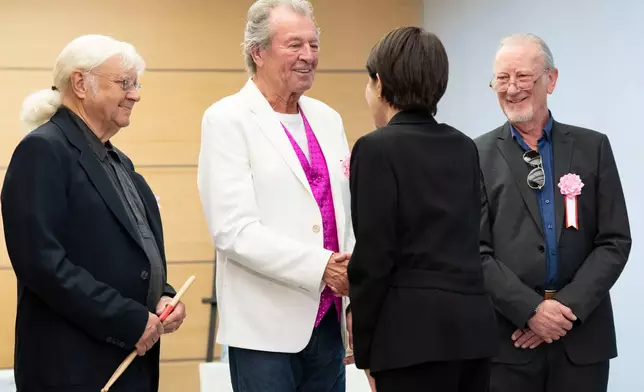
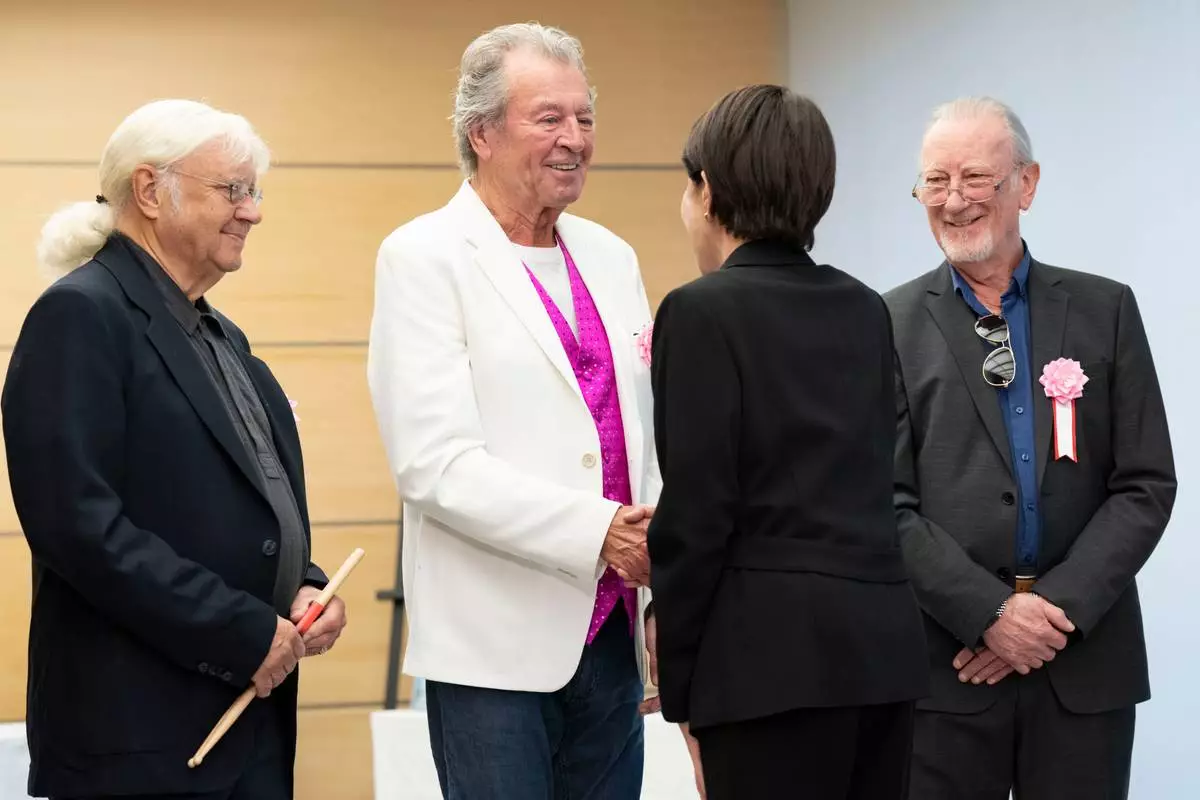
Japan's Prime Minister Sanae Takaichi, back to camera, greets members of British rock band Deep Purple , from left, Ian Paice, Ian Gillan, and Roger Glover at the Prime Minister's Office in Tokyo, Friday, April 10, 2026. (Yuichi Yamazaki/Pool Photo via AP)

Japan's Prime Minister Sanae Takaichi, back to camera, greets members of British rock band Deep Purple , from left, Ian Paice, Ian Gillan, and Roger Glover at the Prime Minister's Office in Tokyo, Friday, April 10, 2026. (Yuichi Yamazaki/Pool Photo via AP)

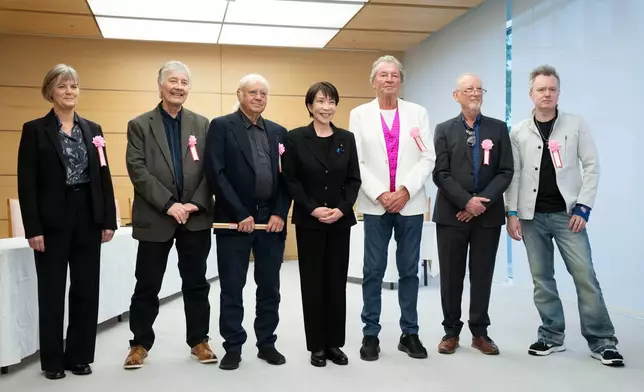
Japan's Prime Minister Sanae Takaichi, poses with members of British rock band Deep Purple, Don Airey, second left, Ian Paice, third left, Ian Gillan, third right, Roger Glover, second right Simon McBrideat, right, and British Ambassador to Japan Julia Longbottom, left, during their meeting the Prime Minister's Office in Tokyo, Friday, April 10, 2026. (Yuichi Yamazaki/Pool Photo via AP)
Japan's Prime Minister Sanae Takaichi, poses with members of British rock band Deep Purple, Don Airey, second left, Ian Paice, third left, Ian Gillan, third right, Roger Glover, second right Simon McBrideat, right, and British Ambassador to Japan Julia Longbottom, left, during their meeting the Prime Minister's Office in Tokyo, Friday, April 10, 2026. (Yuichi Yamazaki/Pool Photo via AP)

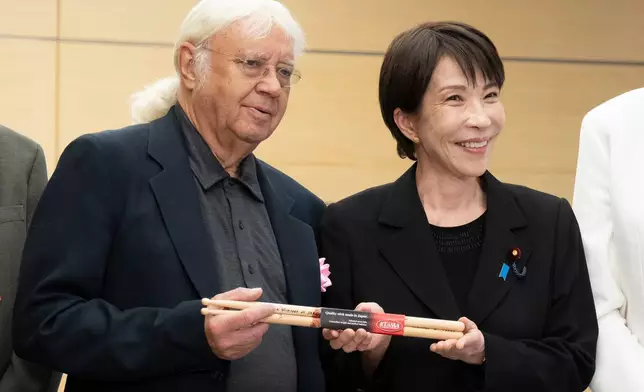
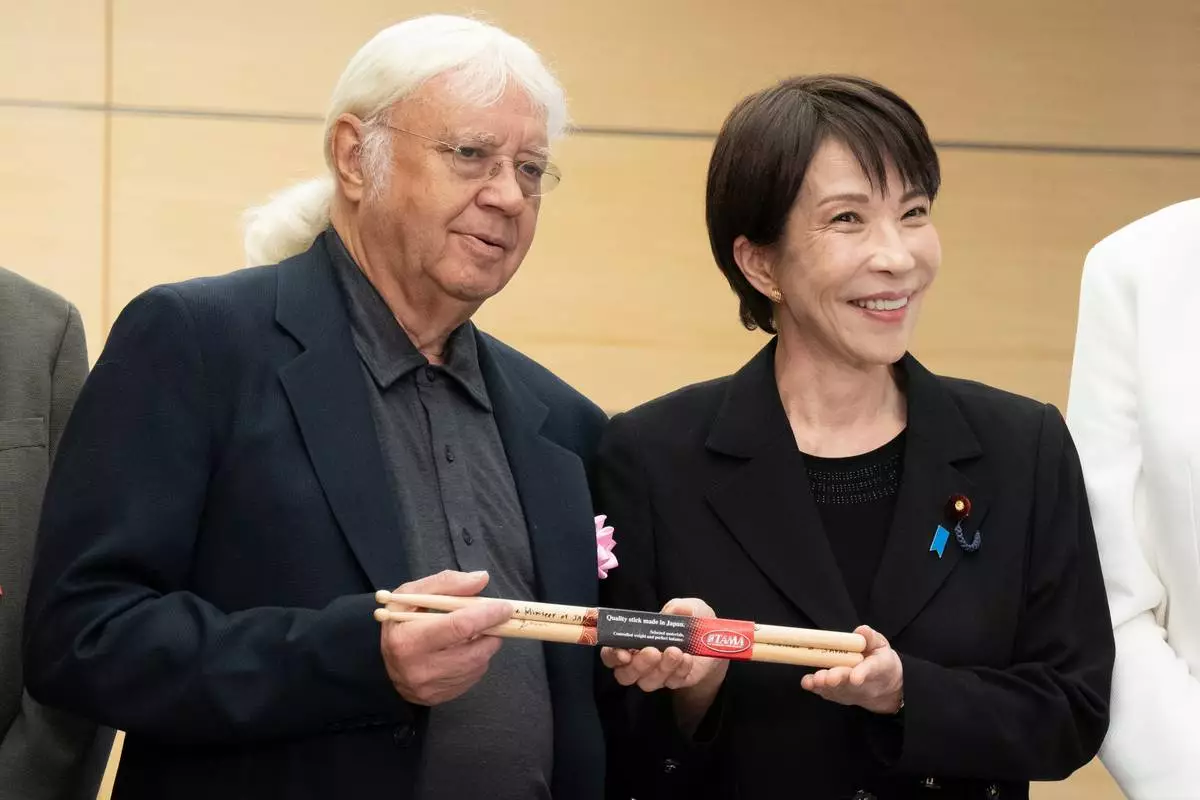
Japan's Prime Minister Sanae Takaichi, right, poses with Ian Paice, a member of British rock band Deep Purple during their meeting at the Prime Minister's Office in Tokyo, Friday, April 10, 2026. (Yuichi Yamazaki/Pool Photo via AP)
Japan's Prime Minister Sanae Takaichi, right, poses with Ian Paice, a member of British rock band Deep Purple during their meeting at the Prime Minister's Office in Tokyo, Friday, April 10, 2026. (Yuichi Yamazaki/Pool Photo via AP)

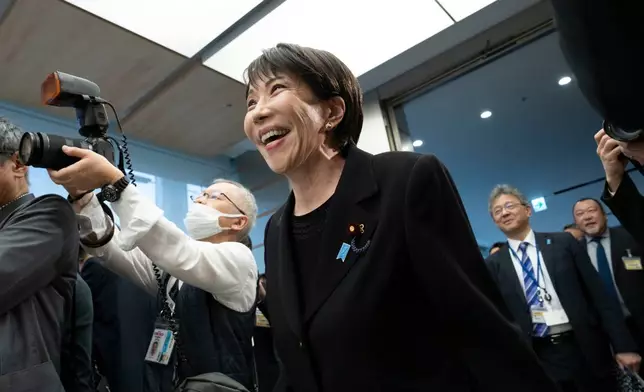
Japan's Prime Minister Sanae Takaichi, arrives for a meeting with members of British rock band Deep Purple at the Prime Minister's Office in Tokyo, Friday, April 10, 2026. (Yuichi Yamazaki/Pool Photo via AP)

Japan's Prime Minister Sanae Takaichi, arrives for a meeting with members of British rock band Deep Purple at the Prime Minister's Office in Tokyo, Friday, April 10, 2026. (Yuichi Yamazaki/Pool Photo via AP)

“You’re my god,” Takaichi told drummer Ian Paice, presenting him with a set of Japanese-made TAMA drumsticks she had signed. “You're a drummer, we are friends,” Paice told her.

Takaichi is a hard rock and heavy metal music fan and was an avid drummer in her college days.

The prime minister explained her history as a Deep Purple superfan for more than half a century. At elementary school, she was already listening to “Machine Head," the band's 1972 album featuring top hits like “Highway Star” and “Smoke on the Water.”

In junior high school, she played the keyboard in a Deep Purple cover band, then as a university student she switched to drums, she said.

“Nowadays, when I have a fight with my husband, I play drums on ‘Burn’ and put a curse on him,” Takaichi joked. She has previously noted “Burn” as one of her favorite songs, saying it “clears my mind.”

The band's courtesy visit was a pleasant break for Japan's first female leader, known for her long working hours and now struggling with strained diplomatic ties with China, the fallouts from the war in the Middle East as well as rising prices at home.

“I express my deepest respect for you for making rock history and continuing to take on new challenges and producing even more compelling music today,” Takaichi said, wishing them a successful tour beginning Saturday in Tokyo.

She did not forget to do her work as prime minister and stressed that promotion of cultural content is one of the key areas of her government's growth strategy.

“I hope Deep Purple’s performances starting tomorrow will excite fans across Japan and serve as a powerful force in promoting the long-standing Japan-UK cultural exchanges,” she said.

Associated Press journalist Ayaka McGill contributed to this report.

Ian Gillanat, a member of British rock band Deep Purple leaves after a meeting with Japan's Prime Minister Sanae Takaichi at the Prime Minister's Office in Tokyo, Friday, April 10, 2026. (Yuichi Yamazaki/Pool Photo via AP)
Ian Gillanat, a member of British rock band Deep Purple leaves after a meeting with Japan's Prime Minister Sanae Takaichi at the Prime Minister's Office in Tokyo, Friday, April 10, 2026. (Yuichi Yamazaki/Pool Photo via AP)

Japan's Prime Minister Sanae Takaichi, back to camera, greets members of British rock band Deep Purple , from left, Ian Paice, Ian Gillan, and Roger Glover at the Prime Minister's Office in Tokyo, Friday, April 10, 2026. (Yuichi Yamazaki/Pool Photo via AP)

Japan's Prime Minister Sanae Takaichi, back to camera, greets members of British rock band Deep Purple , from left, Ian Paice, Ian Gillan, and Roger Glover at the Prime Minister's Office in Tokyo, Friday, April 10, 2026. (Yuichi Yamazaki/Pool Photo via AP)

Japan's Prime Minister Sanae Takaichi, poses with members of British rock band Deep Purple, Don Airey, second left, Ian Paice, third left, Ian Gillan, third right, Roger Glover, second right Simon McBrideat, right, and British Ambassador to Japan Julia Longbottom, left, during their meeting the Prime Minister's Office in Tokyo, Friday, April 10, 2026. (Yuichi Yamazaki/Pool Photo via AP)
Japan's Prime Minister Sanae Takaichi, poses with members of British rock band Deep Purple, Don Airey, second left, Ian Paice, third left, Ian Gillan, third right, Roger Glover, second right Simon McBrideat, right, and British Ambassador to Japan Julia Longbottom, left, during their meeting the Prime Minister's Office in Tokyo, Friday, April 10, 2026. (Yuichi Yamazaki/Pool Photo via AP)

Japan's Prime Minister Sanae Takaichi, right, poses with Ian Paice, a member of British rock band Deep Purple during their meeting at the Prime Minister's Office in Tokyo, Friday, April 10, 2026. (Yuichi Yamazaki/Pool Photo via AP)
Japan's Prime Minister Sanae Takaichi, right, poses with Ian Paice, a member of British rock band Deep Purple during their meeting at the Prime Minister's Office in Tokyo, Friday, April 10, 2026. (Yuichi Yamazaki/Pool Photo via AP)


Japan's Prime Minister Sanae Takaichi, arrives for a meeting with members of British rock band Deep Purple at the Prime Minister's Office in Tokyo, Friday, April 10, 2026. (Yuichi Yamazaki/Pool Photo via AP)

Japan's Prime Minister Sanae Takaichi, arrives for a meeting with members of British rock band Deep Purple at the Prime Minister's Office in Tokyo, Friday, April 10, 2026. (Yuichi Yamazaki/Pool Photo via AP)

NEW YORK (AP) — President Donald Trump's administration this week acknowledged it made a significant error in figures it used to help justify a fraud probe into New York’s Medicaid program, a glaring mistake that undercuts a federal campaign to tackle waste, mostly in Democratic-led states.

The error, one of at least a few misrepresentations in its description of the program, prompted health analysts to question how many of the Republican administration’s sweeping anti-fraud efforts around the country were based on faulty findings. It also reflected a common criticism that’s been made of Trump’s second administration — that it tends to attack first and confirm the facts later.

“These numbers could have been cleared up in a phone call, so it’s really slapdash,” said Fiscal Policy Institute senior health policy adviser Michael Kinnucan, whose recent analysis called attention to the Trump administration’s inaccurate claim.

The mistake appeared in comments made last month by Dr. Mehmet Oz, the administrator of the Centers for Medicare & Medicaid Services, in a social media video and in a letter to New York’s Democratic governor announcing the fraud investigation.

Oz claimed that New York’s Medicaid program last year provided some 5 million people with personal care services, which assist people in need with basic activities like bathing, grooming and meal preparation. That would add up to nearly three-fourths of the state’s 6.8 million Medicaid enrollees.

“That level of utilization is unheard of,” Oz said in the video, adding in his post that New York needs to “come clean about its Medicaid program.”

But the real number of New Yorkers who used those services last year was about 450,000, or between 6% and 7% of total enrollees, CMS spokesman Chris Krepich told The Associated Press this week in the agency’s first public acknowledgment of the error. He said the agency misidentified New York’s approach to applying billing codes and had since refined its methodology.

“CMS is committed to ensuring its analyses fully reflect state-specific billing practices and will continue to work closely with New York to validate data and strengthen program integrity oversight,” he said in an emailed statement.

Krepich said the probe was ongoing as the administration still has concerns with New York’s oversight of personal care services and the Medicaid program and is reviewing the state’s response to last month’s letter. CMS had raised other flags about New York’s program, including that it spends more per beneficiary and per resident than the average state, has high personal care spending and employs so many personal care aides that the job category is now the largest in the state.

Health analysts said the state's high spending reflected both high costs for services in New York and a policy choice to provide robust at-home care. Cadence Acquaviva, senior public information officer for the New York Department of Health, called Oz’s initial mischaracterizations “a targeted attempt to obscure the facts.”

“New York State remains committed to protecting and preserving vital Medicaid programs that deliver high-quality services to New Yorkers who depend on them,” she said.

In a statement, a spokesperson for Gov. Kathy Hochul said, “The initial claim by CMS was patently false, and we are glad they now admit it."

“Governor Hochul has been clear that New York has zero tolerance for waste, fraud and abuse in Medicaid, or any other state programs, and will continue her efforts to root out bad actors, protect taxpayer dollars, and safeguard the critical programs that New Yorkers rely on,” spokesperson Nicolette Simmonds said.

The Trump administration’s investigation into New York comes as it has similarly approached at least four other states, including California, Florida, Maine and Minnesota, with investigations into potential health care fraud. The anti-fraud effort appears to be expanding as voters in the upcoming midterm elections say they’re concerned about affordability.

Trump last month signed an executive order to create an anti-fraud task force across federal benefit programs led by Vice President JD Vance. As part of that project, Vance announced the administration would temporarily halt $243 million in Medicaid funding to Minnesota over fraud concerns, a move over which the state has since sued.

Kinnucan, the analyst with expertise in New York’s Medicaid program, said he’s concerned that the Trump administration’s adversarial approach to targeting fraud in some states “politicizes” a conversation that should be a team effort.

“We want to think collaboratively among all the stakeholders in the program about how we can actually fix it,” Kinnucan said. “We don’t want to have fraud be this political football.”

In his video, Oz made at least two other claims about New York that Medicaid advocates and beneficiaries say distorted the facts.

In one instance, he said the state recently made its screening for personal care eligibility “more lenient by allowing problems like being ‘easily distracted’ to qualify for a personal care assistant.”

Rebecca Antar, director of the health law unit at the Legal Aid Society, said the opposite was true — that the state in a rule change that went into effect last September instead made its program requirements more stringent. She said being “easily distracted” doesn’t appear anywhere among them.

Krepich said the administrator was referring to whether New York’s standard for personal care services was “sufficiently rigorous.”

“When standards are overly permissive, it risks diverting resources away from individuals with the highest levels of need and placing long-term pressure on the sustainability of the Medicaid program,” he said.

Oz in the video also referred to personal care services as “something that our families would normally do for us, like carrying groceries.”

Kathleen Downes, a 33-year-old who has quadriplegic cerebral palsy and uses personal care services in New York’s Nassau County, said she was offended by the notion that all Medicaid beneficiaries have family members who are willing and able to help.

Downes, who has been disabled since birth and needs personal care help for things like showering, using the toilet and eating, said she hires both her mother and outside assistants for personal care services, so her aging mother doesn’t have to take on those tasks full time. She said her mother did the labor unpaid for years, precluding her from pursuing other career opportunities.

“He’s assuming that everybody wants to and can just do it for free forever,” Downes said. "And that’s not feasible for a lot of people.”

Associated Press writer Anthony Izaguirre contributed to this story.

Administrator for the Centers for Medicare & Medicaid Services Dr. Mehmet Oz attends the Future Investment Initiative Institute's summit, where President Donald Trump is set to speak, Friday, March 27, 2026, in Miami Beach, Fla. (AP Photo/Mark Schiefelbein)

Administrator for the Centers for Medicare & Medicaid Services Dr. Mehmet Oz attends the Future Investment Initiative Institute's summit, where President Donald Trump is set to speak, Friday, March 27, 2026, in Miami Beach, Fla. (AP Photo/Mark Schiefelbein)

FILE - Administrator for the Centers for Medicare & Medicaid Services Dr. Mehmet Oz speaks during a news conference on efforts to combat fraud, in the Old Eisenhower Executive Office Building on the White House campus Feb. 25, 2026, in Washington. (AP Photo/Tom Brenner, File)

FILE - Administrator for the Centers for Medicare & Medicaid Services Dr. Mehmet Oz speaks during a news conference on efforts to combat fraud, in the Old Eisenhower Executive Office Building on the White House campus Feb. 25, 2026, in Washington. (AP Photo/Tom Brenner, File)

Recommended Articles