DENVER (AP) — The Colorado Rockies are bringing in Denver Broncos owners Greg Penner and Carrie Walton Penner through a minority investment from the Penner Sports Group.
Rockies chairman & CEO Dick Monfort and owner/general partner Charlie Monfort announced the deal Friday. It's been approved by Major League Baseball.
The Penner group is purchasing approximately a 40% share of the Rockies, a person with knowledge of the situation said. That person spoke to The Associated Press on condition of anonymity because the figure hasn't been released. The group becomes the largest minority partner for the Rockies, a team Forbes has valued at $1.68 billion.
Dick and Charlie Monfort will continue their roles, with Walker Monfort serving as the team's president. The organization said the investment allows the club to “retire all outstanding debt” in addition to providing an enhanced experience at Coors Field.
“Greg and Carrie have proven that they share the same passion for our region and a strong commitment to compete at the highest level," Dick Monfort said in a statement. "We are thrilled to add them to the Colorado Rockies’ ownership group as we best position this franchise for long-term sustained success.”
The Rockies are off to a 6-7 start this season. They made big changes in the offseason after a third straight year with 100 or more losses. The front office is now led by Paul DePodesta, the president of baseball operations, and general manager Josh Byrnes.
The Walton-Penner Family Ownership Group bought the Broncos from the Pat Bowlen Trust in August 2022 for a then-record $4.65 billion. Walmart heir Rob Walton also is an owner, while Formula One driver Lewis Hamilton, Mellody Hobson and former U.S. Secretary of State Condoleezza Rice serve as limited partners.
Denver made it to the AFC championship game last season before losing 10-7 to the New England Patriots.
“While our focus remains firmly on the Broncos, we look forward to being supportive, long-term partners of the Rockies and Major League Baseball,” the Penners said in a joint statement. “We’ve enjoyed getting to know the Monforts and are grateful to join Dick and Charlie in the Rockies’ ownership group along with the other partners.”
AP MLB: https://apnews.com/hub/mlb

Denver Broncos owner Greg Penner walks after attending a session at the NFL football annual meetings, Tuesday, March 31, 2026, in Phoenix. (AP Photo/Ross D. Franklin)
WEST SACRAMENTO, Calif. (AP) — Max Clark homered on his second night in the big leagues and the Detroit Tigers beat the Athletics 8-6 on Saturday night before trading star pitcher Tarik Skubal to the Los Angeles Dodgers.
After the game, the Dodgers acquired the biggest prize on the trade deadline market, getting two-time reigning AL Cy Young Award winner Skubal for three minor league prospects.
Clark was called up from the minors Friday and the No. 3 overall pick from the 2023 draft has made an immediate impact. He had three hits and an RBI in his debut and then broke the game open with a two-run shot in the sixth inning against Jack Perkins (2-7) in his second game.
Kevin McGonigle homered for a second straight game and Gleyber Torres also went deep to help the Tigers move within 2 1/2 games of the final wild-card spot two days before the trade deadline.
The homers by Clark and fellow 2023 draft pick McGonigle marked the first time the Tigers ever got homers from two players age 21 or younger in the same game.
Framber Valdez (6-7) allowed two runs and nine hits in seven innings to get his 10th win of his career against the A's.
Perkins allowed six runs and nine hits in 5 1-3 innings as the A's have lost 11th straight series for just the third time in the last 110 seasons. They also did it in 2008 and 1960.
Henry Bolte hit a three-run homer for the A's.
After Torres broke a tie with a two-run shot in the fifth, Clark delivered his big blow the following inning. His drive to right field went over the Tigers bullpen and was retrieved by a fan on the lawn. Kenley Jansen reacted quickly and got the souvenir ball for Clark in exchange for some swag for the fan.
RH Keider Montero (7-6, 3.34 ERA) was set start the series finale for Detroit on Sunday against LH Gage Jump (4-6, 4.00). With a win the Tigers will finish the season 6-0 against the A's and go undefeated in the season series for the first time ever.
AP MLB: https://apnews.com/hub/mlb
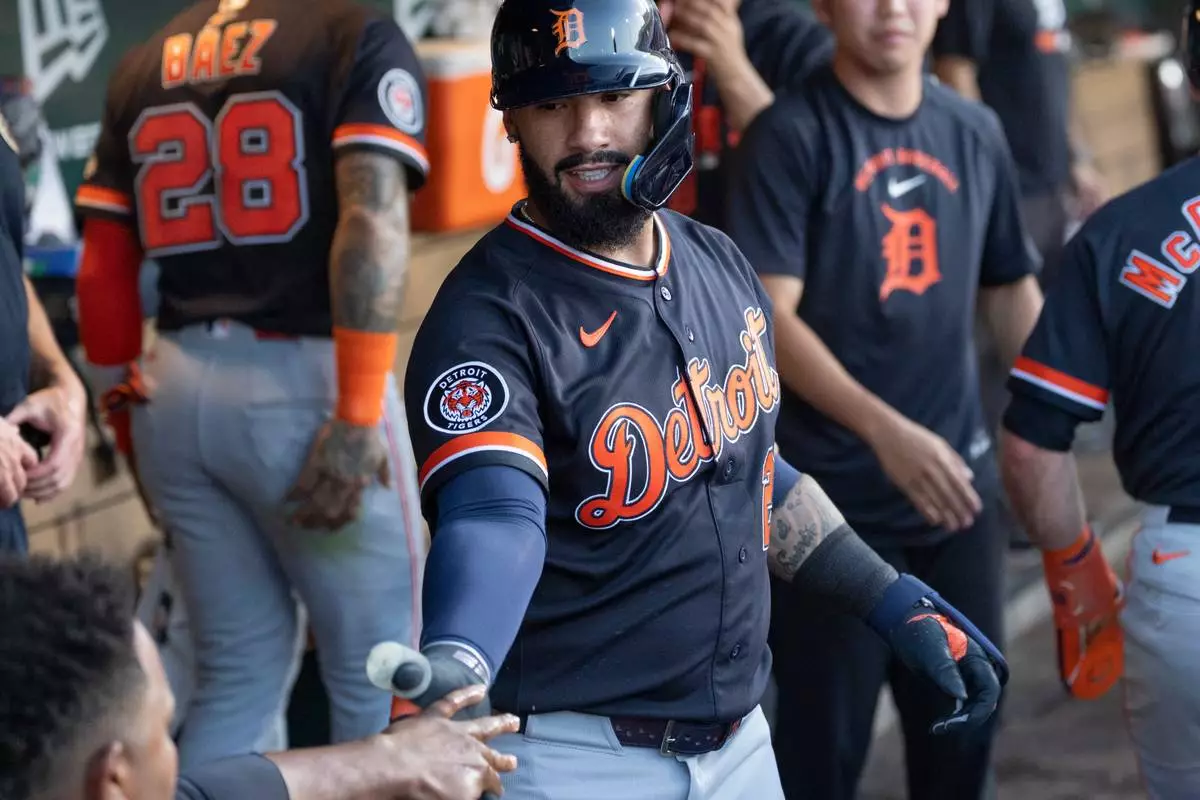
Detroit Tigers' Gleyber Torres celebrates after hitting a two-run home run during the fifth inning of a baseball game against the Athletics Saturday, Aug. 1, 2026, in West Sacramento, Calif. (AP Photo/Sara Nevis)
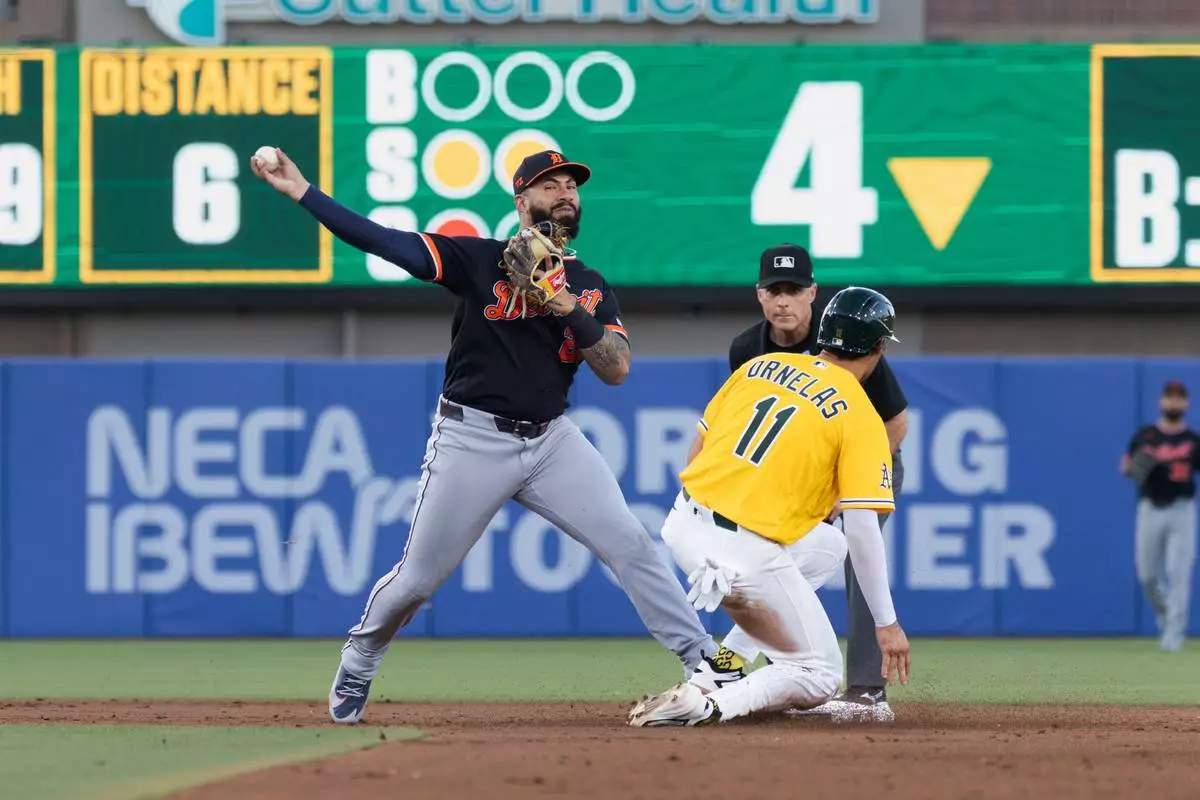
Detroit Tigers second baseman Gleyber Torres, left, attempts to turn a double play after getting Athletics' Jonathan Ornelas (11) out during the fourth inning of a baseball game Saturday, Aug. 1, 2026, in West Sacramento, Calif. (AP Photo/Sara Nevis)
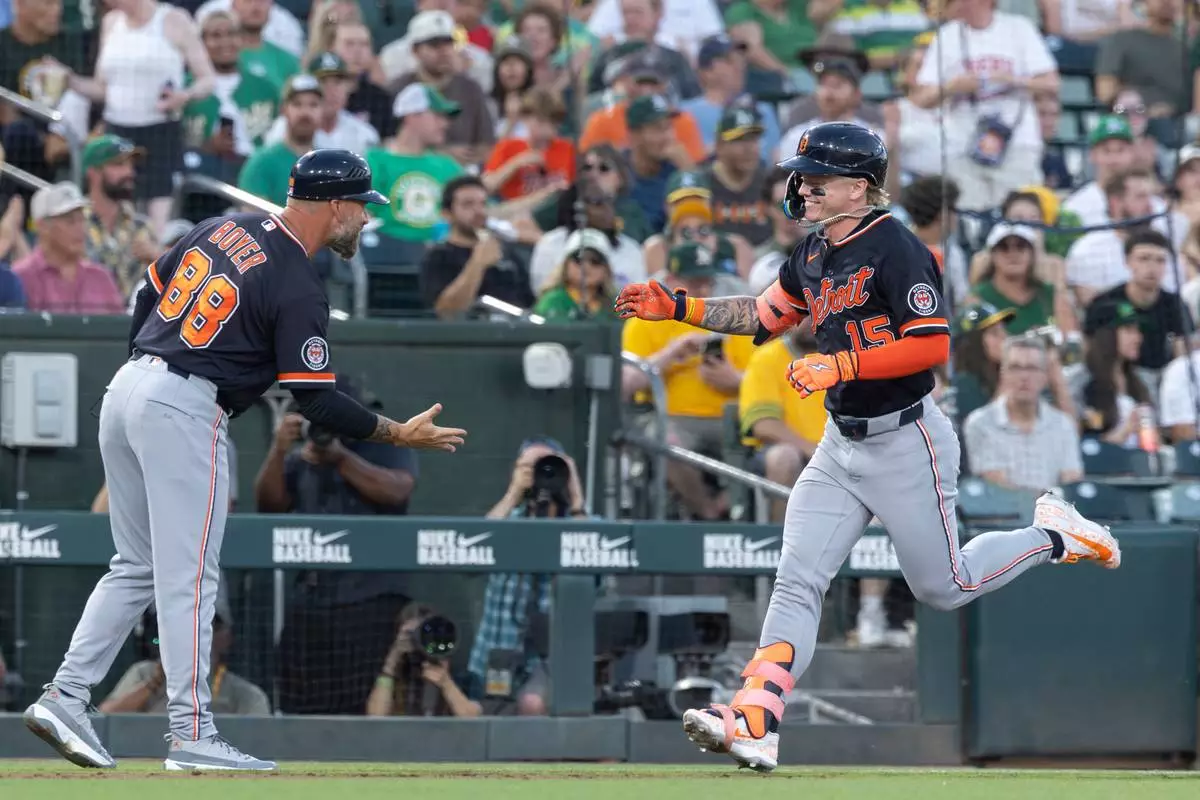
Detroit Tigers' Max Clark, right, greets third base coach Billy Boyer (88) after hitting a two-run home run during the sixth inning of a baseball game against the Athletics, Saturday, Aug. 1, 2026, in West Sacramento, Calif. (AP Photo/Sara Nevis)

Detroit Tigers' Max Clark celebrates after hitting a two-run home run during the sixth inning of a baseball game against the Athletics Saturday, Aug. 1, 2026, in West Sacramento, Calif. (AP Photo/Sara Nevis)