Kansas City, Missouri, would issue $600 million in bonds for a new downtown stadium for Major League Baseball's Royals under a proposal officials are pursuing months after Kansas lured professional football's Chiefs over the state line with a massive stadium subsidy.
Mayor Quinton Lucas and nine of 12 City Council members introduced a proposed ordinance Thursday to allow the city manager to negotiate with the Royals over a new stadium near the city's historic Union Station and its World War I museum, about 6 miles northwest of the Royals' current Kauffman Stadium.
The city expects the new stadium to cost $1.9 billion, and Missouri last year enacted a law allowing the state to cover half, or $950 million. If Kansas City issued its bonds, the Royals would need $350 million in private funds.
Kauffman Stadium sits beside the Chiefs' Arrowhead Stadium in the Truman Sports Complex, owned by Jackson County, Missouri, and home to both teams since 1973. Their stadium leases expire in 2031, and in April 2024, county voters rejected extending a tax that would have helped pay for renovations of both.
The Royals also have considered another site for a new stadium about 5 miles north in neighboring North Kansas City.
Kansas legislative leaders who would have to approve a deal to attract the Royals have shown little appetite for one after the state committed in December to issuing $2.4 billion in bonds to cover 60% of the cost of a new, $3 billion domed stadium for the Chiefs in Kansas City, Kansas. Two of them, House Speaker Dan Hawkins, a Republican, and Minority Leader Brandon Woodard, a Democrat, issued a joint statement Friday congratulating Missouri, adding, “We're looking forward to what's ahead.”
The Kansas City, Missouri, City Council could vote on the proposed ordinance as early as Thursday, but City Manager Mario Vasquez said the work toward keeping the team “is just beginning.”
The team said in a statement Friday: "We are grateful for their engagement in this process, as well as for the critical work of the State of Missouri, and look forward to more detailed conversations as we consider solutions that are best for our team, our fans, and our community.”
Economists who have studied pro sports teams have concluded for decades that subsidizing stadiums isn’t worth the cost for their communities because the venues pull economic activity away from other parts of the area instead of expanding the overall economy. Yet states and cities continue providing subsidies to renovate stadiums or build new ones.
Missouri Gov. Mike Kehoe called the Royals “a key economic catalyst” for his state.
“The State of Missouri is committed to continue working alongside the Kansas City Royals organization and the City of Kansas City to ensure the Royals remain in Missouri — where they belong," Kehoe said.
Of the 60 stadiums used by MLB and NFL teams, 49 are publicly owned or sit on public land.
New York state and Erie County together chipped in $850 million, or 40% of the cost, for the Buffalo Bills' new $2.1 billion NFL stadium. Ohio state and local governments have pledged $1.2 billion to cover half the cost of a new stadium for the NFL's Cleveland Browns, though the state's portion is held up by a lawsuit.
Kansas officials have described the Chiefs' stadium as the largest economic development project in state history. The team also plans a retail district around the stadium and a new training complex in Olathe, Kansas.

Kansas City Royals shortstop Bobby Witt Jr. runs to second after hitting a double during the third inning of a baseball game against the Chicago White Sox, Thursday, April 9, 2026, in Kansas City, Mo. (AP Photo/Charlie Riedel)

Kansas City Royals starting pitcher Seth Lugo throws during the first inning of a baseball game against the Chicago White Sox, Thursday, April 9, 2026, in Kansas City, Mo. (AP Photo/Charlie Riedel)
Stocks drifted mostly lower on Wall Street and oil prices slipped Friday ahead of planned U.S.-Iran talks following a shaky ceasefire agreement.
The S&P 500 inched 0.1% lower after a day of choppy trading. The Dow Jones Industrial Average fell 0.6% and the Nasdaq composite rose 0.4%.
The major indexes each notched a weekly gain for the second week in a row. They have been gaining ground this month amid optimism that the war with Iran could be heading toward a resolution. High-level talks between negotiators from Iran and the U.S. are planned for Saturday in Pakistan.
The benchmark S&P 500 has erased most of its losses from March and is just 2.3% short of its all-time high set in January. The market is still prone to big swings on developments around the war.
Oil prices have been behind many of the stock market’s sharp movements. They've risen sharply as shipping through the vital Strait of Hormuz essentially stalled since the war began.
Brent crude oil, the international standard, has gone from roughly $70 per barrel before the war in late February to more than $119 at times. Brent for June delivery fell 0.8% to $95.20 per barrel Friday.
A barrel of U.S. crude oil for May delivery dropped 1.3% to $96.57.
The situation leading into the peace talks over the weekend remains uncertain. Iran’s semiofficial Tasnim news agency claimed that talks wouldn’t happen unless Israel stopped its attacks in Lebanon.
The conflict is behind surging inflation in the U.S. in March. The government reported the biggest spike in inflation in four years as prices at the gas pump jumped. The inflation increase was just short of what economists expected.
Bond yields rose a bit following the latest inflation update. The yield on the 10-year Treasury climbed to 4.32% from 4.29% late Thursday.
Inflation has been a lingering concern for economists. Prices on a range of consumer goods and services are already stubbornly high, in part from the impact of extensive global tariffs. Higher gas prices are immediately felt by drivers at the pump, but they could eventually raise prices on everything from food to airfare as companies pass along higher costs for shipping and fuel.
Analysts are warning that there might be a drawn out impact from the oil supply shock in the months ahead.
“While I’m glad to see the effects to be less than expected in March, the effects in April are now more likely to be worse,” Jamie Cox, managing partner for Harris Financial Group, wrote in a research note.
Consumer sentiment slumped 10.7% percent in April, according to a closely watched monthly survey from the University of Michigan. It also shows that consumers are growing more worried about inflation, with year-ahead expectations surging to 4.8% in April from 3.8% in March.
Inflation remains a major concern for the Federal Reserve, which has signaled more caution amid worries about inflation reheating. The rate of inflation remains above the central bank's 2% target. The threat of rising inflation will likely mean the central bank continues to hold interest rates steady. Several Fed officials have also said a rate hike may be needed if inflation doesn’t cool.
Lower interest rates help boost stocks and other investments by lowering borrowing costs. Interest rate cuts also risk worsening inflation.
Most companies in the S&P 500 lost ground Friday, with health care and financial company stocks driving much of the decline. Eli Lilly and Co. fell 1.6% and Charles Schwab closed 2.5% lower.
Technology stocks with hefty values helped offset losses elsewhere. Nvidia rose 2.6% and Broadcom rose 4.7%.
All told, the S&P 500 fell 7.77 points to 6,816.89. The Dow dropped 269.23 points to 47,916.57, and the Nasdaq gained 80.48 points to close at 22,902.89.
Markets in Asia gained ground while markets in Europe were mixed.
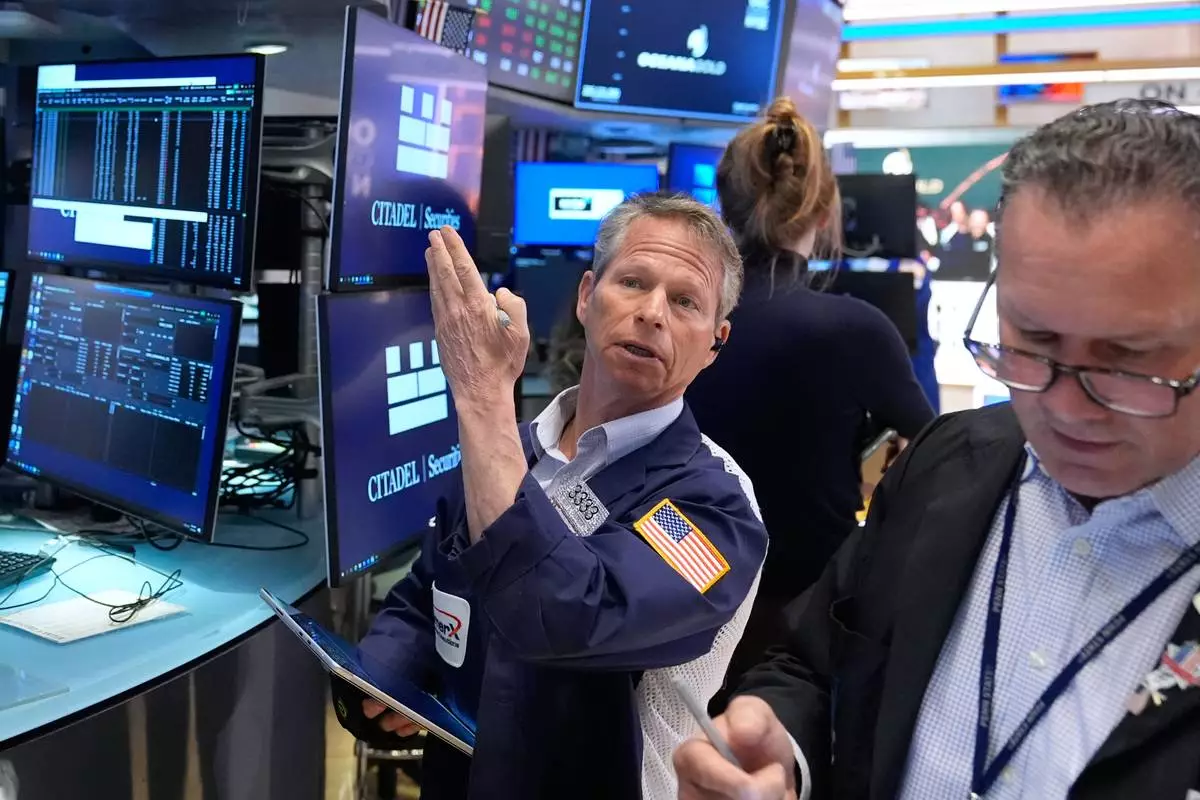
Bobby Charmak works on the floor at the New York Stock Exchange in New York, Tuesday, April 7, 2026. (AP Photo/Seth Wenig)
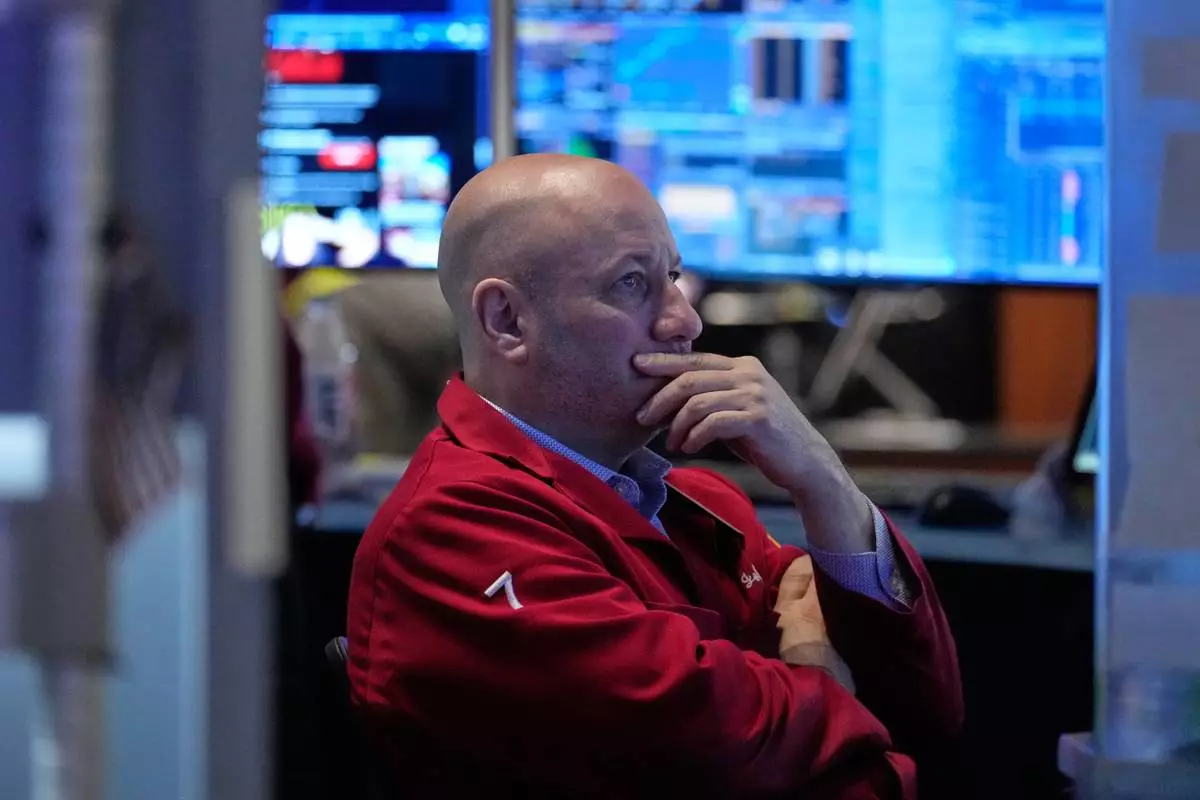
John Mauro works on the floor at the New York Stock Exchange in New York, Tuesday, April 7, 2026. (AP Photo/Seth Wenig)
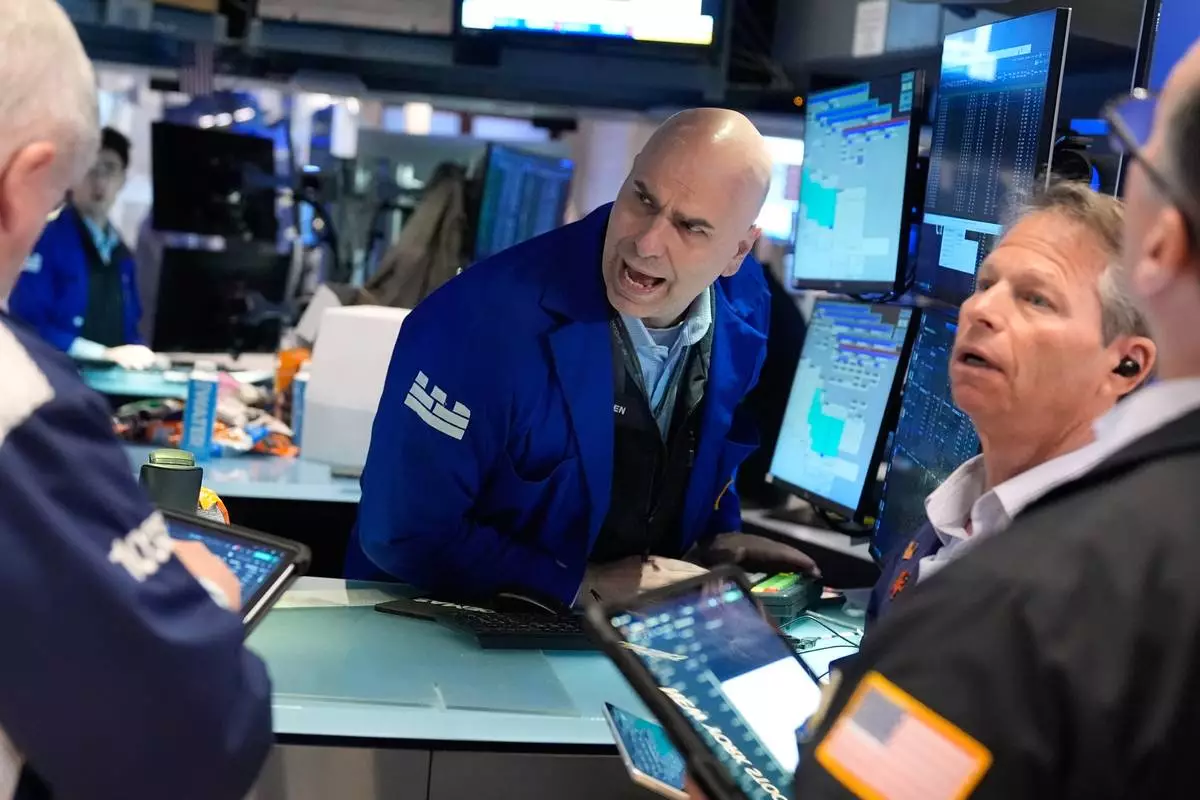
Philip Finale works on the floor at the New York Stock Exchange in New York, Tuesday, April 7, 2026. (AP Photo/Seth Wenig)
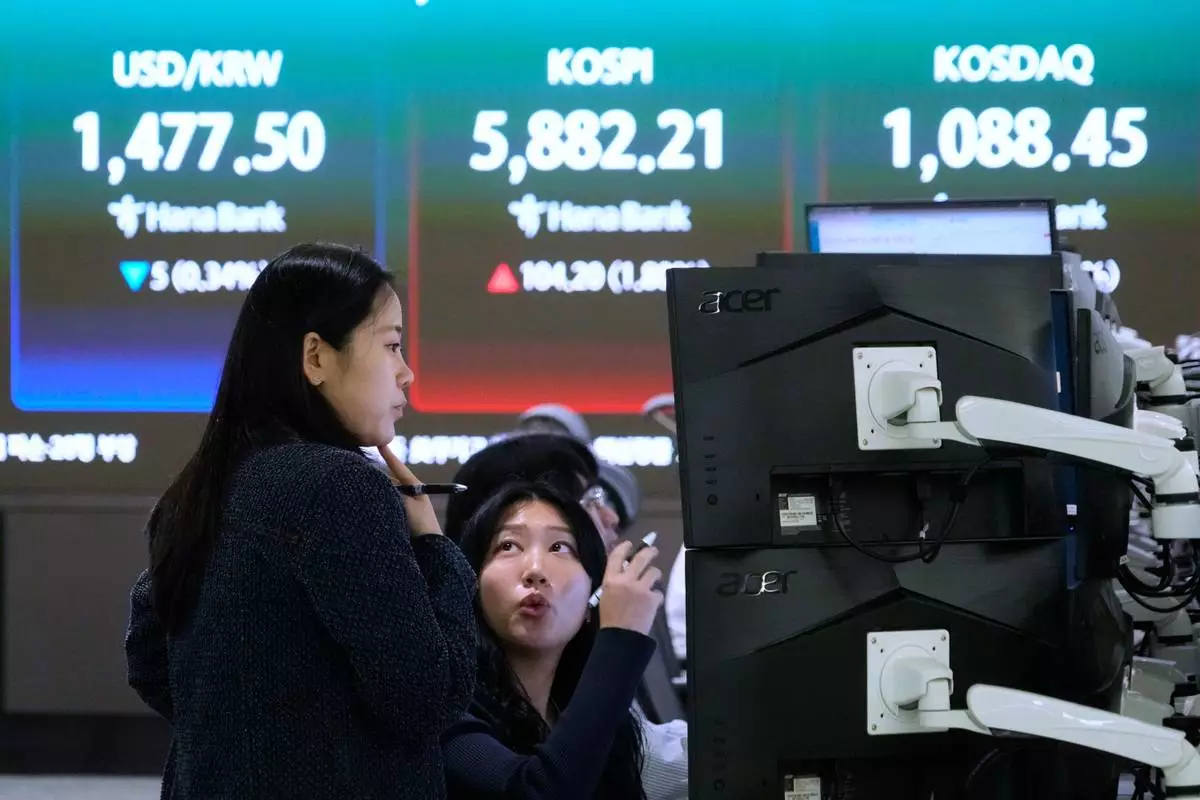
Currency traders work near a screen showing the Korea Composite Stock Price Index (KOSPI), top center, and the foreign exchange rate between U.S. dollar and South Korean won, top center left, at the foreign exchange dealing room of the Hana Bank headquarters, in Seoul, South Korea, Friday, April 10, 2026. (AP Photo/Ahn Young-joon)
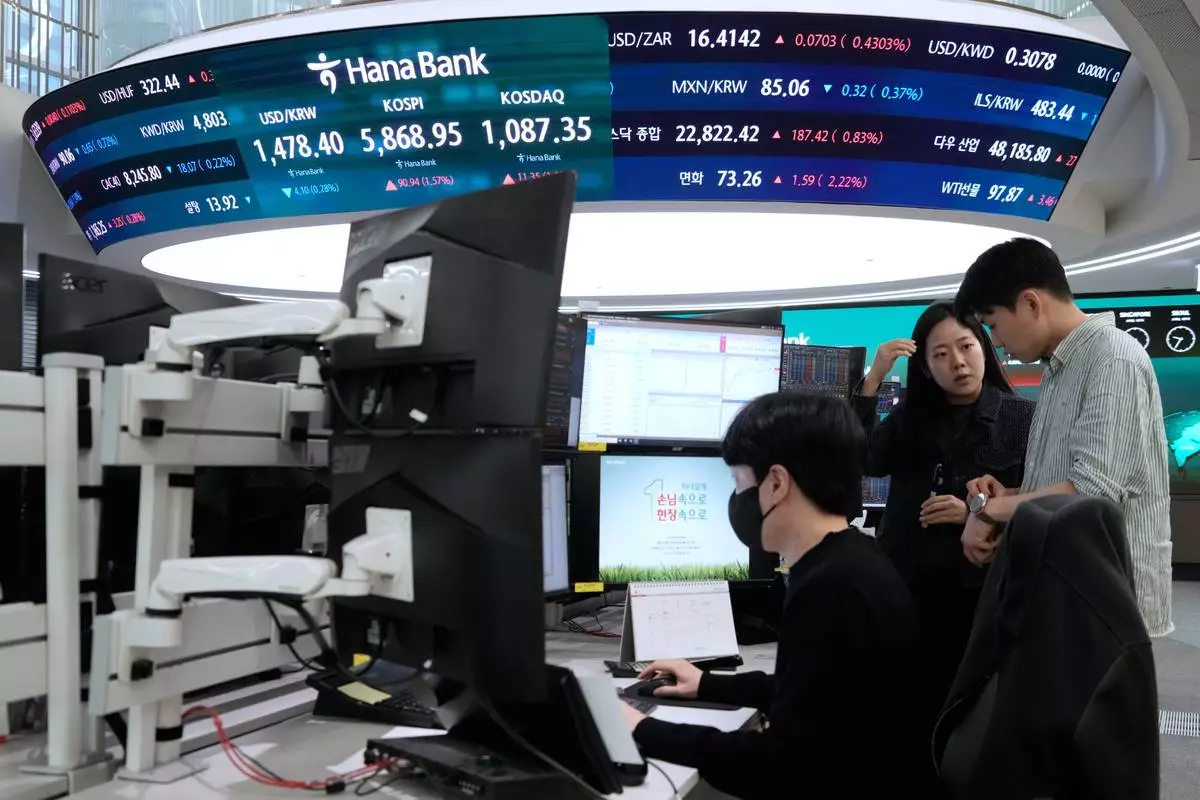
Currency traders work near a screen showing the Korea Composite Stock Price Index (KOSPI), top center, and the foreign exchange rate between U.S. dollar and South Korean won, top center left, at the foreign exchange dealing room of the Hana Bank headquarters, in Seoul, South Korea, Friday, April 10, 2026. (AP Photo/Ahn Young-joon)
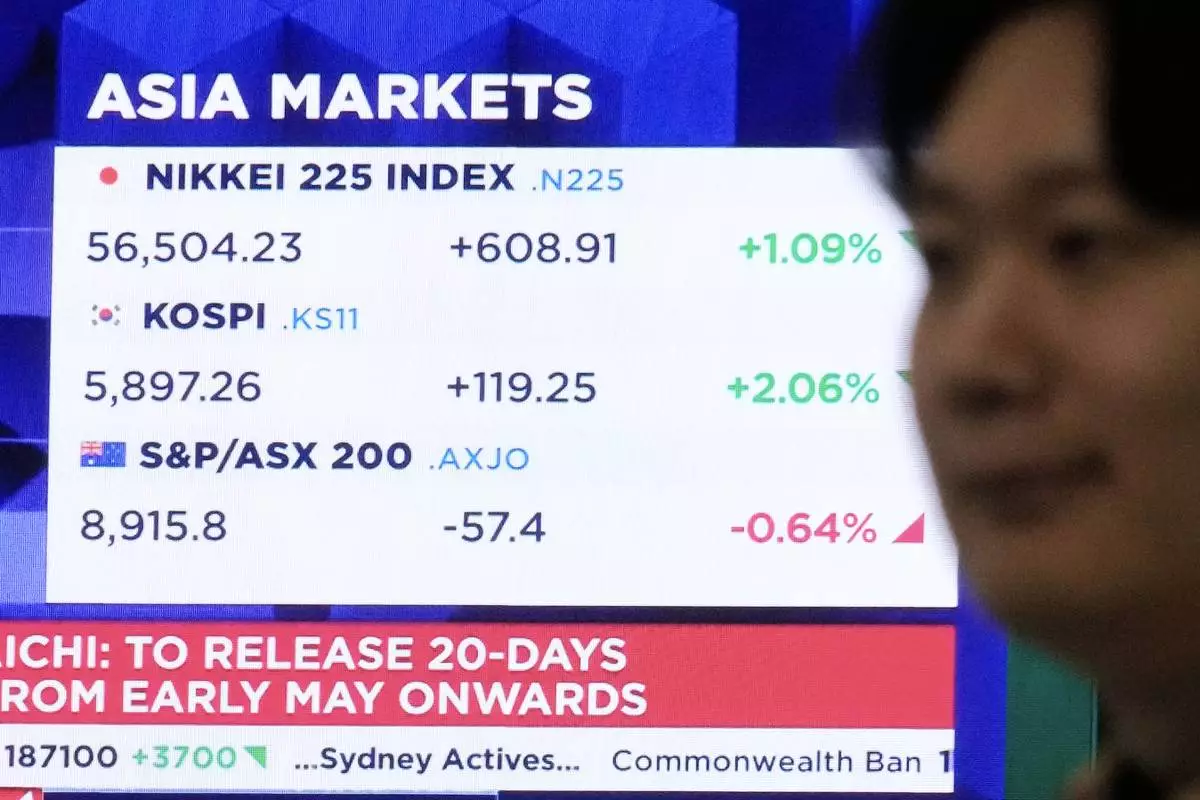
A screen showing Asia markets indexes at the foreign exchange dealing room of the Hana Bank headquarters, in Seoul, South Korea, Friday, April 10, 2026. (AP Photo/Ahn Young-joon)
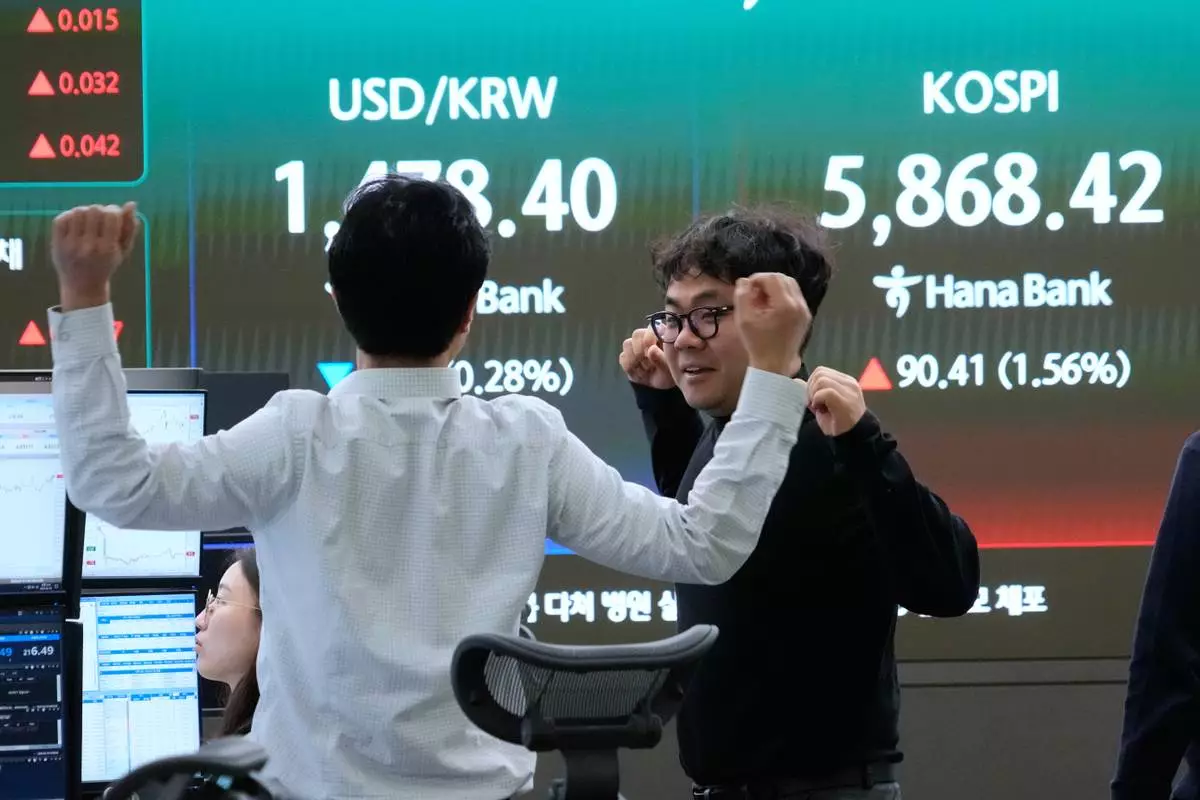
Currency traders stretch near a screen showing the Korea Composite Stock Price Index (KOSPI), right, and the foreign exchange rate between U.S. dollar and South Korean won at the foreign exchange dealing room of the Hana Bank headquarters, in Seoul, South Korea, Friday, April 10, 2026. (AP Photo/Ahn Young-joon)