China posted solid first-quarter growth momentum, with infrastructure investment and machinery activity surging as policy support and favorable conditions took hold.
Data showed that excavator usage, a key gauge of construction demand, jumped 16 percentage points in March from February and 4 points from January, underscoring a broad recovery in the sector.
"Thanks to the implementation of a combination of policy measures, the construction of major projects, and improved weather conditions, 19 provinces saw higher operation rates in March compared to January, showing an accelerated pace of resumption of work," said Shen Chunfeng, a big data expert at ROOTECH, a digital transformation solutions provider.
During this period, concrete equipment and port equipment performed particularly well, with operation rates rising by more than 2 percentage points year on year.
By region, ten provinces including Ningxia Hui Autonomous Region, Chongqing Municipality, and Yunnan Province saw rapid year-on-year growth in construction volume. Among them, western provinces accounted for half, becoming a key driver of national investment and construction growth in the first quarter.
Accelerated infrastructure development is being underpinned by stronger financing. Official data show issuance of new special-purpose bonds jumped 20.8 percent year on year in the first quarter. Contracts for projects tied to computing infrastructure and software and hardware development rose 4.7 percent, while investment in frontier sectors such as artificial intelligence (AI) and humanoid robots surged 45.5 percent.
"Currently, under policy guidance, investment vitality is emerging in cutting-edge fields. In particular, investment in digital infrastructure represented by computing power is advancing steadily, while investment in frontier and leading-edge technology sectors such as AI is gathering pace significantly. This not only provides strong support for the stable growth of investment scale in the opening year of the 15th Five-Year Plan period (2026-2030) but also lays a solid foundation and builds momentum for the development of an intelligent economy," said Xing Yuguan, an associate researcher of the Big Data Development Department under the National Information Center of the NDRC.

China’s economy posts strong Q1 rebound on policy support, infrastructure surge
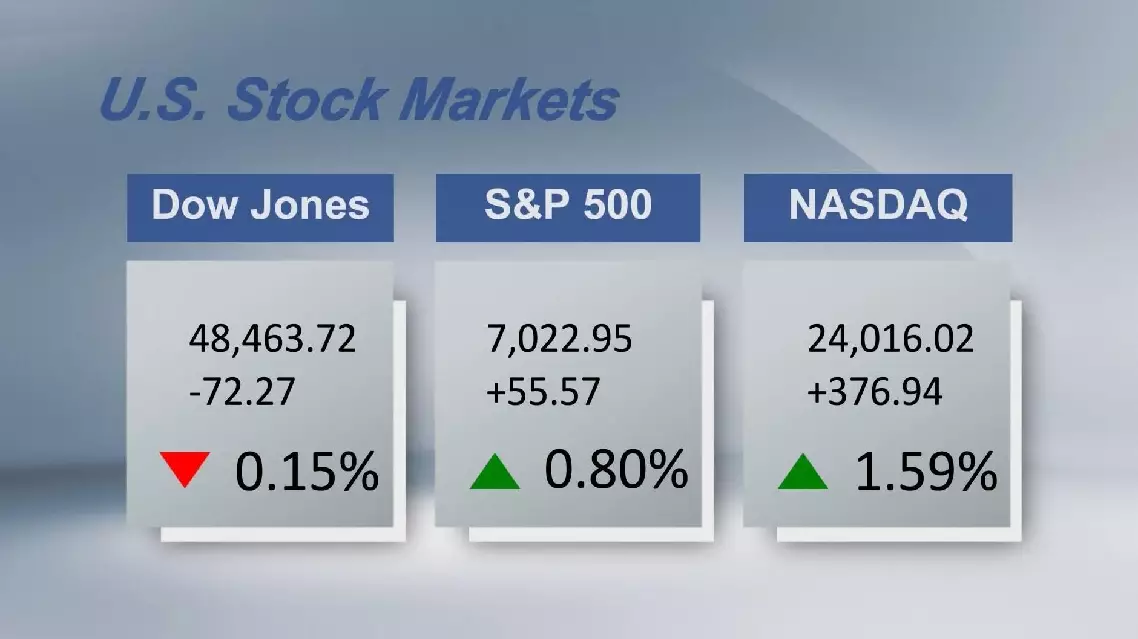
U.S. stocks ended mixed on Wednesday, with the S and P 500 and Nasdaq Composite rising to fresh all-time highs, as investors remained hopeful about progress toward a U.S.-Iran peace deal.
The Dow Jones Industrial Average fell 0.15 percent to 48,463.72. The S and P 500 added 0.8 percent to a new record close of 7,022.95. The Nasdaq Composite Index rose 1.59 percent to 24,016.02, extending its winning streak to 11 consecutive sessions.
Seven of the 11 primary S and P 500 sectors closed lower, with materials and industrials leading the laggards at declines of 1.3 percent and 1.24 percent, respectively. Technology and consumer discretionary were the top performers, rising 2.08 percent and 1.37 percent.
Stocks have rallied strongly this week on hopes that a deal between the United States and Iran may materialize. U.S. President Donald Trump offered further encouragement, telling Fox Business in an interview on Wednesday that the Iran war is "very close to being over."
Broadcom was among the session's standout performers, rising 4.19 percent after Meta Platforms announced an extension of their partnership to deploy custom chips based on Broadcom's technology.
Meanwhile, the U.S. economy grew at a "slight to modest pace" over the past six weeks, even as consumers faced higher prices and increasing demand for assistance, according to the Federal Reserve's Beige Book released Wednesday. The report, covering the 12 Fed districts, described the Iran war as "a major source of uncertainty" for businesses. Price growth was characterized as "moderate," despite a sharp rise in energy and fuel costs.
"Many Districts continued to report signs of consumer financial strain, increased price sensitivity, and rising demand at food banks and other social service organizations, while spending among higher-income consumers was resilient," the Beige Book stated.
Shares of all the "Magnificent Seven" technology giants ended higher except for Amazon, led by a 7.62 percent surge in Tesla.
Bank of America rose nearly 2 percent and Morgan Stanley advanced 4.52 percent after reporting better-than-expected quarterly results. Goldman Sachs kicked off bank earnings season on Monday, followed by Wells Fargo, JPMorgan Chase and Citigroup on Tuesday.
Snap Inc. surged nearly 8 percent after the company announced it would lay off approximately 16 percent of its global workforce, with its CEO Evan Spiegel citing "rapid advancements in artificial intelligence" as a key factor.
U.S. stocks close mixed with S and P 500, Nasdaq hitting record highs