Skip to Content Facebook Feature Image

Xi's remarks during meeting with KMT leader boost confidence in peaceful cross-Strait development

China

China

China

Xi's remarks during meeting with KMT leader boost confidence in peaceful cross-Strait development

2026-04-12 16:58 Last Updated At:04-13 11:48

Communist Party of China (CPC) Central Committee General Secretary Xi Jinping's remarks during his meeting with Cheng Li-wun, chairwoman of the Chinese Kuomintang (KMT) party, have boosted the public's confidence in peaceful development across the Taiwan Strait.

Xi met with Cheng in Beijing on Friday. She is the first KMT chairperson that has led a delegation to the Chinese mainland in the past decade.

During the meeting, Xi expressed the mainland's willingness to share its development opportunities and achievements with compatriots in Taiwan and jointly build a stronger Chinese economy.

Taiwan's United Daily News described this meeting in a commentary as being kind and sincere, pointing out that peace and tranquility should be a common goal of residents and politicians on both sides of the Strait.

Wang Feng, president of Taipei-based China Times newspaper, highly commented on the Chinese mainland's rapid advancements in science and technology in an interview, saying the mainland's development can be a development model for Taiwan.

"I hope the two sides of the Strait could have normal exchanges and mutual learning. The mainland's development can serve as a reference for Taiwan's development. How wonderful that would be," Wang said.

Hsu Meng-hsiang, deputy secretary general of the Labor Party of Taiwan, highlighted the role of youth in cross-Strait relations and the importance that they visit the mainland and see its development in their own eyes to eliminate misgivings.

"Peaceful and stable cross-Strait relations mean a greater stage for the young people in Taiwan. Peaceful development across the Strait can drive economic cooperation. It allows the young people in Taiwan to have opportunities to take part in the mainland's development and realize their personal ambitions in the process of national rejuvenation," Hsu said.

Taiwan youths and entrepreneurs living in Xiamen, east China's coastal Fujian Province situated opposite the Taiwan island, have hailed the visit, saying it allows more compatriots in Taiwan to see the real mainland and the fact that Taiwan's future depends on the strength of the whole country and national rejuvenation bears on their own interests.

"For compatriots from Taiwan like us who have been working and living in the mainland for a long time, this visit is a strong boost that give us more confidence in the integrated development of the two sides of the Strait. We look forward to more activities that promote integrated development and exchanges like this," said Wang Shenhao, a Taiwan youth living in Xiamen.

"Over the past few years, the mainland has kept advancing high-level opening-up and integrated cross-Strait development, creating favorable conditions for compatriots and businesses from Taiwan. People on both sides of the Strait are of one family. It is a natural trend that we go closer and closer. I believe that with concerted efforts, cross-Strait relations will move steadily toward peaceful and integrated development," said Wu Chia-ying, executive vice president of the Association of Taiwan Investment Enterprises on the Mainland and honorary president of the Taiwan Businessmen Association in Xiamen.
Xi's remarks during meeting with KMT leader boost confidence in peaceful cross-Strait development
Xi's remarks during meeting with KMT leader boost confidence in peaceful cross-Strait development
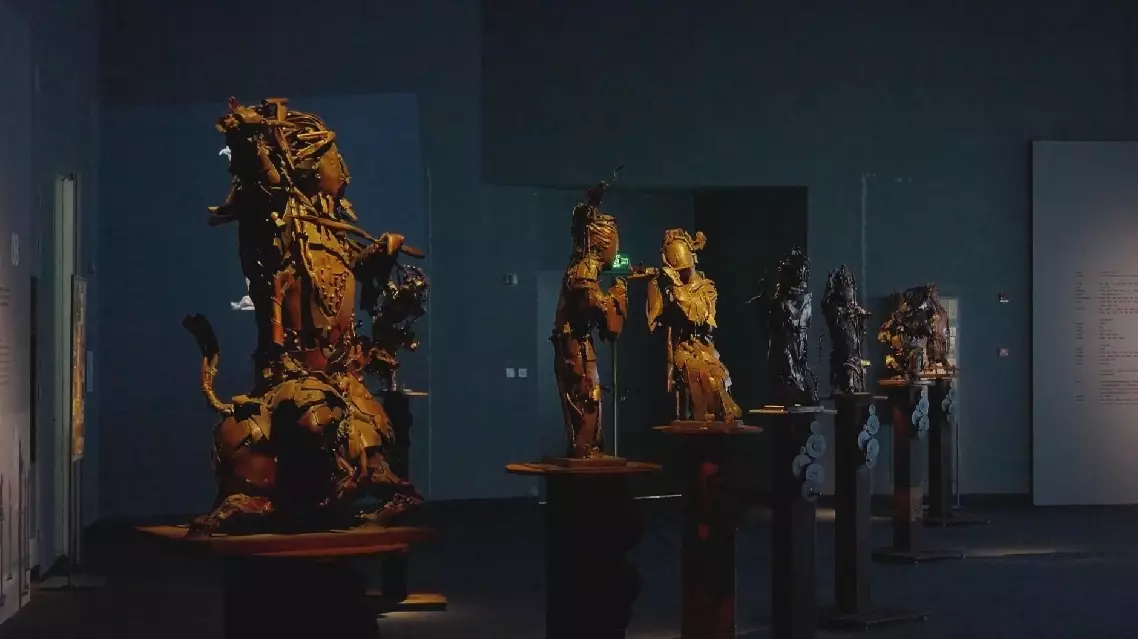
Artists have reimagined ancient themes through a modern lens at the 60th Venice Biennale China National Pavilion Exhibition, now underway in Shanghai.

The main feature of the exhibition is a fully immersive project by artist Che Jianquan, who has placed consecutive screens placed side by side to present his two-decade-long documentation of the same pavilion since 2003.

Through his lens, the artist captures the pavilion, as it emerges and disappears amidst mist and clouds, evoking the aesthetic of misty landscapes in traditional Chinese ink paintings.

"At the beginning, I wanted to use painting to document my feeling, but later I realized that painting was somewhat powerless. So, starting in 2003, I began using the earliest video equipment to start recording. What I care about more is a place—a very small location—and the unique connection it has within that field to history and to the culture of that region. I think this is something I hope to achieve: through a seemingly ordinary scene, to uncover the stories behind it, as well as its possible influence on both the past era and the present," said Chen.

Established in 1895, the Venice Biennale is one of the premier events in the global art world. This year, the China National Pavilion Exhibition, under the theme "Atlas: Harmony in Diversity," presents not only the documentary archives of 100 Chinese paintings held overseas, but also seven contemporary artworks created by seven Chinese artists exploring themes, such as architecture, landscapes, figures, flora and fauna.

"The core of the Venice Biennale is contemporary art, reflecting the spirit of the present era—yet the present and history cannot be separated. This exhibition is rooted in the tradition of Chinese painting across dynasties, drawing from over 20,000 individual works that took us twenty years to collect globally," said Wang Xiaosong, an artist and the curator of the exhibition.

"Notably, we discovered that more than 3,000 of these paintings had been lost overseas, which we spent two decades retrieving through digital tools. This is how we engage with traditional art: through each artist's reflection and a new understanding of the relationship between the ancients, the present, and the future," he added.

Wang drew special attention to a piece by the modern artist Qiu Zhenzhong, who he said merges the art of Chinese gardens with calligraphy using traditional methods to showcase contemporary issues such as environmental and ecological change.

"It's like a dialogue with nature," Wang said.

The exhibition in Shanghai is the final stop of the national tour, following the legs in the southwest Chinese city of Chongqing and the southern Chinese city of Guangzhou, and will run until May 31.

Exhibition in Shanghai bridges contemporary art with centuries of Chinese artistic tradition

Exhibition in Shanghai bridges contemporary art with centuries of Chinese artistic tradition

Recommended Articles