HOUSTON (AP) — Never-before-glimpsed views of the moon’s far side. Check. Total solar eclipse gracing the lunar scene. Check. New distance record for humanity. Check.
With NASA’s lunar comeback a galactic-sized smash thanks to Artemis II, the world is wondering: What’s next? And how do you top that?
Click to Gallery
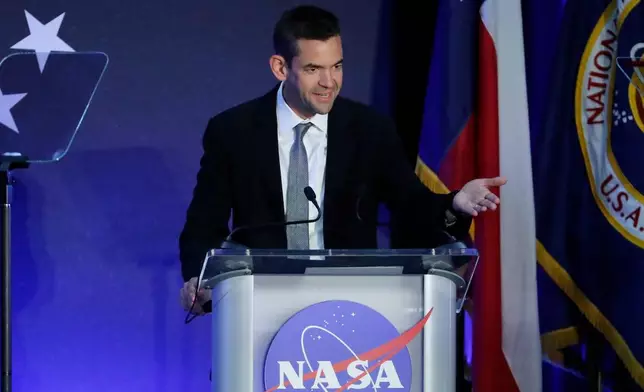
Jared Isaacman, NASA Administrator, speaks before introducing the Artemis II crew during a return event Saturday, April 11, 2026, at Ellington Field in Houston. (AP Photo/Michael Wyke)
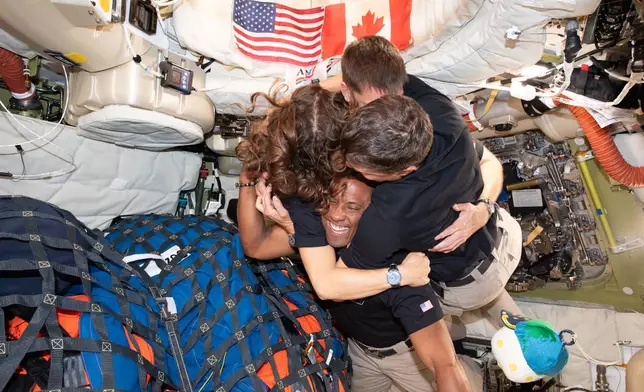
In this image provided by NASA, The Artemis II crew, clockwise from left, Mission Specialist Christina Koch, Mission Specialist Jeremy Hansen, Commander Reid Wiseman, and Pilot Victor Glover, take time out for a group hug inside the Orion spacecraft on their way home on Wednesday, April 7, 2026. (NASA via AP)
In this image provided by NASA, the Artemis II crew photographed a bright portion of the Moon on April 6, 2026. (NASA via AP)
The Artemis II crew, from left, Jeremy Hansen, Reid Wiseman, Christina Koch and Victor Glover gather with Hansen as he speaks during a crew return event Saturday, April 11, 2026, at Ellington Field in Houston. (AP Photo/Michael Wyke)
In this image provided by NASA, The Artemis II crew captured this view of an Earthset on Monday, April 6, 2026, as they flew around the Moon. (NASA via AP)
“To people all around the world who look up and dream about what is possible, the long wait is over,” NASA Administrator Jared Isaacman said as he introduced Artemis II commander Reid Wiseman, pilot Victor Glover, Christina Koch and Canada’s Jeremy Hansen at Saturday’s jubilant homecoming celebration.
Now that the first lunar travelers in more than a half-century are safely back in Houston with their families, NASA has Artemis III in its sights.
“The next mission’s right around the corner,” entry flight director Rick Henfling observed following the crew’s Pacific splashdown on Friday.
In a mission recently added to the docket for next year, Artemis III’s yet-to-be -named astronauts will practice docking their Orion capsule with a lunar lander or two in orbit around Earth. Elon Musk’s SpaceX and Jeff Bezos’ Blue Origin are racing to have their company’s lander ready first.
Musk’s Starship and Bezos’ Blue Moon are vying for the all-important Artemis IV moon landing in 2028. Two astronauts will aim for the south polar region, the preferred location for Isaacman’s envisioned $20 billion to $30 billion moon base. Vast amounts of ice are almost certainly hidden in permanently shadowed craters there — ice that could provide water and rocket fuel.
The docking mechanism for Artemis III’s close-to-home trial run is already at Florida’s Kennedy Space Center. The latest model Starship is close to launching on a test flight from South Texas, and a scaled-down version of Blue Moon will attempt a lunar landing later this year.
NASA promises to announce the Artemis III crew “soon.” Like 1969’s Apollo 9, Artemis III aims to reduce risk for the moon landings that follow.
Apollo 9 astronaut Rusty Schweickart loved flying the lunar module in low-Earth orbit — “a test pilot’s dream.” But there’s no question, he noted, that “the real astronauts” at least in the public’s mind were the ones who walked on the moon.
Wiseman and his crew put their passion and feelings on full display as they flew around the moon and back, choking up over lost loved ones as well as those left behind on Earth.
During the their nearly 10-day journey, they tearfully requested that a fresh, bright lunar crater be named after Wiseman’s late wife, Carroll, who died of cancer in 2020. They also openly shared their love for one another and Planet Earth, an exquisite yet delicate oasis in the black void that they said needs better care.
Artemis II included the first woman, the first person of color and the first non-U.S. citizen to fly to the moon.
“Wonderful communicators, almost poets,” Isaacman said from the recovery ship while awaiting their return.
Apollo’s manly, all-business moon crews of the 1960s and 1970s certainly did not do group hugs.
For those old enough to remember Apollo, Artemis — Apollo’s twin sister in Greek mythology — couldn’t come fast enough.
Author Andy Chaikin said he felt like Rip Van Winkle awakening from a nearly 54-year nap. His 1994 biography “A Man on the Moon” led to the HBO miniseries “From the Earth to the Moon.”
“It’s amazing how far we’ve come and how different this experience is from back then,” Chaikin said from Johnson Space Center late last week.
The hardest part, according to NASA Associate Administrator Amit Kshatriya, is becoming so close to the crews and their families and then blasting them to the moon. He anxiously monitored Friday’s reentry alongside the astronauts’ spouses and children.
“You know what’s at stake,” Kshatriya confided afterward. “It’s going to take risk to explore, but you have to make sure you find the right line between being paralyzed by it and being able to manage it.”
Calling it “mission complete” only after being reunited with his two daughters, Wiseman issued a rallying cry to the rows of blue-flight-suited astronauts at Saturday’s celebration.
“It is time to go and be ready,” he said, pointing at them, “because it takes courage. It takes determination, and you all are freaking going and we are going to be standing there supporting you every single step of the way in every possible way possible.”
The Associated Press Health and Science Department receives support from the Howard Hughes Medical Institute’s Department of Science Education and the Robert Wood Johnson Foundation. The AP is solely responsible for all content.
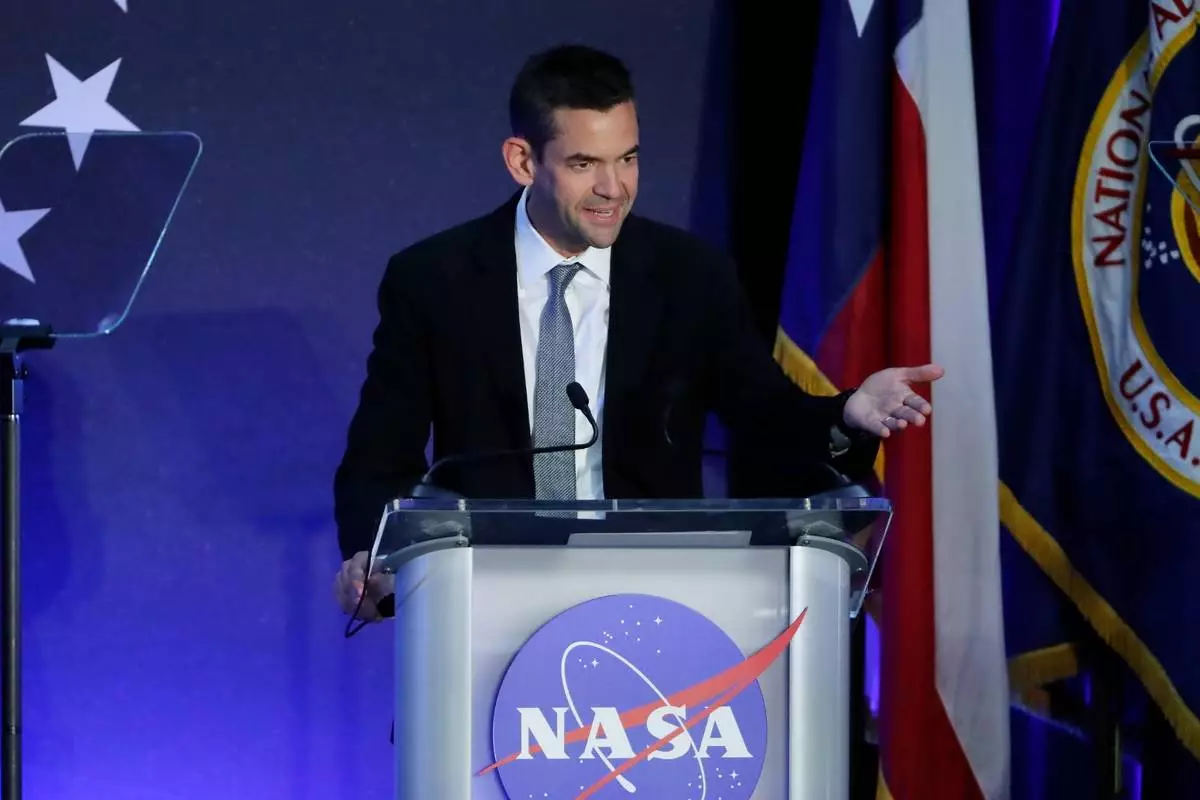
Jared Isaacman, NASA Administrator, speaks before introducing the Artemis II crew during a return event Saturday, April 11, 2026, at Ellington Field in Houston. (AP Photo/Michael Wyke)
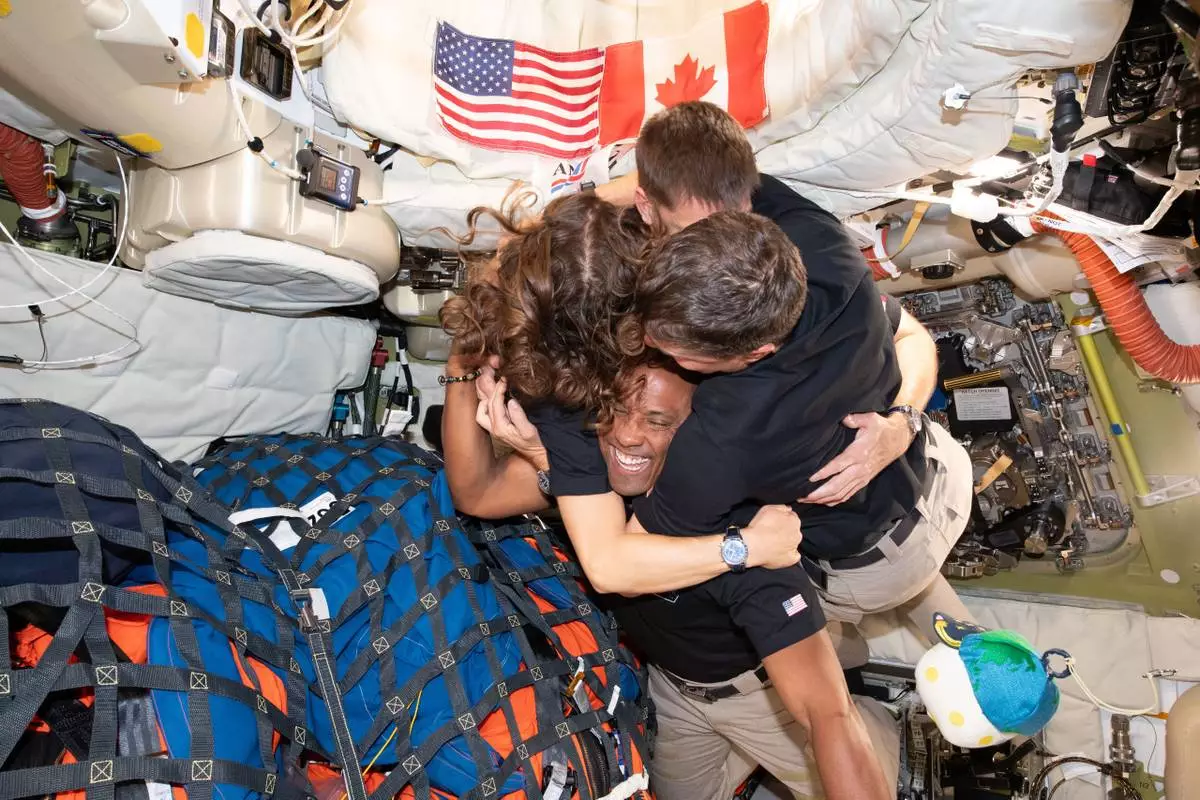
In this image provided by NASA, The Artemis II crew, clockwise from left, Mission Specialist Christina Koch, Mission Specialist Jeremy Hansen, Commander Reid Wiseman, and Pilot Victor Glover, take time out for a group hug inside the Orion spacecraft on their way home on Wednesday, April 7, 2026. (NASA via AP)

In this image provided by NASA, the Artemis II crew photographed a bright portion of the Moon on April 6, 2026. (NASA via AP)

The Artemis II crew, from left, Jeremy Hansen, Reid Wiseman, Christina Koch and Victor Glover gather with Hansen as he speaks during a crew return event Saturday, April 11, 2026, at Ellington Field in Houston. (AP Photo/Michael Wyke)

In this image provided by NASA, The Artemis II crew captured this view of an Earthset on Monday, April 6, 2026, as they flew around the Moon. (NASA via AP)
ISLAMABAD (AP) — President Donald Trump on Sunday said the U.S. Navy would “immediately” begin a blockade to stop ships from entering or leaving the Strait of Hormuz, after historic U.S.-Iran ceasefire talks in Pakistan ended without an agreement or next diplomatic steps in sight.
In his first public comments after the 21-hour talks, Trump sought to exert strategic control over the waterway that was responsible for the shipping of 20% of global oil supplies before the war, hoping to eliminate Iran’s key source of leverage.
A U.S. blockade could further rattle global energy markets and prices for oil, natural gas and related products. It was not immediately clear how it might be carried out, but Trump told Fox News the goal was to ensure all ships could transit: “It’s going to be all or none, and that’s the way it is.”
Trump said he has “instructed our Navy to seek and interdict every vessel in International Waters that has paid a toll to Iran. No one who pays an illegal toll will have safe passage on the high seas.” Other nations would be involved in the blockade, he said, but did not name them.
During the talks, the U.S. military said two destroyers transited the strait ahead of mine-clearing work, a first since the war began. Iran’s state media said the joint military command denied that.
Trump stressed that Tehran’s nuclear ambitions were at the core of the failure to end the war, and the U.S. was ready to “finish up” Iran at the “appropriate moment." In comments to Fox News, he again threatened to strike civilian infrastructure and said he was fine with his widely criticized threat shortly before the ceasefire announcement that a “whole civilization will die tonight.”
The face-to-face talks that ended earlier Sunday were the highest-level negotiations between the longtime rivals since the 1979 Islamic Revolution. Both delegations later left Islamabad.
Neither indicated what will happen after the 14-day ceasefire expires on April 22. Pakistani mediators urged all parties to maintain it. Each side said their positions were clear and blamed the other.
“We need to see an affirmative commitment that they will not seek a nuclear weapon, and they will not seek the tools that would enable them to quickly achieve a nuclear weapon,” Vice President JD Vance, leading the U.S. side, said afterward.
Iran’s parliament speaker Mohammad Bagher Qalibaf, who led Iran's side, said it was time for the United States “to decide whether it can gain our trust or not.” Iranian officials earlier said talks fell apart over two or three key issues, blaming what they called U.S. overreach.
Pakistani Foreign Minister Ishaq Dar said his country will try to facilitate a new dialogue in the coming days. Iran said it was open to continuing the dialogue, Iran’s state-run IRNA news agency reported.
The European Union urged further diplomatic efforts. The foreign minister of Oman, on the Strait of Hormuz' southern coast, called for parties to “make painful concessions." And the Kremlin said Russian President Vladimir Putin “emphasized his readiness” to help bring about a diplomatic settlement in a call with Iran's president.
Iran’s nuclear program had been at the center of tensions long before the U.S. and Israel launched the war on Feb. 28. The fighting has killed at least 3,000 people in Iran, 2,020 in Lebanon, 23 in Israel and more than a dozen in Gulf Arab states, and caused lasting damage to infrastructure in half a dozen Middle Eastern countries.
Tehran has long denied seeking nuclear weapons but insisted on its right to a civilian nuclear program. The landmark 2015 nuclear deal took well over a year of negotiations. Experts say Iran's stockpile of enriched uranium, though not weapons-grade, is only a short technical step away.
An Iranian diplomatic official, speaking on condition of anonymity because of the sensitivity of closed-door talks, denied that negotiations had failed over Iran's nuclear ambitions. “Iran is not seeking to acquire nuclear weapons, but it has the right to nuclear energy for peaceful purposes,” the official said.
Inside Iran, there was fresh exhaustion and anger after months of unrest that had begun with nationwide protests against economic issues and then political ones, and then weeks of sheltering from U.S. and Israeli bombardment.
“We have never sought war. But if they try to win what they failed to win on the battlefield through talks, that’s absolutely unacceptable,” 60-year-old Mohammad Bagher Karami said in Tehran.
Iran’s 10-point proposal for the talks had called for a guaranteed end to the war, including the end of fighting against Iran’s “regional allies,” explicitly calling for a halt to Israeli strikes on the Iranian-backed Hezbollah in Lebanon.
Israel has said the ceasefire deal did not apply in Lebanon, but Iran and Pakistan said otherwise. Negotiations between Israel and Lebanon are expected to begin Tuesday in Washington after Israel’s surprise announcement authorizing talks despite their lack of official relations.
The day the Iran ceasefire deal was announced, Israel pounded Beirut with airstrikes, killing more than 300 people in the deadliest day in Lebanon since the war began, according to the country’s Health Ministry.
Though Israel’s strikes have calmed in Beirut, its attacks on southern Lebanon have intensified alongside the ground invasion it renewed after Hezbollah launched rockets toward Israel in the war's opening days.
Lebanon’s state-run National News Agency reported six people were killed Sunday by a strike in Maaroub village near the coastal city of Tyre.
Israel wants Lebanon's government to assume responsibility for disarming Hezbollah, but the militant group has survived efforts to curb its strength for decades.
Metz reported from Ramallah, West Bank, Boak from Miami and Magdy from Cairo. E. Eduardo Castillo in Beijing, Collin Binkley and Ben Finley in Washington, Kareem Chehayeb in Beirut and Ghaya Ben MBarek in Tunis contributed.

A women sits at a cafe in northern Tehran, Iran, Sunday, April 12, 2026. (AP Photo/Vahid Salemi)

Women walk past a banner depicting the late Iranian Supreme Leader Ayatollah Ali Khamenei, who was killed in the U.S. and Israel strikes on Feb. 28, in northern Tehran, Iran, Sunday, April 12, 2026. (AP Photo/Vahid Salemi)

Vice President JD Vance walking on the tarmac for a planned refueling stop in Ramstein Air Base in Germany, Sunday, April 12, 2026, after attending talks on Iran. (AP Photo/Jacquelyn Martin, pool)
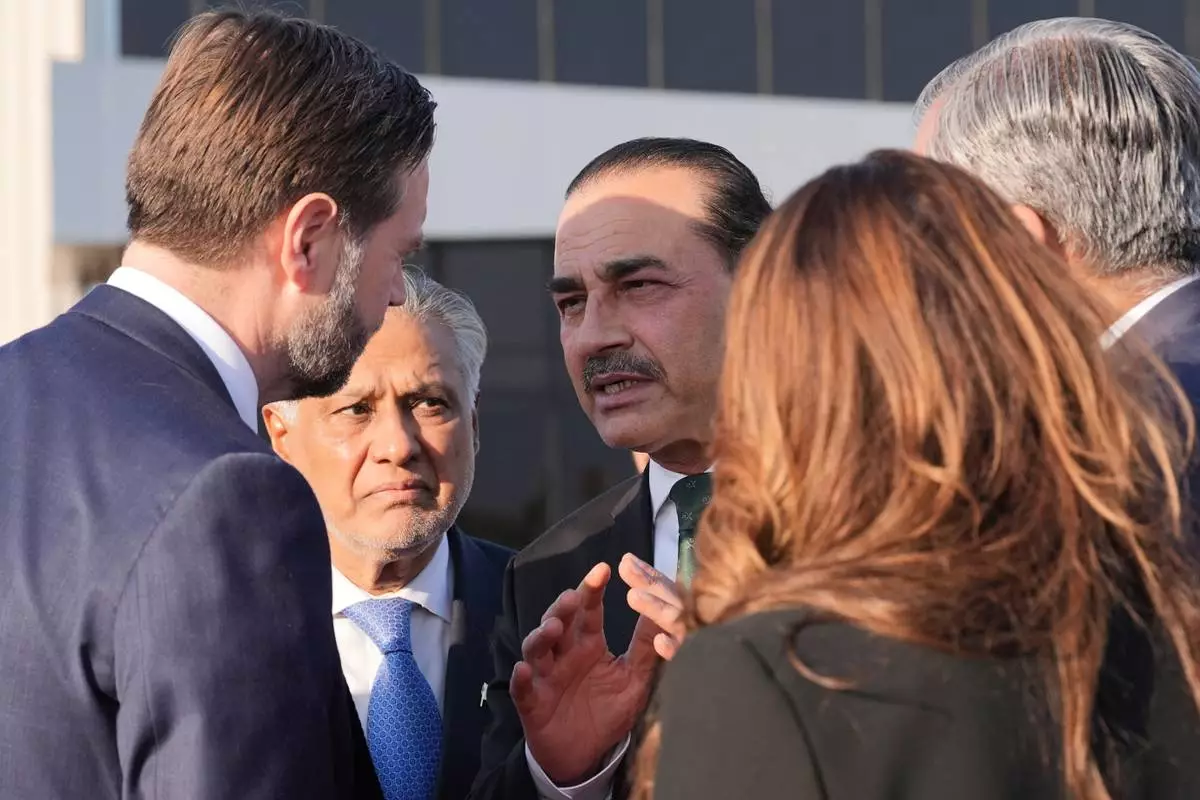
Vice President JD Vance, left, talks to Pakistan's Chief of Defence Forces and Chief of Army Staff Field Marshall Asim Munir, right, and Pakistani Deputy Prime Minister and Foreign Minister Mohammad Ishaq Dar, center, before boarding Air Force Two after attending talks on Iran in Islamabad, Pakistan, Sunday, April 12, 2026. (AP Photo/Jacquelyn Martin, Pool)
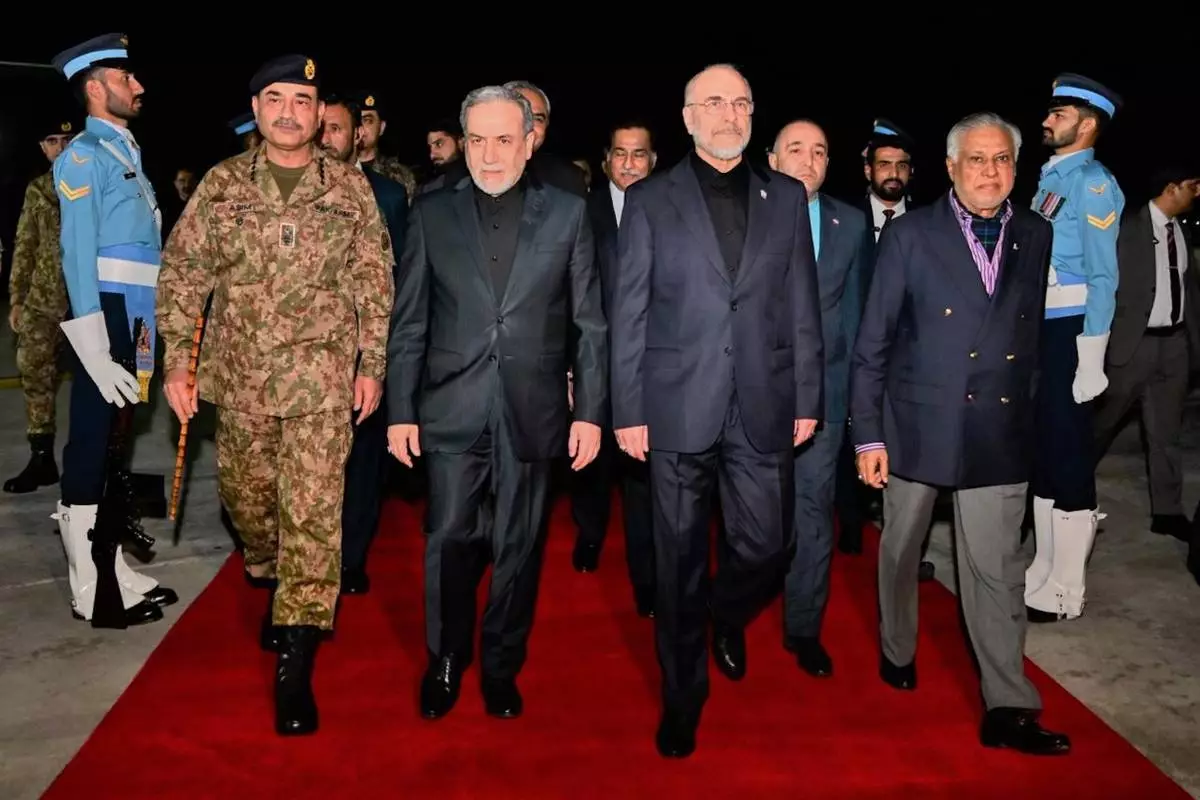
In this photo released by the Pakistan Foreign Ministry, Iran's Parliament Speaker Mohammad Bagher Qalibaf, center right, and Iran's Foreign Minister Abbas Araghchi, center left, are greeted by Pakistan Foreign Minister Ishaq Dar, right, and Army Chief Field Marshal Gen. Asim Munir, left, upon their arrival at Nur Khan airbase in Rawalpindi, Pakistan, Saturday, April 11, 2026. (Pakistan Ministry of Foreign Affairs via AP)
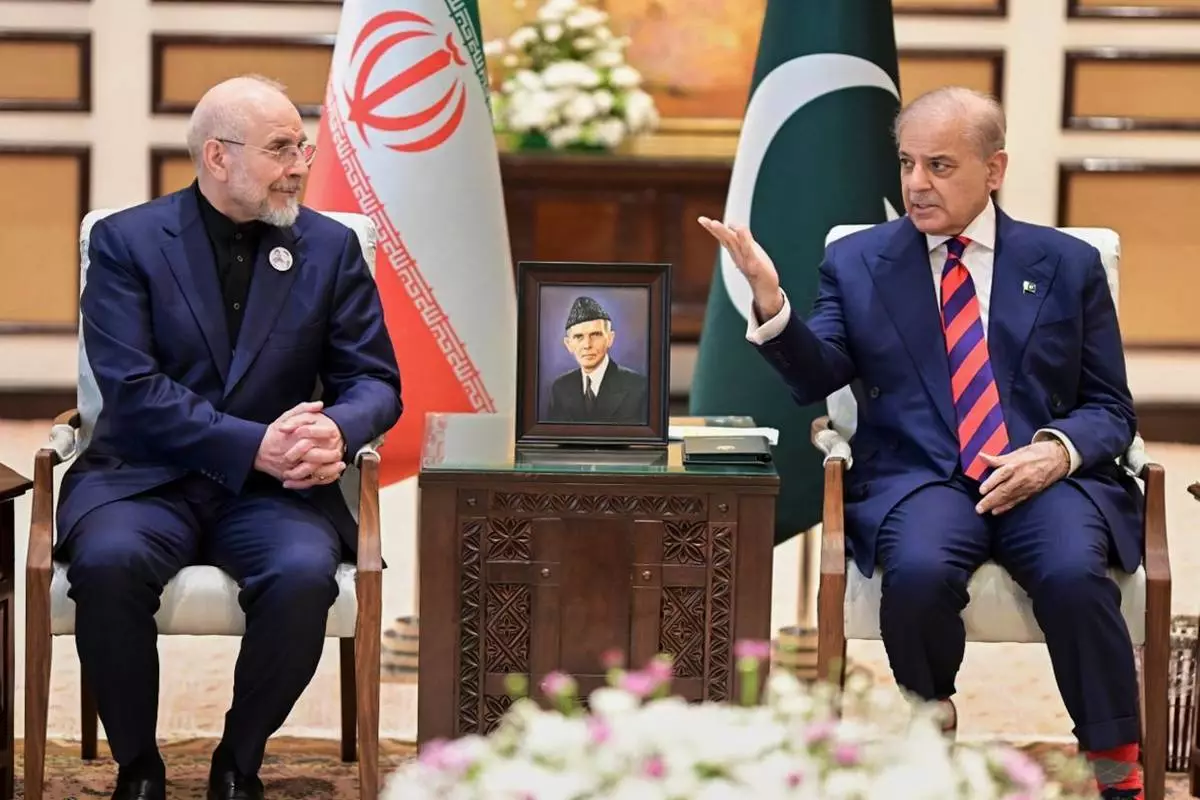
In this photo released by the Pakistan Prime Minister Office, Iran's Parliament Speaker Mohammad Bagher Ghalibaf, left, meets with hand with Pakistani Prime Minister Shehbaz Sharif, in Islamabad, Pakistan, Saturday, April 11, 2026 (Pakistan Prime Minister Office via AP)
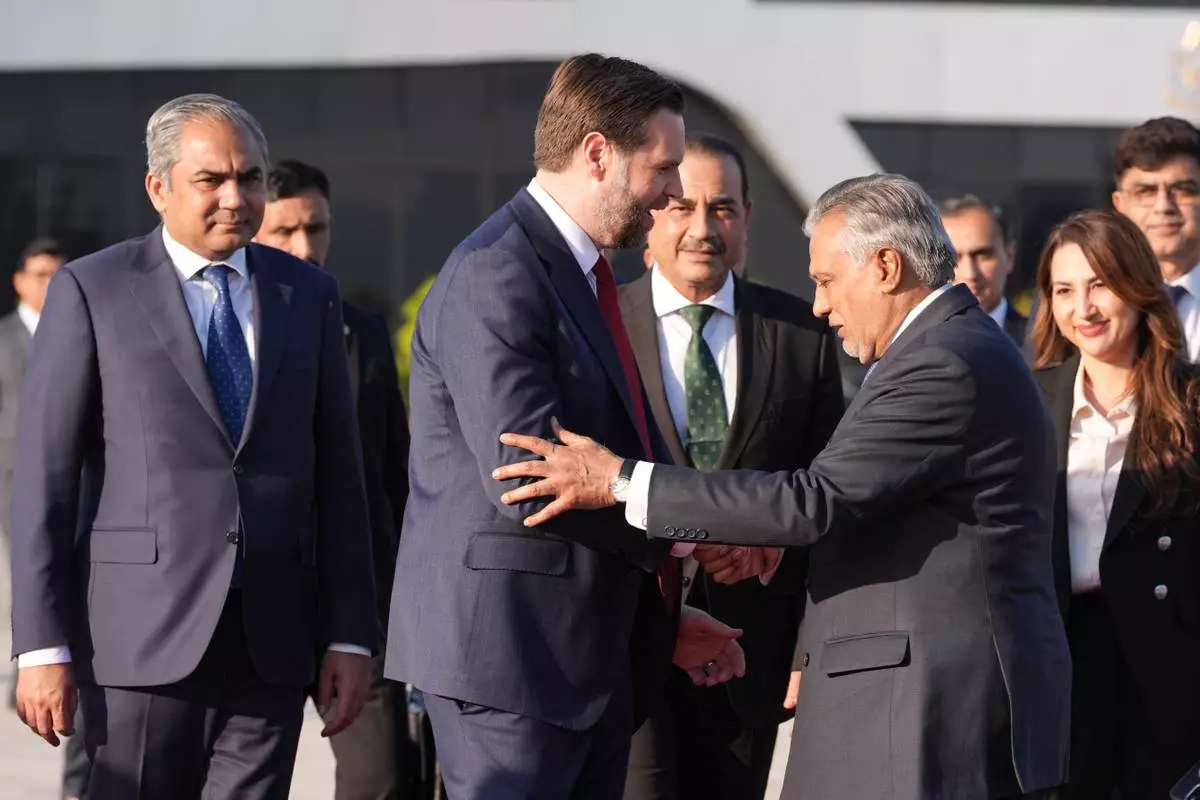
Vice President JD Vance, second left, shakes hands with Pakistani Deputy Prime Minister and Foreign Minister Mohammad Ishaq Dar, as Pakistan's Interior Minister Mohsin Naqvi, left, Pakistan's Chief of Defence Forces Chief of Army Staff Field Marshall Asim Munir, third left, and Charge d'Affaires of the U.S. Embassy in Islamabad Natalie A. Baker, right, look on, as he prepares to board Air Force Two after attending talks on Iran in Islamabad, Pakistan, Sunday, April 12, 2026. (AP Photo/Jacquelyn Martin, Pool)
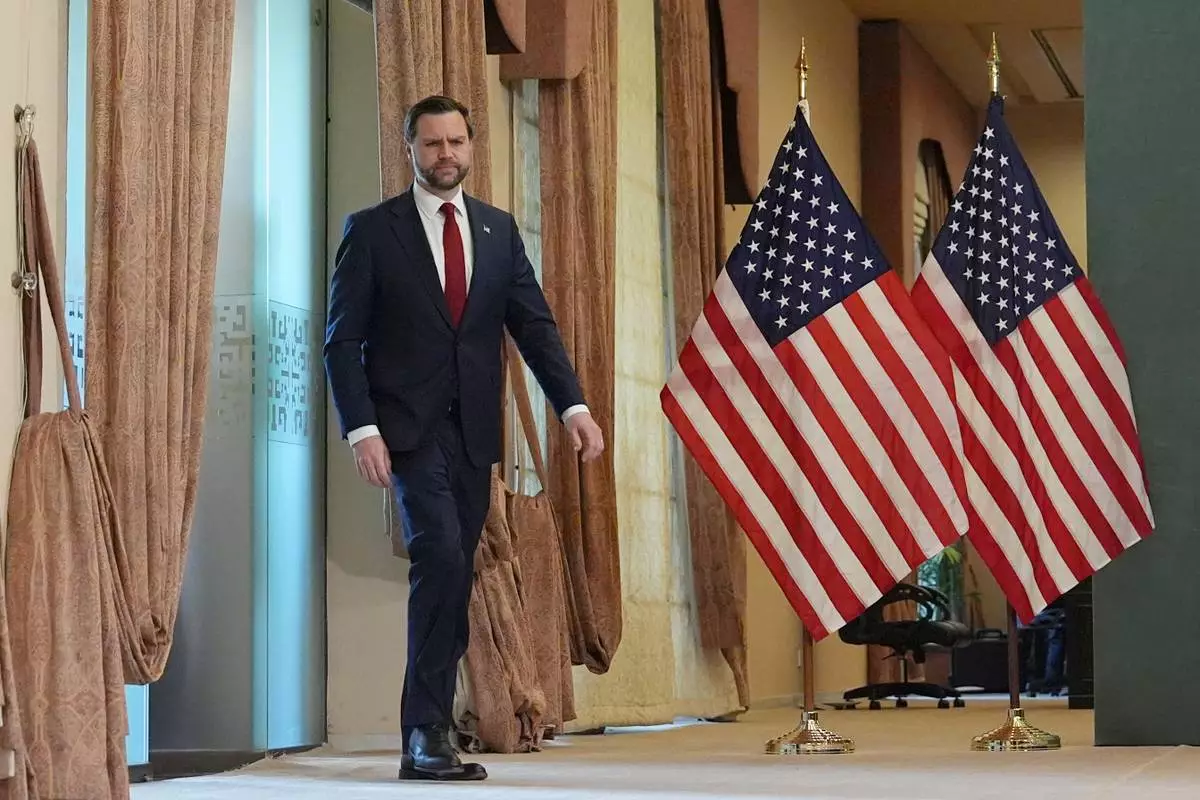
Vice President JD Vance arrives for news conference after meeting with representatives from Pakistan and Iran, Sunday, April 12, 2026, in Islamabad, Pakistan. (AP Photo/Jacquelyn Martin, Pool)
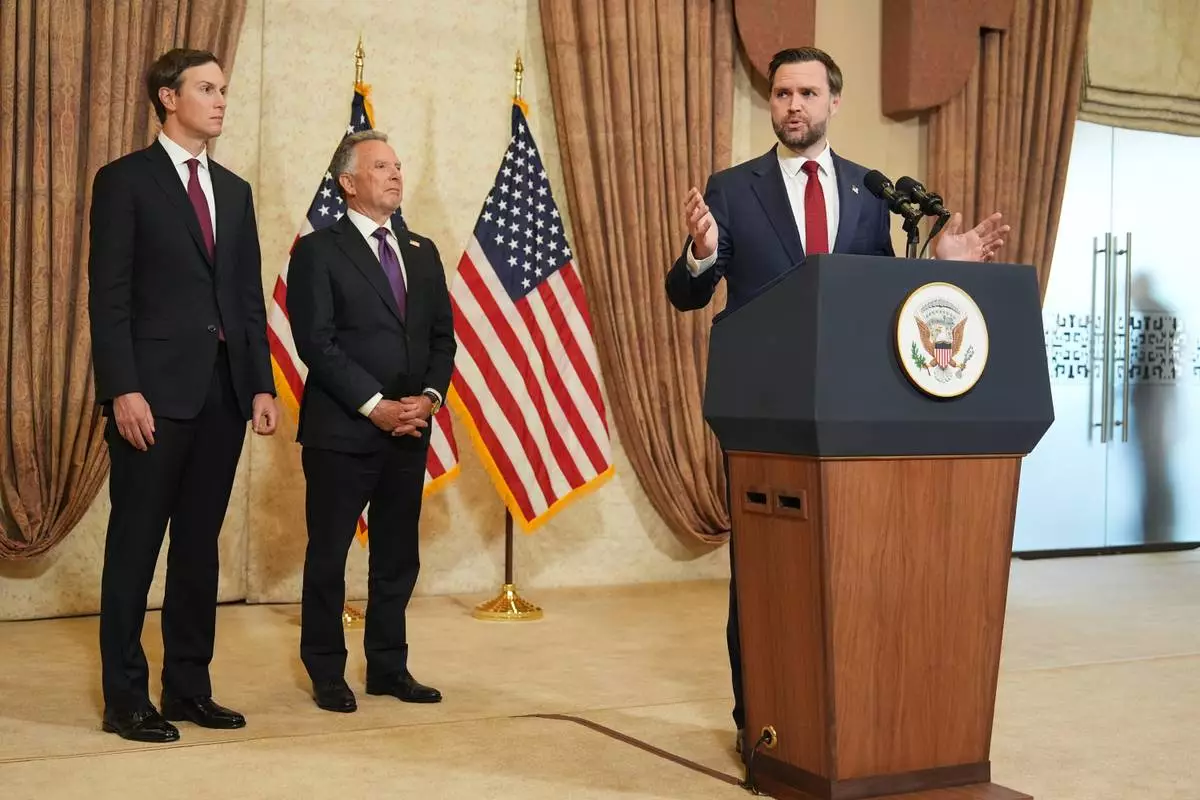
Vice President JD Vance, right, speaks during a news conference after meeting with representatives from Pakistan and Iran as Jared Kushner, left, and Steve Witkoff, Special Envoy for Peace Missions listen, on Sunday, April 12, 2026, in Islamabad, Pakistan. (AP Photo/Jacquelyn Martin, Pool)