CHICAGO--(BUSINESS WIRE)--Apr 13, 2026--
Envisionit today named Tiffany Kirby President and Chief Growth Officer, expanding her mandate to lead the agency into its next phase of growth as the marketing industry reaches an inflection point.
This press release features multimedia. View the full release here: https://www.businesswire.com/news/home/20260413502396/en/
Since joining in 2022, Kirby has driven double-digit growth year over year by doing something most agencies still can't: delivering truly integrated solutions across brand, media, and technology without sacrificing depth in any of them.
That integration-first mindset is now more critical than ever. Agencies across the industry have rushed to attach the word "AI" to their capabilities, but few have done the work to make it operational or meaningful for clients. Envisionit has. In 2023, CEO Todd Brook founded Unchained, a specialized AI consultancy focused on AI strategy, education, and development. Kirby has been central to bridging that capability back to Envisionit's clients, partnering with Unchained to apply AI in ways that strengthen marketing outcomes rather than just streamline internal processes.
As President, Kirby's scope now extends beyond growth to encompass operations, client strategy, and team development. She is joined in the leadership structure by Jason Goldberg, an owner and Chief Innovation Officer, who reports directly to Kirby and ensures that innovation and AI integration remain embedded in how the agency serves clients.
The result is a leadership model built for where the industry is heading: fully integrated services with AI applied practically to help clients work smarter and maintain a competitive edge.
"AI without a marketing lens risks efficiency at the expense of experience. Marketing without AI means falling behind. Our clients get both: integrated marketing excellence and specialized AI working together, so the technology behind the scenes works to improve the brand experiences people feel," said Kirby.
"What Tiffany has built at Envisionit speaks for itself: double-digit growth and real results for clients driven by truly integrated thinking," said Todd Brook, CEO of Envisionit. "She's carried our AI vision forward, made sure every department has the resources to be successful, and leads with a people-first mindset that gets the best out of the team. This role puts her at the center of all of it."
About Envisionit
Envisionit is an award-winning strategic growth and integrated marketing agency. Traditional agencies create dependency, but today’s marketers need clarity to navigate expanding platforms, data, and pressure. Envisionit aligns brand, digital, media, technology, and performance around a unified growth strategy, empowering teams to make smarter decisions, maximize every dollar, and move forward with confidence and control.

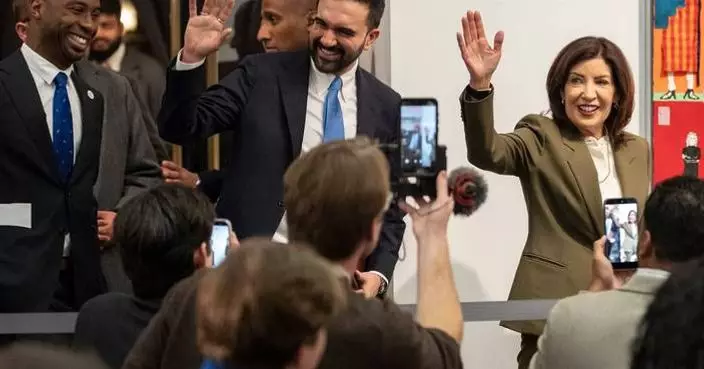
Tiffany Kirby, recently appointed President and Chief Growth Officer at Envisionit, is leading a new era of fully integrated marketing, combining brand, media, and AI-driven technology to help clients move faster, work smarter, and deliver more meaningful customer experiences.
NEW YORK (AP) — A jury has found that concert giant Live Nation and its Ticketmaster subsidiary had a harmful monopoly over big concert venues, dealing the company a loss in a lawsuit over claims brought by dozens of U.S. states.
A Manhattan federal jury deliberated for four days before reaching its decision Wednesday in the closely watched case, which gave fans the equivalent of a backstage pass to a business that dominates live entertainment in the U.S. and beyond.
At the end of the proceeding, the judge told lawyers on both sides to meet with one another “and the United States” to provide a joint letter proposing a schedule for motions and how the remedies phase of the case would occur. He told them to deliver it by late next week.
Live Nation Entertainment owns, operates, controls booking for or has an equity interest in hundreds of venues. Its subsidiary Ticketmaster is widely considered to be the world’s largest ticket-seller for live events. Its lawyers did not immediately comment as they left the courthouse, but said a statement would be issued shortly.
The verdict could cost Live Nation and Ticketmaster hundreds of millions of dollars, just for the $1.72 per ticket that the jury found Ticketmaster had overcharged consumers in 22 states. The companies could also be assessed penalties. In addition, sanctions could result in court orders that they divest themselves of some entities, including venues such as amphitheaters that they own.
The civil case, initially led by the U.S. federal government, accused Live Nation of using its reach to smother competition — by blocking venues from using multiple ticket sellers, for example.
“It is time to hold them accountable,” Jeffrey Kessler, an attorney for the states, said in a closing argument, calling Live Nation a “monopolistic bully” that drove up prices for ticket buyers.
Live Nation insisted it's not a monopoly, saying that artists, sports teams and venues decide prices and ticketing practices. A company lawyer insisted its size was simply a function of excellence and effort.
“Success is not against the antitrust laws in the United States,” attorney David Marriott said in his summation.
Ticketmaster was established in 1976 and merged with Live Nation in 2010. The company now controls of 86% of the market for concerts and 73% of the overall market when sports events are included, according to Kessler.
Ticketmaster has long drawn ire from fans and some artists. Grunge rock titans Pearl Jam battled the business in the 1990s, even filing an anti-monopoly complaint with the U.S. Department of Justice, which declined to bring a case then.
Decades later, the Justice Department, joined by dozens of states, brought the current lawsuit during Democratic former President Joe Biden's administration. Days into the trial, Republican President Donald Trump's administration announced it was settling its claims against Live Nation.
The deal included a cap on service fees at some amphitheaters, plus some new ticket-selling options for promoters and venues — potentially allowing, but not requiring, them to open doors to Ticketmaster competitors such as SeatGeek or AXS. But the settlement doesn't force Live Nation to split from Ticketmaster.
A handful of the states joined the settlement. But more than 30 pressed ahead with the trial, saying the federal government hadn't gotten enough concessions from Live Nation.
The trial brought Live Nation CEO Michael Rapino to the witness stand, where he was questioned about matters including the company’s Taylor Swift ticket debacle in 2022. Rapino blamed a cyberattack.
The proceedings also aired a Live Nation executive's internal messages declaring some prices “outrageous,” calling customers “so stupid” and boasting that the company “robbing them blind, baby.” The executive, Benjamin Baker, apologetically testified that the messages were “very immature and unacceptable.”
FILE - The Ticketmaster logo is seen along the sideline of the field before an NFL football game, Sept. 15, 2024, in Jacksonville, Fla. (AP Photo/Phelan M. Ebenhack, File)