SAN FRANCISCO--(BUSINESS WIRE)--Apr 13, 2026--
Across Ventures, a Silicon Valley-based venture capital firm founded by Managing Partner, Emi Yoshikawa, today announced that it will enter into a strategic alliance with SBI Holdings, Inc., and will launch a new fund, Across Ventures Fund I, L.P. The fund is targeting approximately USD 100 million (approximately ¥16 billion) with an objective of connecting leading-edge U.S. innovation with Japanese enterprises.
This press release features multimedia. View the full release here: https://www.businesswire.com/news/home/20260413495289/en/
This fund will operate as a Fund-of-Funds with an investment strategy focused across a diversified portfolio of “specialized micro VCs,” a segment that has rapidly gained prominence in the U.S. venture capital ecosystem. Through this structure, the fund aims to provide Japanese corporations with systematic access to early-stage innovation opportunities that have traditionally been difficult to reach.
Accessing Emerging Innovation Through Specialized Micro VCs
The U.S. venture capital landscape is increasingly characterized by a barbell dynamic, bifurcating into mega funds and micro VCs. Across Ventures believes mega funds (with fund sizes ranging from several billion to tens of billions of dollars) are shifting toward later-stage, large-scale investments, while highly specialized micro VCs (typically USD 20–50 million funds) are playing an increasingly critical role in backing high-potential startups at the pre-seed and seed stages.
In Across Ventures’ view, these specialized micro VCs represent a compelling point of access to next-generation innovation, driven by deep domain expertise, close relationships with founders, and differentiated deal sourcing capabilities built on unique networks.
Through this fund, Across Ventures intends to invest in a curated portfolio of more than 20 micro VC funds, and aims to provide Japanese enterprises with indirect access to hundreds of cutting-edge startups. This approach is designed to deliver both breadth and depth, with the goal of unlocking new open innovation opportunities.
From AI to Quantum: Strategically Covering Frontier Industries
The fund seeks to take a cross-sector approach to frontier technologies by investing in micro VC funds focused on areas such as AI / Physical AI, Fintech / Blockchain, ClimateTech, HealthTech, next-generation computing, space, and other deep tech sectors.
By partnering closely with the general partners of these specialized micro VCs, Japanese enterprises can identify emerging technological and market trends at an early stage. This is intended to enhance corporate venture deal flow, facilitate early-stage strategic partnerships, and provide critical insights for mid- to long-term business strategy development.
Strategic Capital Partnership with SBI Holdings
The alliance with SBI Holdings is intended to establish a comprehensive strategic collaboration designed to bridge U.S. innovation with the Japanese corporate ecosystem.
SBI Holdings is one of Japan’s most active venture capital investors and is widely recognized as a driving force in innovation across the financial and technology sectors both domestically and globally. Through this partnership, SBI intends to participate in the fund as an anchor LP upon its formation, with both parties seeking to combine SBI Holdings' deep investment expertise and extensive network of Japanese corporate relationships with Across Ventures' network of leading Silicon Valley micro VCs and startups.
Through this collaboration, the fund intends to function not only as an investment vehicle, but also as a strategic platform that connects Japanese enterprises with cutting-edge U.S. innovation—aiming to redefine and elevate U.S.-Japan innovation collaboration beyond traditional cross-border frameworks.
“ Through years of engaging with Japanese corporations seeking to access Silicon Valley innovation, I have recognized the need for a fundamentally new approach,” said Emi Yoshikawa, Managing Partner. “ Across Ventures' platform — built on deep partnerships with specialized micro VCs — is designed with the goal of delivering early-stage insights and investment access that have been difficult to obtain through conventional models.
We are honored to partner with SBI Holdings—an organization with an unparalleled track record of driving financial innovation. We believe this alliance will serve as a powerful catalyst to accelerate our initiative.
Across Ventures is committed to building a platform for co-creating next-generation industries together with Japanese enterprises, and to advancing a new innovation ecosystem that bridges Japan and the United States. ”
SBI Holdings, Inc.’s Representative Director, Chairman and President, Yoshitaka Kitao, commented as follows:
“ SBI has been strengthening its investments in U.S.-based startups in recent years, and this strategic capital partnership with Across Ventures will further accelerate those efforts. In the United States, advances in AI are driving innovation across a wide range of sectors at an unprecedented pace, and we believe that Japanese companies’ ability to access these cutting-edge developments will be a key factor in determining their future competitiveness.
Through this partnership, together with other forward-looking Japanese companies, we aim to further enhance the presence of Japanese enterprises in the U.S. innovation ecosystem and contribute to the creation of global innovation. We have built a strong relationship with Ms. Yoshikawa based on mutual trust since her time at Ripple, where she played a central role in successfully advancing strategic joint ventures with SBI Holdings. We are therefore very pleased to deepen our strategic collaboration with her across a broader range of innovation areas.
We are confident that this partnership will further accelerate collaboration between Japanese companies and U.S. startups and generate meaningful impact across the innovation ecosystems of both countries. ”
About Across Ventures
Founded in 2025, Across Ventures is a Silicon Valley-based venture capital firm dedicated to connecting cutting-edge U.S. innovation with Japanese enterprises. The firm is building a Fund-of-Funds platform that aims to invest in specialized micro VCs across frontier technology sectors.
Founder & Managing Partner Emi Yoshikawa brings over 20 years of experience across technology and finance in the United States. Prior to founding Across Ventures, she served as Vice President at Ripple, where she led corporate strategy, international expansion, joint ventures, and the launch of the company’s ecosystem fund, contributing significantly to its global growth. Through her involvement in SBI Ripple Asia — a joint venture with SBI Holdings — she has played a central role in advancing blockchain-based financial innovation in Japan. Ms. Yoshikawa holds an MBA from Harvard Business School and is a CFA charterholder.
About SBI Holdings
SBI Holdings is a Tokyo-based comprehensive financial group established in 1999 and listed on the Tokyo Stock Exchange. Through its subsidiaries—including SBI Shinsei Bank, SBI Securities, and SBI Investment—it provides a wide range of financial services such as banking, securities, asset management, and insurance, all within an internet-based financial ecosystem. In addition to its financial services, SBI has expanded into areas such as digital assets, biotechnology, and media. In 2022, it announced a capital and business alliance with Sumitomo Mitsui Financial Group (SMFG), followed by a similar partnership with the NTT Group in 2025, further strengthening its position as one of Japan’s leading financial groups.
This communication is for informational purposes only and does not constitute an offer to sell or a solicitation of an offer to buy any securities, nor does it constitute investment advice or a recommendation. Any offering will be made only by means of definitive offering documents. This communication is intended solely for accredited investors. Certain statements are forward-looking and subject to risks and uncertainties; actual results may differ materially from forward-looking statements that are based on current expectations and assumptions.

Across Ventures builds a bridge connecting Japanese corporations and specialized micro VCs.
The commander of Iran’s joint military command on Wednesday threatened to halt trade in the Gulf region if the U.S. does not lift its blockade on Iranian ports. No vessels have made it past U.S. naval forces during the first 48 hours of the blockade, according to the U.S. Central Command. Even so, U.S. President Donald Trump said the war in Iran was “very close to over” in an interview that aired Wednesday.
Trump also claimed that China has agreed not to provide weapons to Iran as reports circulate that Beijing has considered transferring arms. China’s Foreign Ministry has repeatedly denied in recent days that the country is providing any form of military support to Iran.
Separately, Treasury Secretary Scott Bessent warned on Wednesday that the U.S. is preparing to ramp up economic pain on Iran by levying secondary sanctions on financial institutions that do business with the Middle Eastern nation. Bessent called the measure the “financial equivalent” of the bombing campaign.
Meanwhile, mediators’ efforts to extend a ceasefire between the United States and Iran have made progress as the warring sides are expected to return soon to the table for another round of negotiations, regional officials said. However, a senior U.S. official said Wednesday the U.S. has not formally agreed to extend the ceasefire and that “engagement” with Iran continues. The latest diplomatic move came hours later, when a Pakistani delegation arrived for talks in Tehran.
Israel, meanwhile, is pressing ahead with its aerial and ground war in Lebanon, where the death toll has climbed to more than 2,100 people. The country’s National News Agency reported airstrikes and artillery shelling throughout southern Lebanon on Wednesday, where Israeli forces have encircled fighters with the Lebanese militant group Hezbollah. A day earlier, the two nations held their first direct talks in decades.
Here is the latest:
Prime Minister Benjamin Netanyahu said the current fighting is concentrated in the strategic south Lebanon town of Bint Jbeil, where Israeli troops are about to “eliminate this great stronghold of Hezbollah.”
Netanyahu, in a video address Wednesday evening, said he has given instructions for the military to continue to widen the security zone in south Lebanon — a reference to areas close to the border that the Israeli army now occupies — and to spread it eastward.
He said Israel is concurrently negotiating with Lebanon, with two central goals: disarming Hezbollah and a sustainable peace. “Peace through strength,” he added.
He also said the U.S. was updating Israel on the talks with Iran and that Israel was prepared for any scenario, should the fighting with Iran resume.
The Republican-led Senate on Wednesday rejected the latest Democratic attempt to halt President Donald Trump’s war in Iran, turning aside a resolution that would require the U.S. to withdraw forces from the conflict until Congress authorizes further action.
The 47-52 vote was the fourth time this year that the Senate has voted to cede its war powers to the president in a conflict that Democrats say is illegal and unjustified. Republicans say they will keep faith in Trump’s wartime leadership, for now, citing Iran’s nuclear capabilities and the high stakes of withdrawal. But GOP lawmakers are also anxious for the conflict to end — and they may not defer to the executive branch indefinitely.
Some Republicans have already made clear that they are eyeing future votes that could become an important test for the president if the war drags on.
▶ Read more
The U.S. is imposing sanctions targeting an Iranian oil smuggling network tied to the deceased senior Iranian security official Ali Shamkhani.
Sanctions include dozens of individuals and companies accused of transporting and selling Iranian and Russian oil through front companies, many of which are in the UAE.
Treasury Secretary Scott Bessent said in a statement, that banks “should be on notice that Treasury will leverage all tools and authorities, including secondary sanctions, against those that continue to support Tehran’s terrorist activities.”
The first Israel-Lebanon meeting in decades is key to moving Israel and Lebanon “towards breaking the recurrent rounds of violence that have caused considerable suffering for too long,” U.N. deputy spokesman Farhan Haq said Wednesday.
“Maintaining dialogue will be essential in resolving outstanding issues and achieving progress towards stability,” he said, adding that the U.N. is ready to support these efforts.
Despite the talks, Haq said the U.N. peacekeeping mission in southern Lebanon known as UNIFIL continues to report ongoing hostilities in the Israel-Hezbollah conflict, with projectiles fired toward Israel and its forces in the south, and Israeli forces continuing airstrikes, armored vehicle movements and other activities.
Across southern and eastern Lebanon, dozens of locations are being hit daily by Israeli strikes, he said. At leader 35 villages in the south were reportedly struck Tuesday causing extensive damage to residential areas.
As a result of the ongoing hostilities, Haq said more than 1.2 million Lebanese people have now been displaced.
Certain ships navigating waters around the Strait of Hormuz may be disguising their identities or destinations to evade interception under the U.S. blockade, but Joshua Tallis, director of security affairs at the Center for Naval Analyses, said the U.S. Navy likely has the tools to track them, even if doing so requires more resources.
Some ships appear to have slipped through, according to maritime trackers, but the blockade’s effectiveness depends less on individual crossings than on how Washington defines success, Tallis said.
A campaign aimed at pressuring Iran back to negotiations differs sharply from one intended to inflict enough economic pain to threaten the government itself. Blockades typically operate cumulatively, with economic repercussions unchanged if a ship or two pass through, Tallis said.
With no alternative route out of the Gulf, vessels appear more willing to take risks than in past crises, including off Venezuela or in the Red Sea, where they could reroute.
“There’s a kind of pent-up pressure, especially among ships stuck inside the Gulf,” Tallis said, adding that it is pushing owners and captains toward decisions they might otherwise avoid. “We’re seeing a higher tolerance for risk than in other scenarios.”
That pressure is compounded by murky visibility at sea. Not all “shadow vessels” broadcast their positions or destinations, and while large oil tankers are relatively easy to track, smaller ships carrying other cargo are harder to identify, creating openings some may try to exploit, he said.
Treasury Secretary Scott Bessent warned on Wednesday that the U.S. is preparing to ramp up economic pain on Iran, saying the Republican administration is preparing action that will be the “financial equivalent” of the bombing campaign.
Bessent said the administration has “told companies, we have told countries that if you are buying Iranian oil, that if Iranian money is sitting in your banks, we are now willing to apply secondary sanctions, which is a very stern measure. And the Iranians should know that this is going to be the financial equivalent of what we saw in the kinetic activities.”
The warning comes the day after Treasury Department sent a letter to financial institutions in China, Hong Kong, the United Arab Emirates, and Oman, threatening to levy secondary sanctions for doing business with Iran.
White House press secretary Karoline Leavitt said the U.S. had not “formally requested an extension of the ceasefire” with Iran.
The ceasefire announced on April 7 is currently slated to expire next Tuesday.
“At this moment, we remain very much engaged, in these negotiations, in these talks,” Leavitt said, adding that there are “discussions” about more talks being held unperson “but nothing is official until you hear it from us here at the White House.”
She said that the possible next rounds of talks “would very likely” be in the Pakistani capital of Islamabad as they were previously.
Asked if the tax refunds would go toward gasoline averaging more than $4 a gallon, Treasury Secretary Scott Bessent said the public is free to spend its money however it wants.
“Americans have more money. They can decide how they want to spend it,” Bessent said.
Higher prices at the pump because of the Iran War has created the risk that President Donald Trump’s tax cuts will offset the cost of fueling up autos to go to work and run errands, instead of boosting spending in ways that could help overall economic growth.
Treasury Secretary Scott Bessent told reporters that he believes gasoline prices will be closer to $3 gallon this summer, saying pumping oil can resume within a week of the Strait of Hormuz opening.
“I’m optimistic that sometime between June 20th and September 20th that we can have $3 gas again,” said Bessent.
Gas prices are averaging $4.11 a gallon, up from $3.17 a year ago, according to AAA.
U.S. Navy warships are telling merchant ships in and around Iran that they are ready to board them and use force to compel compliance with the blockade on ships trading with Iran.
“Vessels will be boarded for interdiction and seizure transiting to or from Iranian port,” a Navy radio message, posted to social media by U.S. Central Command, said. A military official, who spoke on condition of anonymity to discuss an ongoing military operation, confirmed the message is currently being broadcast to all ships in the region.
“If you do not comply with this blockade, we will use force,” the radio message added.
—- Konstantin Toropin
UAE Vice President Sheikh Mansour bin Zayed Al Nahyan and Iran’s parliamentary Speaker Mohammad Bagher Qalibaf discussed regional developments on a phone call and ways to de-escalate tensions, UAE state-run news agency WAM reported, without further details.
The chairman of the U.S Conference of Catholic Bishops’ Committee on Doctrine is defending Pope Leo XIV’s comments on the church’s “just war” doctrine.
The statement doesn’t directly refer to the Iran war, President Trump or Vice President Vance. But it cites “recent public comments” regarding church teachings on war and peace. It comes after Trump blasted the pope on social media. Vance, a Catholic convert, said Leo should be “careful” addressing such matters.
Bishop James Massa said the Catholic Church has long taught that “a nation can only legitimately take up the sword ‘in self-defense, once all peace efforts have failed.’”
That, said Massa, is the basis of Pope Leo’s comment that God “does not listen to the prayers of those who wage war.’”
The pope is “not merely offering opinions on theology, he is preaching the Gospel and exercising his ministry as the Vicar of Christ,” Massa said.
UN Relief Chief Tom Fletcher said $12 million has been allocated for humanitarian support in Iran.
“Thousands of civilians killed. Infrastructure destroyed. Essential services disrupted. This funding will help our partners deliver life-saving assistance at scale,” he wrote on X.
“If you wade into political waters, I think you should expect some political response,” the Republican leader said at the Capitol. “The pope’s received some of that.”
Johnson insisted he’s not one to criticize clerics or religious leaders, but he leaned into what he called the just war doctrine when it comes to the U.S. military action against Iran. “The stakes are so high,” he said.
“I don’t want to engage in a theological debate with the pope,” he said. “These are matters that people of good faith and good sense can debate.”
Johnson a day earlier at the Capitol said that he had asked Trump to take down a social media post that was interpreted as the president depicting himself as Jesus.
An Israeli official said the meeting would be held Wednesday evening. The official spoke on the condition of anonymity because they were not authorized to speak to the media.
The meeting comes a day after Lebanon and Israel held their first direct diplomatic talks in decades in Washington, following more than a month of war between Israel and the Iran-backed Hezbollah militant group.
—- Melanie Lidman
U.S. Central Command said in a statement Wednesday that no vessels have made it past U.S. naval forces during the first 48 hours of the blockade on ships entering and exiting Iranian ports.
Central Command also said nine vessels have complied with direction from U.S. forces to turn around and return toward an Iranian port or Iran’s coastal area.
A Malta-flagged vessel is the first crude oil carrier to head west through Strait of Hormuz since the United States blocked Iranian ports, according to a global shipping tracking monitor.
The Malta-flagged VLCC Agios Fanourios I is expected to arrive on Thursday to Basra, Iraq, where ports are not under U.S. blockade. Marine Traffic said the vessel attempted again a transit after anchoring in the Gulf of Oman for nearly two days.
The negotiating team led by Vice President JD Vance called for Iran to agree to a uranium enrichment moratorium as part of a potential deal to end the war, according to a regional official involved in the mediation efforts and a person briefed on the matter.
The Iranians rejected the U.S. plan laid out during last weekend’s talks in Islamabad and came back with a counteroffer to suspend enrichment for five years, the regional official and a person briefed on the matter. They spoke on condition of anonymity because they were not authorized to comment publicly on the negotiations.
The White House rejected the Iranian proposal that was conveyed by Tehran’s negotiators earlier this week.
The White House and the vice president’s office did not respond to requests for comment about the proposals.
The U.S. and Iranian proposals were first reported by the New York Times.
Attending a Senate Foreign Relations committee hearing on reforms to the United Nations, ambassador Mike Waltz unintentionally became the highest-level U.S. official to testify before Congress since U.S. and Israeli strikes started a war against Iran.
Democratic senators, including Chris Coons, Chris Murphy and Tim Kaine, took that opportunity to express their frustration with the Trump administration’s decision not to consult or further brief Capitol Hill on military action it is taking against Tehran.
“Those of us on the Democratic side do find it amazing that we still have not had an open hearing on this committee or the Armed Services Committee on this conflict,” Murphy, who represents Connecticut, told Waltz.
Asked several times about Trump’s threats last week to end Iranian civilization, Waltz defended it as “tough talk” and a “mean tweet” that yielded diplomatic results.
“They clearly got the message, and they clearly came back to the table,” he said.
Johann Wadephul said it is “unacceptable” that the strait is being controlled by a single state and that tolls are being collected.
“We will demand that a complete opening of the Strait of Hormuz is guaranteed once again,” the foreign minister told reporters in Berlin on Wednesday. “This is not just in the interest of the Gulf states, this is not just in the interest of the immediate Asian neighboring states, but it is in the interest of the entire global community.”
Referring to the Iran war, Wadephul reiterated that “this conflict can’t be solved through military means, it must be solved through negotiations.”
He also stressed that “the demands of the U.S. president are right — that the result of negotiations must be that there is no nuclear threat coming from Iran in the future.
The attacks in southern Lebanon killed three paramedics, wounded six others and left a fourth medic missing in the town of Mayfadoun, the health ministry said.
The ministry said Israel struck the first team of paramedics on Wednesday as it was heading to rescue wounded people, killing one paramedic. Another medical worker on that initial mission remains “missing,” the ministry said, without elaborating.
Israel struck the second team as it rushed to rescue the first, wounding three more paramedics.
In the third and final rescue attempt, Israel again hit ambulances heading to the site, killing two paramedics and wounding three more.
The Israeli military did not immediately respond to a request for comment on the strikes.
Lebanon’s health ministry denounced Israel’s attacks as “a flagrant crime” and warned that “paramedics have become direct targets, pursued relentlessly in a blatant violation (of) … international humanitarian law.”
Prime Minister Shehbaz Sharif arrived in Jeddah on Wednesday and is set to meet Saudi Crown Prince Mohammed bin Salman to discuss bilateral ties and regional issues, following recent Pakistan-hosted talks between the United States and Iran.
A statement from Sharif’s office in Islamabad said the prime minister was received at the airport by senior Saudi officials.
Sharif is accompanied by a high-level delegation including Foreign Minister Ishaq Dar, Information Minister Attaullah Tarar and the prime minister’s spokesman, Mosharraf Zaidi.
Jawad Younes, 11, and his cousins were playing soccer in the lot between their houses, as they often did. His little brother, 4-year-old Mehdi, had joined them but grew tired, so Jawad took him home and handed him off to their mother before returning to the game. Minutes later, an Israeli strike came.
The target was Jawad’s uncle’s home. The blast shook neighboring buildings and threw Jawad’s siblings at home to the ground. As their mother, Malak Meslmani, scrambled to help them up, she could think only of Jawad.
“I was pulling my children off the floor in the house, but as I was running to pick them up, I screamed, ‘Jawad,’” she said. ”My heart told me.”
Her son was instantly killed in the March 27 Israeli strike in Saksakieh. So was one of his cousins — so close they were more like brothers. Several other children were wounded.
▶ Read more
Pakistan’s army chief arrived in Tehran on Wednesday in the latest diplomatic move to ease tensions in the region and facilitate a second round of negotiations between the United States and Iran, two Pakistani officials said.
The military said the visit is “part of the ongoing mediation efforts” and gave no details.
The head of the U.N. General Assembly’s nuclear watchdog said Wednesday that “very detailed” measures to verify Iran’s nuclear activities must be included in a potential U.S.-Iran agreement to end their war in the Middle East.
International Atomic Energy Agency Director General Rafael Grossi stressed the need for a thorough verification regime for Iran’s nuclear program, as U.S. President Donald Trump said Tuesday that a second round of talks could happen over the next two days.
The Trump administration has said that preventing Iran from gaining a nuclear weapon is a key war aim. Iran has previously said it isn’t developing such weapons but rejected limits on its nuclear program.
▶ Read more
Lebanese were divided on Wednesday over their government’s decision to pursue rare, direct negotiations with Israel in hopes of ending the war between Israel and Iran-backed Hezbollah.
Some forced to flee their homes and communities in southern Lebanon say they believe Israel’s ground invasion can only be stopped through military force, not diplomacy.
“We stand with the young men, the fighters, and those stationed on the border, and with whatever decision they make,” said Mustafa Alaa Al-Din, now living in Beirut after being displaced from a southern border village. “These negotiations do not represent us … it’s as if they never existed.”
Others said they support any initiative that promises to hasten the end of the war.
“The negotiations are more in our interest than in Israel’s interest, because we are the ones whose country is being destroyed, we are the ones suffering losses,” said Mohamed Saad, a resident of Beirut, the Lebanese capital. “We are the ones out in the streets.”
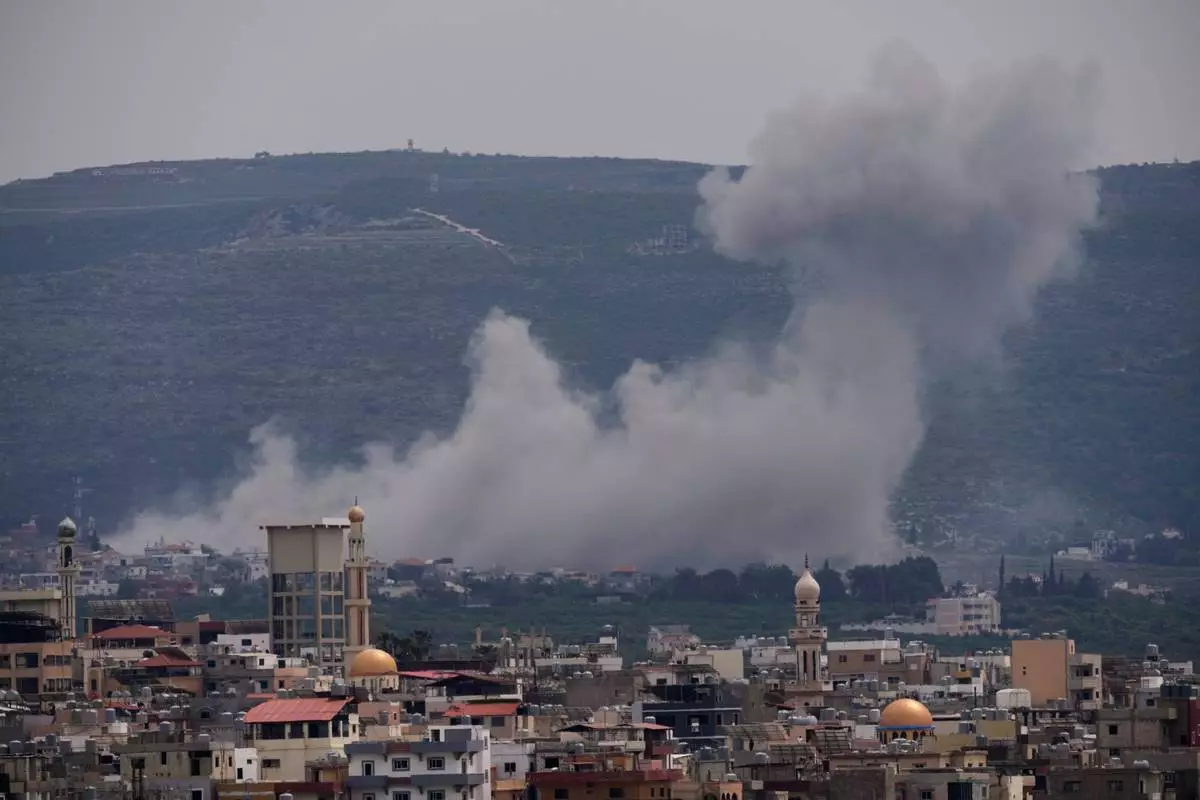
Smoke rises following an Israeli airstrike on the village of Qlaileh, as seen from the southern port city of Tyre, Lebanon, Wednesday, April 15, 2026. (AP Photo/Hussein Malla)

Residents sit on a sofa in front of charred cars at the site of a building destroyed in an Israeli airstrike last Wednesday in central Beirut, Lebanon, Tuesday, April 14, 2026. (AP Photo/Hassan Ammar)
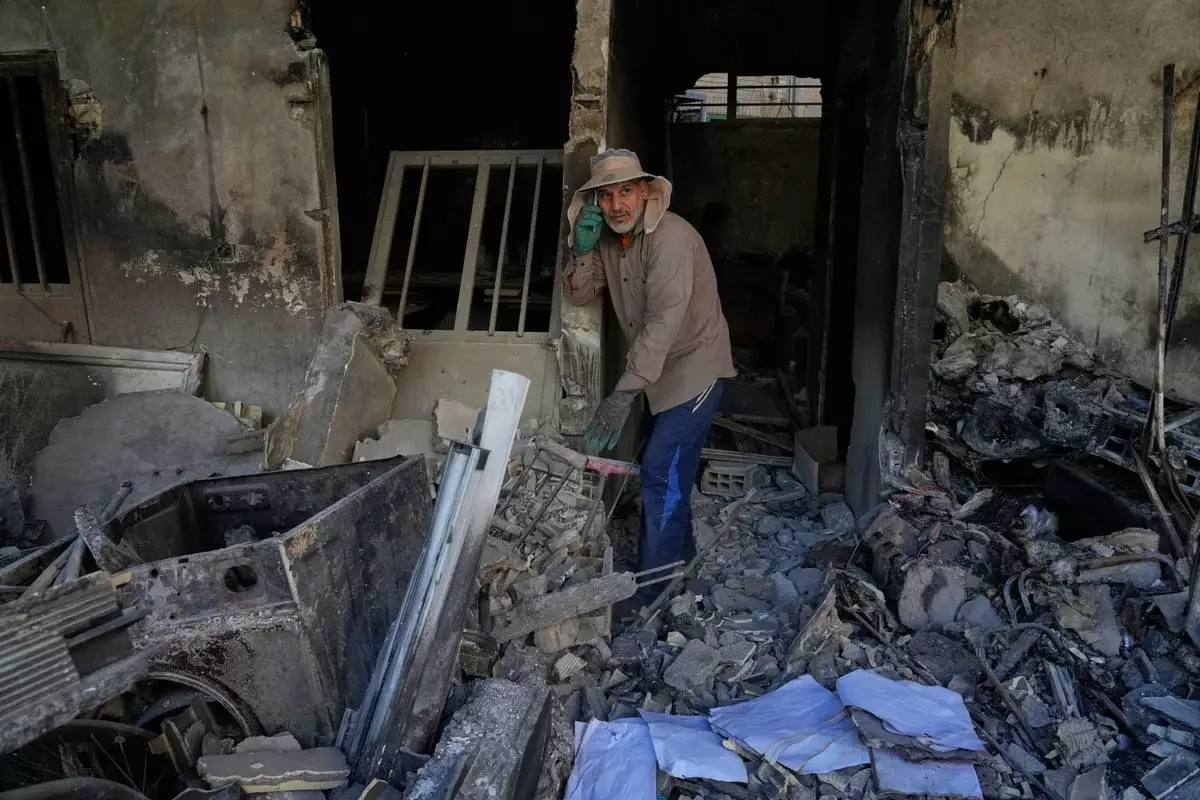
A volunteer talks on his phone while walking amid the debris of a residential building that, according to the authorities, was damaged on March 4 during the U.S.-Israeli military campaign, in southeastern Tehran, Iran, Tuesday, April 14, 2026. (AP Photo/Vahid Salemi)
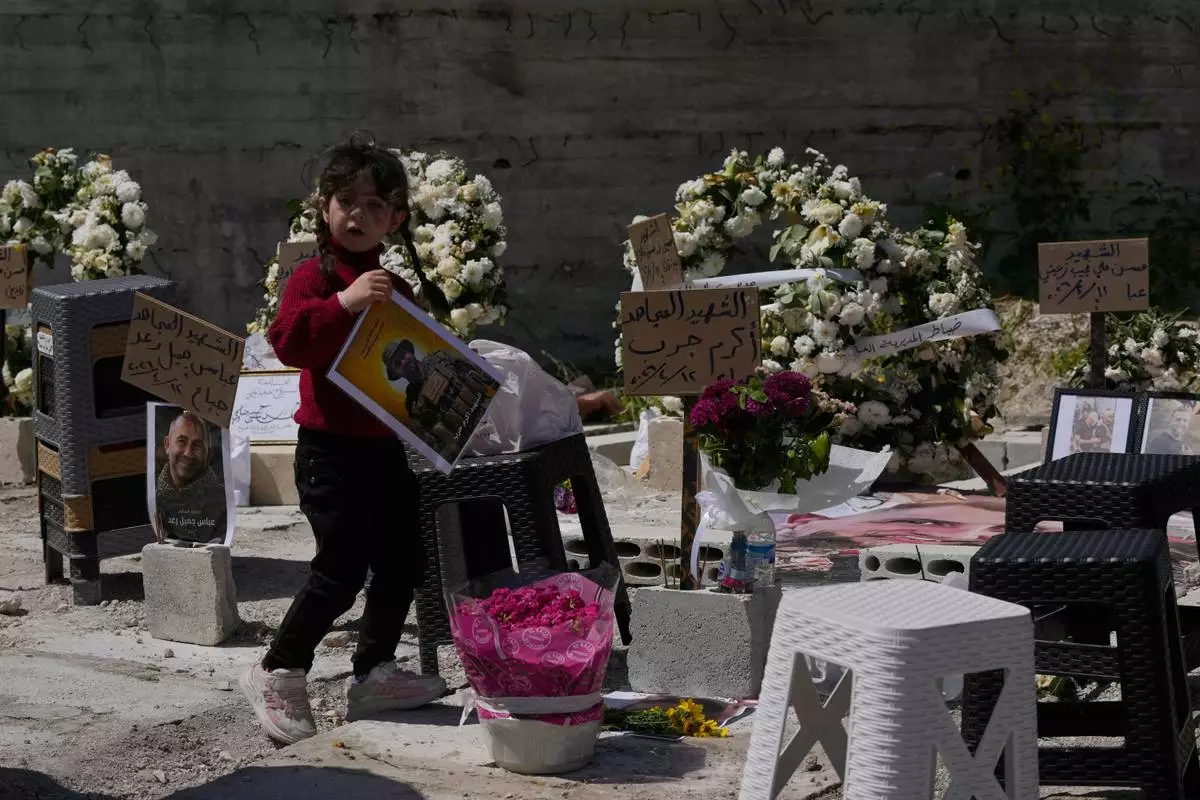
A young girl carries a portrait of a killed Hezbollah fighter at a mass grave where civilians and Hezbollah fighters killed in Israeli airstrikes are temporarily buried in the southern port city of Sidon, Lebanon, Tuesday, April 14, 2026. (AP Photo/Mohammed Zaatari)
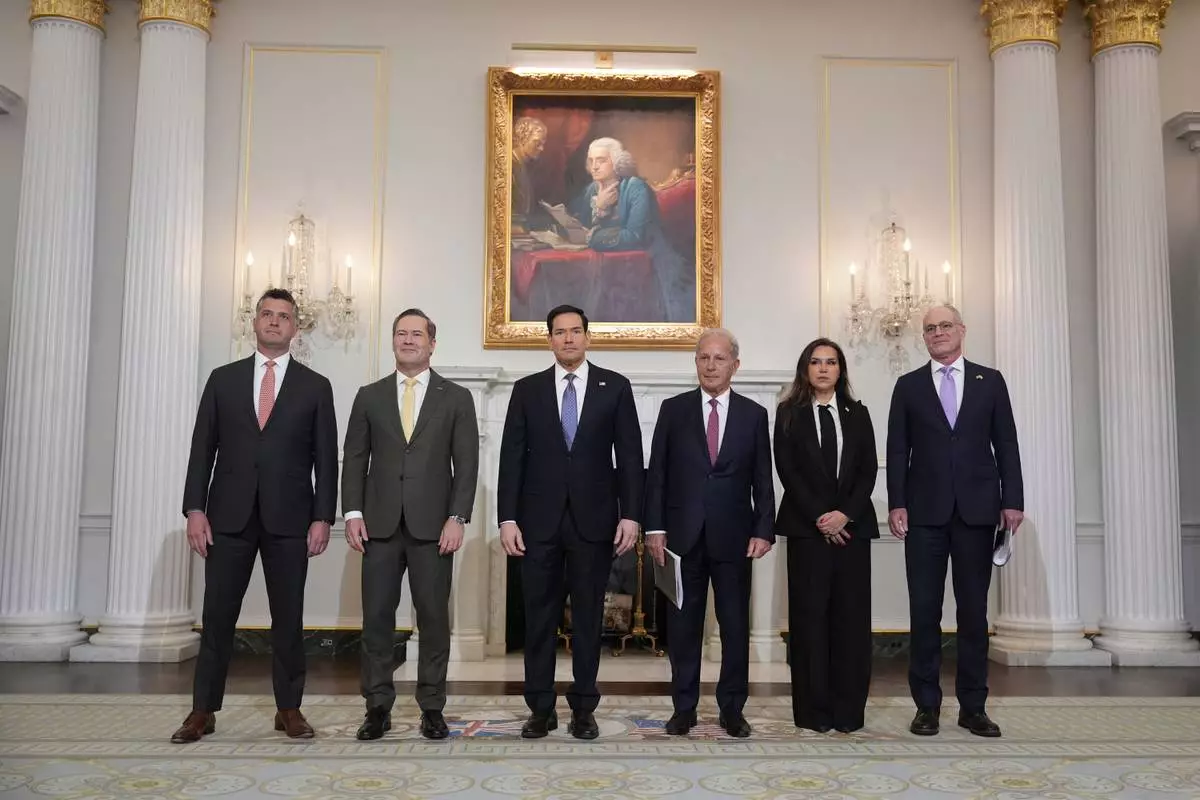
From left, Michael Needham, counselor for the U.S. Dept. of State, U.S. Ambassador to the United Nations Mike Waltz, Secretary of State Marco Rubio, U.S. Ambassador to Lebanon Michel Issa, Lebanese Ambassador to the U.S. Nada Hamadeh Moawad, and Israeli Ambassador to the U.S. Yechiel Leiter pose for a photo before a meeting at the State Department in Washington, Tuesday, April 14, 2026. (AP Photo/Jacquelyn Martin)
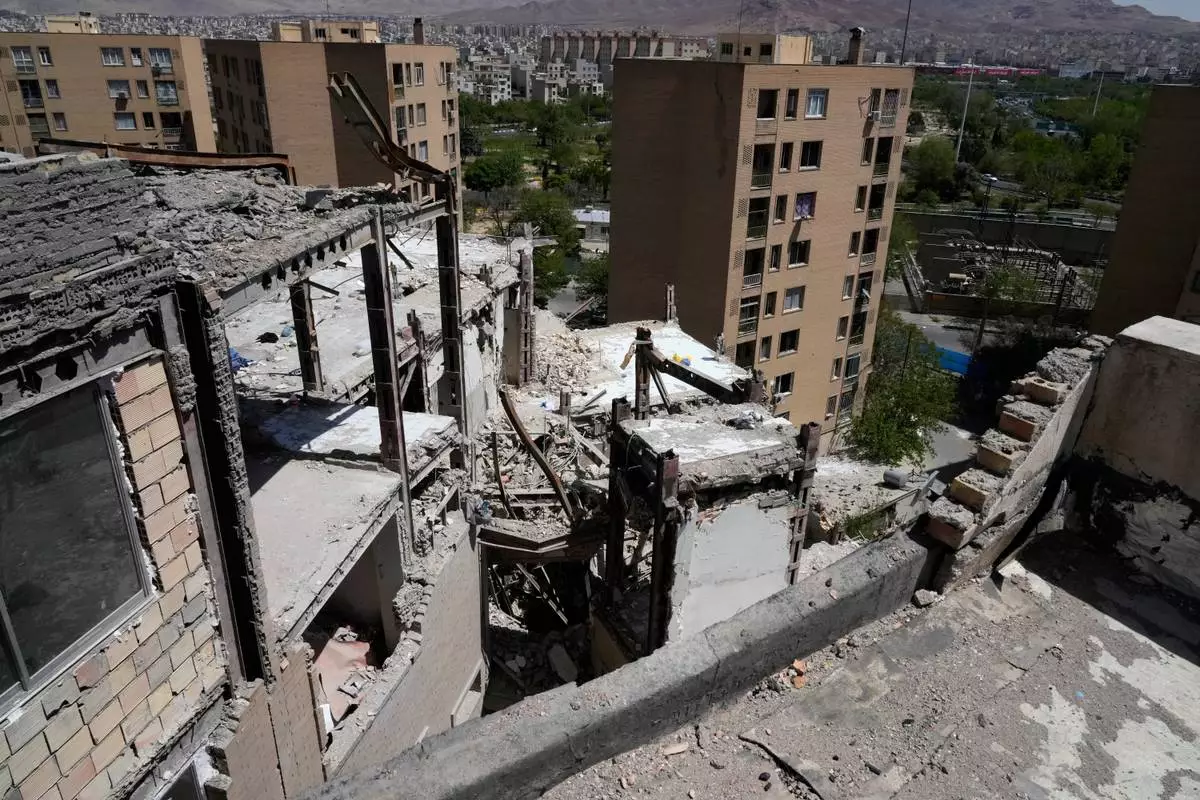
Damage is visible on a residential building that, according to Iranian authorities, was hit by a strike on March 4 during the U.S.-Israeli military campaign, in southeastern Tehran, Iran, Tuesday, April 14, 2026. (AP Photo/Vahid Salemi)