Residents in Madrid have reacted positively to Prime Minister Pedro Sanchez’s visit to China, viewing it as a beneficial step for promoting bilateral relations.
At the invitation of Chinese Premier Li Qiang, Sanchez is paying an official visit to China from Saturday to Wednesday, marking the prime minister's fourth visit to China within four years.
Many Spaniards see the visit as a sign of deepening ties between the two nations. Diego, a bartender in Madrid, suggested that frequent high-level visits foster stronger cross-cultural and economic exchanges.
"The prime minister is currently on a visit. If (bilateral relations) can continue and more visits are made, it would mean better relations and cultural exchange, or other types of exchanges, such as better economic relations. It depends," said Diego.
Camilo, a local student, noted that Sanchez’s visit could boost cooperation not only in culture but also in trade, particularly in sectors like electric vehicles.
"Well, I believe China and Spain already have established ties in these areas, (for example), through things like the Chinese New Year or imports. I think that these kinds of meetings can happen not only in the cultural sphere but also in the commercial sphere, which ultimately helps Spain import more products from China and vice versa. For example, China produces good electric goods. They are quite advanced in this field and can help countries like Spain," said Camilo.

Spanish public sees Sanchez's visit to China as boost to cultural, trade ties
The China-Laos Railway marked the third anniversary of its international passenger service on Monday, having carried over 840,000 cross-border travelers.
The flagship project under the Belt and Road Initiative has made cross-border travel faster and more convenient, while reshaping regional connectivity.
Since April 2023, some 3,200 cross-border passenger trains have operated on the China-Laos Railway, servicing passengers from 120 countries and regions.
"Before the railway opened, traveling from Laos to China was quite difficult. Now taking the train makes everything much easier, whether it's for tourism, study, or business," said Phout, a Lao passenger.
"This is my first time taking the China-Laos Railway, and my favorite part about it is how easy it is to use, and I love how connected it makes the world feel," said Feili Johnson, an Australian Passenger. Currently, four international passenger trains run daily between Kunming in China and the Lao capital, Vientiane, with seating capacity increasing from 250 at launch to 420 per train.
Data from the operator shows that in the first quarter of this year, the railway handled 112,000 cross-border passengers, up 32 percent year on year.
With policies such as 240-hour visa-free transit now in place, cross-border travel has become significantly easier and more efficient for international travelers.
"I think it's very convenient with the visa-free arrival in China, because you can see the whole country. Instead of going for one single purpose, you're more free to do a little bit of what you want," said Gabriel Andersson, a Swedish traveler.
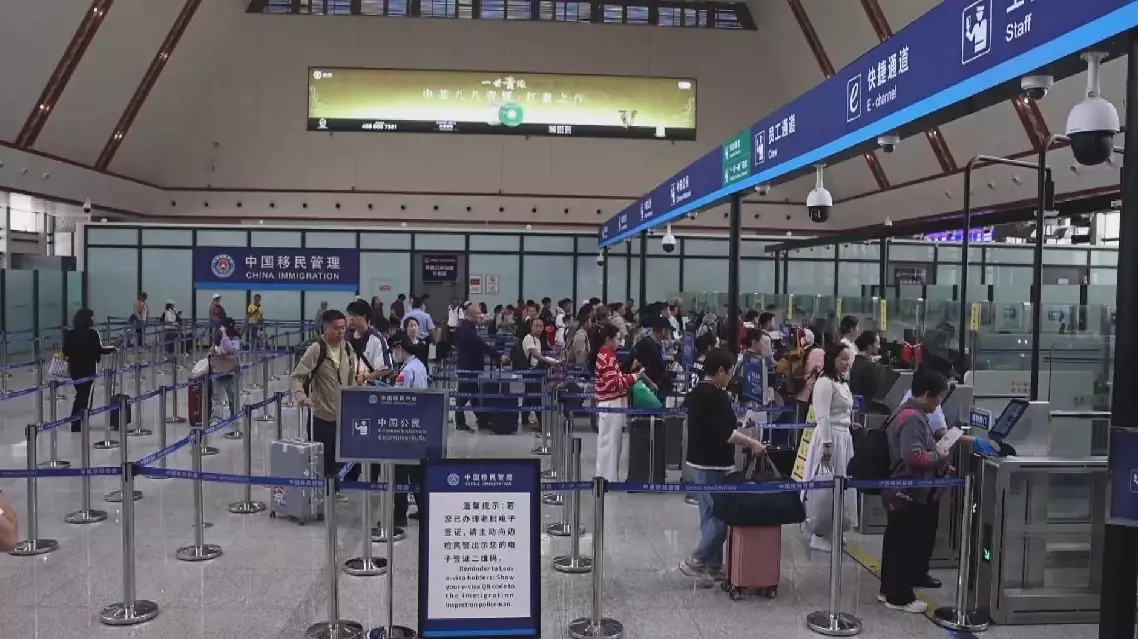
Adding to the convenience, immigration authorities have rolled out a range of measures to streamline border clearance. At the Mohan railway port, processing time has now been reduced to around 50 minutes.
"We've introduced more than a dozen measures to facilitate customs clearance, such as passenger classification and diversion, group booking for clearance, establishment of special channels for 240-hour visa-free transit, and pre-arrival entry card service," said Yang Xueqin, an officer from Mohan Immigration Inspection Station.
The port has also adopted smart technologies, including automated verification systems and real-time translation devices, cutting inspection time by more than 30 percent, Yang said.
With a steady rise in cross-border travelers, tourism in cities along the route — such as Xishuangbanna and Luang Prabang — is experiencing robust growth. As further facilitation measures advance between the two countries, the railway corridor is expected to unlock even greater vitality for regional tourism and economic exchanges.
China-Laos Railway marks three years of cross-border passenger services