Engineers at a robotics company, in east China's Shandong Province, are racing against time to test and improve their humanoid robots in preparation for the upcoming 2026 Humanoid Robot Half Marathon in Beijing.
Co-hosted by the Beijing Municipal People's Government and China Media Group (CMG), the official event will kick off on April 19.
More than 70 teams have joined a technical test for the event, which was held from Saturday night to the early hours of Sunday, run under full-process, all-scenario conditions to simulate the official race environment.
A humanoid robot developed by Yobotics broke its arm in an accident during a 1500-meter event at the 2025 World Robot Games, but still managed to finish the race, becoming a focus of attention at the time.
Engineers said the robot is currently undergoing extreme testing to further improve its speed and stability.
"We send different robots out for testing every day, and then we use the data they record to refine our algorithms and optimize their motion performance," said Lu Na, a robotics algorithm engineer.
After a year of technological iteration, the robot's running posture is significantly improved from last year. When passing through turns and going up and down slopes, its swing of arms and the bending posture of the knees are very natural, with smooth foot transitions.
The team also registered for the autonomous navigation group competition, in which the robot needs to complete the entire race autonomously after the start. This requires the robot to perceive the surrounding environment in real time, adapt to the elements on the racetrack, and anticipate route conflicts with other robots, accompanying personnel and vehicles, to avoid obstacles in a timely manner.
"Most important, we added a LiDAR system, including RTK positioning data, and a camera—essentially, its eyes and ears. Currently, the focus is on fine-tuning its obstacle avoidance strategy, ensuring both high speed and timely obstacle detection," said Liu Dayu, another robotics algorithm engineer of the company.
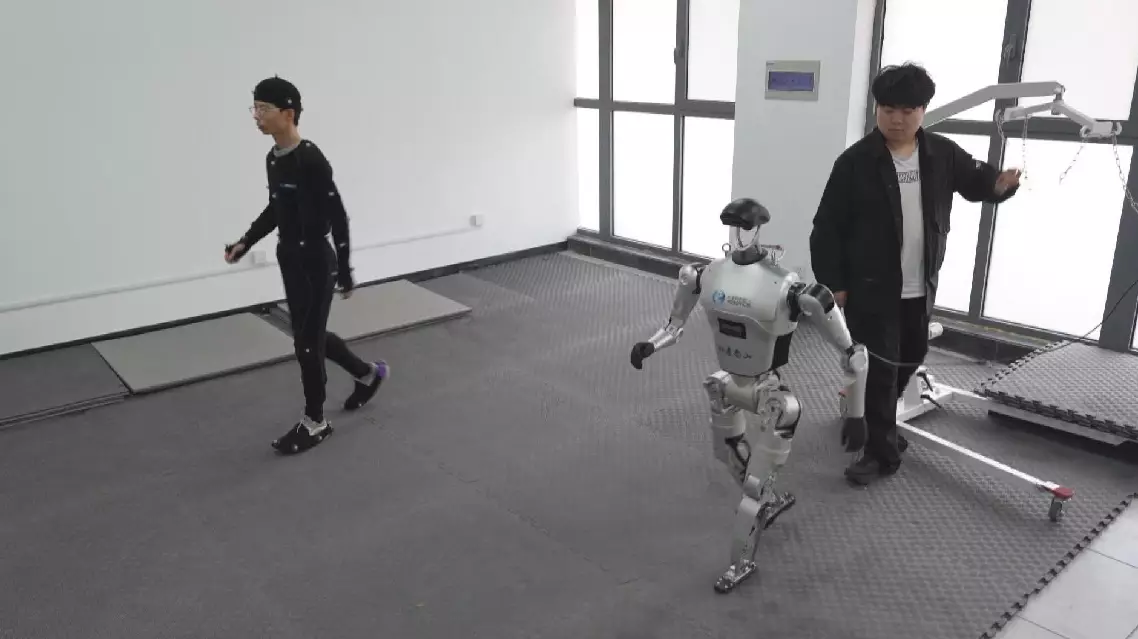
Engineers testing, adjusting humanoid robots for upcoming half-marathon