Chinese and Russian foreign ministers on Tuesday compared notes on the preparations for the meeting between the two heads of state within the year, and exchanged in-depth views on international and regional issues of common concern, including U.S.-Iran conflict, the situation in the Asia-Pacific, and the crisis in Ukraine.
Chinese Foreign Minister Wang Yi held talks with Russian Foreign Minister Sergei Lavrov in Beijing, saying that the current international situation is experiencing severe turbulence, the harm of unilateral hegemony has intensified, the global governance system is undergoing profound adjustments, and the cause of human peace and development is facing severe challenges.
Wang, also a member of the Political Bureau of the Communist Party of China Central Committee, said that facing a complex and volatile external environment, under the personal care and strategic guidance of the two heads of state, China-Russia relations have stood firm, and cooperation in various fields has remained strong and resilient.
This year marks the 30th anniversary of the establishment of the China-Russia strategic partnership of coordination and the 25th anniversary of the signing of the China-Russia Treaty of Good-Neighborliness and Friendly Cooperation, said Wang, adding that this year also marks the first year of China's 15th Five-Year Plan period.
He said that China and Russia should implement the important consensus reached by the two heads of state, and promote the bilateral strategic partnership of coordination and mutually beneficial cooperation in various fields to a higher level.
Both sides should enhance cooperation under multilateral frameworks such as the United Nations, said Wang, adding that taking the 25th anniversary of the establishment of the Shanghai Cooperation Organization as an opportunity, the two sides should implement the consensus reached at the Tianjin Summit and support Kyrgyzstan in hosting this year's summit successfully.
The two countries should jointly maintain the momentum of unity among BRICS countries and safeguard the legitimate rights and interests of the Global South, he added.
Wang called on the two sides to continue to maintain strategic coordination on major international and regional issues, join hands to practice multilateralism and international morality, and jointly advance the process of world multi-polarization.
For his part, Lavrov said Russia is willing to work with China to maintain close high-level exchanges, deepen practical cooperation and achieve mutual benefit and win-win results.
The current international situation is facing severe challenges, and some countries are attempting to form "small circles" to contain Russia and China, said Lavrov.
Lavrov called on both sides to align well with the series of global initiatives proposed by the Chinese side and the vision of the Greater Eurasian Partnership and the Eurasian security architecture proposed by the Russian side, maintain coordination and cooperation on the multilateral platform and in international and regional affairs, safeguard their respective national interests, and jointly maintain the security and stability of the international system.
After their talks, the two sides jointly signed the 2026 consultation plan of the foreign ministries of the two countries.
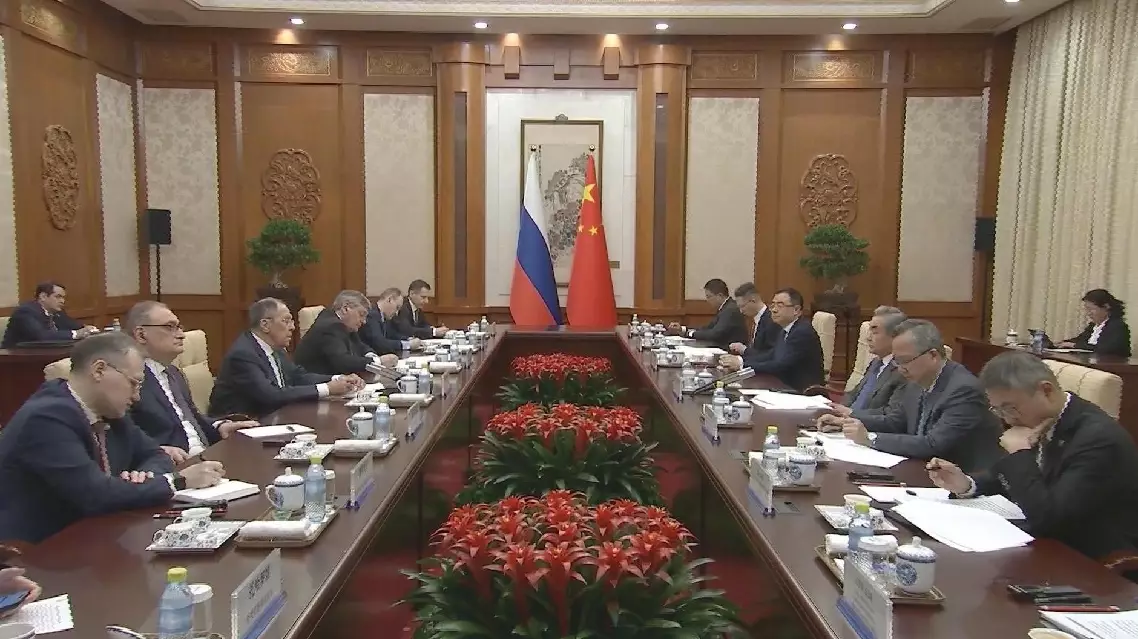
Chinese, Russian FMs exchange views on US-Iran conflict, situation in Asia-Pacific region, Ukraine crisis, other issues