Speech by DSJ at National Security Legal Forum (with photo/video)
Following are the closing remarks by the Deputy Secretary for Justice, Dr Cheung Kwok-kwan, at the National Security Legal Forum today (April 15):
Professor Wang (Vice President of the Chinese Association of Hong Kong and Macao Studies and Professor of the School of Law of Tsinghua University, Professor Wang Zhenmin), distinguished guests, ladies and gentlemen,
Good afternoon. Having heard our eminent speakers share views on the practice of Hong Kong's national security laws and on how Hong Kong continues to thrive in an orderly and stable environment, today's Legal Forum has successfully come to an end. I would like to take this opportunity to summarise and share with you the key takeaways of this forum.
First, this year is the inaugural year of the National 15th Five-Year Plan, a pivotal year that Hong Kong is poised for leapfrog development in both its economy and society. At this juncture, the white paper released in February this year has significant guiding value as an authoritative pronouncement for Hong Kong. It stated outright in its preface that the highest principle of fully, faithfully and resolutely implementing the policy of "one country, two systems" is to safeguard national sovereignty, security and development interests. It comprehensively outlined five important areas, namely (i) the unrelenting fight for safeguarding national security in Hong Kong, (ii) the Central Government's fundamental responsibility for national security matters concerning Hong Kong, (iii) Hong Kong's achievements in fulfilling its constitutional responsibility for safeguarding national security, (iv) Hong Kong's transformation from disorder to stability and prosperity, and (v) creating high-standard security for the high-quality development of the "one country, two systems" policy. Last but not least, the white paper reminded us once again that Hong Kong has the constitutional responsibility of effectively safeguarding national security, and that we, including the Hong Kong Special Administrative Region Government and all sectors of the community, should proactively implement the requirement. In this regard, we are honoured to have had Professor Wang deliver a keynote speech earlier this afternoon, which reaffirmed our dedication and solidified our commitment to the essence and principles set out in the white paper.
Second, the Hong Kong National Security Law was enacted to address prominent issues related to national security in the implementation of "one country, two systems" and to prevent national security risks. Its ultimate purpose is to uphold the "one country, two systems" principle, maintain prosperity and stability in Hong Kong, and serve the best interests of Hong Kong and its residents. Together, the Hong Kong National Security Law and the Basic Law constitute a legal foundation for Hong Kong to safeguard national security. In Panel Session 1, we were most delighted to have in our company, Mr Jonathan Chang, SC, the honourable Carmen Kan, Professor Cross, SC, and our Anthony Chau to review the developments of Hong Kong's national security laws, including how Hong Kong continues to improve the legal system and enforcement mechanism for safeguarding national security. Most importantly, without compromise to the practical need to address security risks, they highlighted the significant features of the improvement exercises that we have been undergoing while strictly adhering to the rule of law principle, with reference to recent major national security cases and comparable overseas legislation. I am sure we all find their sharing to be insightful, informative, and leave us on a high note.
Third, in every community, security is a prerequisite for development, and development provides a guarantee for security. Without national security, we cannot offer better development and a better life for residents, and we cannot provide better protection for the legitimate rights and interests of investors. We know from experience that the Hong Kong National Security Law and the Safeguarding National Security Ordinance have been jointly serving as a shield for safeguarding national security in Hong Kong, and the society continues to remain stable and prosperous. Last year, Hong Kong was the world's freest economy. We were also number one in global IPO market rankings, and number one as Asia's largest hedge fund hub and cross-border wealth management centre. Having said that, we must not overlook the importance of national security education as an essential tool for encouraging a proactive and continuing commitment from the community at large in safeguarding national security. On this front, I am indebted to our Panel Session 2 guest speakers Ms Melissa Pang, Dr William Wong, SC, Mr PC Yu and Ms Joyce Chan for their sharing from the holistic perspective, and from standpoints of the court room, board room and classroom. Their contribution sparked our exploration of how Hong Kong could achieve a dynamic balance between development and safeguarding national security.
Safeguarding national security is a responsibility shared by all members of society; everyone is a stakeholder and beneficiary, and no one can be a mere spectator. The fruitful discussion by our distinguished guests this afternoon provides an excellent starting point for us to understand the essential requirements of the white paper. It is my hope that the insights shared by our guests this afternoon could further enhance public awareness of safeguarding national security, and enrich our understanding of the importance of the white paper.
As the white paper affirms, we should all share a common aspiration: stability and peace, not riot and turbulence; vitality and prosperity, not decline and decay; unity and solidarity, not opposition and division; civility and rule of law, not lawlessness and disorder. We must bear that in mind and cherish the safe and stable environment today. Thank you.
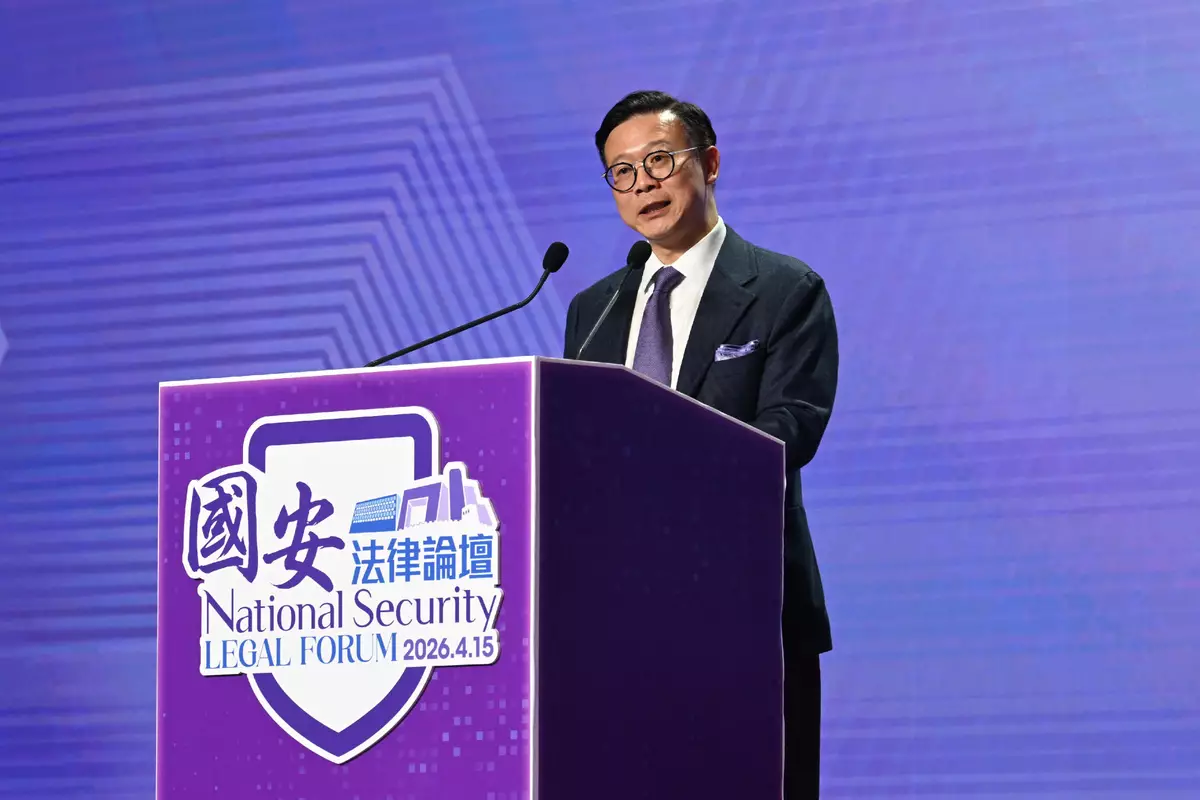
Speech by DSJ at National Security Legal Forum Source: HKSAR Government Press Releases

Source: AI-found images