Sudan's civil war has entered its fourth year, deepening political fractures and driving one of the world's worst humanitarian crises, with no peace deal in sight.
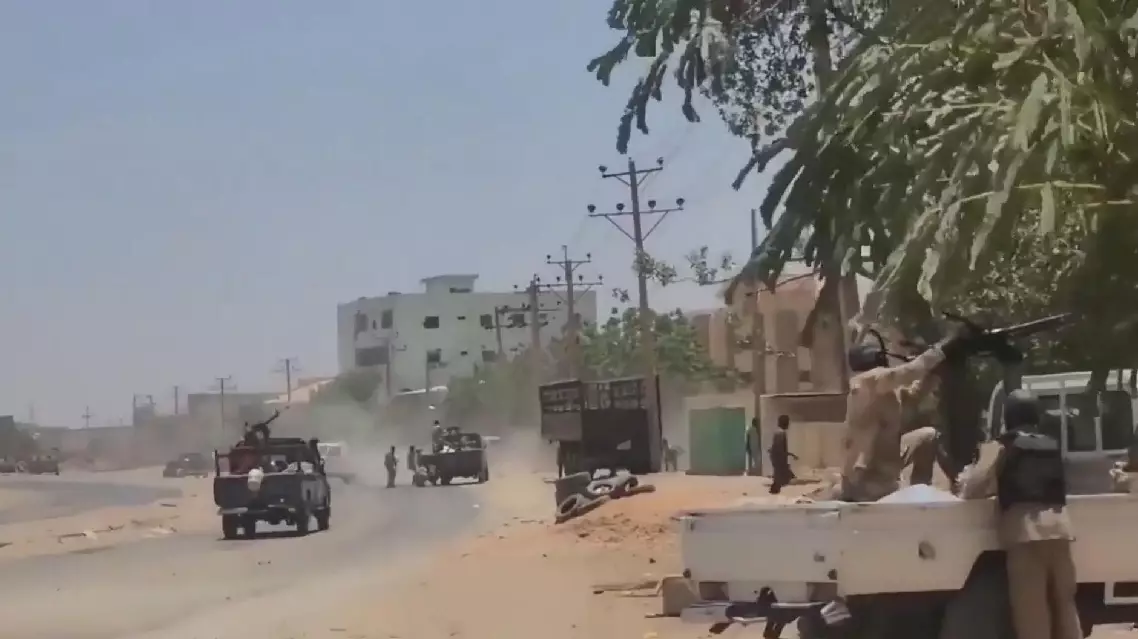
Fighting between the Sudanese Armed Forces (SAF) and paramilitary Rapid Support Forces (RSF) erupted in April 2023, following months of escalating tensions between Abdel Fattah al-Burhan, the army chief and head of Sudan's ruling council, and Mohamed Hamdan Dagalo, the RSF commander and al-Burhan's former deputy.
The conflict has killed tens of thousands of people and displaced millions inside Sudan and across the region. Approximately 14 million people have been forced to flee their homes, with 9 million displaced inside Sudan and 4.4 million across borders. One in four Sudanese people is displaced so far.
Since 2025, the fighting between the two sides has been locked in a stalemate. Currently, SAF remains entrenched in eastern, northern and central Sudan, while the RSF and its allies control most of the west and south-central regions, covering about 40 percent of the country's territory.
Beyond territorial division, the country also faces political power fragmentation. In July last year, the RSF declared a "parallel government", a move condemned by Sudan's central authorities as "illegal", making Sudan have two rival governments co-existing.
"Now, after three years now, we are seeing that the conflict is continuous in the six states of the country. But the big issue now, we see that there is political fragmentation in Sudan and also the big social fragmentation [due to the] direct impact of the war," said Mohamed Altahir, a political commentator.
The civil war has damaged infrastructure in the country, disrupting industrial and agricultural production and public services, making civilians bearing most brunt.
"Everyone is in a very difficult situation. Life is hard, and we are already exhausted. Drone attacks happen all the time, so we have to sleep on the streets often. There are no beds, no toilets. The situation is really terrible," said Ahmed Abdalaal, a resident.
The civil war has created one of the world's largest and most destructive humanitarian disasters, bringing widespread hunger, disease, displacement and the collapse of social services.
Over 60 percent of Sudan's population, approximately 33.7 million people, are expected to need humanitarian assistance in 2026, an increase of 3.3 million compared to the previous year, according to a recent report from the United Nations Office for the Coordination of Humanitarian Affairs (OCHA). Sudan has become what UN agencies now describe as the largest humanitarian emergency in the world.
"The current humanitarian situation in Sudan is nothing short of a disaster. And the number of displaced continues to grow. The number of malnourished children continues to grow.The outbreaks of cholera, measles, and other diseases continue on a regular basis. The war continues to move," said Sheldon Yett, United Nations Children's Fund (UNICEF) Representative in Sudan.
The civil war has crippled Sudan's already fragile economy. Transport, communication, electricity, water supply, education, and healthcare infrastructure has been severely damaged, disrupting water, electricity, and gas supplies. Public services such as garbage collection and environmental sanitation are nearly paralyzed.
"The sanitation here is very poor, and there are many mosquitoes. We desperately need insecticides and clean drinking water. The power supply is also very unstable. Even more serious is the water problem. We have to pay high prices for drinking water. The current situation is really very difficult," said Ishraqah Nour El-Din, a resident.
Despite the scale of suffering, the severe humanitarian crisis is still not getting the attention it deserves from the international community, and aid efforts are hindered by funding shortages and worsening security situation. The UN humanitarian response plan for Sudan was only 16 percent funded against a 2.9 billion U.S. dollars ask for 2026. Meanwhile, the humanitarian access remains restricted due to deteriorating security situation.
Many aid organizations describe the humanitarian crises in Sudan as "the most neglected crisis on the planet." While the international community's attention is drawn to other global hotspots, Sudanese civilians remain in darkness, waiting for a dawn that remains uncertain.
Political fragmentation, humanitarian crisis grip Sudan as civil war enters 4th year