JACKSON, Miss. (AP) — Brandi Carter needs her wine.
As the owner of Levure Bottle Shop in Jackson, Mississippi, she sells natural wine delivered to her business by a state agency responsible for distributing alcoholic beverages to liquor stores, bars and restaurants. But delays caused by problems in a state warehouse have led Carter and many other retailers to see their inventory dwindle and their business drop as they wait for new shipments.
Carter, who also handles the beverage program for a restaurant in Jackson, said she has been dealing with delays since February, and she's feeling helpless as traffic in her store goes down.
“I’ve just reached acceptance that this is our new normal, and it’s awful,” Carter said Wednesday.
In Mississippi, the state's Alcoholic Beverage Control department — an arm of the Mississippi Department of Revenue — is responsible for distributing wine and liquor to businesses that sell it. That's different than other states, where individual companies handle alcohol distribution, Carter said.
During the week ending April 12, there were more than 172,000 cases that were pending delivery, and it was taking an average of 17 days for businesses to receive their orders, according to the Mississippi Department of Revenue.
Those numbers are down from the week ending March 1, when the backup appeared to be at its peak for the year. At that time, there were more than 220,000 cases pending delivery, and it was taking an average of 25 days for the process to be completed.
In contrast, the number of cases pending delivery was more than 51,000 and the wait time was three days for the week ending Jan. 11., the department said.
Carter said the backlog has resulted in a wait of four to five weeks, as opposed to a few days to two weeks before the delays began.
Shipping delays from the state's 40-year-old warehouse emerged in January as it went away from an “obsolete” conveyor belt system to one where pallets were used to move cases, according to a statement from the Mississippi Department of Revenue. A new warehouse management system experienced technical issues, leading to delays, the department said.
“The computer program that they implemented for the warehouse wasn’t working effectively with the ordering side,” Carter said. “So the first big chunk was the biggest problem, because things were being marked as shipped, but they weren’t shipped.”
The department said technical issues have been resolved and the warehouse is operating at full capacity, with pending orders being shipped as retail orders increase.
“While capacity at the existing facility has been a challenge for well over five years, there is not an alcohol shortage,” the department said. “As retail ordering stabilizes, we anticipate shipments returning to normal volume within the coming weeks.”
The Mississippi legislature debated temporarily allowing out-of-state distributors to sell and ship alcohol directly to retailers. The law would have been repealed after two years, but it did not pass. The state’s legislative session has since ended.
A new warehouse set to be completed by the end of this year will be able to store and ship over twice as many cases as the current facility, the revenue department said.
Josh Sorrell, owner of Spillway Wine and Spirits in Brandon, said he used to order 600 cases in a day, but he is now limited to 100 cases per day. About 30% to 40% of the items he usually orders on a daily basis have been unavailable, he said.
Sorrell believes restoring the conveyor belt system would fix the problem. He has asked Mississippi Gov. Tate Reeves to declare a state of emergency.
If delays continue, Sorrell's concerned that business will suffer into the end of the year, when he makes a lot of his sales.
“As it gets busier, we’re gonna crumble,” he said. “I mean, it’s going to be really hard at 100 cases a day to stock up for a full October, November, December.”
Meanwhile, customers are going to three or four stores looking for their specific bottle, and they sometimes can’t find it, Sorrell said.
“It’s frustrating to lose people at the door who are looking for a specific product that I can’t even get from the state,” he said.
On Thursday, Lauren Roberts went to Sorrell's store looking for Soda Jerk's orange cream shots, but he was out, just like the supermarket where she usually buys it. So, she bought another type of drink for an upcoming celebration with her family.
“We’re having a little get-together this weekend because it’s my daughter’s prom and her boyfriend’s family’s coming,” Roberts said. “So everybody has their drink of choice, but me.”
Sainz reported from Memphis, Tennessee.
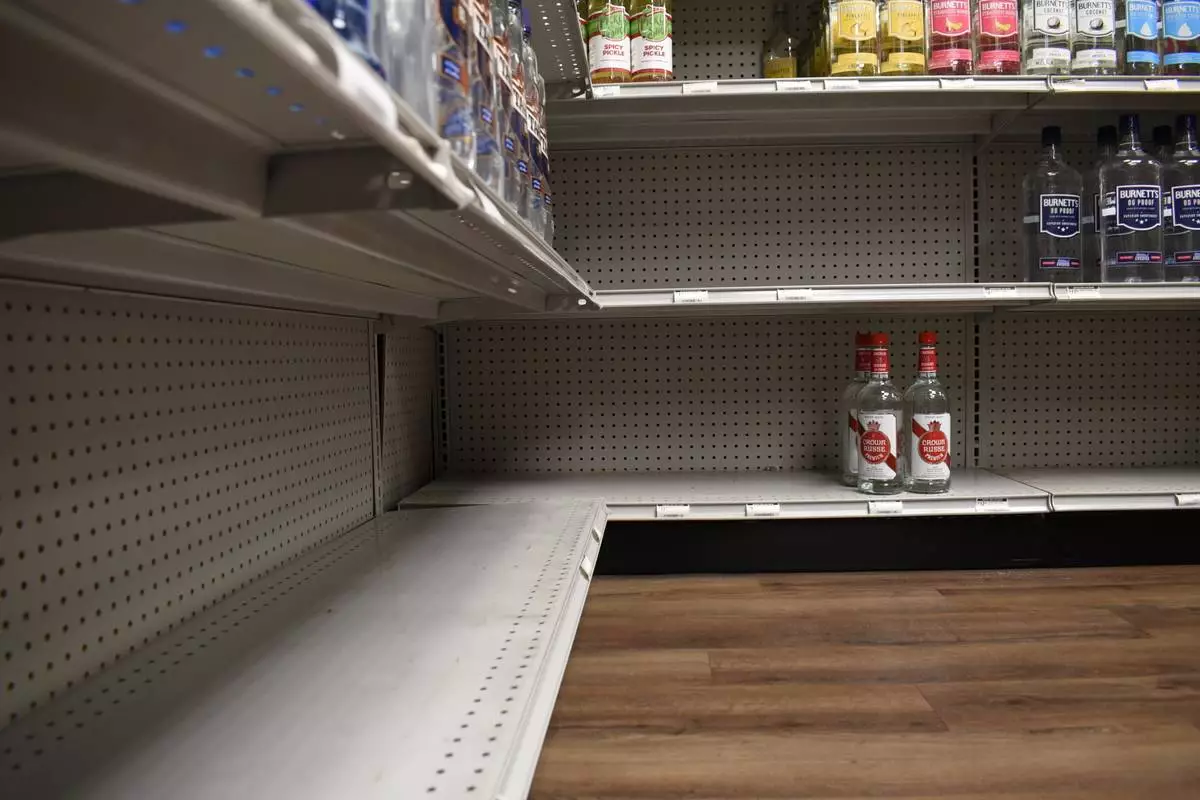
A shelf stands partially empty at Spillway Wine and Spirits in Brandon, Miss, on Thursday, April 16, 2026. (AP Photo/Sophie Bates)
NEW YORK (AP) — Oil prices dropped more than 10% Friday, and U.S. stocks raced toward another record after Iran said the Strait of Hormuz is open again for commercial tankers carrying oil from the Persian Gulf to customers worldwide.
The S&P 500 leaped 1.3% as Wall Street rallied to the finish of a third straight week of big gains, its longest streak since Halloween. A freer flow of oil would take pressure off prices not only for gasoline but also for groceries and all kinds of other products that get moved by vehicles. It could even ultimately help people pay less on credit-card interest or mortgage bills.
The Dow Jones Industrial Average briefly climbed nearly 1,070 points and was up 978 points, or 2%, as of 11:45 a.m. Eastern time, while the Nasdaq composite was 1.6% higher
The U.S. stock market has jumped more than 12% since hitting a bottom in late March on hopes the United States and Iran can avoid a worst-case scenario for the global economy despite their war. Friday’s reopening of the Strait of Hormuz, which may only be temporary, is the clearest signal yet for optimism, and President Donald Trump said late Thursday that the war “should be ending pretty soon.”
The price for a barrel of benchmark U.S. crude plunged immediately after Iran’s foreign minister, Abbas Araghchi, posted on X that the passage for all commercial vessels through the strait “is declared completely open” as a ceasefire appears to be holding in Lebanon. He said it would stay open for the remaining period of the ceasefire, and U.S. oil tumbled 10.8% to $81.38 per barrel.
Brent crude, the international standard, dropped 10.5% to $88.96 per barrel. To be sure, it remains above its $70 price from before the war, indicating some caution is still embedded in financial markets.
Several times since the war began, optimism on Wall Street has quickly swung to doubt about a possible end to the fighting. That in turn has caused vicious and sudden swings of prices for everything from stocks to bonds to oil.
Minutes after the Iranian foreign minister’s announcement of the reopening of the Strait of Hormuz, Trump said on his social media network that the U.S. Navy’s blockade of Iranian ports remains “in full force” until both sides reach a deal on the war. He, though, also said that “should go very quickly in that most of the points are already negotiated” and emphasized it by using all capital letters.
Companies with big fuel bills soared to some of Wall Street’s biggest gains following the easing of oil prices.
United Airlines surged 8.8%. On Thursday, the head of the International Energy Agency had said that Europe has “maybe six weeks or so” of remaining jet fuel supplies.
Operators of cruise ships, which guzzle fuel, also steamed higher. Norwegian Cruise Line jumped 7.8%, and Royal Caribbean Group gained 9.5%.
Housing and auto-related companies also got some relief from the drop in oil prices.
With less threat of high inflation hurting the economy, a sustained drop in oil prices could convince the Federal Reserve to resume its cuts to interest rates to invigorate the economy. The yield on the 10-year Treasury sank to 4.23% from 4.32% late Thursday, and lower yields can bring down rates for mortgages and other loans going to U.S. households and businesses.
Builders FirstSource, a supplier of windows and other products, rose 7.1%, and homebuilder Lennar gained 5.7% on hopes that lower mortgage rates will spur more people to buy houses. Carvana climbed 9.2% because lower loan rates can get more customers into new autos.
A strong start to the earnings reporting season for big U.S. companies has also helped to support the U.S. stock market, and several more financial companies joined the list of companies delivering bigger profits for the start of 2026 than analysts expected.
State Street rose 4.6%, and Fifth Third Bancorp added 1.9% after both reported better results for the latest quarter than expected.
They helped offset a 9.9% drop for Netflix, which fell even though it likewise delivered a better profit than expected. It did not raise its forecast for revenue growth for the full year, which analysts said may have disappointed some investors.
It also said Reed Hastings, cofounder and chairman of the streaming company, will step down from its board of directors in June when his term expires.
In stock markets abroad, stock indexes leaped in Europe following Iran’s announcement about the Strait of Hormuz. France’s CAC 40 jumped 2%, and Germany’s DAX returned 2.3%.
In Asia, where trading finished for the day before the announcement, indexes were weaker. Japan’s Nikkei 225 lost 1.8%, and Hong Kong’s Hang Seng fell 0.9% for two of the bigger losses.
AP Business Writers Chan Ho-him and Matt Ott contributed to this report.
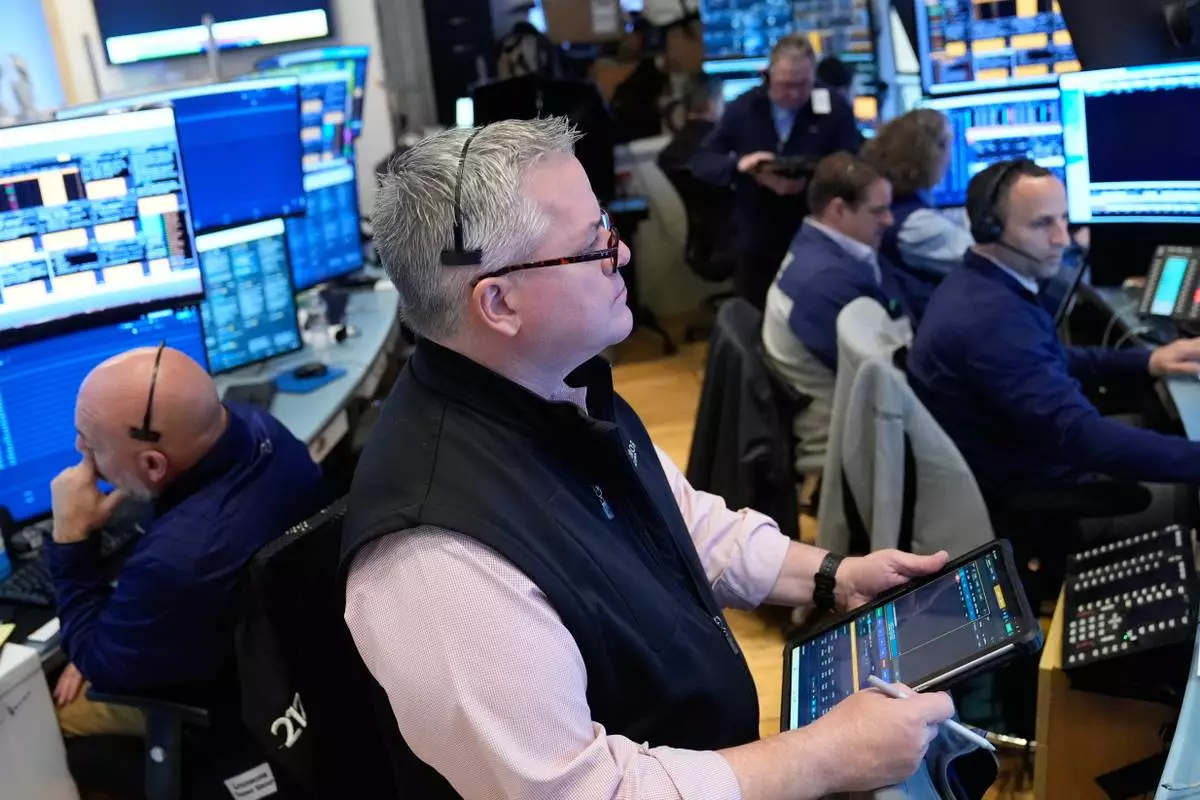
People work on the floor at the New York Stock Exchange in New York, Monday, April 13, 2026. (AP Photo/Seth Wenig)
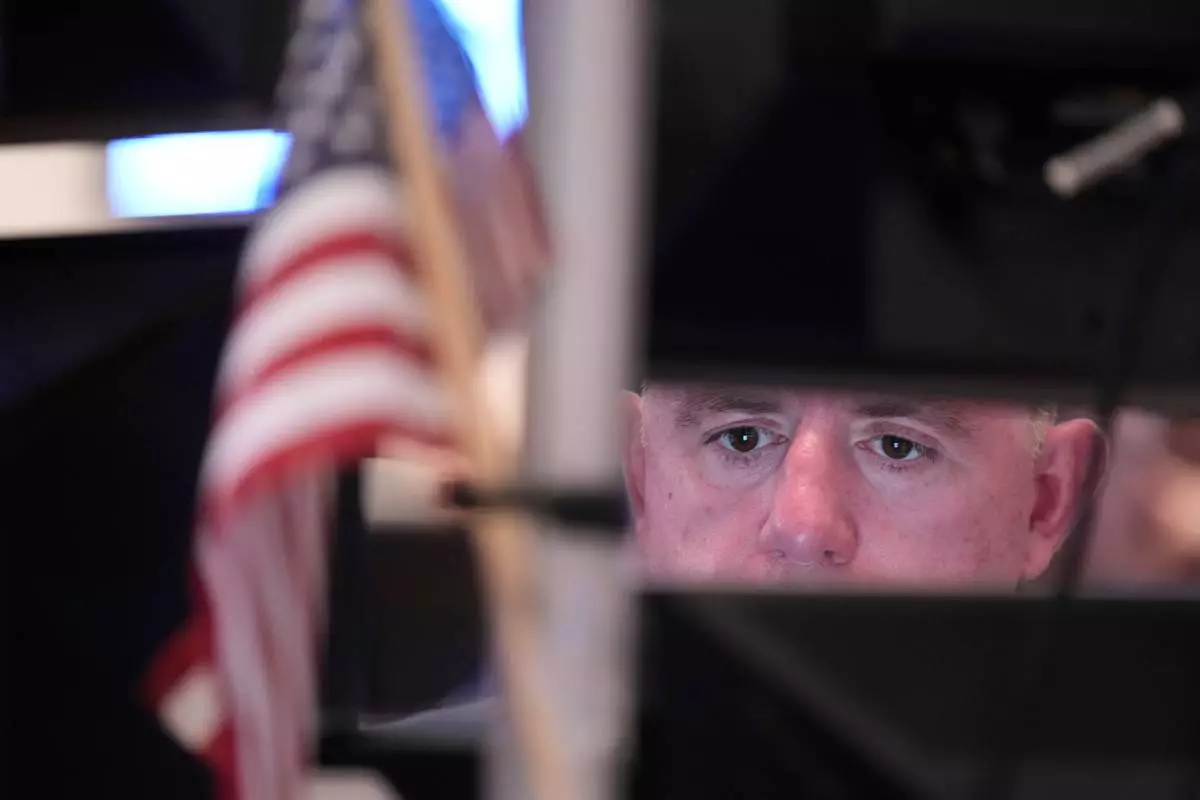
People work on the floor at the New York Stock Exchange in New York, Monday, April 13, 2026. (AP Photo/Seth Wenig)

People work on the floor at the New York Stock Exchange in New York, Monday, April 13, 2026. (AP Photo/Seth Wenig)

A currency trader talks on the phone near a screen showing the Korea Composite Stock Price Index (KOSPI), top center, and the foreign exchange rate between U.S. dollar and South Korean won, top center left, at the foreign exchange dealing room of the Hana Bank headquarters, in Seoul, South Korea, Friday, April 17, 2026. (AP Photo/Ahn Young-joon)

Currency traders work near a screen showing the Korea Composite Stock Price Index (KOSPI), top center, and the foreign exchange rate between U.S. dollar and South Korean won, top center left, at the foreign exchange dealing room of the Hana Bank headquarters, in Seoul, South Korea, Friday, April 17, 2026. (AP Photo/Ahn Young-joon)
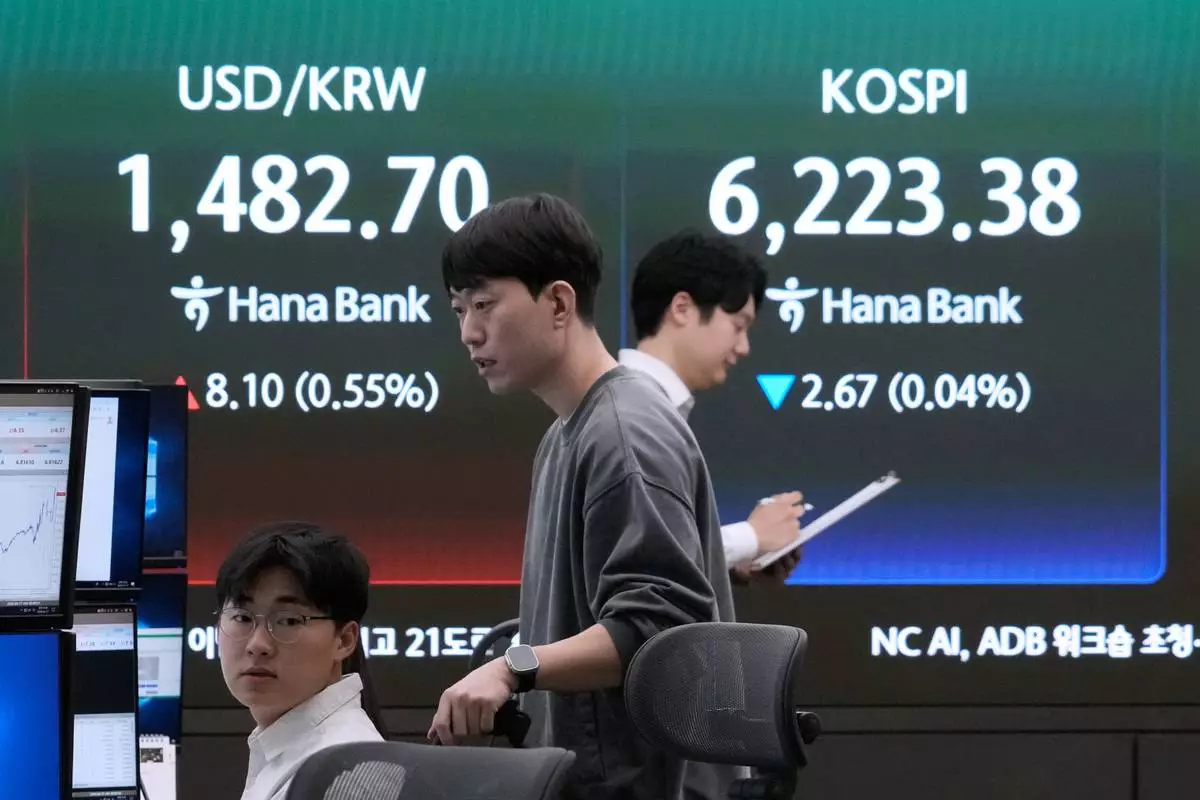
Currency traders work near a screen showing the Korea Composite Stock Price Index (KOSPI), right, and the foreign exchange rate between U.S. dollar and South Korean won at the foreign exchange dealing room of the Hana Bank headquarters, in Seoul, South Korea, Friday, April 17, 2026. (AP Photo/Ahn Young-joon)