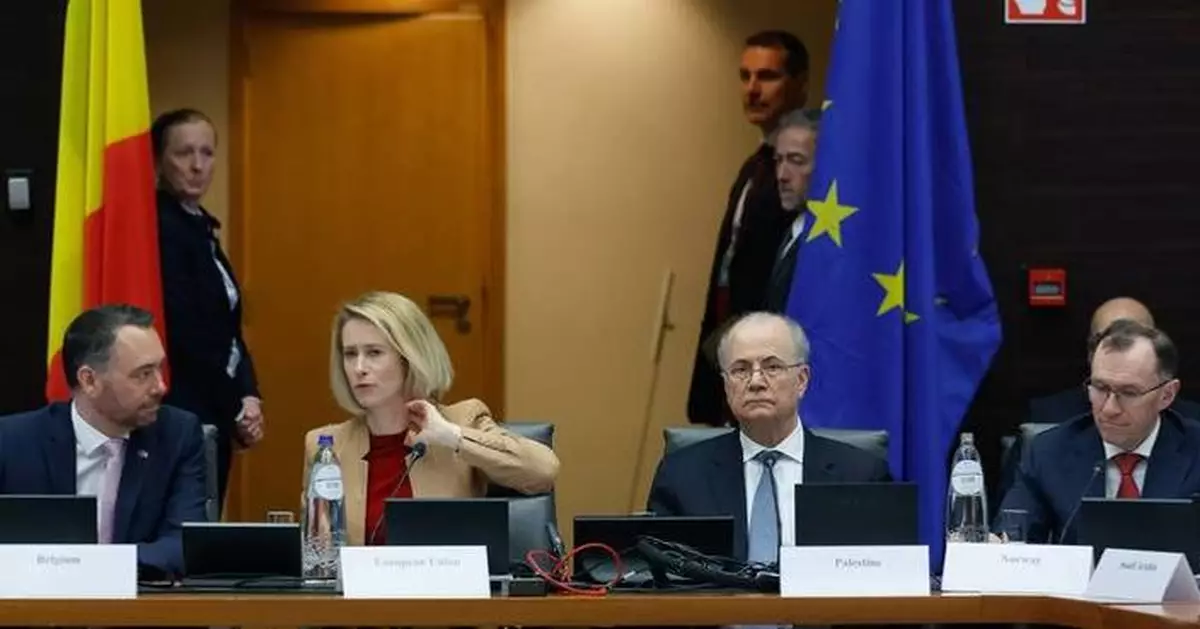
BRUSSELS (AP) — More than 60 nations sent representatives to Brussels Monday to discuss with Palestinian Prime Minister Mohamed Mustafa stability, security and long-term peace in Israel, the West Bank and Gaza, as global attention largely remains focused in the Middle East on the ongoing crises in Iran and Lebanon.
Ongoing attacks in the West Bank and continued devastation in Gaza have dimmed the prospect for a two-state solution, said Belgian Foreign Minister Maxime Prévot ahead of the meeting Monday. He is co-hosting the meeting with the EU’s top diplomat, Kaja Kallas.
“We observe without naivety that the two-state solution is being made more difficult by the day,” Prévot said. “But Belgium and many European and Arab partners continue to believe that this remains the only realistic path to a lasting peace, for Israelis, for Palestinians and for the stability of the entire region.”
Nikolay Mladenov, the director of the Board of Peace created by United States President Donald Trump, and a well-known figure in Brussels, also attended the meeting.
Palestinians in the West Bank say that Israel has used the cover of the Iran war to tighten its grip over the territory, as settler attacks surge and the military imposes additional wartime restrictions on movement, citing security.
Gaza requires “one state, one government, one law and one goal,” Mustafa said on Monday in Brussels.
“Our common objective of achieving one security structure under the legitimate authority should guide the effective coordination between the International Stabilization Force, the Palestinian Authority, security institutions and other international actors. Security must not be fragmented,” he said.
He also called for “the gradual and responsible collection of arms from all armed groups and also the full Israeli withdrawal from Gaza.”
The 27-nation European Union is the largest single donor to the Palestinian Authority, with its 90-year-old president Mahmoud Abbas ruling from Ramallah for two decades. And while the EU has avoided directly joining the Board of Peace, preferring the multilateralism of the United Nations and global legal norms, the bloc is eager to not be sidelined in diplomacy in a volatile region just across the Mediterranean.
Outrage in Europe over the humanitarian catastrophe in Gaza drove many EU leaders to condemn Israel’s war conduct and to pressure Prime Minister Benjamin Netanyahu’s government. With the recent election defeat of long-serving Hungarian Prime Minister Viktor Orbán, a close ally of Netanyahu, there might now be enough political support within the bloc for stronger actions like targeted sanctions on Israeli settlers or even the suspension of some ties to Israel.
Hungarian election winner Péter Magyar said during his first news conference on April 13 that he would seek “pragmatic relations” with Israel but also rejoin the International Criminal Court, which has issued an arrest warrant for Netanyahu. Orbán had defied that warrant while hosting Netanyahu in Budapest in 2025 and then started the process of Hungary leaving the world's only court for war crimes and genocide.
Magyar said that he might not continue Orbán's policy of vetoing actions on Israel — a stumbling block that EU leaders critical of Israel have failed to overcome over the past three years of brutal conflict in the Middle East.
Spanish Prime Minister Pedro Sánchez wants the EU to tear up its long-standing Association Agreement with Israel.
In force since 2000, that agreement sets out the legal and institutional framework within which the bloc and Israel conduct trade and cooperation. The EU had found indications Israel had violated that agreement in its military campaign in Gaza.
“We have nothing against the people of Israel; quite the contrary,” Sánchez said in a post on X on Sunday. “But a Government that violates international law and, therefore, the principles and values of the EU cannot be our partner.”
Spain will table a formal proposal at an EU foreign ministers’ meeting on Tuesday to end the agreement with Israel, he said.
Spain, Ireland, and the Netherlands have voiced deep criticism of Israel's military campaigns in the Middle East but have failed to garner enough support to spur joint EU action.
———
Associated Press writers Barry Hatton in Lisbon, Portugal and Justin Spike in Budapest, Hungary contributed to this report.
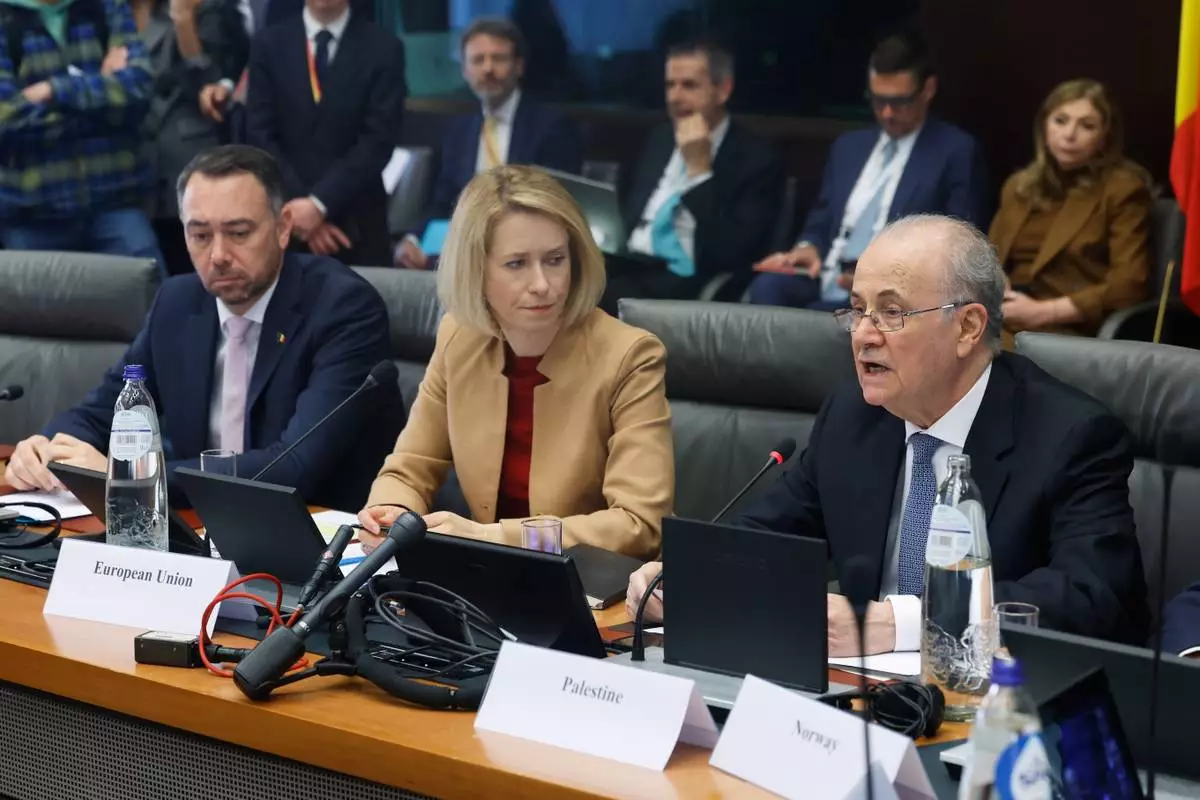
European Union foreign policy chief Kaja Kallas, center, listens as Palestinian Prime Minister Mohammad Mustafa, right, speaks during a meeting of the Global Alliance for the Implementation of the Two-State Solution in Brussels, Monday, April 20, 2026. (AP Photo/Geert Vanden Wijngaert)
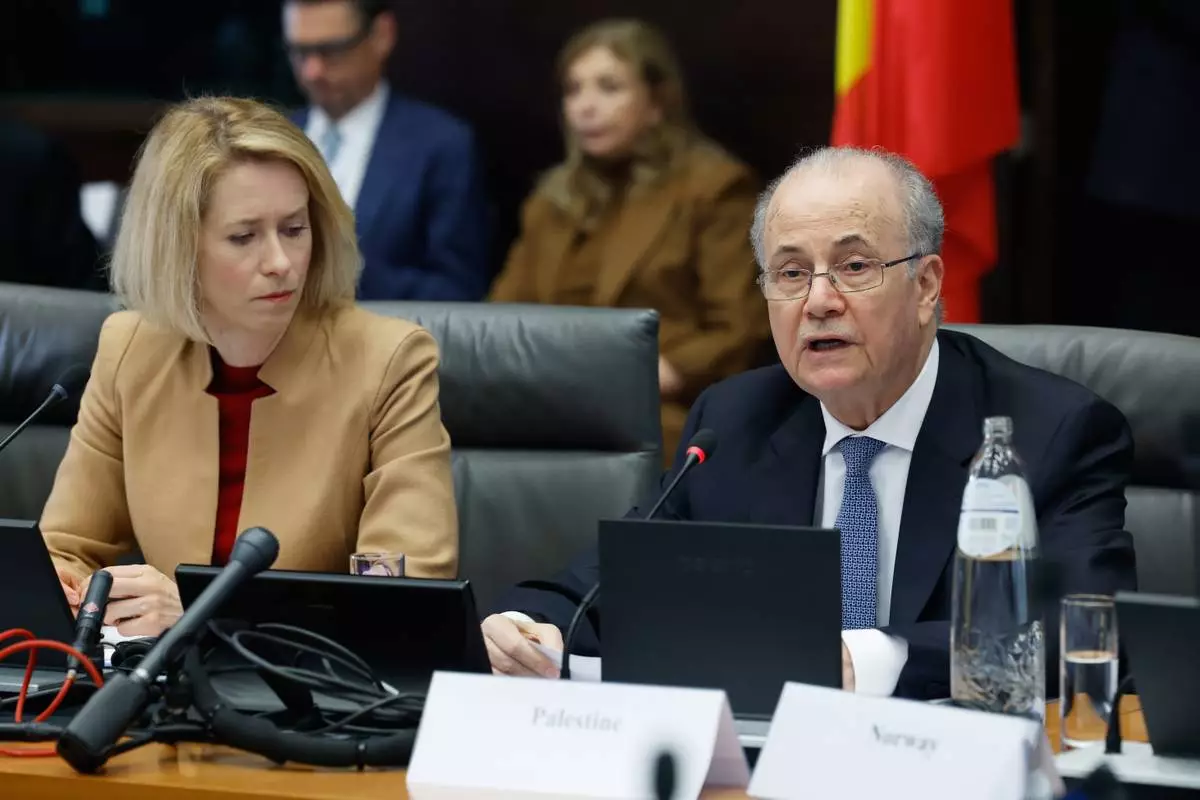
European Union foreign policy chief Kaja Kallas, left, listens as Palestinian Prime Minister Mohammad Mustafa speaks during a meeting of the Global Alliance for the Implementation of the Two-State Solution in Brussels, Monday, April 20, 2026. (AP Photo/Geert Vanden Wijngaert)
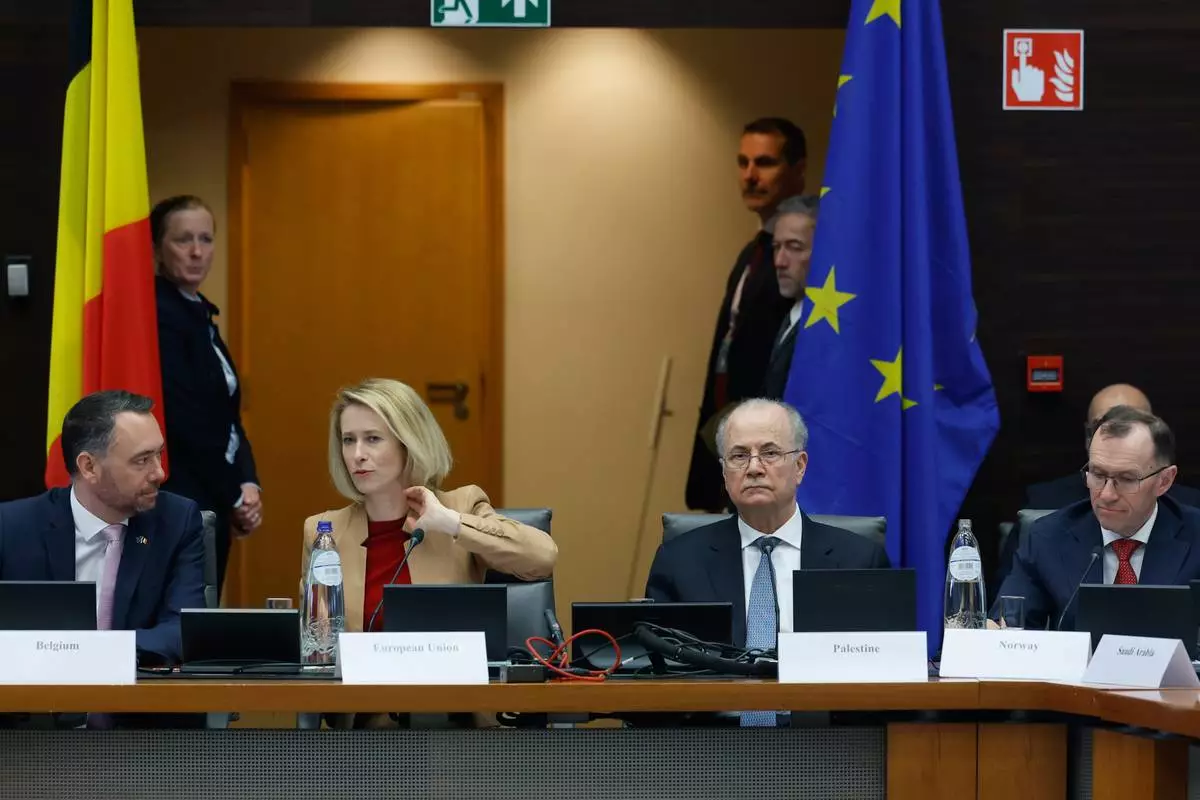
From left, Belgium's Foreign Minister Maxime Prevot, European Union foreign policy chief Kaja Kallas, Palestinian Prime Minister Mohammad Mustafa and Norway's Foreign Minister Espen Barth Eide during a meeting of the Global Alliance for the Implementation of the Two-State Solution in Brussels, Monday, April 20, 2026. (AP Photo/Geert Vanden Wijngaert)