Skip to Content Facebook Feature Image

Despite a new proposal from Iran, ceasefire negotiations with US are in flux

News

Despite a new proposal from Iran, ceasefire negotiations with US are in flux
News

News

Despite a new proposal from Iran, ceasefire negotiations with US are in flux

2026-04-28 08:13 Last Updated At:08:20

DUBAI, United Arab Emirates (AP) — Diplomatic efforts to end the Iran war stalled again over the weekend as both sides dug in on their demands, even as they face mounting pressure to reach a compromise.

Iran said it won’t reopen the Strait of Hormuz unless the United States lifts its blockade and ends the war. U.S. President Donald Trump wants a broader deal that would end Iran’s nuclear program and address other issues like its missile program and support for regional proxies.

More Images
Russian President Vladimir Putin, right, shakes hands with Iranian Deputy Foreign Minister Kazem Gharibabadi, at the Boris Yeltsin Presidential Library, in St. Petersburg, Russia, Monday, April 27, 2026. (Gavriil Grigorov, Sputnik, Kremlin Pool Photo via AP)

Russian President Vladimir Putin, right, shakes hands with Iranian Deputy Foreign Minister Kazem Gharibabadi, at the Boris Yeltsin Presidential Library, in St. Petersburg, Russia, Monday, April 27, 2026. (Gavriil Grigorov, Sputnik, Kremlin Pool Photo via AP)

Iranian Foreign Minister Abbas Araghchi arrives to attend the talks with Russian President Vladimir Putin at the Boris Yeltsin Presidential Library, in St. Petersburg, Russia, Monday, April 27, 2026. (AP Photo/Dmitri Lovetsky, Pool)

Iranian Foreign Minister Abbas Araghchi arrives to attend the talks with Russian President Vladimir Putin at the Boris Yeltsin Presidential Library, in St. Petersburg, Russia, Monday, April 27, 2026. (AP Photo/Dmitri Lovetsky, Pool)

Pro-government demonstrators attend a gathering in Tehran, Iran, Monday, April 27, 2026. (AP Photo/Vahid Salemi)

Pro-government demonstrators attend a gathering in Tehran, Iran, Monday, April 27, 2026. (AP Photo/Vahid Salemi)

A cargo ship sails in the Persian Gulf toward the Strait of Hormuz, Wednesday, April 22, 2026. (AP Photo)

A cargo ship sails in the Persian Gulf toward the Strait of Hormuz, Wednesday, April 22, 2026. (AP Photo)

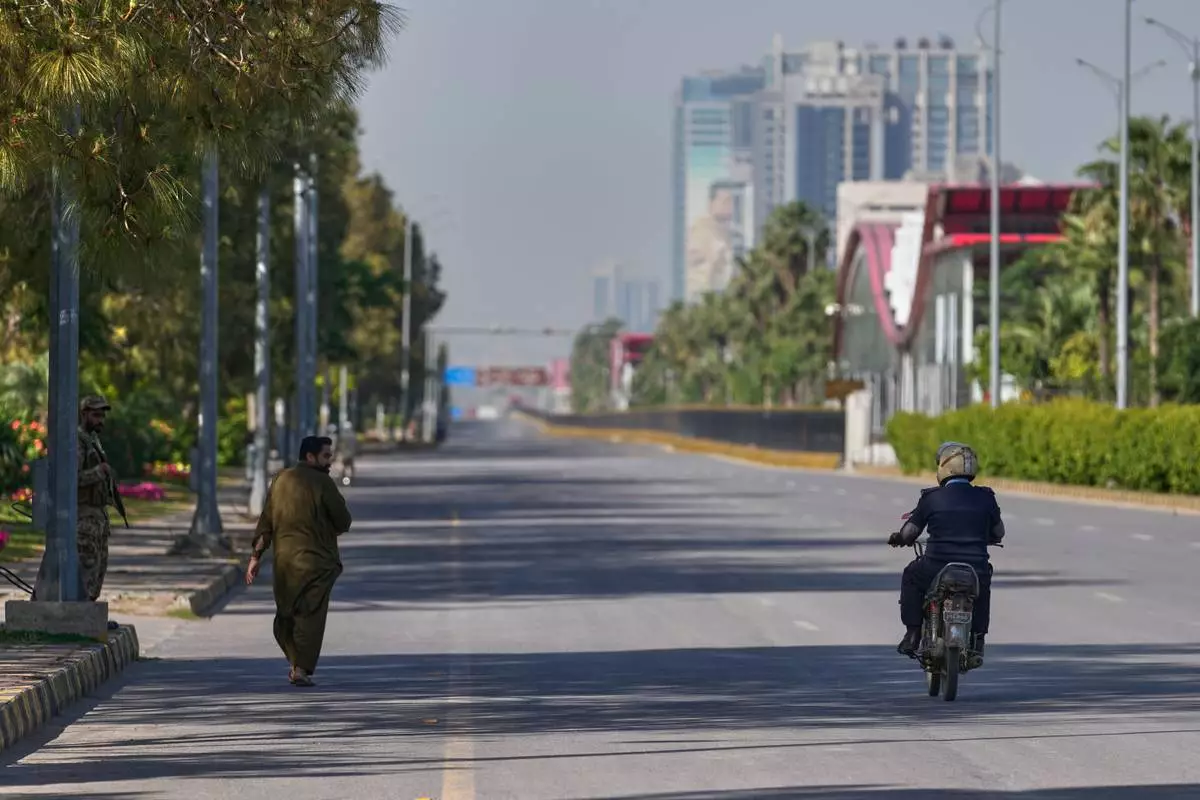
An army soldier, left, walks as police officer drives motorcycle on an empty road ahead of second round of negotiations between the U.S. and Iran, in Islamabad, Pakistan, Monday, April 20, 2026. (AP Photo/Anjum Naveed)
An army soldier, left, walks as police officer drives motorcycle on an empty road ahead of second round of negotiations between the U.S. and Iran, in Islamabad, Pakistan, Monday, April 20, 2026. (AP Photo/Anjum Naveed)

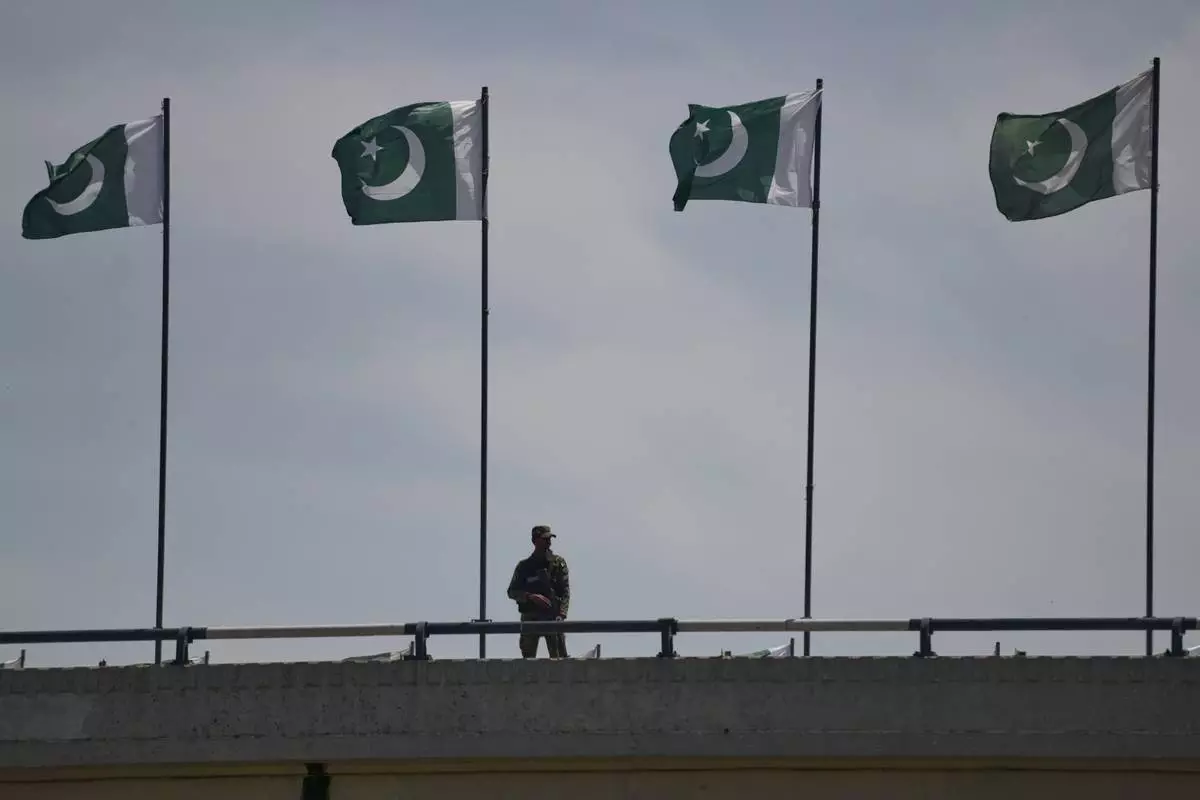
A soldier stands guard on a bridge ahead of second round of negotiations between the U.S. and Iran, in Islamabad, Pakistan, Monday, April 20, 2026. (AP Photo/M.A. Sheikh)
A soldier stands guard on a bridge ahead of second round of negotiations between the U.S. and Iran, in Islamabad, Pakistan, Monday, April 20, 2026. (AP Photo/M.A. Sheikh)

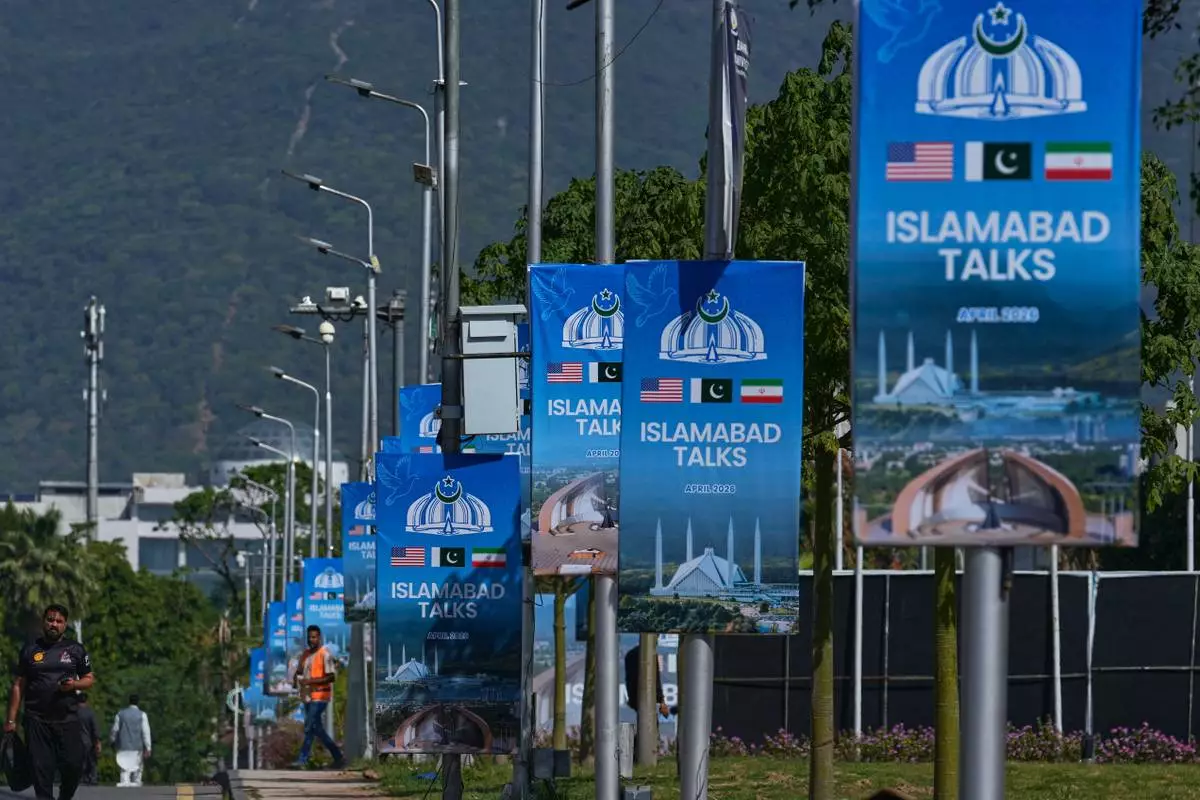
Workers walk past billboards near the Serena Hotel ahead of the second round of negotiations between the U.S. and Iran, in Islamabad, Pakistan, Monday, April 20, 2026. (AP Photo/Anjum Naveed)

Workers walk past billboards near the Serena Hotel ahead of the second round of negotiations between the U.S. and Iran, in Islamabad, Pakistan, Monday, April 20, 2026. (AP Photo/Anjum Naveed)

For both sides, the clock is ticking.

The continued closure of the strait has sent gas prices soaring and could cause further damage to the world economy ahead of U.S. midterm elections. The blockade is strangling Iran’s economy.

Each side is waiting for the other to blink. Here is what to know.

Iran's latest proposal would put off negotiations on its nuclear program to a future date.

Instead, the deal would only see Tehran end its chokehold on the Strait of Hormuz in exchange for Washington lifting its blockade on Iranian ports and a long-term or permanent truce, according to two regional officials with knowledge of the proposal who spoke on condition of anonymity to discuss the closed-door negotiations.

That offer will likely be rejected by Trump. For one, it doesn't address the core issue he cited when he began bombing on Feb. 28: finding a way to ensure that Iran cannot build an atomic weapon. It also appears to be silent on other major questions, like Iran's missile program and its support of proxies in the region.

U.S. Secretary of State Marco Rubio appeared to rule out any deal that excludes Iran’s nuclear program, telling Fox News in an interview Monday, “We can’t let them get away with it.”

“We have to ensure that any deal that is made, any agreement that is made, is one that definitively prevents them from sprinting towards a nuclear weapon at any point,” Rubio said.

This weekend, Trump held back sending envoys to Pakistan, which has been playing a crucial mediating role. By saying the Iranians could call Washington with any proposal, Trump appears to be signaling he's content to try to continue to squeeze Iran via a blockade.

The U.S. blockade both squeezes Iran's oil sales — a key source of hard currency for its theocracy — and threatens to force Tehran to eventually shut down its production if it can't get its crude to market. Already, Iran has faced troubles at home over its economy, and it could worsen as time goes on.

The global economy also is suffering: With few ships able to cross the strait, through which about 20% of all traded oil and natural gas passes, oil and gasoline prices are skyrocketing and jet fuel, cooking gas and other energy products are starting to become scarce in parts of the world.

The current truce began April 8 after multiple deadlines posed by Trump that threatened Iran’s very “civilization” at one point. A separate ceasefire between Israel and the Iran-backed Hezbollah militant group in Lebanon also has taken effect.

Trump has now extended the ceasefire with Iran indefinitely after whipsawing between various timelines for the conflict.

But negotiations for ending the war have stalled.

U.S. Vice President JD Vance took part in an earlier round of talks days after the truce began — the highest-level ones between America and Iran since the 1979 Islamic Revolution. They ended without agreement.

Pakistan is trying to get the two sides back to the table in Islamabad. But this weekend it took down all the checkpoints and security it had in place in anticipation of negotiations. That signals there’s no immediate hope of talks resuming.

While negotiations appear at a stalemate, the U.S. military presence in the Middle East continues to grow. As of Monday, the U.S. Navy had three aircraft carrier groups in the region: the USS Abraham Lincoln, the USS Gerald R. Ford and the USS George H.W. Bush.

Those carriers include some 15,000 sailors and Marines, as well as over 200 aircraft and additional ships. An amphibious assault group led by the USS Tripoli is also in the Mideast, with its own sailors, Marines and aircraft.

That comes on top of the warplanes, refuelers and other troop deployments to the region.

Iranian Foreign Minister Abbas Araghchi met with Russian President Vladimir Putin on Monday, Russian state news agency Tass said. That followed Araghchi's visits to Pakistan and Oman in recent days. Pakistan has been a key mediator in this war, and Oman has long has been a key interlocutor between the U.S. and Iran.

Russia broadly has stayed out of the latest conflict. Moscow has been floated as a possibility to take in Iran's highly enriched uranium — removal of which Trump has insisted on. That uranium could be used to build a bomb, should Iran choose to pursue one — though Tehran insists its program is only for civilian purposes.

Russia has signaled it is willing to assist, though Tehran maintains it will not give up its stockpile.

All of Iran’s highly enriched uranium remains in the country, likely entombed at enrichment sites bombed by the U.S. during a 12-day war last June.

Associated Press writer Samy Magdy in Cairo contributed to this report.

Russian President Vladimir Putin, right, shakes hands with Iranian Deputy Foreign Minister Kazem Gharibabadi, at the Boris Yeltsin Presidential Library, in St. Petersburg, Russia, Monday, April 27, 2026. (Gavriil Grigorov, Sputnik, Kremlin Pool Photo via AP)

Russian President Vladimir Putin, right, shakes hands with Iranian Deputy Foreign Minister Kazem Gharibabadi, at the Boris Yeltsin Presidential Library, in St. Petersburg, Russia, Monday, April 27, 2026. (Gavriil Grigorov, Sputnik, Kremlin Pool Photo via AP)

Iranian Foreign Minister Abbas Araghchi arrives to attend the talks with Russian President Vladimir Putin at the Boris Yeltsin Presidential Library, in St. Petersburg, Russia, Monday, April 27, 2026. (AP Photo/Dmitri Lovetsky, Pool)

Iranian Foreign Minister Abbas Araghchi arrives to attend the talks with Russian President Vladimir Putin at the Boris Yeltsin Presidential Library, in St. Petersburg, Russia, Monday, April 27, 2026. (AP Photo/Dmitri Lovetsky, Pool)

Pro-government demonstrators attend a gathering in Tehran, Iran, Monday, April 27, 2026. (AP Photo/Vahid Salemi)

Pro-government demonstrators attend a gathering in Tehran, Iran, Monday, April 27, 2026. (AP Photo/Vahid Salemi)

A cargo ship sails in the Persian Gulf toward the Strait of Hormuz, Wednesday, April 22, 2026. (AP Photo)

A cargo ship sails in the Persian Gulf toward the Strait of Hormuz, Wednesday, April 22, 2026. (AP Photo)

An army soldier, left, walks as police officer drives motorcycle on an empty road ahead of second round of negotiations between the U.S. and Iran, in Islamabad, Pakistan, Monday, April 20, 2026. (AP Photo/Anjum Naveed)
An army soldier, left, walks as police officer drives motorcycle on an empty road ahead of second round of negotiations between the U.S. and Iran, in Islamabad, Pakistan, Monday, April 20, 2026. (AP Photo/Anjum Naveed)

A soldier stands guard on a bridge ahead of second round of negotiations between the U.S. and Iran, in Islamabad, Pakistan, Monday, April 20, 2026. (AP Photo/M.A. Sheikh)

A soldier stands guard on a bridge ahead of second round of negotiations between the U.S. and Iran, in Islamabad, Pakistan, Monday, April 20, 2026. (AP Photo/M.A. Sheikh)

Workers walk past billboards near the Serena Hotel ahead of the second round of negotiations between the U.S. and Iran, in Islamabad, Pakistan, Monday, April 20, 2026. (AP Photo/Anjum Naveed)

Workers walk past billboards near the Serena Hotel ahead of the second round of negotiations between the U.S. and Iran, in Islamabad, Pakistan, Monday, April 20, 2026. (AP Photo/Anjum Naveed)
The company that operates the cruise ship at the center of a hantavirus outbreak told The Associated Press Wednesday that it expects to know by the end of the week if the vessel will keep to its cruising schedule for the rest of the summer, as it previously indicated it would.

The Dutch-flagged MV Hondius is listed on Oceanwide Expeditions' website as scheduled to depart on a cruise later in May that would take it to the Arctic for a series of cruises throughout the summer.

Three cruise ship passengers have died, including a Dutch couple whom health officials believe were the first exposed to the virus while visiting South America. In all, there have been 11 cases reported in the outbreak, nine of which have been confirmed.

On Monday, after the ship reached Spain's Canary Islands where all remaining passengers were taken off, Oceanwide Expeditions said that it did not “foresee changes to our operations” — which included a new cruise beginning May 29.

But on Wednesday the company said it expects “clarity on whether the vessel will sail and the sailing schedule by the end of this week.”

More than 120 people on board during the outbreak — all passengers and some crew — disembarked on Sunday and Monday and are now quarantined in several countries. The ship then set sail for Rotterdam, the Netherlands, where it is expected to arrive on May 17 or 18, Oceanwide Expeditions says.

Twenty-five crew members, two health workers and the body of one of the passengers who died are still on board. None are showing any symptoms, the company has said.

Hantavirus usually spreads from rodent droppings and is not easily transmitted between people, though the Andes virus detected on the Hondius may be able to spread between people in rare cases. Symptoms usually show between one and eight weeks after exposure.

Becatoros reported from Athens, Greece, and Shastri reported from Milwaukee.

Passengers board a plane bound for Eindhoven, after disembarking from the hantavirus-stricken cruise ship MV Hondius at the airport in Tenerife, Canary Islands, Spain, Monday, May 11, 2026. (AP Photo/Arturo Rodriguez)

Passengers board a plane bound for Eindhoven, after disembarking from the hantavirus-stricken cruise ship MV Hondius at the airport in Tenerife, Canary Islands, Spain, Monday, May 11, 2026. (AP Photo/Arturo Rodriguez)

The hantavirus-stricken cruise ship MV Hondius is seen at anchor at the port of Granadilla in Tenerife, Canary Islands, Spain, Monday, May 11, 2026. (AP Photo/Arturo Rodriguez)

The hantavirus-stricken cruise ship MV Hondius is seen at anchor at the port of Granadilla in Tenerife, Canary Islands, Spain, Monday, May 11, 2026. (AP Photo/Arturo Rodriguez)

Recommended Articles