DH announces latest situation regarding Legionnaires' disease case
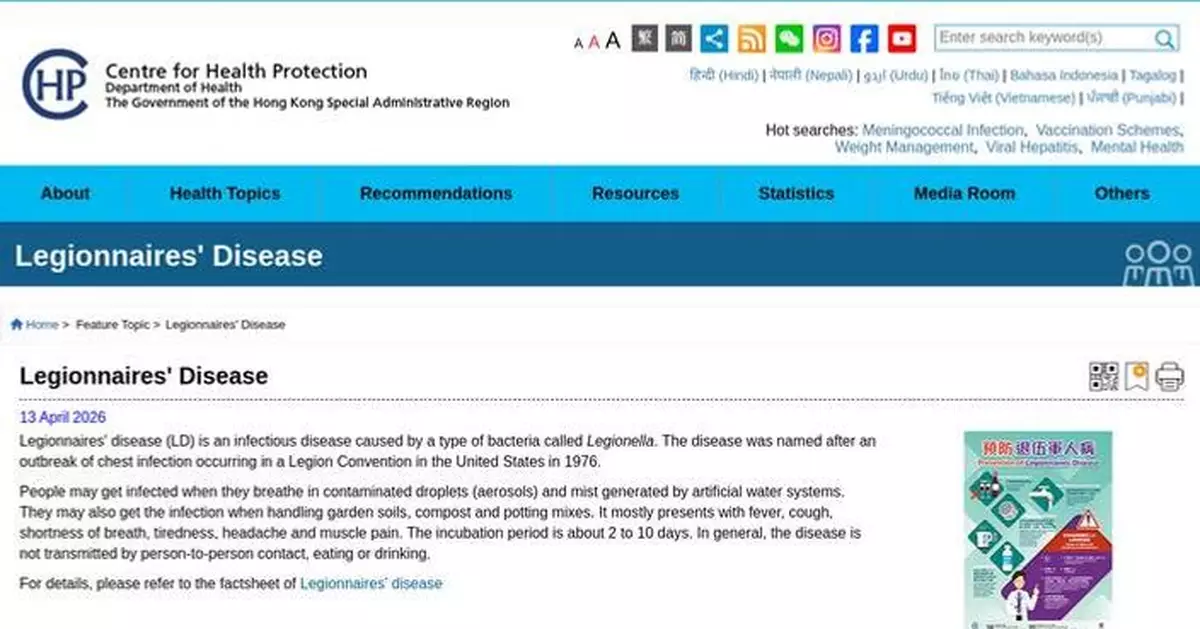
The Centre for Health Protection (CHP) of the Department of Health (DH) today (April 20) reported the latest number of Legionnaires' disease (LD) cases, and reminded the public of the importance of using and maintaining properly designed man-made water systems, adding that susceptible groups should strictly observe relevant precautions.
From April 12 to 18, the CHP recorded four community-acquired LD cases. The details are as follows:
 a 69-year-old female with good past health living in Eastern District;
a 73-year-old male with underlying illnesses living in Tai Po District;
a 68-year-old male with underlying illnesses living in North District; and
a 62-year-old male with underlying illnesses living in Wong Tai Sin District.
a 69-year-old female with good past health living in Eastern District;
a 73-year-old male with underlying illnesses living in Tai Po District;
a 68-year-old male with underlying illnesses living in North District; and
a 62-year-old male with underlying illnesses living in Wong Tai Sin District.
The CHP is conducting epidemiological investigations to identify the potential sources of infection and high-risk exposure. An initial investigation revealed that the four cases are sporadic cases. No epidemiological linkages have been established between these cases and other confirmed cases previously recorded in Hong Kong.
As of April 18, 31 LD cases had been recorded this year. In 2025 and 2024, there were 167 and 135 LD cases respectively.
Men, people aged over 50, smokers, alcoholics and persons with weakened immunity are more susceptible to LD. Some situations may also increase the risk of infection, including poor maintenance of water systems; living in areas with old water systems, cooling towers or fountains; using electric water heaters, whirlpool spas or hot water spring spas; and recent stays in hotels or ships.
Legionellae are found in various environmental settings and grow well in warm water (20 to 45 degrees Celsius). They can be found in aqueous environments such as water tanks, hot and cold water systems, cooling towers, whirlpool spas, water fountains, humidifiers and home respiratory devices that support breathing. People may become infected when they breathe in contaminated droplets (aerosols) and mist generated by artificial water systems, or when handling garden soil, compost and potting mixes.
Immunocompromised persons should:
Use sterile or boiled water for drinking, tooth brushing and mouth rinsing;
Avoid using humidifiers, or other mist- or aerosol-generating devices; and
If using humidifiers, or other mist- or aerosol-generating devices, fill the water tank with only sterile or cooled freshly boiled water, and not water directly from the tap. Also, clean and maintain humidifiers/devices regularly according to manufacturers' instructions. Never leave stagnant water in a humidifier/device. Empty the water tank, wipe all surfaces dry, and change the water daily.
The public should observe the health advice below:
Observe personal hygiene;
Do not smoke and avoid alcohol consumption;
Strainers in water taps and shower heads should be inspected, cleaned, descaled and disinfected regularly or at a frequency recommended by the manufacturer;
If a fresh-water plumbing system is properly maintained, it is not necessary to install domestic water filters. Use of water filters is not encouraged as clogging occurs easily, which can promote growth of micro-organisms. In case water filters are used, the pore size should be 0.2 micrometres (µm) or less and the filter needs to be changed periodically according to the manufacturer's recommendations;
Drain and clean water tanks of buildings at least quarterly;
Drain or purge for at least one minute infrequently used water outlets (e.g. water taps, shower heads and hot water outlets) and stagnant points of the pipework weekly or before use;
Seek and follow doctors' professional advice regarding the use and maintenance of home respiratory devices and use only sterile water (not distilled or tap water) to clean and fill the reservoir. Clean and maintain the device regularly according to the manufacturer's instructions. After cleaning/disinfection, rinse the device with sterile water, cooled freshly boiled water or water filtered with 0.2 µm filters. Never leave stagnant water in the device. Empty the water tank, keep all surfaces dry, and change the water daily; and
When handling garden soil, compost and potting mixes:
Wear gloves and a face mask;
Water gardens and compost gently using low pressure;
Open composted potting mixes slowly and make sure the opening is directed away from the face;
Wet the soil to reduce dust when potting plants; and
Avoid working in poorly ventilated places such as enclosed greenhouses.
The public may visit the CHP'sLD page, theCode of Practice for Prevention of LDand theHousekeeping Guidelines for Cold and Hot Water Systems for Building Managementof the Prevention of LD Committee, and the CHP'srisk-based strategyfor prevention and control of LD.
Additionally, as smokers and alcoholics are more susceptible to LD, the Government urgesmembers of the public to quit smoking and avoid drinking. Members of the public may call the DH Integrated Smoking Cessation Hotline at 1833 183, which is answered by registered nurses who provide professional counselling and referral to a wide range of free smoking cessation services. The public may also visit the smoking cessation thematic website (www.livetobaccofree.hk) for more information on smoking cessation. The DH has also developed and promulgated the Alcohol Screening and Brief Intervention tool to primary healthcare service providers to facilitate the early identification and management of at-risk drinkers. For information on alcohol-related harm, please visit the DH'sChange for Health website.
Source: AI-found images
CE meets Governor of Anhui Province
The Chief Executive, Mr John Lee, met with the Governor of Anhui Province, Mr Wang Qingxian, at Government House today (April 20) to exchange views on deepening co-operation between Anhui and Hong Kong. The Secretary for Constitutional and Mainland Affairs, Miss Janice Tse Siu-wa; and the Director of the Chief Executive's Office, Ms Carol Yip, also attended the meeting.
Mr Lee welcomed Mr Wang and his delegation to Hong Kong for a conference promoting innovation co-operation between Anhui and Hong Kong. He said that this year marks the opening year of the National 15th Five-Year Plan which emphasises promoting co-ordinated regional development, and consolidating and enhancing the roles of the Yangtze River Delta and the Guangdong-Hong Kong-Macao Greater Bay Area (GBA) as driving forces. Anhui is an important engine for the high-quality development of the Yangtze River Delta Region, and Hong Kong is a core city and key driving engine of the GBA. The two places enjoy close cultural and business ties, and maintain close co-operation. He expressed confidence that the two places will continue to deepen co-operation, promote the Yangtze River Delta and the GBA as world-class city clusters, and jointly seize the new opportunities brought by the National 15th Five-Year Plan.
Mr Lee said that Hong Kong has long been Anhui's largest source of external investment, and the two places enjoy close economic and trade ties. Hong Kong is ranked No. 1 in the world in economic freedom, and enjoys the unique advantage of having both national and international opportunitiespresent simultaneously in the same city under the "one country, two systems" principle, playing its roles as a "super connector" and a "super value-adder". The Hong Kong Special Administrative Region Government has established the Task Force on Supporting Mainland Enterprises in Going Global (GoGlobal Task Force). Through its cross-sector professional services platform, the GoGlobal Task Force serves Mainland enterprises in "going global" and attracts international capital to Hong Kong, firmly advancing high-quality economic development. He welcomed more Mainland enterprises, including those from Anhui, to make good use of Hong Kong's highly internationalised market and high value-added professional services to enhance their business competitiveness, and to use Hong Kong as a springboard to expand into global markets for shared development.
Mr Lee said that Anhui has experienced rapid economic development, with active efforts to foster emerging industries such as the digital economy and AI. Hong Kong is actively advancing the preparation of its first five-year plan, and is making every effort to build an international innovation and technology (I&T) centre and an international hub for high-calibre talent, thereby opening up a new chapter of high-quality development and better integrating into and serving the country's overall development. Hong Kong will further expand co-operation with Anhui in cutting-edge I&T fields and promote the development of the I&T sectors in both places to jointly drive the development of new quality productive forces and contribute to building a technologically advanced nation. The two places will also advance deeper and broader co-operation in areas such as finance, economics and trade, and people-to-people and cultural exchanges to achieve complementary strengths and mutual benefits for win-win outcomes.
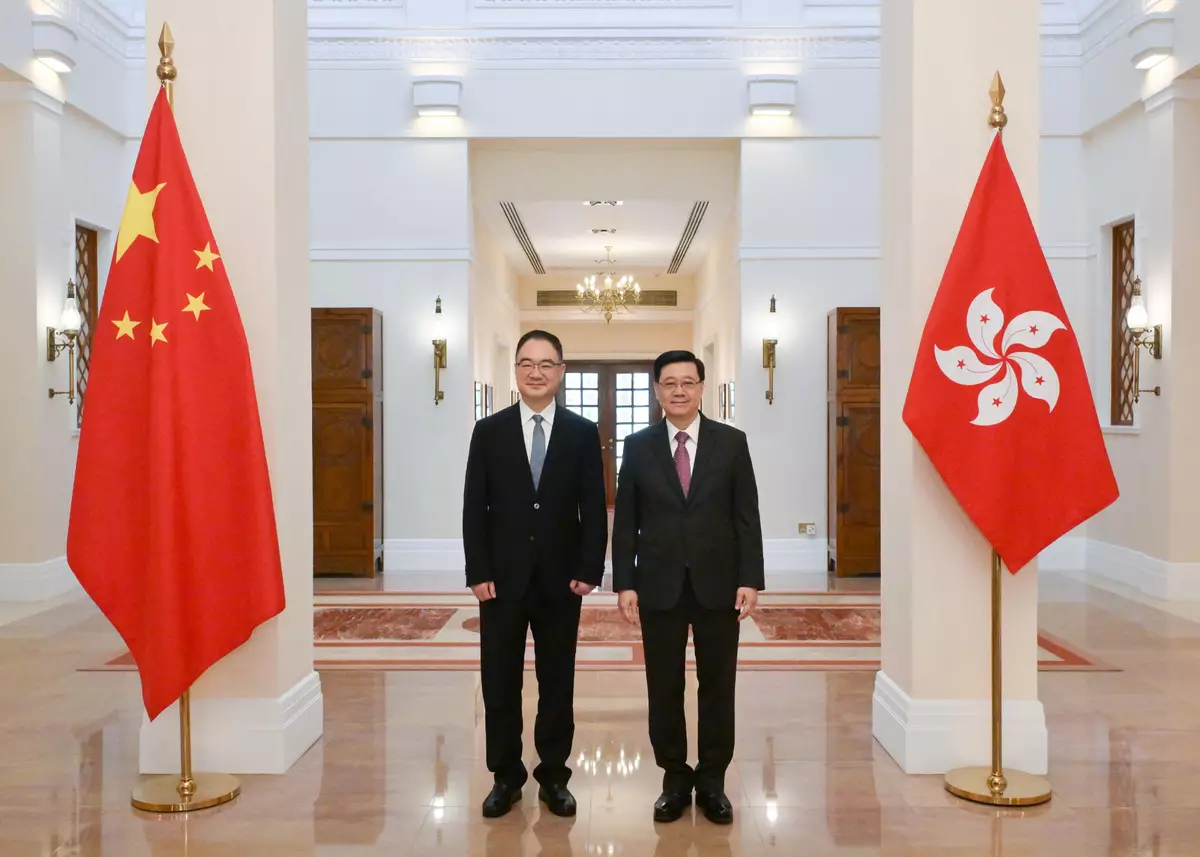
CE meets Governor of Anhui Province Source: HKSAR Government Press Releases