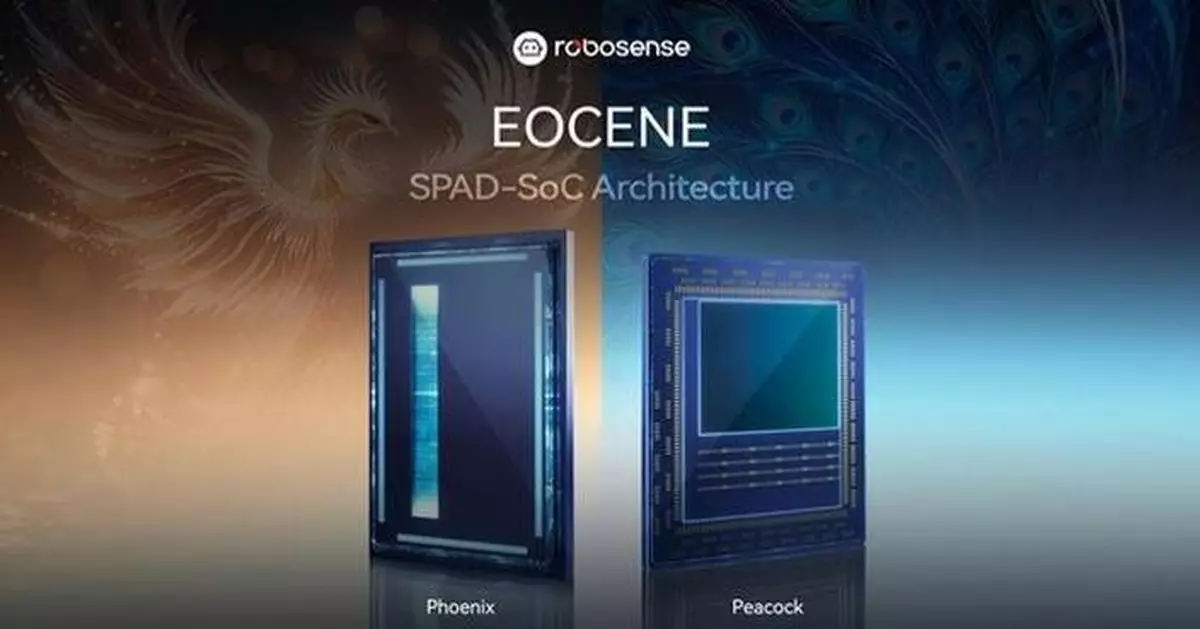
- RoboSense debuted the EOCENE SPAD-SoC architecture, enabling rapid incubation of a diverse chipset portfolio while streamlining R&D workflows to deliver significant structural cost advantages.
- RoboSense launched the Phoenix chipset, the industry's first automotive-grade monolithic SPAD-SoC, delivering 2,160-beam image-grade output to establish a new benchmark for high-definition 3D perception.
- RoboSense introduced the Peacock chipset, a fully solid-state, ultra-large array SPAD-SoC, propelling robotics into the era of image-grade 3D perception
- RoboSense's RGBD sensor is slated for official release by the end of 2027
- Fundamental Process Layer: Unified 28nm advanced process node with automotive-grade design; features 3rd-Gen ultra-sensitivity SPAD with a world-leading 45% PDE and 2nd-Gen 3D-stacking via wafer-level hybrid bonding.
- Core Computational Layer: Configurable 4320-Core heterogeneous compute Array; powered by a high-bandwidth network-on-chip (NoC) supporting 495 billion point-cloud samplings/s and an up to thousand-beam ultra-HD perception enhancement engine.
- Algorithm Acceleration Layer: hardware-integrated anti-Interference & signal processing engine; delivers up to 99.9% sunlight noise suppression and 99.9% crosstalk immunity with smart pixel management for optimized perception.
- Security & Reliability Layer: Automotive-grade secure silicon architecture; strictly engineered for extreme reliability and operational resilience across a temperature range of -40°C to 125°C.
SHENZHEN, China, April 21, 2026 /PRNewswire/ -- RoboSense (HKEX: 2498), an AI-driven robotics technology company, hosted its 2026 Tech Day in Shenzhen today, marking a landmark moment with the global debut of its pioneering self-developed SPAD-SoC architecture, EOCENE, and two flagship image-grade chipsets, Phoenix and Peacock. Alongside these core launches, RoboSense offered a strategic preview of its revolutionary RGBD sensor, slated for release in 2027. This breakthrough signifies a paradigm shift in 3D perception technology, solidifying RoboSense's position as the architect of the industry's next technological cycle, and an insightful visionary poised to capture the expansive market potential now unfolding.
Mark Qiu, CEO of RoboSense, remarked: "Drawing a strategic parallel to the historic transition from CCD to CMOS within the imaging industry, we believe the LiDAR sector has reached a critical inflection point. By establishing our proprietary SPAD-SoC architecture as the foundation, we are redefining the metrics of 3D perception. In our view, mastery of chipset capability is the ultimate arbiter of generational advantage. Those who command the silicon effectively wield control over product generational evolution, securing a privileged position and holding the high ground in the future industry landscape."
RoboSense's overarching strategy centers on the vertical integration of proprietary chipset R&D and advanced module engineering. Securing a dominant position in the coming stage of large-scale commercialization requires a full-stack approach: proprietary chipset capabilities establish technological generational leads and structural cost advantages, while module engineering ensures system-level excellence in point-cloud fidelity, ranging precision, and interference rejection. By integrating these twin engines, RoboSense is establishing the definitive performance benchmarks for the next phase of industrial evolution of 3D perception.
The Visionary Trend of LiDAR Industry Evolution
The shift from analog to digital architectures is an industry imperative. Mirroring the historic pivot from CCD to CMOS in the imaging sector, RoboSense recognizes that the LiDAR industry has reached its definitive "CMOS moment." Legacy analog architectures have hit inherent performance ceilings, where further scaling triggers prohibitive complexity and linear cost escalation. In the LiDAR sector, analog solutions—epitomized by SiPM—are destined to be superseded by SPAD architectures, much like the transition that once rendered CCD obsolete. Furthermore, sharing the same semiconductor lineage as CMOS, SPAD technology capitalizes on Moore's Law, enabling direct access to the mature process nodes and infrastructure of the global semiconductor ecosystem.
The evolution toward high-beam, image-grade performance is equally irreversible. Under the SPAD architecture, the performance ceiling of LiDAR has been significantly elevated, dramatically enhancing detection capabilities for small objects at long ranges and ensuring robustness in adverse weather. By reaching 2160 beams, LiDAR enters the 4-megapixel era; as it scales further to 4000 beams, it achieves an 8-megapixel output, meeting the true 4K standard. This transition into the image-grade era will fundamentally redefine safety standards—positioning high-resolution LiDAR as a non-negotiable safeguard for both L2+ and L3 autonomous vehicles.
EOCENE:The SPAD-SoC Platform
RoboSense introduced its groundbreaking SPAD-SoC architecture, the EOCENE. Named after the dawn of a new era, the platform marks a fundamental transition from discrete technical breakthroughs to a scalable production model. By codifying nine years of full-stack experience into a standardized R&D paradigm, EOCENE enables the rapid incubation of a high-performance SoC portfolio, establishing a systematic competitive barrier through efficient innovation.
The EOCENE SPAD-SoC architecture is designed with 4 Core Functional Layers:
SHENZHEN, China, April 21, 2026 /PRNewswire/ -- RoboSense (HKEX: 2498), an AI-driven robotics technology company, hosted its 2026 Tech Day in Shenzhen today, marking a landmark moment with the global debut of its pioneering self-developed SPAD-SoC architecture, EOCENE, and two flagship image-grade chipsets, Phoenix and Peacock. Alongside these core launches, RoboSense offered a strategic preview of its revolutionary RGBD sensor, slated for release in 2027. This breakthrough signifies a paradigm shift in 3D perception technology, solidifying RoboSense's position as the architect of the industry's next technological cycle, and an insightful visionary poised to capture the expansive market potential now unfolding.
Mark Qiu, CEO of RoboSense, remarked: "Drawing a strategic parallel to the historic transition from CCD to CMOS within the imaging industry, we believe the LiDAR sector has reached a critical inflection point. By establishing our proprietary SPAD-SoC architecture as the foundation, we are redefining the metrics of 3D perception. In our view, mastery of chipset capability is the ultimate arbiter of generational advantage. Those who command the silicon effectively wield control over product generational evolution, securing a privileged position and holding the high ground in the future industry landscape."
RoboSense's overarching strategy centers on the vertical integration of proprietary chipset R&D and advanced module engineering. Securing a dominant position in the coming stage of large-scale commercialization requires a full-stack approach: proprietary chipset capabilities establish technological generational leads and structural cost advantages, while module engineering ensures system-level excellence in point-cloud fidelity, ranging precision, and interference rejection. By integrating these twin engines, RoboSense is establishing the definitive performance benchmarks for the next phase of industrial evolution of 3D perception.
The Visionary Trend of LiDAR Industry Evolution
The shift from analog to digital architectures is an industry imperative. Mirroring the historic pivot from CCD to CMOS in the imaging sector, RoboSense recognizes that the LiDAR industry has reached its definitive "CMOS moment." Legacy analog architectures have hit inherent performance ceilings, where further scaling triggers prohibitive complexity and linear cost escalation. In the LiDAR sector, analog solutions—epitomized by SiPM—are destined to be superseded by SPAD architectures, much like the transition that once rendered CCD obsolete. Furthermore, sharing the same semiconductor lineage as CMOS, SPAD technology capitalizes on Moore's Law, enabling direct access to the mature process nodes and infrastructure of the global semiconductor ecosystem.
The evolution toward high-beam, image-grade performance is equally irreversible. Under the SPAD architecture, the performance ceiling of LiDAR has been significantly elevated, dramatically enhancing detection capabilities for small objects at long ranges and ensuring robustness in adverse weather. By reaching 2160 beams, LiDAR enters the 4-megapixel era; as it scales further to 4000 beams, it achieves an 8-megapixel output, meeting the true 4K standard. This transition into the image-grade era will fundamentally redefine safety standards—positioning high-resolution LiDAR as a non-negotiable safeguard for both L2+ and L3 autonomous vehicles.
EOCENE:The SPAD-SoC Platform
RoboSense introduced its groundbreaking SPAD-SoC architecture, the EOCENE. Named after the dawn of a new era, the platform marks a fundamental transition from discrete technical breakthroughs to a scalable production model. By codifying nine years of full-stack experience into a standardized R&D paradigm, EOCENE enables the rapid incubation of a high-performance SoC portfolio, establishing a systematic competitive barrier through efficient innovation.
The EOCENE SPAD-SoC architecture is designed with 4 Core Functional Layers:
The Phoenix Chipsets
RoboSense unveiled Phoenix, an automotive-grade monolithic SPAD-SoC capable of 2,160-beam image-grade output. The Phoenix series will feature a versatile lineup of five distinct models, specifically engineered to support LiDAR designs spanning 2160, 1440, 720, 480, and 240 beams. Compared to designs that cluster or cascade multiple chips to achieve high beam counts, Phoenix delivers true 2160-beam performance independently through a streamlined, single-optical path. This state-of-the-art monolithic integration enables an ultra-high resolution of 2160 × 1900—surpassing the point-cloud fidelity of a 4MP camera—and outputs 2K ultra-HD near-infrared (NIR) imagery. With a 600-meter detection range and AEC-Q100 certification, Phoenix evolves LiDAR from a basic ranging sensor into a sophisticated visual imaging system. The 2,160-beam solution based on Phoenix have already secured design wins from world-leading automakers, with mass production scheduled in 2026.
The Peacock Chipset
RoboSense unveiled Peacock, a premier all-solid-state ultra-large array SPAD-SoC featuring a high-density resolution of 640 × 480, propelling robotics into the era of image-grade 3D perception. By integrating this massive matrix into a single SoC, Peacock shifts LiDAR output from sparse data points to VGA-level imaging output. The chipset provides an expansive 180° × 135° field of view (FOV) and millimeter-level precision, capable of detecting objects as close as 5cm. Designed for broad cross-industry adoption, Peacock's versatile architecture seamlessly adapts to diverse applications—from automotive blind-spot detection and low-speed autonomous vehicles to industrial safety, robotics, and emerging super-sensor form factors. Peacock is slated for mass production in Q3 2026, with initial batch deliveries already underway to key customers.
RGBD: Advancing Spatial Intelligence with Color-Enriched 3D Imaging
By integrating a color filter array with the high-resolution output of the Peacock chipset, RoboSense has achieved advanced RGBD (Red, Green, Blue + Depth) 3D vision. The core of this innovation is Peacock's ability to output high-density spatial data, which allows the seamless integration of color information directly onto 3D point clouds.
RoboSense has long been a pioneer in the exploration of sensor fusion. The introduction of the AC1 and AC2 Active Camera series in 2025 provided the industry with a diverse range of integrated perception solutions, laying the essential groundwork for advancing colorized 3D vision. RoboSense's new RGBD sensor is slated for official release by the end of 2027.
Looking ahead, RoboSense is committed to ushering in an era where 3D perception achieves the same ubiquity as the modern camera. By integrating its visionary technology into every vehicle, every robot, and every physical AI terminal, RoboSense is not merely participating in a technological shift—it is standing as the definitive architect of a new epoch in 3D perception.
Please access the full press kit via the link:
https://www.dropbox.com/scl/fo/zafeavobmdke8cp0mgmtt/AKduk648136gxk3w9moF87o?rlkey=5n0n2843o5hpvqgm0fxmi2q9t&st=nagfu804&dl=0
About RoboSense
RoboSense (02498 HKEX) is an AI-driven robotics company, founded in 2014 and headquartered in Shenzhen, China. Leveraging its full-stack, in-house developed digital chips and a robust AI technology system, the company provides core robotic components, perception systems, and manipulation solutions across a wide range of industries, including autonomous passenger and commercial vehicles, Robotaxi, as well as robotics applications in autonomous logistics, robotic lawn mowers, and humanoid robots.
As a global leader in the LiDAR industry, RoboSense has partnered with over 310 automotive brands and Tier-1 suppliers. In the robotics sector, it is the preferred solution provider for autonomous logistics, robotic lawn mowers, humanoid robots, and other pan-robotics applications, serving more than 3,400 clients worldwide. In 2025, the company ranked first in LiDAR market share in the robotics sector.
Building on its globally leading perception capabilities, RoboSense has extended its technology into robotic manipulation, launching robotic vision systems, dexterous hands, and hand-eye coordination solutions, driving the large-scale commercialization in the era of Physical AI.
** This press release is distributed by PR Newswire through automated distribution system, for which the client assumes full responsibility. **
RoboSense Unveiled EOCENE SPAD-SoC Architecture and Chipsets Phoenix and Peacock: Ushering the LiDAR Industry into the Image-grade Era of High-Definition 3D Perception