MUNICH & PFORZHEIM, Germany--(BUSINESS WIRE)--Apr 21, 2026--
The current geopolitical situation once again highlights the risks of depending on fossil fuels and the increasing need to transform our energy supply. Solar and wind power have long been established as cost-efficient energy sources, and the International Energy Agency (IEA) has predicted a global 2.6-fold capacity growth between 2022 and 2030. Against this backdrop, The smarter E Europe alliance of exhibitions will spotlight the feasibility of a renewable energy system from June 23–25 in Munich. The Special Exhibit Renewables 24/7 uses best practices, presentations and live demos to show how a round-the-clock renewable energy supply can be achieved. To kick off the exhibition on June 23, The smarter E Europe will present an exclusive accompanying study, conducted in collaboration with the Fraunhofer Institute for Solar Energy Systems, that dispels common myths about system stability and provides scientific proof that such an energy system is viable. The study, Pathways to a Renewable Energy Supply – uses Germany, where 60 percent of electricity is already generated by renewable sources – as an example to demonstrate the supply security of a renewable energy system in leading industrial nations. More than 2,800 exhibitors and over 100,000 visitors from all over the world are expected to attend Europe’s largest alliance of exhibitions for the energy industry.
This press release features multimedia. View the full release here: https://www.businesswire.com/news/home/20260421244001/en/
Interested visitors can immerse themselves in the special exhibit’s four thematic areas: industry, commerce, residential applications and mobility. In each area you can experience how power generation, storage, flexibilization and digitalization work together. While wind and solar are volatile and do not provide a constant power supply, solutions and technologies are already available today that allow companies, utilities, and consumers to manage fluctuations and surplus generation. “Electricity from solar and wind is already unbeatably cheap. The energy transition is unstoppable and delaying it will only damage the economy. Companies can reduce their energy costs long term and ensure competitiveness through renewable energy. Secure supply is guaranteed through flexibilization, the combination of intelligent storage, digital grid solutions and sector coupling,” says Markus Elsässer, Founder and CEO of Solar Promotion GmbH.
The energy system of the future
The key to transforming the energy supply is the electrification of all areas – from transportation and heat generation to industry. Electrification will act as a driver for innovation and economic growth. This, in turn, will increase added value, much more than through imported crude oil and gas. “With the special exhibit, we will highlight the right topics at the right time, showing that the energy transition is not only possible, but also makes sense from an economic, political and social point of view. It is down to us to seize this opportunity,” says Jens Mohrmann, CEO of Freiburg Wirtschaft Touristik und Messe GmbH & Co. KG (FWTM). The special exhibit will be accompanied by live demos, discussions and expert presentations that will highlight the opportunities and challenges of the renewable energy system.
As Europe’s largest alliance of exhibitions for the energy industry, The smarter E Europe unites four exhibitions (Intersolar Europe, ees Europe, Power2Drive Europe and EM-Power Europe) and will take place at Messe München from June 23–25, 2026.
For more information, please visit:www.TheSmarterE.de
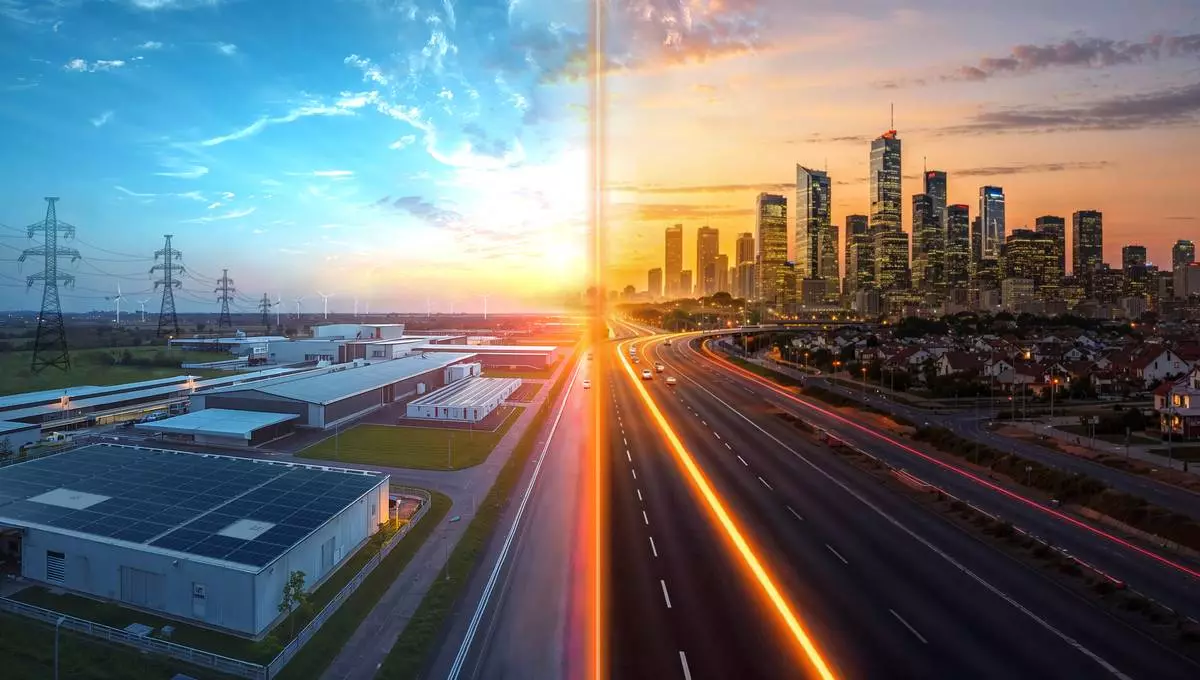
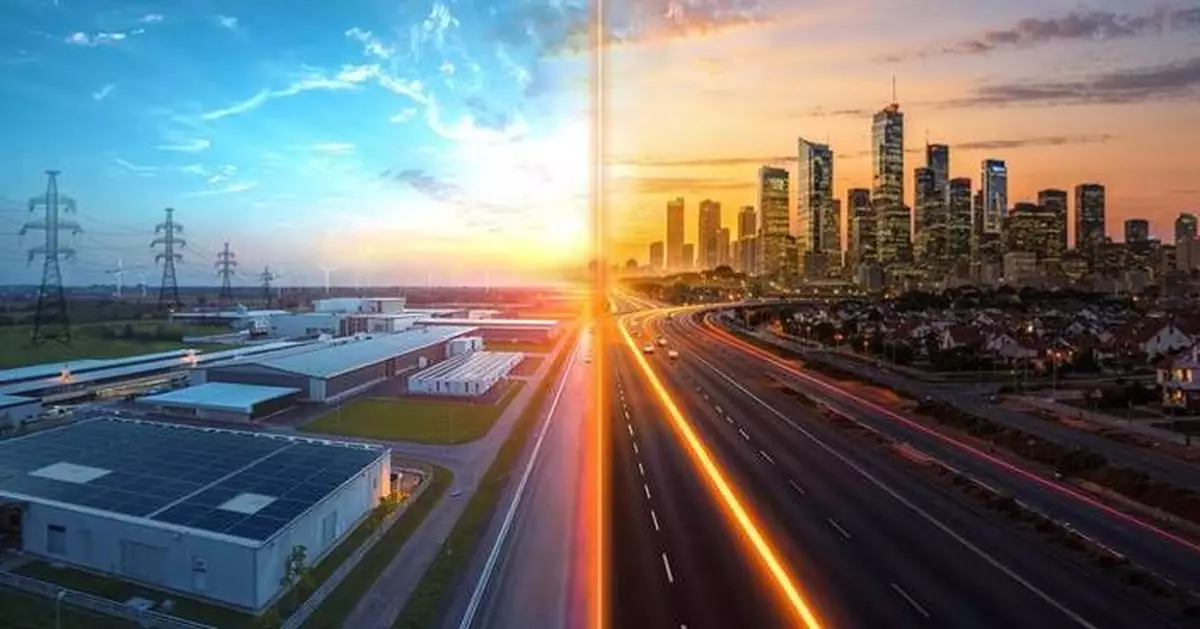
The special exhibit will take place as part of The smarter E Europe 2026 from June 23 to 25, 2026, at Messe München. © Solar Promotion GmbH
MALABO, Equatorial Guinea (AP) — Pope Leo XIV arrived Tuesday in Equatorial Guinea for the final leg of his four-nation African journey, a country that presents perhaps the most diplomatically delicate challenge of this trip and his young papacy.
The papal plane landed in the city of Malabo at around 11:35 a.m., with a crowd of officials and citizens at the local airport and along the major roads to welcome him.
“There is a lot of joy today because we waited 44 years for the pope to come, after the visit of John Paul II,” said Diosdao Marques, a senior Catholic official in the country. “It’s a blessing for the country, we hope many things will change and we will deepen our faith.”
The former Spanish colony on Africa’s western coast is run by Africa’s longest-serving president, Teodoro Obiang Nguema Mbasogo, 83. He has been in power since 1979 and is accused of widespread corruption and authoritarianism.
The discovery of offshore oil in the mid-1990s transformed Equatorial Guinea’s economy virtually overnight, with oil now accounting for almost half of its GDP and more than 90% of exports, according to the African Development Bank.
Yet more than half of the country’s nearly 2 million people live in poverty. And rights groups including Human Rights Watch — as well as court cases in France and Spain — have documented how revenues have enriched the ruling Obiang family rather than the broader population.
Leo has shown he won't mince words on this maiden African journey as pope, and the church’s teaching on the scourge of social inequity and corruption is clear. If Leo’s stop in Cameroon was any indication, the pope's messaging in Equatorial Guinea might be just as sharp.
Upon arriving in Yaounde, Cameroon, last week, Leo met with President Paul Biya, at 93 the world’s oldest leader. Like Obiang, Biya has also been in power for decades — since 1982 — and like Obiang, he’s accused of presiding over an authoritarian government.
Leo didn’t hold back as he stood next to Biya and delivered his arrival speech in the presidential palace.
“In order for peace and justice to prevail, the chains of corruption — which disfigure authority and strip it of its credibility — must be broken,” Leo said. “Hearts must be set free from an idolatrous thirst for profit.”
Equatorial Guinea is officially a secular country, but the Catholic Church is at the center of its political and social systems.
Church leaders “are very much interconnected intrinsically with the government,” said Tutu Alicante, a U.S.-based activist who runs the EG Justice rights group. “Part of it is the fear the government has instilled in everyone, including the church, and part of it is the monetary gains that the church derives from this government.”
The Rev. Fortunatus Nwachukwu, No. 2 in the Vatican’s missionary evangelization office, said the Catholic Church is present in difficult civil spaces and knows how to operate in them to carry out its mission.
“Should the church go to war against the government? Surely no,” Nwatchukwu said. “Should the church swallow everything as if it were normal? No. The church has to continue preaching justice, always in defense of life, human dignity and the common good.”
That is particularly challenging in Equatorial Guinea, which with about 75% of its population Catholic is one of the most Catholic countries in Africa.
But it’s also one of the most oppressed. In addition to official corruption, the country’s government also faces rampant accusations of harassment, arrest and intimidation of political opponents, critics and journalists.
It has consistently ranked among the bottom 10 countries in Transparency International’s annual corruption perception index, though the government has in recent years taken some steps to improve the situation, said Transparency International’s regional advisor for Africa, Samuel Kaninda.
The government passed an anti-corruption law and is working to fund an anti-corruption commission. But the only way such measures will be effective is if the commission is truly independent to investigate and the judiciary is independent as well, he said.
Kaninda said he hoped the pope’s visit would draw attention to such shortcomings, and give the people of Equatorial Guinea hope. Even if the government exploits the visit to signal a papal endorsement of its rule, historically pope trips to even authoritarian regimes have ended up as a net positive experience for the people, he said.
“The risk is there, but at the same time, we see more of the opportunity to shed more light on a lot more that is happening there,” he said.
Juliana Bopabote Lopete, a mother of 11 visiting Malabo from a village two hours away to see the pope, was wearing a new dress she said she bought for the occasion, with the pope’s face printed on the traditional fabric.
“Today is a big celebration,” she said, as her friends and her husband sang, played tambourines and swayed next to her. “You need a special outfit.”
At the very least, the first papal visit since St. John Paul II came in 1982 is giving seamstress Tumi Carine lots of business, as she makes dresses with fabric stamped with Leo’s image.
“The coming of the pope brought us many customers,” Carine said. “ We are really grateful for the coming of the pope, so, we are really happy.”
Leo has a packed schedule in Equatorial Guinea. He will meet with Obiang and then delivers two sets of remarks: A speech to government authorities and diplomats, and then another speech at the national university.
In addition to celebrating Masses, he’ll visit a psychiatric hospital and a prison and will meet with young people and their families. Before leaving Thursday, he’ll pray at a memorial to victims of a 2021 blast at a military barracks in Bata that killed more than 100 people. The explosions were blamed on the negligent handling of dynamite in a barracks close to residential areas.
Associated Press writer Monika Pronczuk in Malabo, Equatorial Guinea and Ope Adetayo in Lagos, Nigeria, contributed to the reporting.
Associated Press religion coverage receives support through the AP’s collaboration with The Conversation US, with funding from Lilly Endowment Inc. The AP is solely responsible for this content.
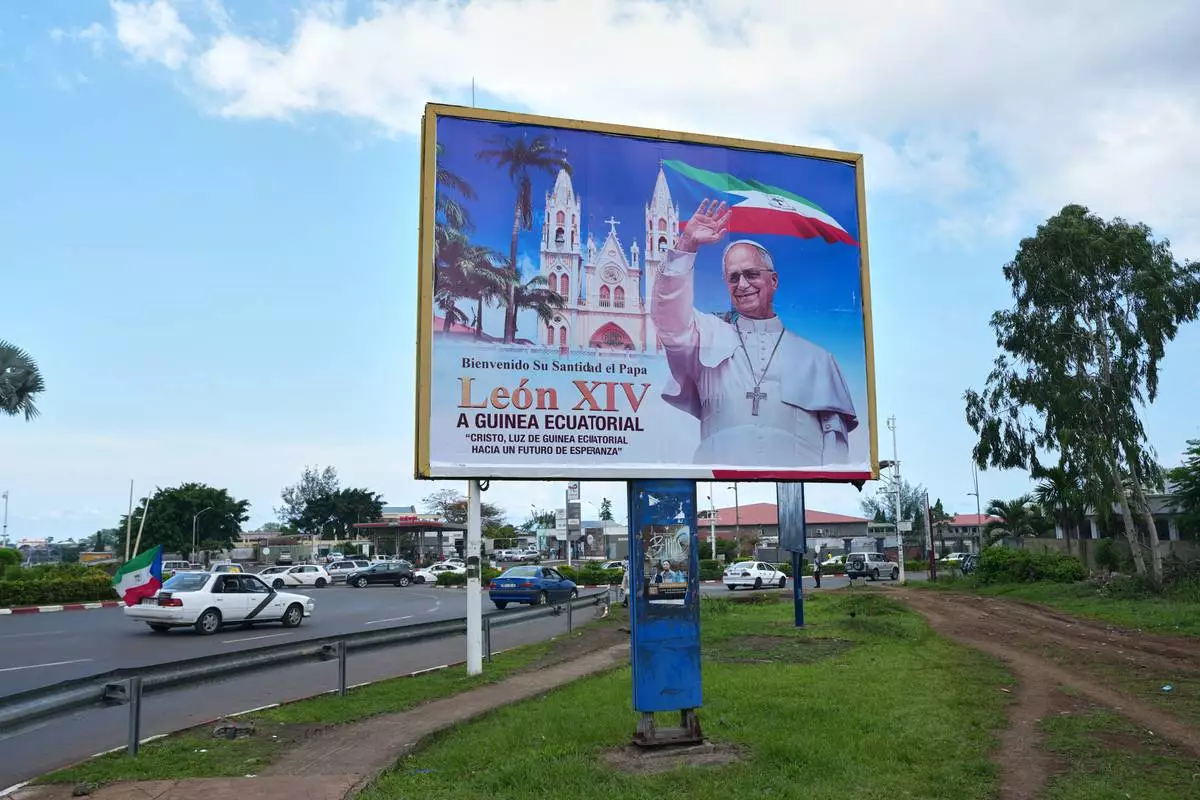
A billboard featuring Pope Leo XIV is seen ahead of his visit in Malabo, Equatorial Guinea, Friday, April 17, 2026. (AP Photo/Misper Apawu)
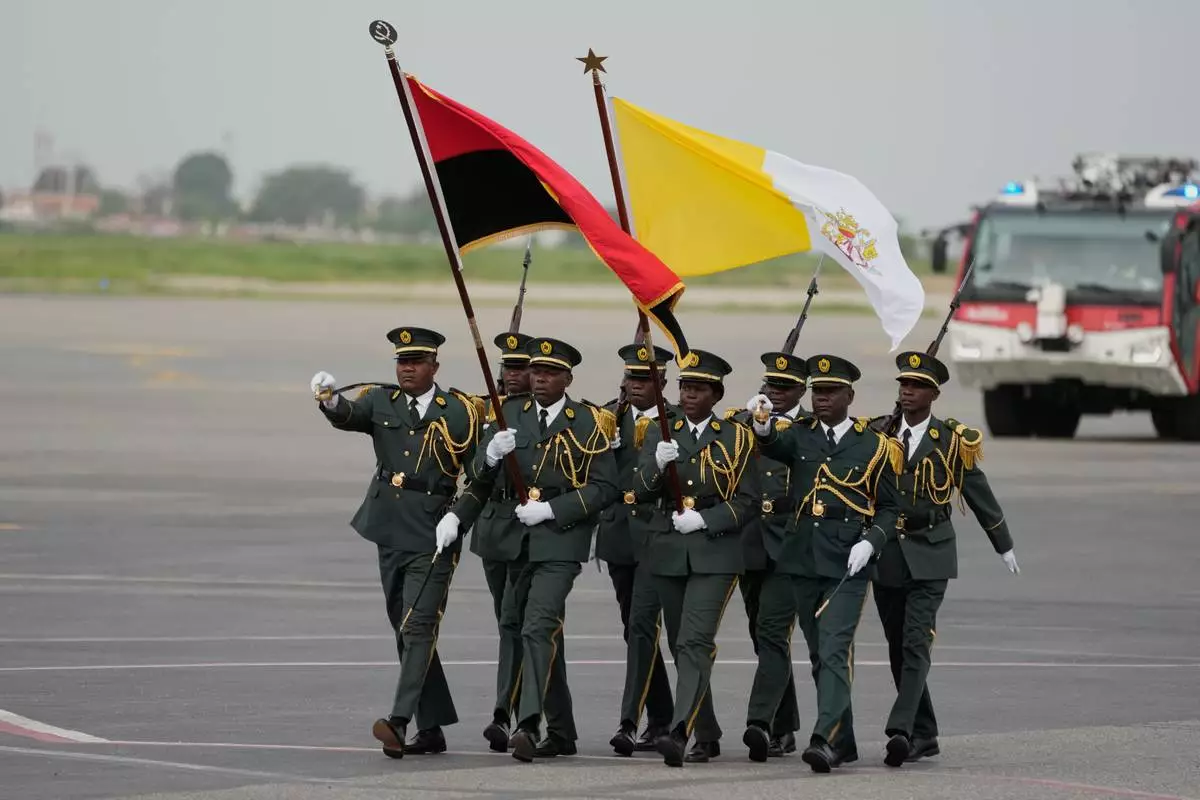
Soldiers march carrying the Vatican flag, right, and Angolan flag prior to Pope Leo XIV's departure for Equatorial Guinea, at the airport in Luanda, Angola, Tuesday, April 21, 2026. (AP Photo/Themba Hadebe)
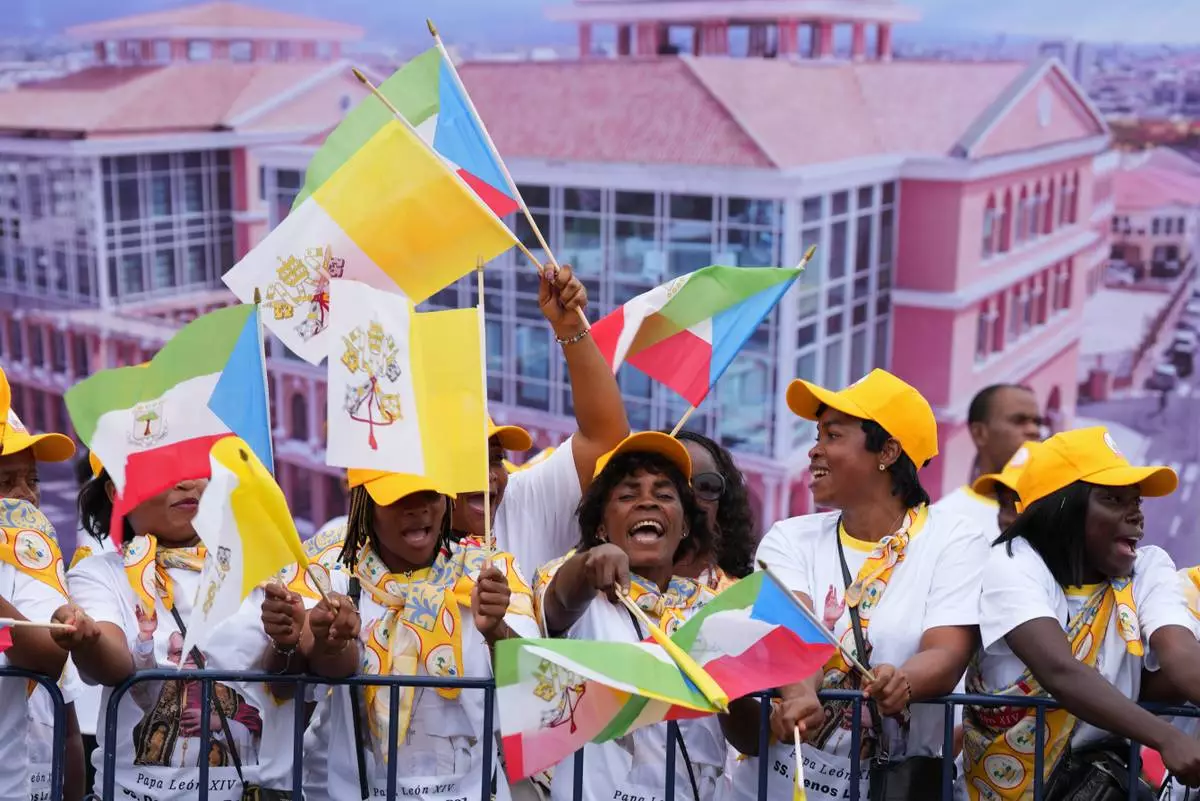
Faithful wait for the arrival of Pope Leo XIV at the airport in Malabo, Equatorial Guinea, Tuesday, April 21, 2026. (AP Photo/Misper Apawu)
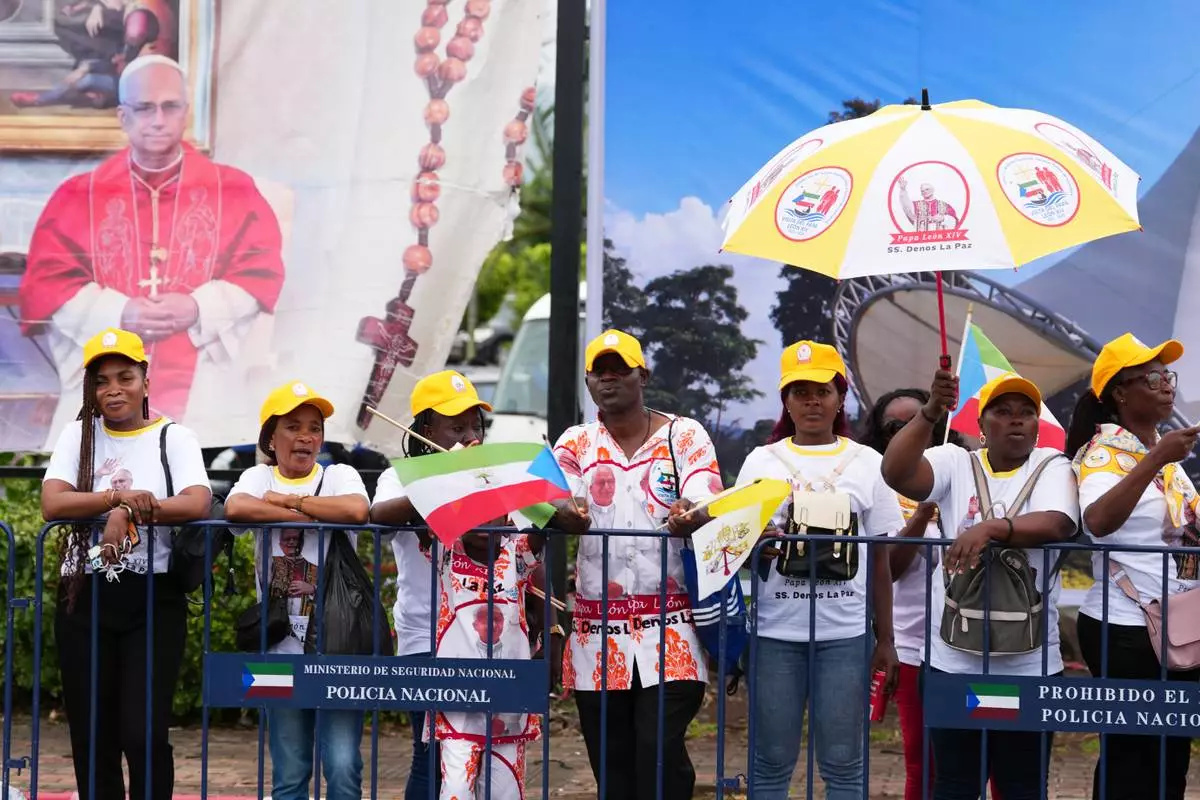
Faithful wait for the arrival of Pope Leo XIV at the airport in Malabo, Equatorial Guinea, Tuesday, April 21, 2026. (AP Photo/Misper Apawu)
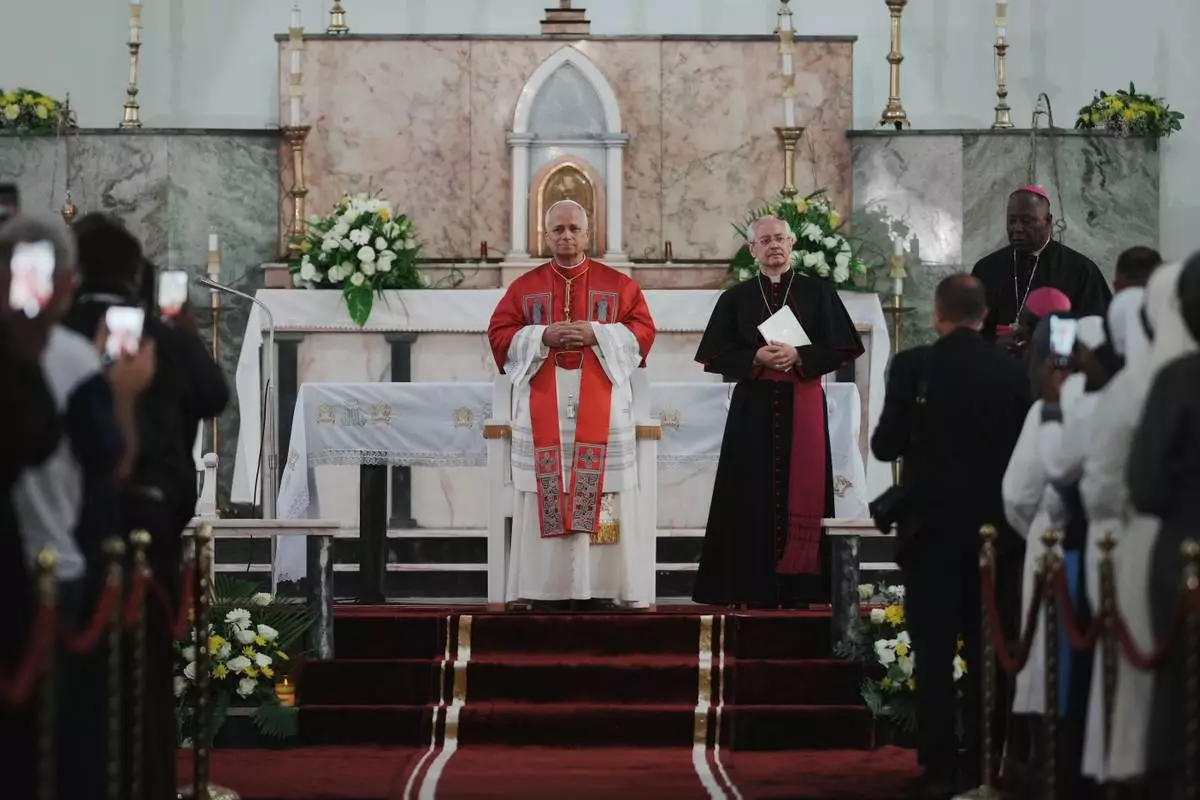
Pope Leo XIV arrives at the Parish of Our Lady of Fatima in Luanda, Angola, for a meeting with bishops, priests, consecrated men and women, and pastoral workers Monday, April 20, 2026, on the eighth day of an 11-day apostolic journey to Africa (AP Photo/Andrew Medichini)
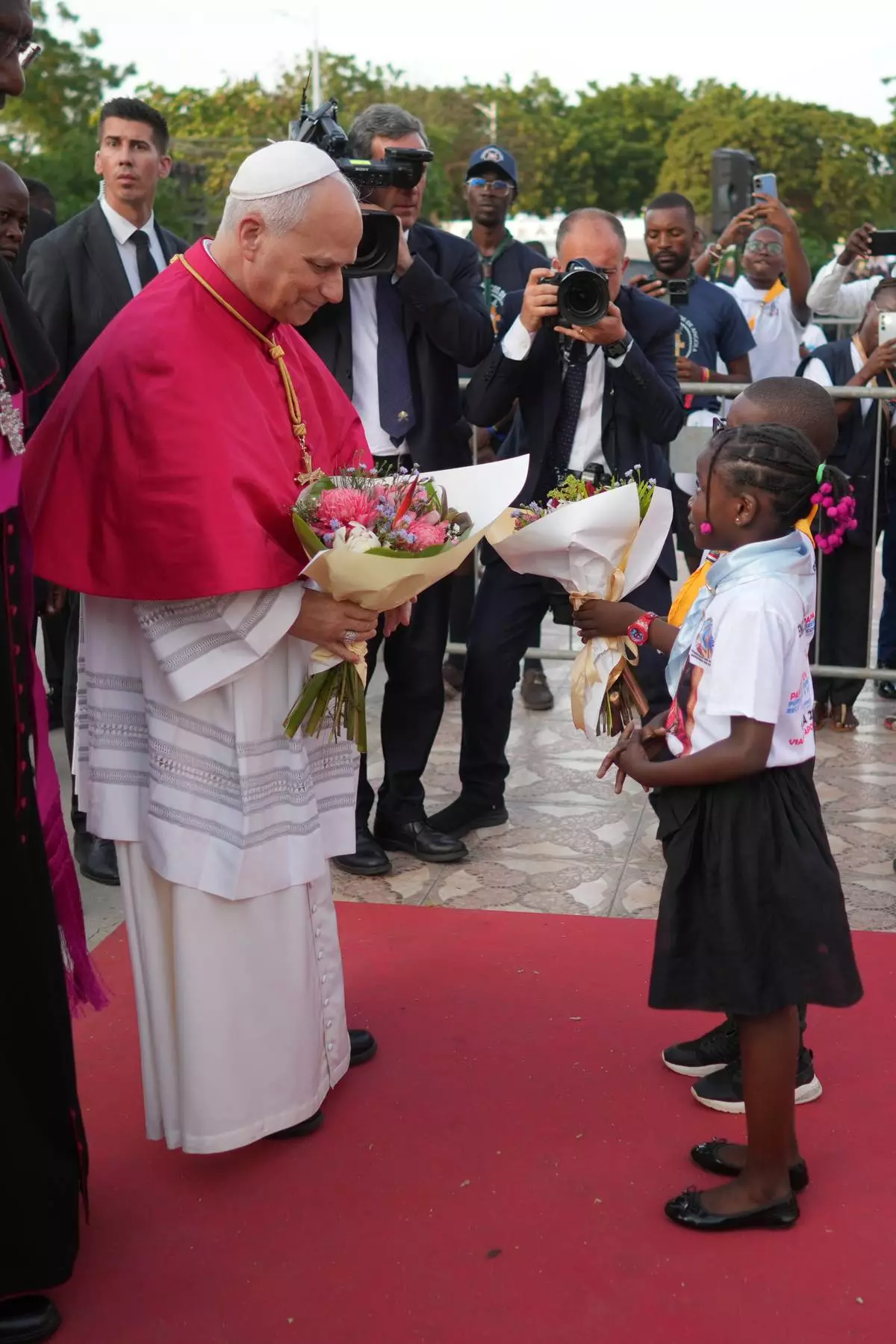
Pope Leo XIV arrives at the Parish of Our Lady of Fatima in Luanda, Angola, for a meeting with bishops, priests, consecrated men and women, and pastoral workers Monday, April 20, 2026, on the eighth day of an 11-day apostolic journey to Africa (AP Photo/Andrew Medichini)
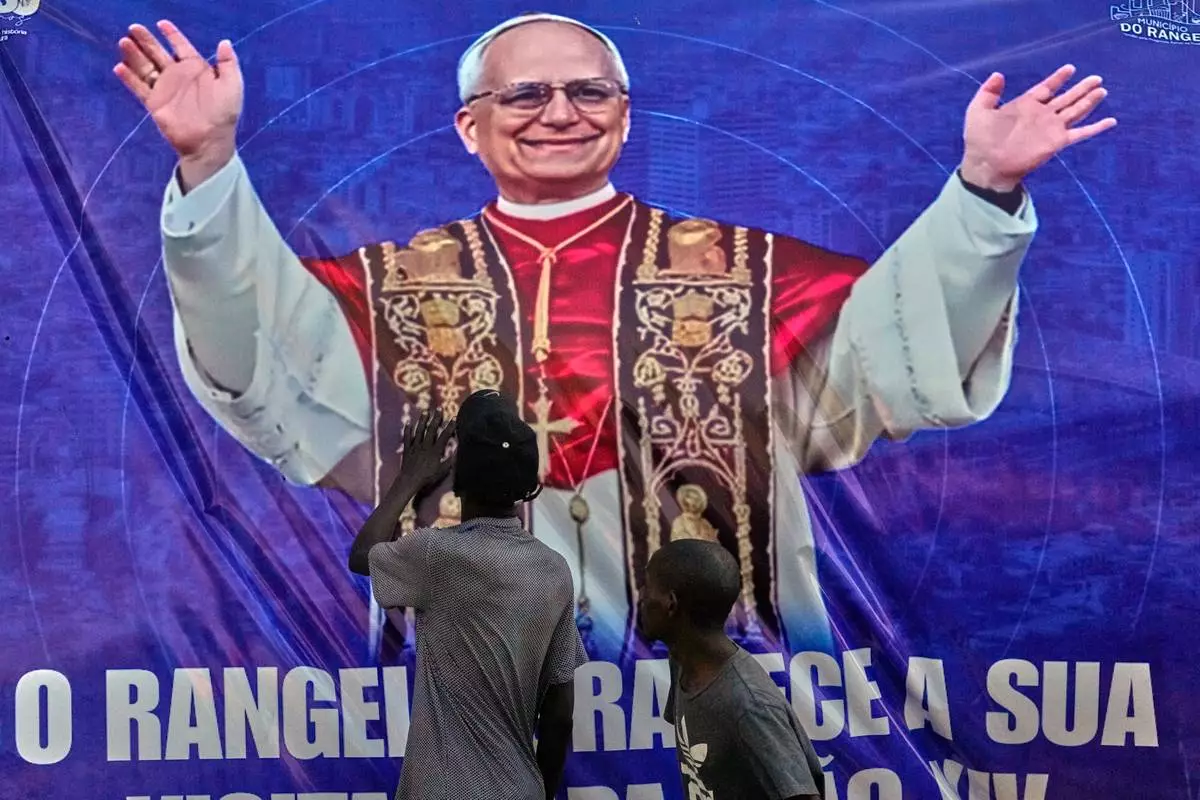
People touch a banner bearing an image of Pope Leo XIV in Luanda, Angola, Monday, April 20, 2026. (AP Photo/Themba Hadebe)
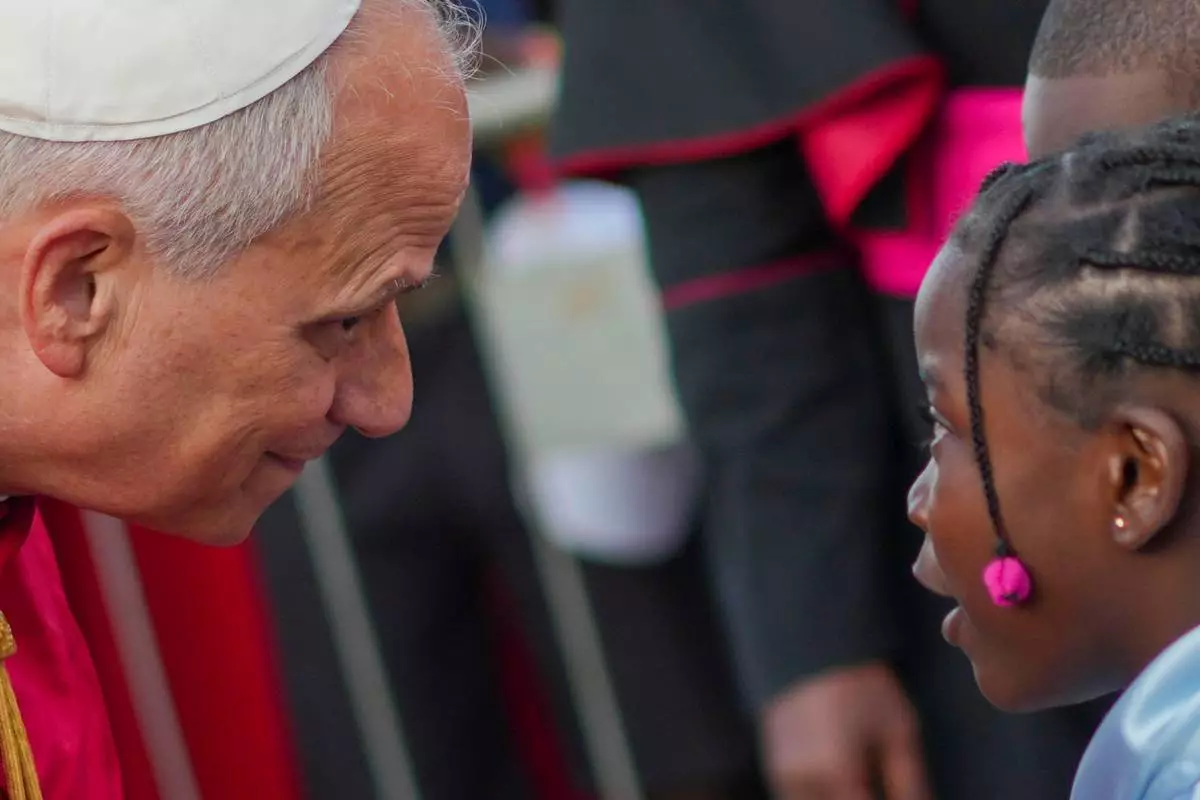
Pope Leo XIV listens to a girl as he arrives at the Parish of Our Lady of Fatima in Luanda, Angola, for a meeting with bishops, priests, consecrated men and women, and pastoral workers Monday, April 20, 2026, on the eighth day of an 11-day apostolic journey to Africa (AP Photo/Andrew Medichini)