Skip to Content Facebook Feature Image

Priceless 2,500-year-old golden helmet returned to Romania after Dutch museum raid

News

Priceless 2,500-year-old golden helmet returned to Romania after Dutch museum raid
News

News

Priceless 2,500-year-old golden helmet returned to Romania after Dutch museum raid

2026-04-22 11:20 Last Updated At:11:30

BUCHAREST, Romania (AP) — A priceless golden helmet dating back 2,500 years was returned to Romania on Tuesday after the national heirloom was stolen from a Dutch museum where it was on loan last year.

The ornate Cotofenesti helmet and three golden bracelets — some of Romania’s most revered national treasures from the Dacia civilization — were taken from the Drents Museum in January 2025 in a raid which shocked the art world and devastated Romanian authorities.

More Images
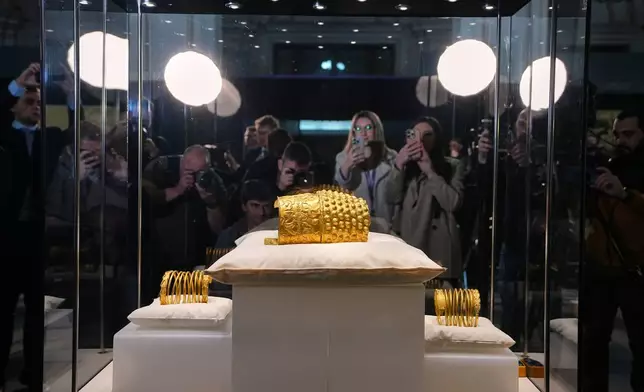
Journalists gather around a glass enclosure with the Dacian gold items, a 2,500-year-old helmet and wristbands, stolen from a museum in the Netherlands and then recovered by Dutch authorities, after they were presented upon being returned at the National Museum of Romanian History, in Bucharest, Romania, Tuesday, April 21, 2026. (AP Photo/Andreea Alexandru)
Journalists gather around a glass enclosure with the Dacian gold items, a 2,500-year-old helmet and wristbands, stolen from a museum in the Netherlands and then recovered by Dutch authorities, after they were presented upon being returned at the National Museum of Romanian History, in Bucharest, Romania, Tuesday, April 21, 2026. (AP Photo/Andreea Alexandru)

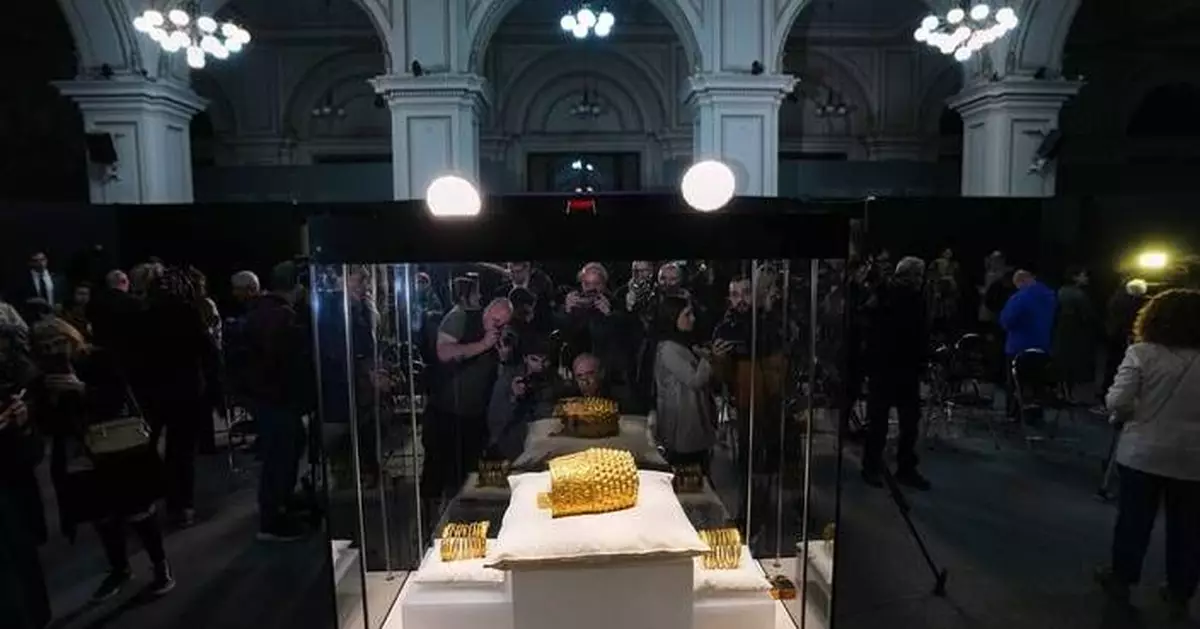
Journalists take photos of the Dacian gold items, a 2,500-year-old helmet and wristbands, stolen from a museum in the Netherlands and then recovered by Dutch authorities, after they were presented upon being returned at the National Museum of Romanian History, in Bucharest, Romania, Tuesday, April 21, 2026. (AP Photo/Andreea Alexandru)
Journalists take photos of the Dacian gold items, a 2,500-year-old helmet and wristbands, stolen from a museum in the Netherlands and then recovered by Dutch authorities, after they were presented upon being returned at the National Museum of Romanian History, in Bucharest, Romania, Tuesday, April 21, 2026. (AP Photo/Andreea Alexandru)
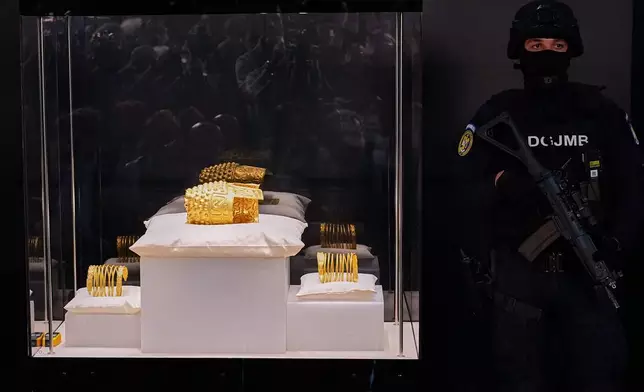
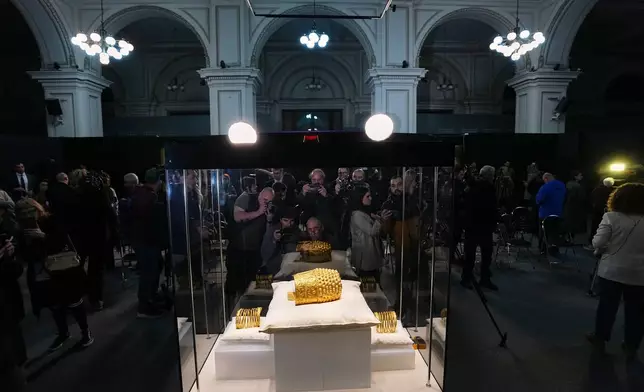
Dacian gold items, a 2,500-year-old helmet and wristbands, stolen from a museum in the Netherlands and then recovered by Dutch authorities, are presented during a press conference after being returned, at the National Museum of Romanian History, in Bucharest, Romania, Tuesday, April 21, 2026. (AP Photo/Andreea Alexandru)
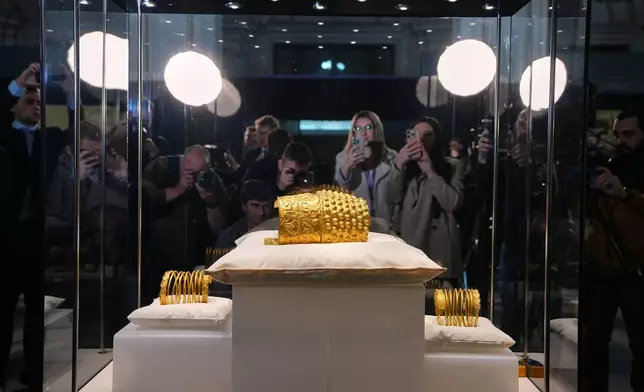
Dacian gold items, a 2,500-year-old helmet and wristbands, stolen from a museum in the Netherlands and then recovered by Dutch authorities, are presented during a press conference after being returned, at the National Museum of Romanian History, in Bucharest, Romania, Tuesday, April 21, 2026. (AP Photo/Andreea Alexandru)
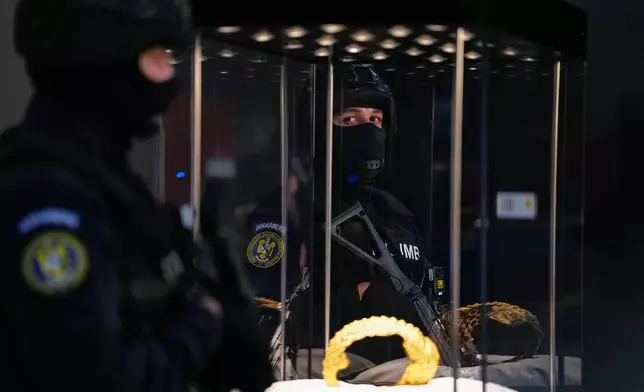
Armed gendarmes stand by Dacian gold items, a 2,500-year-old helmet and wristbands, stolen from a museum in the Netherlands and then recovered by Dutch authorities, during a press conference after being returned, at the National Museum of Romanian History, in Bucharest, Romania, Tuesday, April 21, 2026. (AP Photo/Andreea Alexandru)

Armed gendarmes stand by Dacian gold items, a 2,500-year-old helmet and wristbands, stolen from a museum in the Netherlands and then recovered by Dutch authorities, during a press conference after being returned, at the National Museum of Romanian History, in Bucharest, Romania, Tuesday, April 21, 2026. (AP Photo/Andreea Alexandru)

An armed gendarme stands by Dacian gold items, a 2,500-year-old helmet and wristbands, stolen from a museum in the Netherlands and then recovered by Dutch authorities, during a press conference after being returned, at the National Museum of Romanian History, in Bucharest, Romania, Tuesday, April 21, 2026. (AP Photo/Andreea Alexandru)

An armed gendarme stands by Dacian gold items, a 2,500-year-old helmet and wristbands, stolen from a museum in the Netherlands and then recovered by Dutch authorities, during a press conference after being returned, at the National Museum of Romanian History, in Bucharest, Romania, Tuesday, April 21, 2026. (AP Photo/Andreea Alexandru)

Journalists gather around a glass enclosure with the Dacian gold items, a 2,500-year-old helmet and wristbands, stolen from a museum in the Netherlands and then recovered by Dutch authorities, after they were presented upon being returned at the National Museum of Romanian History, in Bucharest, Romania, Tuesday, April 21, 2026. (AP Photo/Andreea Alexandru)

Journalists gather around a glass enclosure with the Dacian gold items, a 2,500-year-old helmet and wristbands, stolen from a museum in the Netherlands and then recovered by Dutch authorities, after they were presented upon being returned at the National Museum of Romanian History, in Bucharest, Romania, Tuesday, April 21, 2026. (AP Photo/Andreea Alexandru)

Journalists take photos of the Dacian gold items, a 2,500-year-old helmet and wristbands, stolen from a museum in the Netherlands and then recovered by Dutch authorities, after they were presented upon being returned at the National Museum of Romanian History, in Bucharest, Romania, Tuesday, April 21, 2026. (AP Photo/Andreea Alexandru)

Journalists take photos of the Dacian gold items, a 2,500-year-old helmet and wristbands, stolen from a museum in the Netherlands and then recovered by Dutch authorities, after they were presented upon being returned at the National Museum of Romanian History, in Bucharest, Romania, Tuesday, April 21, 2026. (AP Photo/Andreea Alexandru)

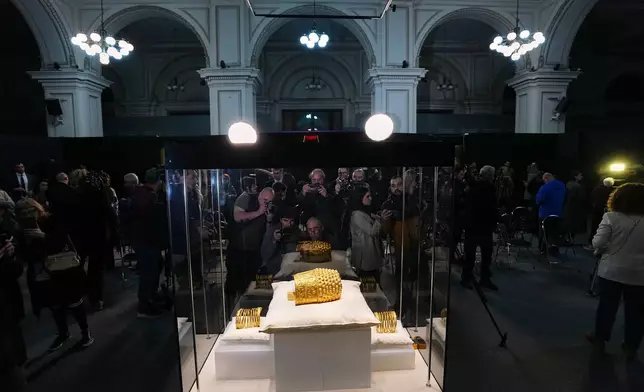
But after 14 months of investigations, diplomatic tensions, and three suspects in an ongoing trial, most of the artifacts arrived at Bucharest Henri Coanda International Airport on Tuesday from where authorities transported them under guard to Bucharest’s National History Museum. They were displayed in a glass cabinet, flanked by masked, armed guards.

Cornel Constantin Ilie, the museum's interim director, said that the artifacts have been returned “not as simple patrimony items, but as relics of our historical memory, as the legacy of a civilization that continues to define us.”

“For us, this is a moment of joy, but also of contemplation,” he said. “For months, we have lived with the fear that part of our past could be lost forever. Today we can say that an essential part of this treasure has returned.”

Robert van Langh, the Drents Museum director, described the recovery and return of the relics as “an emotional moment for all involved,” and acknowledged “the grief, the anger and now the relief have naturally been even greater” in Romania than in the Netherlands.

“Romanian national heritage has returned home,” he said. “The impact of this robbery was already significant in the Netherlands, but here it must have been truly unparalleled … The police and judicial authorities of both countries have done extraordinary work.”

Dutch prosecutors unveiled the recovered items at a news conference in the eastern Dutch city of Assen earlier this month. The whereabouts of the third golden bracelet remains unknown, but van Langh vowed the search would continue and that a judicial verdict is expected in the coming weeks.

During its disappearance, the golden helmet was slightly dented, while the recovered bracelets were in perfect condition.

Romania’s Minister of Culture Demeter Andras Istvan said the return of the artifacts had shown “how strong the connection between heritage and collective consciousness can be.”

“This entire episode reminds us at the same time how exposed heritage can be. It can be exposed to violence, illegal trafficking, negligence, oblivion,” he said.

After the raid, Dutch authorities were left with grainy security footage of three people wrenching open a museum door with a crowbar, after which an explosion was seen. Before its recovery, there were fears the helmet may have been melted down because its fame and distinctive appearance made it virtually unsellable.

The artifacts will be exhibited to the public in Bucharest before undergoing some restoration work, the museum's interim director said.

“We believe that the public has the pleasure of celebrating them ... not only as splendid objects, but as a witness to an ordeal, an almost irreparable loss, and a return that we owe to the operation between institutions and the perseverance of the authorities,” he said. “Today, these treasures returned home.”

McGrath reported from Leamington Spa, England.
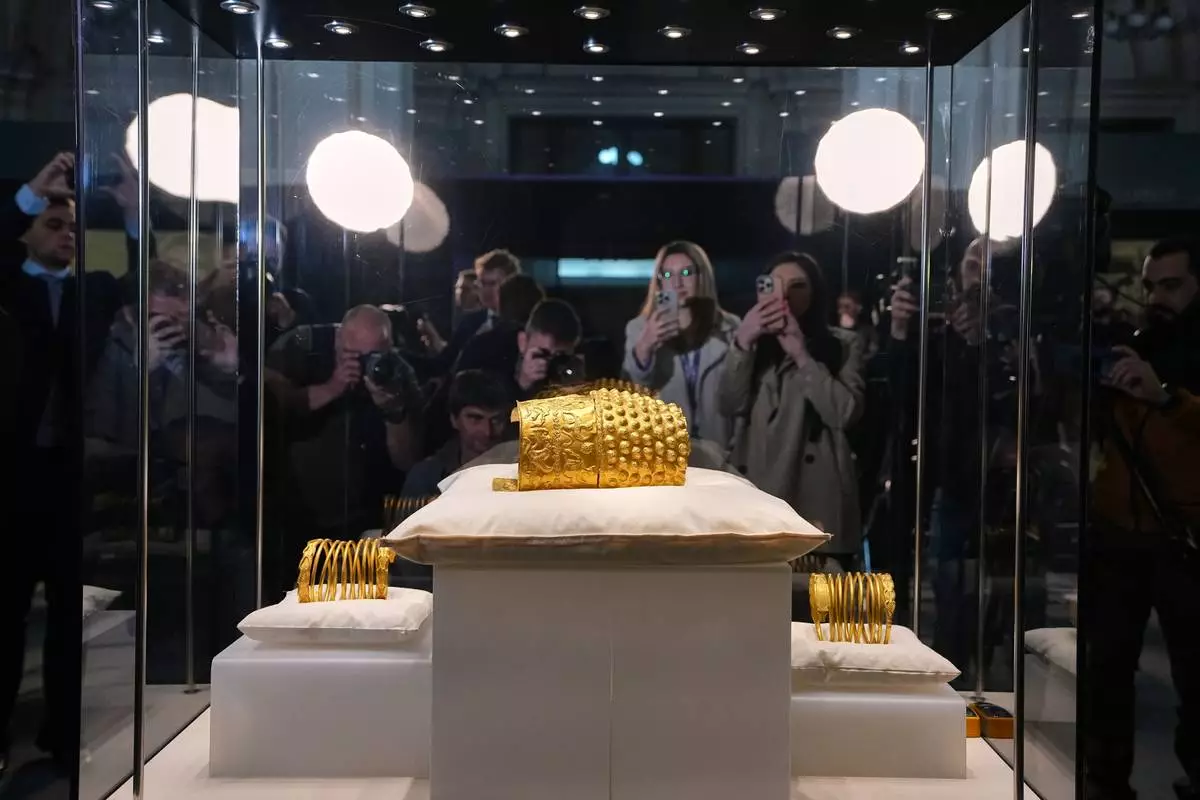
Journalists gather around a glass enclosure with the Dacian gold items, a 2,500-year-old helmet and wristbands, stolen from a museum in the Netherlands and then recovered by Dutch authorities, after they were presented upon being returned at the National Museum of Romanian History, in Bucharest, Romania, Tuesday, April 21, 2026. (AP Photo/Andreea Alexandru)
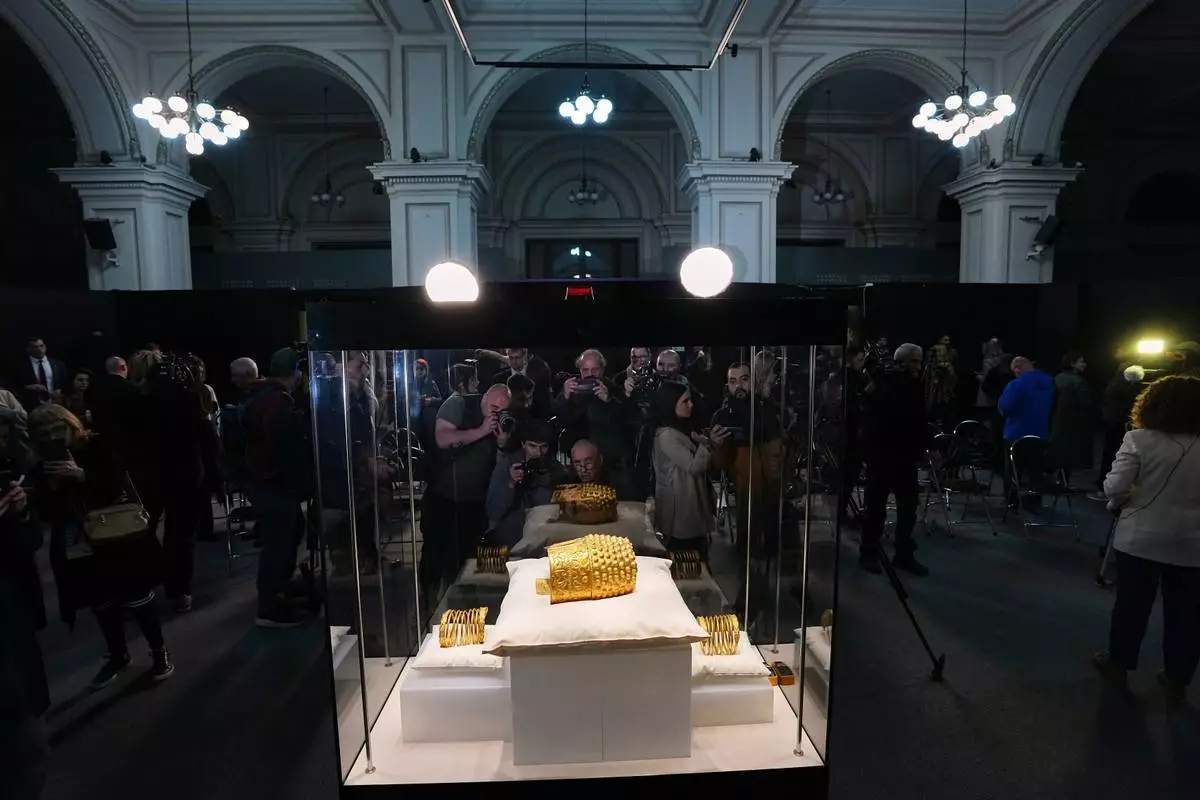
Journalists gather around a glass enclosure with the Dacian gold items, a 2,500-year-old helmet and wristbands, stolen from a museum in the Netherlands and then recovered by Dutch authorities, after they were presented upon being returned at the National Museum of Romanian History, in Bucharest, Romania, Tuesday, April 21, 2026. (AP Photo/Andreea Alexandru)
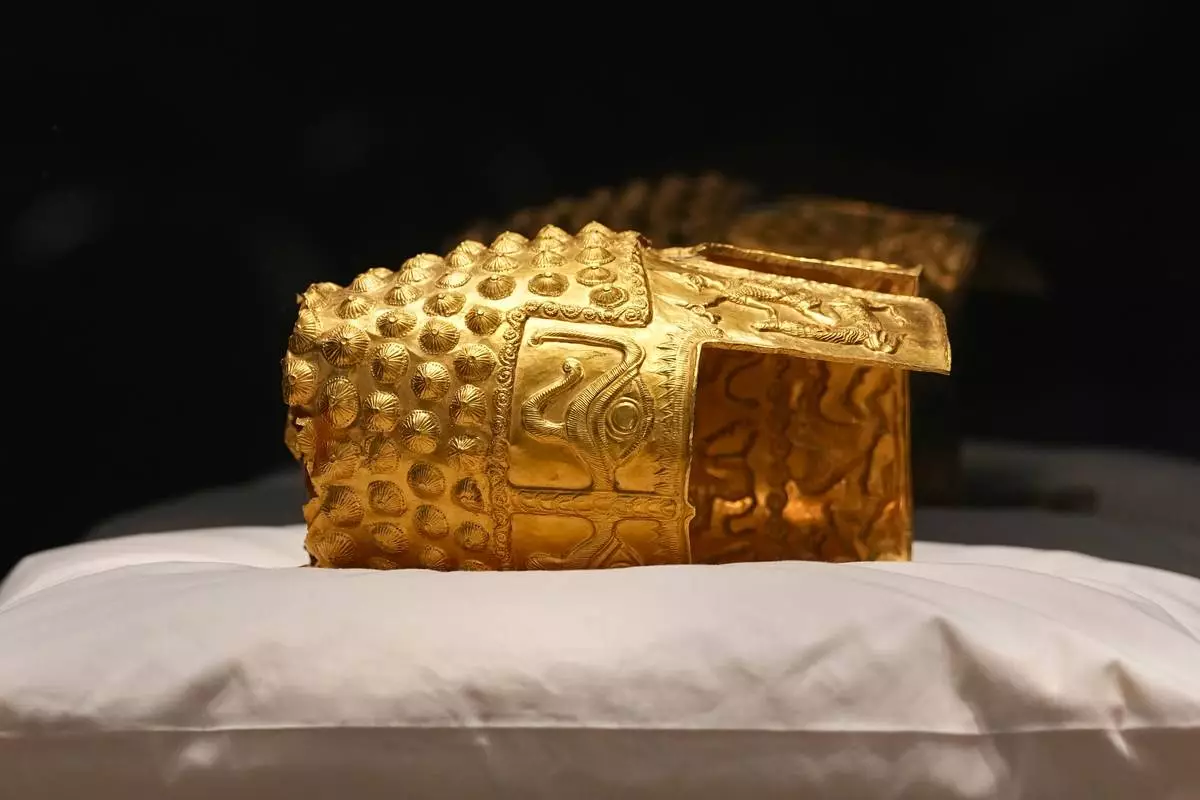
Journalists take photos of the Dacian gold items, a 2,500-year-old helmet and wristbands, stolen from a museum in the Netherlands and then recovered by Dutch authorities, after they were presented upon being returned at the National Museum of Romanian History, in Bucharest, Romania, Tuesday, April 21, 2026. (AP Photo/Andreea Alexandru)
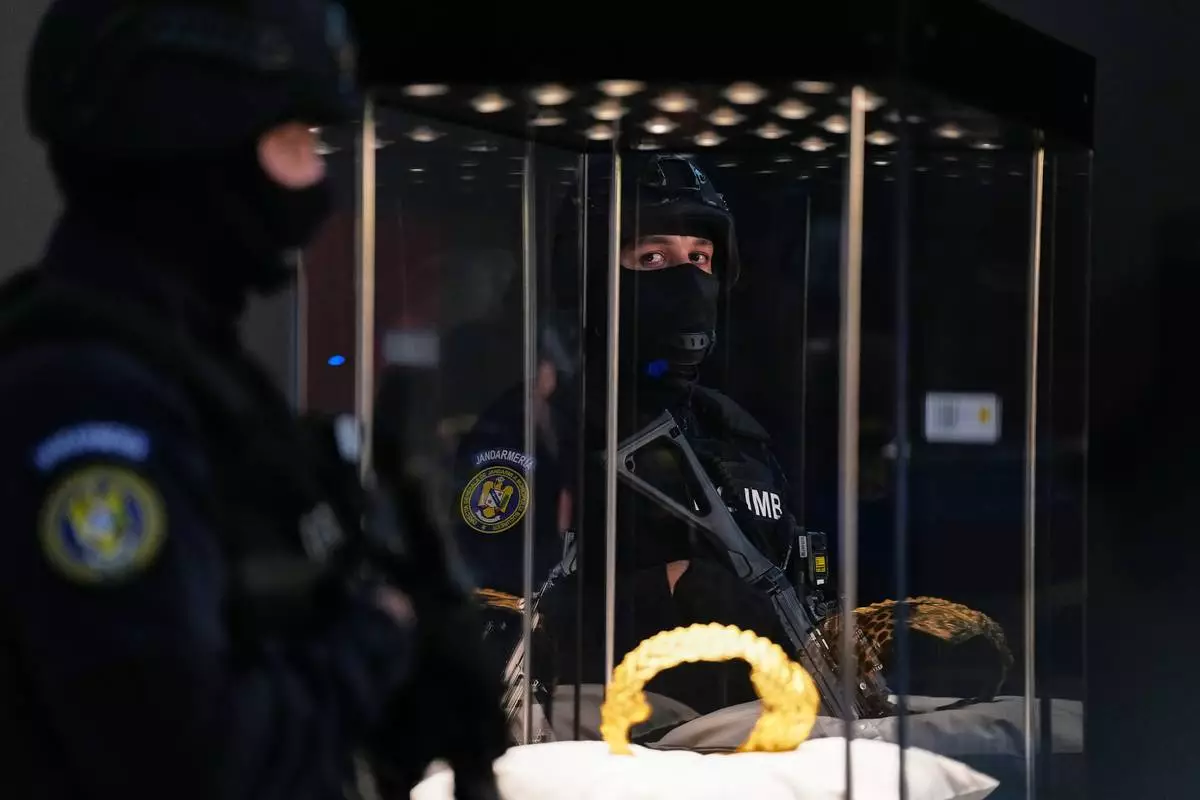
Journalists take photos of the Dacian gold items, a 2,500-year-old helmet and wristbands, stolen from a museum in the Netherlands and then recovered by Dutch authorities, after they were presented upon being returned at the National Museum of Romanian History, in Bucharest, Romania, Tuesday, April 21, 2026. (AP Photo/Andreea Alexandru)
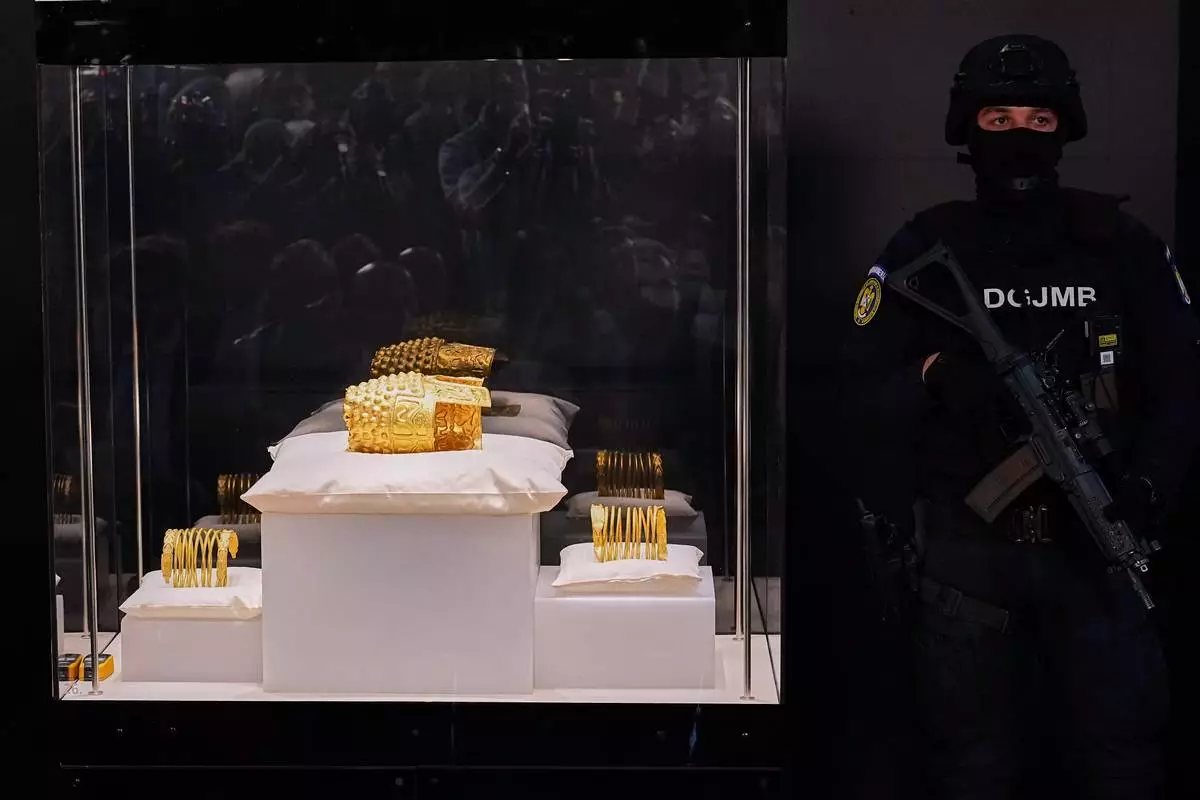
Dacian gold items, a 2,500-year-old helmet and wristbands, stolen from a museum in the Netherlands and then recovered by Dutch authorities, are presented during a press conference after being returned, at the National Museum of Romanian History, in Bucharest, Romania, Tuesday, April 21, 2026. (AP Photo/Andreea Alexandru)
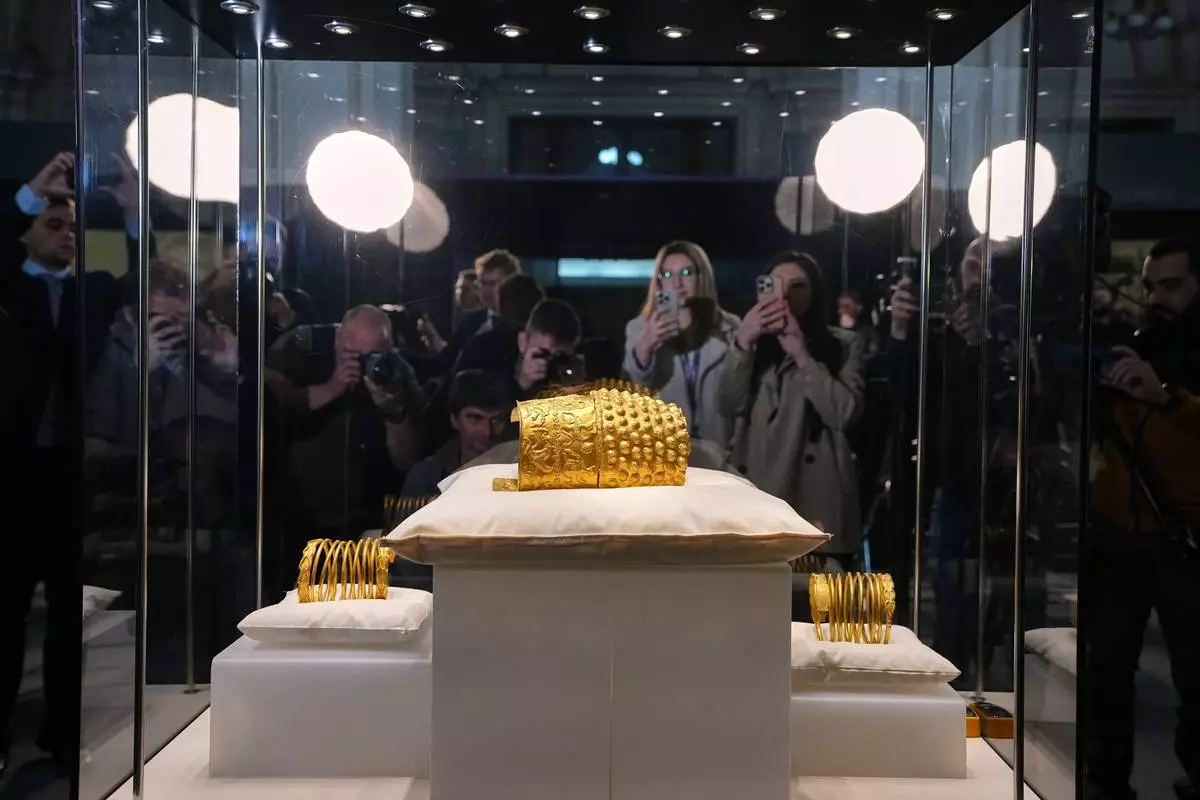
Dacian gold items, a 2,500-year-old helmet and wristbands, stolen from a museum in the Netherlands and then recovered by Dutch authorities, are presented during a press conference after being returned, at the National Museum of Romanian History, in Bucharest, Romania, Tuesday, April 21, 2026. (AP Photo/Andreea Alexandru)
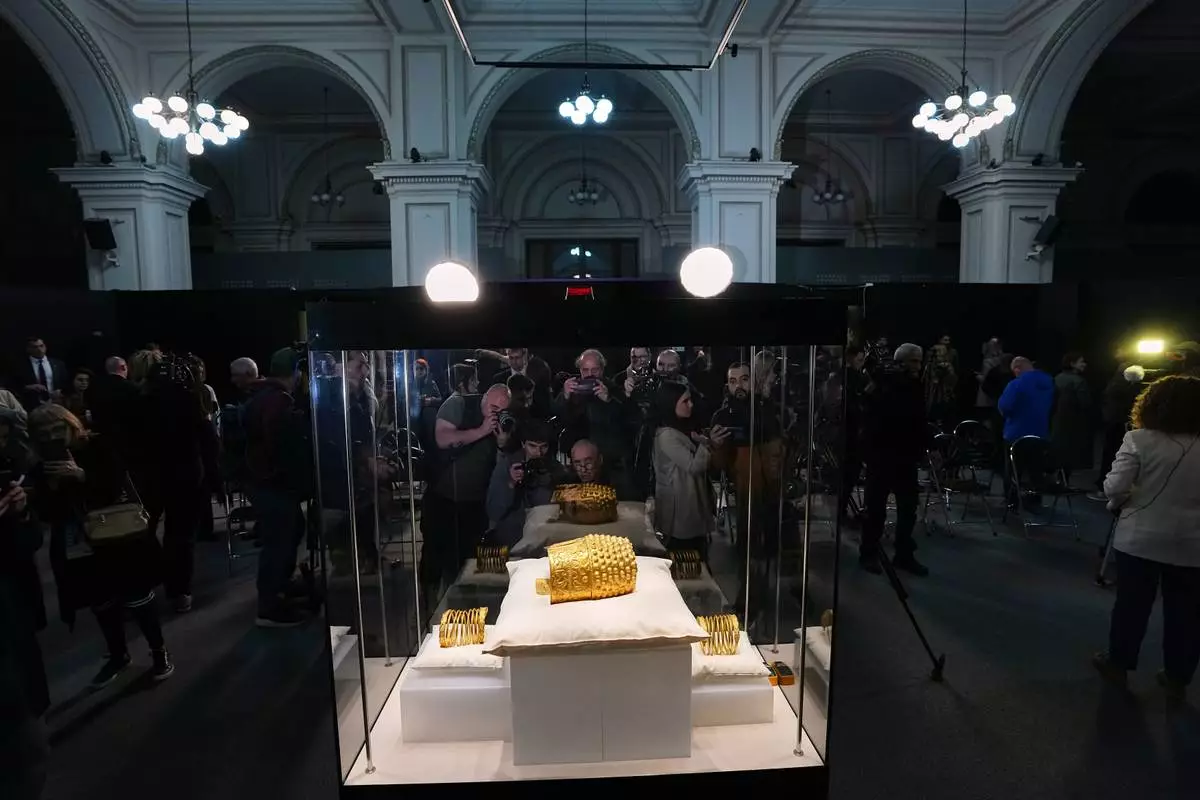
Armed gendarmes stand by Dacian gold items, a 2,500-year-old helmet and wristbands, stolen from a museum in the Netherlands and then recovered by Dutch authorities, during a press conference after being returned, at the National Museum of Romanian History, in Bucharest, Romania, Tuesday, April 21, 2026. (AP Photo/Andreea Alexandru)
Armed gendarmes stand by Dacian gold items, a 2,500-year-old helmet and wristbands, stolen from a museum in the Netherlands and then recovered by Dutch authorities, during a press conference after being returned, at the National Museum of Romanian History, in Bucharest, Romania, Tuesday, April 21, 2026. (AP Photo/Andreea Alexandru)
An armed gendarme stands by Dacian gold items, a 2,500-year-old helmet and wristbands, stolen from a museum in the Netherlands and then recovered by Dutch authorities, during a press conference after being returned, at the National Museum of Romanian History, in Bucharest, Romania, Tuesday, April 21, 2026. (AP Photo/Andreea Alexandru)
An armed gendarme stands by Dacian gold items, a 2,500-year-old helmet and wristbands, stolen from a museum in the Netherlands and then recovered by Dutch authorities, during a press conference after being returned, at the National Museum of Romanian History, in Bucharest, Romania, Tuesday, April 21, 2026. (AP Photo/Andreea Alexandru)
Journalists gather around a glass enclosure with the Dacian gold items, a 2,500-year-old helmet and wristbands, stolen from a museum in the Netherlands and then recovered by Dutch authorities, after they were presented upon being returned at the National Museum of Romanian History, in Bucharest, Romania, Tuesday, April 21, 2026. (AP Photo/Andreea Alexandru)

Journalists gather around a glass enclosure with the Dacian gold items, a 2,500-year-old helmet and wristbands, stolen from a museum in the Netherlands and then recovered by Dutch authorities, after they were presented upon being returned at the National Museum of Romanian History, in Bucharest, Romania, Tuesday, April 21, 2026. (AP Photo/Andreea Alexandru)

Journalists take photos of the Dacian gold items, a 2,500-year-old helmet and wristbands, stolen from a museum in the Netherlands and then recovered by Dutch authorities, after they were presented upon being returned at the National Museum of Romanian History, in Bucharest, Romania, Tuesday, April 21, 2026. (AP Photo/Andreea Alexandru)
Journalists take photos of the Dacian gold items, a 2,500-year-old helmet and wristbands, stolen from a museum in the Netherlands and then recovered by Dutch authorities, after they were presented upon being returned at the National Museum of Romanian History, in Bucharest, Romania, Tuesday, April 21, 2026. (AP Photo/Andreea Alexandru)
The final of the Eurovision Song Contest got underway Saturday with tight security and rainy weather failing to dent the enthusiasm of the fans — or that of the critics who think Israel shouldn’t have been invited to the party.

After a week’s buildup, acts from 25 countries took the stage at the Wiener Stadthalle arena in Vienna to battle for the continent’s pop crown. Millions of viewers around the world will cast judgment on a fiery Finnish violinist, a Moldovan folk rapper, a Serbian metal band and many more at Eurovision’s 70th anniversary event.

The contest has been clouded for a third year by calls for Israel to be excluded over its conflicts in Gaza and elsewhere, with five longtime participants — Spain, the Netherlands, Ireland, Iceland and Slovenia — boycotting in protest.

Here is the latest:

Croatia’s Lelek channeled something ancient and powerful with their goth-y folk “Andromeda.” Their stacked harmonies were only emboldened by their physical appearance: The women wore marks on their face and body meant to look like the same used to repel the Ottoman Empire.

The U.K.’s Look Mum No Computer with its “Eins, Zwei, Drei” was a thoughtful critique of the mundanity of labor but also catchy, synth-pop and goofy. Their stage design was also one of the most fun: soulless rectangular desks became imaginative platforms, like an alternative universe nightclub in space.

From France, Monroe’s “Regarde!” was strong on classism over all and judging by the cheers in the room – an effective one.

After the halfway mark, with just 10 performances remaining, Moldova’s rapper Satoshi performed the cheekily patriotic “Viva, Moldova!” with his full heart, in several languages, in a chorus so addictive it almost recalls the anthemic work of anthemic Irish hip-hop trio Kneecap.

Ukrainian singer Leléka offered the ethereal, beautiful “Ridnym,” and Australian star Delta Goodrem showed what a diva should be like with her slick midtempo ballad “Eclipse” — and a bravura performance that saw her raised into the air above a glittery piano. Id she wins, a European country would likely host for Australia next year.

Serbian metal band Lavina provided a dramatic change of pace with the angst “Kraj Mene.”

Aidan’s big-feelings “Bella,” Malta’s Eurovision entry, was all about romance: strings, big belts, swooning instrumentation. It was also one of few Eurovision entries from Malta to feature the Maltese language.

The Czech Republic put their hopes in Daniel Žižka’s “Crossroads,” a restrained pop ballad that builds to a triumphant chorus. Bulgaria’s Dara, a veteran pop performer at this stage, delivered an up-tempo pop banger “Bangaranga,” easily one of the most animated tracks of the bunch this year. And on stage, it was a mood elevator.

Even before the show’s halfway mark, there was already fire, smoke, animal prints and lots of sunglasses worn inside. Lavina, a metal band from Serbia, performed in a digital rainfall as well as burst of flames in studded leather, “Mad Max”-looking costumes.

Albania’s Alis used a smoke-filled stage with digital wings and a clock, inviting a woman depicting a mother onto the stage in a traditional folk dress for his driving, gloomy track, “Nân.” Sarah Engels of Germany added pyrotechnics to her “Fire,” naturally, and Delta Goodrem of Australia added a shimmering golden piano, fire and enough wind machines to power a small town.

Greece’s Akylas was playful with his pounding house track “Ferto,” dressed in tiger-striped shorts and a knit hat and using a scooter to glide along the stage, adding human statues. Ukraine needed only beams of light, a blowing curtain effect and Leleka’s powerhouse vocals as she delivered “Ridnym.”

Denmark’s all-Danish-language Eurovision entry was first with Søren Torpegaard’s “Før Vi Går Hjem,” which he delivered with the specific skillset of someone who has starred as Tony in “West Side Story,” Angel in “Kinky Boots” and Romeo in “Romeo & Juliet.”

Sarah Engels followed, representing her home country of Germany with “Fire.” As the second performer of the night, she took the opportunity to bring pyrotechnics to the stage.

Then came Noam Bettan’s “Michelle” — Israel’s inclusion in Eurovision, which has drawn criticisms. Spain, Ireland, the Netherlands, Slovenia and Iceland withdrew from the competition this year, choosing not to participate to protest Israel’s inclusion.

Most recently, Bettan’s performance was disrupted by protesters during the first semifinal on Tuesday; chants of “Stop the genocide!” were heard in the crowd. At the final, it wasn’t immediately clear if that continued.

Belgium’s Essyla took the stage with “Dancing on the Ice” — a cool ride with its chilly vocal performance and Billie Eilish-informed production, followed by Albania’s Alis.

Protesters called for Israel to be excluded from Eurovision demonstrated near the contest arena ahead of the final. Several hundred marched, with chants of “all of Vienna hates the ESC,” a reference to the Eurovision Song Contest.

They were kept well away from the venue which lies behind a police security cordon.

Demonstrator Echo Vinasha Lex said it was “important to protest against that idea that the song contest is not political. The song contest is a very political event.”

At the start, a filmed opening montage showcased Austria’s majestic scenery as a paper boat made its way to Vienna — a reference to 2025 Eurovision winner JJ’s storm-tossed performance of “Wasted Love.”

The show opened with a performance by last year’s winner, the operatically trained Austrian singer JJ, and an Olympic-style flag parade of the 25 finalists. Then it was on to performances by the musicians, who have just 3 minutes to win over millions of viewers who, along with national juries of music professionals, pick the winner.

The hosts for the extravaganza on Saturday are Michael Ostrowski, an Austrian actor best known for German-language comedy films, and Victoria Swarovski, a model, singer, TV presenter and heir to the Swarovski crystal and luxury goods business.

The head of the Eurovision Song Contest has urged viewers to put politics aside and enjoy the “brilliant, wonderful, heartfelt show” that is the competition’s grand final.

As the contest turns 70 with calls for Israel to be kicked out over the conduct of its war in Gaza and a five-country boycott, Eurovision director Martin Green said the contest is a chance for a few hours to “close the curtains to the outside world and dream that something else is possible.”

He told a news conference that for 70 years Eurovision has given “voice to the voiceless” and celebrated marginalized communities.

“Here’s to the next 70 years,” he said.

Demonstrators protest against Israel ahead of the Grand Final of the 70th Eurovision Song Contest in Vienna, Austria, Saturday, May 16, 2026. (AP Photo/Martin Meissner)

Demonstrators protest against Israel ahead of the Grand Final of the 70th Eurovision Song Contest in Vienna, Austria, Saturday, May 16, 2026. (AP Photo/Martin Meissner)

Satoshi from Moldova performs the song "Viva, Moldova!" during the dress rehearsal for the Grand Final of the 70th Eurovision Song Contest in Vienna, Austria, Friday, May 15, 2026. (AP Photo/Martin Meissner)

Satoshi from Moldova performs the song "Viva, Moldova!" during the dress rehearsal for the Grand Final of the 70th Eurovision Song Contest in Vienna, Austria, Friday, May 15, 2026. (AP Photo/Martin Meissner)

Delta Goodrem from Australia performs the song "Eclipse" during the dress rehearsal for the Grand Final of the 70th Eurovision Song Contest in Vienna, Austria, Friday, May 15, 2026. (AP Photo/Martin Meissner)

Delta Goodrem from Australia performs the song "Eclipse" during the dress rehearsal for the Grand Final of the 70th Eurovision Song Contest in Vienna, Austria, Friday, May 15, 2026. (AP Photo/Martin Meissner)

Linda Lampenius and Pete Parkkonen from Finland perform the song "Liekinheitin" during the first semifinal of the 70th Eurovision Song Contest in Vienna, Austria, Tuesday, May 12, 2026. (AP Photo/Martin Meissner)

Linda Lampenius and Pete Parkkonen from Finland perform the song "Liekinheitin" during the first semifinal of the 70th Eurovision Song Contest in Vienna, Austria, Tuesday, May 12, 2026. (AP Photo/Martin Meissner)

Demonstrators protest against Israel ahead of the Grand Final of the 70th Eurovision Song Contest in Vienna, Austria, Saturday, May 16, 2026. (AP Photo/Martin Meissner)

Demonstrators protest against Israel ahead of the Grand Final of the 70th Eurovision Song Contest in Vienna, Austria, Saturday, May 16, 2026. (AP Photo/Martin Meissner)

Recommended Articles