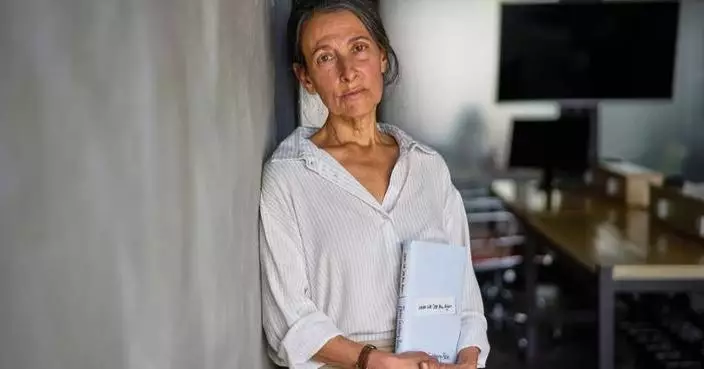
WASHINGTON (AP) — Democratic Rep. Sheila Cherfilus-McCormick of Florida resigned Tuesday moments before a hearing was to begin to consider what punishment to recommend after a House ethics panel found she had committed numerous campaign finance and reporting violations.
The congresswoman was facing the possible threat of expulsion, something that has only occurred six times in the history of the House. Support from her own party was increasingly in doubt.
It's the third resignation in a little more than a week from a House lawmaker. Reps. Eric Swalwell, a California Democrat, and Tony Gonzales, a Texas Republican, announced within hours of each other that they were leaving Congress. Both men were facing sexual misconduct allegations and possible expulsion.
In a statement, Chefilus-McCormick said a House committee denied her new attorney's request for more time to prepare a defense. Cherfilus-McCormick said she would not pretend that the investigation had been anything other than a “witch hunt,” and rather than play political games, she would choose to step away and her resignation was effective immediately.
“But let me say this plainly: we should be very careful about the precedent we are setting in this country, we do not punish people before due process is complete," she said. "We do not allow allegations alone to override the will of the people. That is a dangerous patch, and one that should concern every American, regardless of party.”
The committee had previously determined she committed 25 violations of House rules and ethical standards, including breaking campaign finance laws.
She is also facing federal criminal charges accusing her of stealing $5 million in federal disaster funds and using the money to buy items such as a 3-carat yellow diamond ring.
Cherfilus-McCormick has pleaded not guilty to the criminal charges and says she is not guilty of ethics violations, either.
The allegations against the congresswoman center on how she received millions of dollars from her family’s health care business after Florida mistakenly overpaid the business by roughly $5 million with COVID-19 disaster relief funds. She is accused of using that money to fund her 2022 congressional campaign through a network of businesses and family members.
Cherfilus-McCormick declined to testify during a previous Ethics Committee hearing, citing her Fifth Amendment right against self-incrimination. Her attorney, William Barzee, sparred with some of the lawmakers and argued that they should have allowed a thorough ethics trial, at which he could present witnesses and evidence to counter the conclusions of House investigators.
A group of supporters in Cherfilus-McCormick's congressional district had weighed in on her behalf with the lawmakers who lead the Ethics Committee, urging committee leaders to proceed with caution in sanctioning her.
“Our communities deserve stability. Our voices deserve to be heard. And our right to representation must be protected,” said one of the letters sent to the committee and signed by about a dozen local faith leaders, union officials and others.
Rep. Yvette Clarke, D-N.Y., chair of the Congressional Black Caucus, along with other members of the caucus, issued a statement that said during Cherfilus-McCormick's time in Congress she “worked to uplift her constituents and elevate issues impacting underserved communities at home and abroad.”
“We extend our appreciation for her service and offer our prayers for her and her family," the caucus members said.
In all, the panel's two-year investigation led to the issuance of 59 subpoenas, 28 witness interviews and a review of more than 33,000 pages of documents.
House Democratic leaders had declined to condemn Cherfilus-McCormick, saying they wanted to see the ethics process play out. Potential punishments included a reprimand or a censure, which serve as forms of public rebuke. The committee could also have recommended a fine. The most severe form of punishment is expulsion.
But the House has historically been reluctant to serve as the final arbiter of a lawmaker’s career, preferring to give that final say to the voters. Of the six House members expelled, the first three fought for the Confederacy during the Civil War and were expelled for disloyalty. The next two had been convicted of crimes. The final one was George Santos, the scandal-plagued freshman who was the subject of a blistering ethics report on his conduct as well as federal indictment. Santos, a New York Republican, served time in prison for ripping off his campaign donors before President Donald Trump granted him clemency, and he has apologized to his former constituents.
Under the Constitution, at least two-thirds of the House has to vote for expulsion for it to occur, a high threshold that requires enormous bipartisan support.
House Speaker Mike Johnson, R-La., told reporters last week he believed the House would move to expel Cherfilus-McCormick.
“The facts are indisputable at this point," Johnson said.

FILE - Rep. Sheila Cherfilus-McCormick, D-Fla., condemns hate speech and misinformation about Haitian immigrants, at the Capitol in Washington, Sept. 20, 2024. (AP Photo/J. Scott Applewhite, File)
A judge on Tuesday delayed the criminal sentencing of OxyContin maker Purdue Pharma in order to allow victims to attend the court proceeding in person.
U.S. District Judge Madeline Cox Arleo was originally planning to hand down the sentence Tuesday during a court proceeding conducted only by videoconferencing. But she said she changed her mind after seeing some victims of the opioid crisis protesting outside her courthouse in Newark, New Jersey. She said they should be allowed to attend in person, too, and moved the hearing to next Tuesday.
When it happens, Arleo is expected to order the company to forfeit $225 million to the Justice Department, clearing the way for the company to finalize a settlement of nearly all of the thousands of lawsuits it faces over its role in the opioid crisis.
The penalty was agreed to in a 2020 pact to resolve federal civil and criminal probes it was facing. If the judge signs off, other penalties will not be collected in return for Purdue settling the other lawsuits.
After years of legal twists and turns, the settlement was approved by another judge last year and could take effect as soon as a week after the sentence is delivered. It requires members of the Sackler family who own the company to pay up to $7 billion to state, local and Native American tribal governments, some individual victims and others.
Here’s a look at the situation.
Purdue pleaded guilty to three federal criminal charges in November 2020.
The Stamford, Connecticut-based company admitted that it did not have an effective program to keep its powerful prescription painkillers from being diverted to the black market, even though it told the U.S. Drug Enforcement Administration that it did.
It also admitted that it paid doctors through a speakers program to prescribe the drugs and paid an electronic medical records company to send doctors information on patients that encouraged more opioid prescriptions.
While Purdue produced only a fraction of the opioid pills that flooded the market in the 2000s, advocates have long seen aggressive sales of OxyContin as one of the touchstones of the crisis. At a 1996 event to rally Purdue’s sales force, Richard Sackler, then a top Purdue executive and later president of the company, called for a “blizzard of prescriptions.”
While Purdue is expected to pay $225 million, the government agreed in the plea deal not to collect $5.3 billion in criminal forfeitures and fines and $2.8 billion in civil liabilities. Instead, portions of that money are considered part of the broader settlement — and the federal government will receive a small slice of that.
The broader settlement calls for members of the Sackler family who own the company to contribute up to $7 billion over 15 years. Most of the money is to go to government entities to use to fight the opioid crisis.
It's among the largest in a series of settlements by drugmakers, wholesalers and pharmacies in recent years — and the only major one that includes payments for some individual victims or their survivors.
Together, the settlements are worth more than $50 billion, and most of the money is to be used to address the overdose epidemic.
Under the Purdue deal, members of the Sackler family would be shielded from lawsuits over opioids from those who agree to the payments.
Purdue itself would cease to exist and be replaced by a new company, Knoa Pharma, which would operate for the public benefit and have a board appointed by the states.
The reorganization is considered one of the most complicated ever. By the end of last year, Purdue had paid law firms and other professionals working on all sides of the case more than $1 billion, according to a court filing.
Members of the Sackler family have long been cast as villains in the opioid crisis, seeking to increase profits even as it became clear people were becoming addicted to OxyContin and overdosing.
But no members of the family were charged.
Family members received $10.7 billion in payments from Purdue from 2008 to 2018 -- with nearly half of it used to pay taxes on behalf of Purdue. They have not been paid by the company since 2018 — and the last of them left Purdue's board in 2019.
Under the settlement, they would not object if their names are removed from museums and other institutions they've supported — something that's already been happening.
More than 54,000 people with personal injury claims against Purdue voted to accept the settlement, and 218 voted against it.
Still, some victims and their family members have been pushing back for years, asserting that the settlement and the guilty plea stop short of justice for victims of a crisis that has been linked to 900,000 deaths in the U.S. since 1999.
The sentencing will give them another chance to make that case to the judge.
Susan Ousterman, whose son, Tyler Cordiero, died at age 24 in 2020 after overdosing on a mixture that included fentanyl after years of using heroin and other opioids, organized a rally outside of Tuesday's hearing for people who lost loved ones to the crisis.
She hopes the judge rejects the plea deal and the Justice Department pursues charges against individuals, including Sackler family members.
She said that the decision to postpone the sentencing was a victory for advocates like her.
“We feel like victims need to be heard,” she said.
Associated Press reporter Alanna Durkin Richer contributed to this article.

FILE - Cheryl Juaire holds photos of her sons, both of whom died from overdoses, Sean Merrill, left, and Corey Merrill, after making a statement during a hearing in New York on March 10, 2022. (AP Photo/Seth Wenig, File)

FILE - A sign with some names of the Sackler family is displayed at the Metropolitan Museum of Art Jan. 17, 2019, in New York. (AP Photo/Seth Wenig, File)

FILE - Pills spill in an arrangement photo of prescription Oxycodone in New York. (AP Photo/Mark Lennihan, File)

FILE - Protesters who have lost love ones to the opioid crisis protest outside a courthouse in Boston, Aug. 2, 2019, where a judge heard arguments in a lawsuit against Purdue Pharma. (AP Photo/Charles Krupa, File)