MADRID (AP) — Carlos Alcaraz is only 22 years old but there's already talk about the next generation of talented Spanish tennis players.
And one of them has the same first name of all-time great Rafael Nadal — 19-year-old Rafael Jódar, who has been making headlines in Spain and across the tennis world thanks to a rapid rise through the rankings.
Jódar, who like Nadal also goes by the “Rafa” nickname, made it to the top 50 just ahead of his debut at the Madrid Open on Wednesday.
Another promising star is 20-year-old Martin Landaluce, who just recently broke into the top 100 in the men's rankings.
They will be among the crowd favorites in the Spanish capital after Alcaraz withdrew because of a wrist injury.
“The two of them will mutually help each other to keep improving and reach the top," Alcaraz told the ATP Tour. "They have a great future.”
Jódar was outside the top 600 just a year ago. He entered the top 100 in March and is up to No. 42 in the world in the latest ATP rankings released on Monday.
“I try to handle the pressure as I have done since I was little,” Jódar said. “I’ve always been a very calm person both on and off the court. I know there’ll be moments when things don’t go as well as they have in recent tournaments. In those moments, you prove whether you’re mentally strong. Those moments will also make me stronger."
Jódar advanced to the semifinals in Barcelona after three straight-set wins. He lost in three sets to eventual champion Arthur Fils in the semifinals. The Spaniard won his first tour-level trophy in Morocco earlier this month.
“I knew I was doing things right," Jódar said. “These last few months have gone very quickly for me and I’ve played a lot of matches. I can’t say I could have imagined it. But I’m very happy to have started the clay swing like this, having played so many matches gives me a lot of confidence for this Madrid tournament.”
Jódar, a U.S. Open boys’ singles champion, competed for the University of Virginia last year before deciding to turn pro.
The Madrid native will make his debut in the Madrid Open against 109th-ranked Jesper de Jong. Jódar said he used to come to the Madrid Open as a spectator when he was younger. He also joined Spain's 2024 Davis Cup team to help the team train.
“I’ve never set myself a goal,” Jódar told the ATP. “I have to take it tournament by tournament, it’s my first year on tour. I think I’m still a young player and I’m discovering a lot at these tournaments. I need to gain experience, compete against these kinds of players. I don’t set targets for the future, just take it tournament by tournament and do my best."
Alcaraz, a seven-time Grand Slam champion, called Jódar "an outstanding player."
"I’ve been following him and I think he’s broken into the tour really quickly,” Alcaraz said.
Jódar and Landaluce both participated in the Next Gen ATP Finals, the tournament that features the world’s top 20-and-under singles players of the ATP. Jódar beat Landaluce, but both failed to advance past the round robin.
Landaluce, a member of the Rafa Nadal Academy, arrived at the Madrid Open ranked No. 99 after having reached the quarterfinals in Miami for his best-ever finish in an ATP Masters 1000 event. He fell to Jiri Lehecka in the last eight.
“It’s very special to see myself there (in the top 100),” said Landaluce, also a U.S. Open boys' singles champion. “It’s something we’ve all wanted to achieve since we were young. I’ve never set a specific ranking goal, but now that I’m in this position, I believe I can go further, and that’s what I intend to do.”
The second-ranked Alcaraz recently practiced with Landaluce, whom he called “an incredible player.”
The other Spaniards in the top 100 are Alejandro Davidovich Fokina at No. 24, Jaume Munar at No. 38, Roberto Bautista Agut at No. 93 and Pablo Carreno Busta at No. 94.
AP tennis: https://apnews.com/hub/tennis

FILE - Rafael Jodar of Spain plays a forehand return to Rei Sakamoto of Japan during their first round match at the Australian Open tennis championship in Melbourne, Australia, Tuesday, Jan. 20, 2026. (AP Photo/Dar Yasin,File)

FILE - Rafael Jodar of Spain plays a backhand return to Rei Sakamoto of Japan during their first round match at the Australian Open tennis championship in Melbourne, Australia, Tuesday, Jan. 20, 2026. (AP Photo/Dar Yasin,File)
Virginia voters on Tuesday were deciding whether to ratify an unusual mid-decade redrawing of U.S. House districts that could boost Democrats’ chances of flipping control of the closely divided chamber, as the state becomes the latest front in a national redistricting battle.
A proposed constitutional amendment backed by Democratic officials would bypass the state's bipartisan redistricting commission to allow use of new congressional districts approved by state lawmakers in this year's midterm elections.
The referendum, which needs a simple majority to pass, tests Democrats' ability to push back against President Donald Trump, who started the gerrymandering competition between states after successfully urging Texas Republicans to redraw congressional districts in their favor last year. Virginia is the second state, after California last fall, to put the question to voters.
It also tests voters' willingness to accept districts gerrymandered for political advantage — coming just six years after Virginia voters approved an amendment meant to diminish such partisan gamesmanship by shifting redistricting away from the legislature.
Though polling places have closed, ballots mailed by Tuesday can still be counted if they arrive in the next few days. But even if the referendum is successful, the public vote may not be the final word. The state Supreme Court is considering whether the redistricting plan is illegal in a case that could make the referendum results meaningless.
Congressional redistricting typically is done once a decade after each U.S. census. But Trump urged Texas Republicans to redistrict ahead of the November elections in hopes of winning several additional seats and maintaining the GOP's narrow House majority in the face of political headwinds that typically favor the party that is out of power during midterms.
The Texas gambit led to a burst of redistricting nationwide. So far, Republicans believe they can win up to nine more House seats in newly redrawn districts in Texas, Missouri, North Carolina and Ohio.
Democrats think they can win up to five more seats in California, where voters approved a mid-decade redistricting effort last November, and one more seat under new court-imposed districts in Utah. Democrats hope to offset the rest of that gap in Virginia, where they decisively flipped 13 seats in the state House and won back the governor’s office last year.
The stream of voters was steady Tuesday at a recreation center in the Old Town area of Alexandria, Virginia.
Matt Wallace, 31, said he votes regularly but this election has additional emphasis.
“I think the redistricting issue across the country is unfortunate, that we’ve had to resort to temporary redistricting in order to sort of alter our elections across the country," he said. Wallace said he voted for the Democratic redistricting amendment "to help balance the scales a bit until things get back to normal.”
Katie Reusch, 35, said she thought the amendment was necessary to respond to the Republicans' redrawing of congressional districts in Texas last year: “You can’t just say we’re in power so we’re changing things so we stay in power,” she said.
But Joanna Miller, 29, said she voted against the redistricting measure, “because I want my vote to count in a fair way.” Miller said she was more concerned about representation in Virginia than trying to offset actions in other states.
“I want my vote and my representation to matter this fall,” she said.
That concern is particularly acute among conservative voters in the state's rural areas, many of which would be drawn into congressional districts that will be dominated by Democratic-leaning cities and suburbs.
Ruth Ann McCartney, voting in the town of South Hill, a few miles north of the North Carolina border, said she cast her ballot against the amendment.
“I look at it more, not really in terms of Republican versus Democrat,” she said. “I look at it more as we don’t have the population as northern Virginia. And as a rural area, we just need to be heard.”
Leaders of both major parties see Tuesday’s vote as crucial to their chances to win a House majority in the fall. Trump weighed in via social media Tuesday morning, telling Virginians to “vote ‘no’ to save your country!”
Former Virginia Gov. Glenn Youngkin, a Republican, rallied with opponents of the measure Monday night, calling the redistricting plan “dishonest” and “brazenly deceptive.” House Minority Leader Hakeem Jeffries told reporters at the Capitol earlier in the day that a vote to approve the redraw “will serve as a check and balance on this out-of-control Trump administration.”
A committee supporting the Democratic redistricting effort had raised more than $64 million — three times as much as the roughly $20 million raised by opponents, according to finance reports filed less than two weeks before the election.
The back-and-forth battle over congressional districts is expected to continue in Florida, where the Republican-led legislature is scheduled to convene April 28 for a special session that could result in a more favorable map for Republicans.
In Virginia, Democrats currently hold six of the 11 U.S. House seats under districts that were imposed by the state Supreme Court in 2021 after a bipartisan commission failed to agree on a map based on the latest census data.
The new plan could help Democrats win as many as 10 seats. Five are anchored in Democratic-heavy northern Virginia, including one shaped like a lobster that stretches into Republican-leaning rural areas.
Revisions to four other districts across Richmond, southern Virginia and Hampton Roads dilute the voting power of conservative blocs in those areas. And a reshaped district in parts of western Virginia lumps together three Democratic-leaning college towns to offset other Republican voters.
The Virginia redistricting plan is "pushing back against what other states have done in trying to stack the deck for Donald Trump in those congressional elections,” Democratic Gov. Abigail Spanberger said during an online rally last week.
Ads for the “yes to redistricting” campaign featuring former President Barack Obama have flooded the airwaves.
Opponents have distributed campaign materials citing past statements from Obama and Spanberger criticizing gerrymandering, but those were before Trump pushed Republican states to redraw their congressional maps in advance of this year's midterms.
Democrats “were all against gerrymandering before they were for it,” Virginia Republican Party Chairman Jeff Ryer said.
Virginia lawmakers endorsed a constitutional amendment allowing their mid-decade redistricting last fall, then passed it again in January as part of a two-step process that requires an intervening election for an amendment to be placed on the ballot. The measure allows lawmakers to redistrict until returning the task to a bipartisan commission after the 2030 census.
In February, they passed a new U.S. House map to take effect pending the outcome of the redistricting referendum. Republicans have filed multiple legal challenges against the effort.
A Tazewell County judge ruled that the redistricting push was illegal for several reasons. Circuit Court Judge Jack Hurley Jr. said lawmakers failed to follow their own rules for adding the redistricting amendment to a special session.
He ruled that their initial vote failed to occur before the public began casting ballots in last year’s general election and thus didn’t count toward the two-step process. He also ruled that the state failed to publish the amendment three months before that election, as required by law.
If the state Supreme Court agrees with the lower court, the results from Tuesday's vote could be rendered moot.
Associated Press writers Allen G. Breed in South Hill, Virginia, Gary Fields in Alexandria, Virginia, and Lisa Mascaro in Washington contributed to this report.
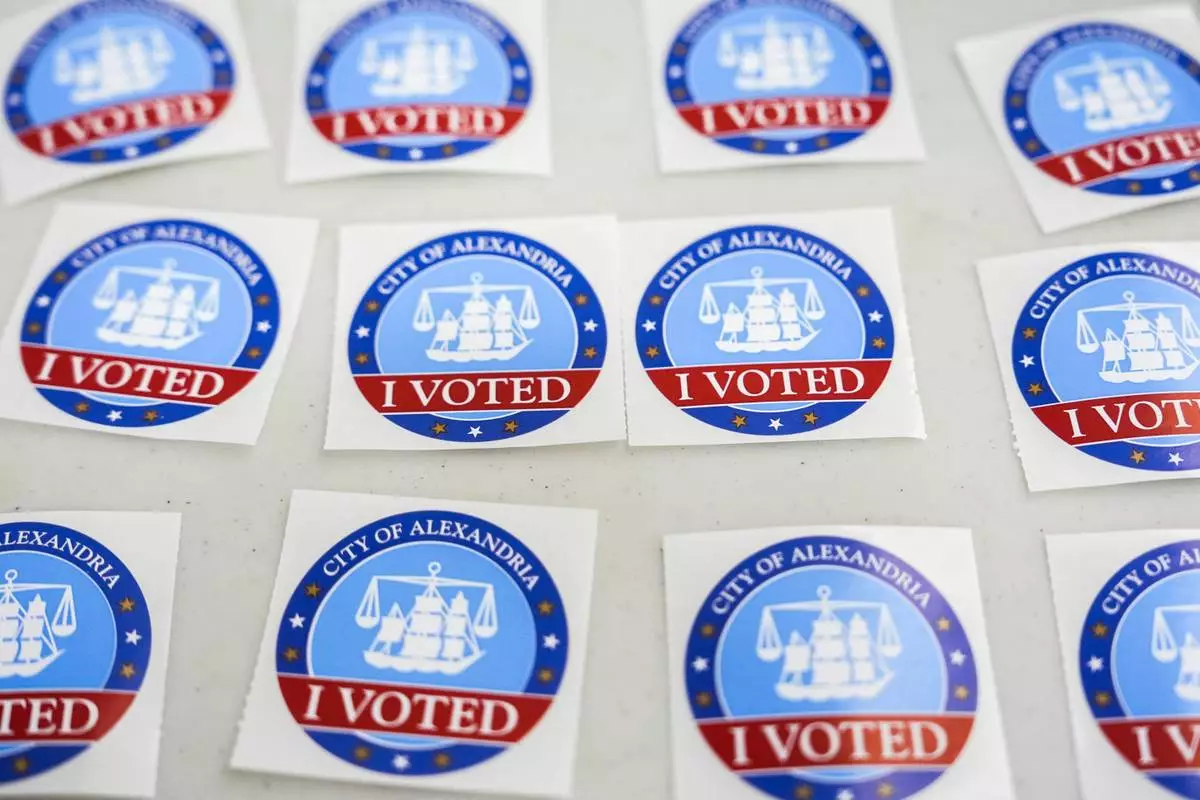
"I Voted" stickers are laid out on a table at Lyles-Crouch Traditional Academy on election day for the Virginia redistricting referendum, Tuesday, April 21, 2026, in Alexandria, Va. (AP Photo/Julia Demaree Nikhinson)
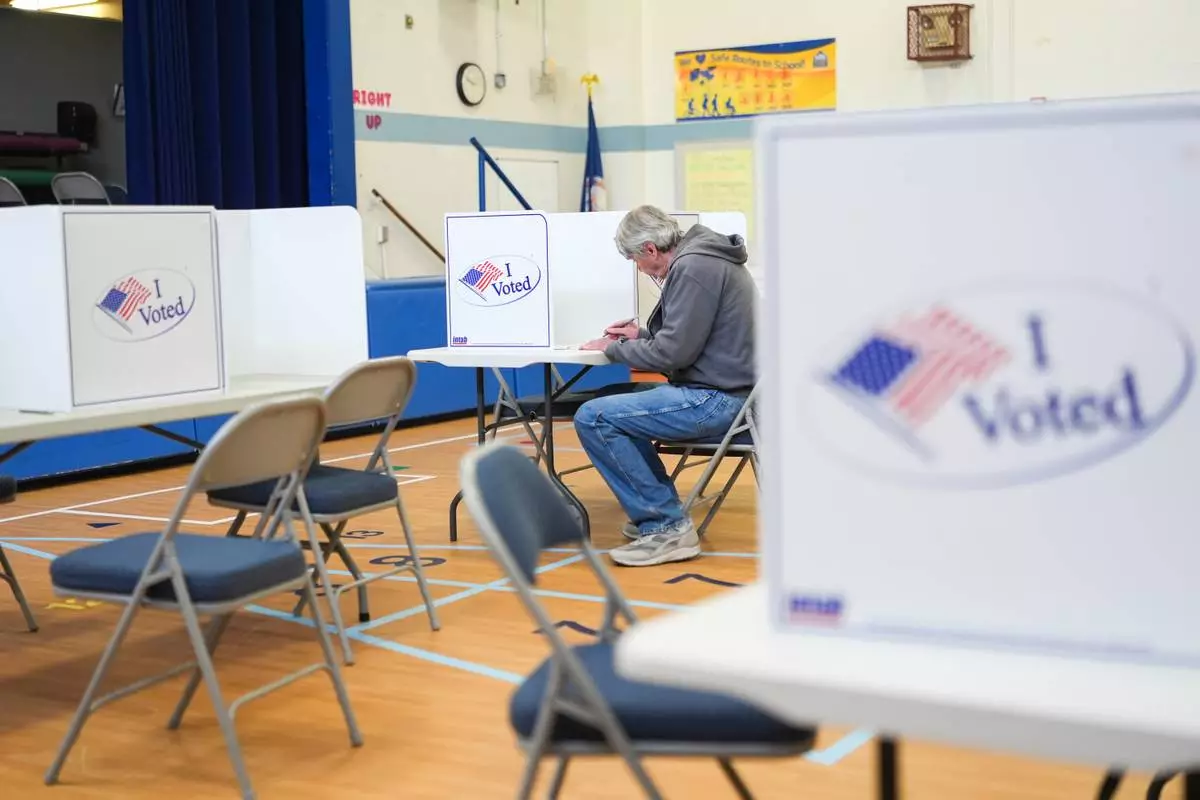
A person votes in the Virginia redistricting referendum at Lyles-Crouch Traditional Academy, Tuesday, April 21, 2026, in Alexandria, Va. (AP Photo/Julia Demaree Nikhinson)
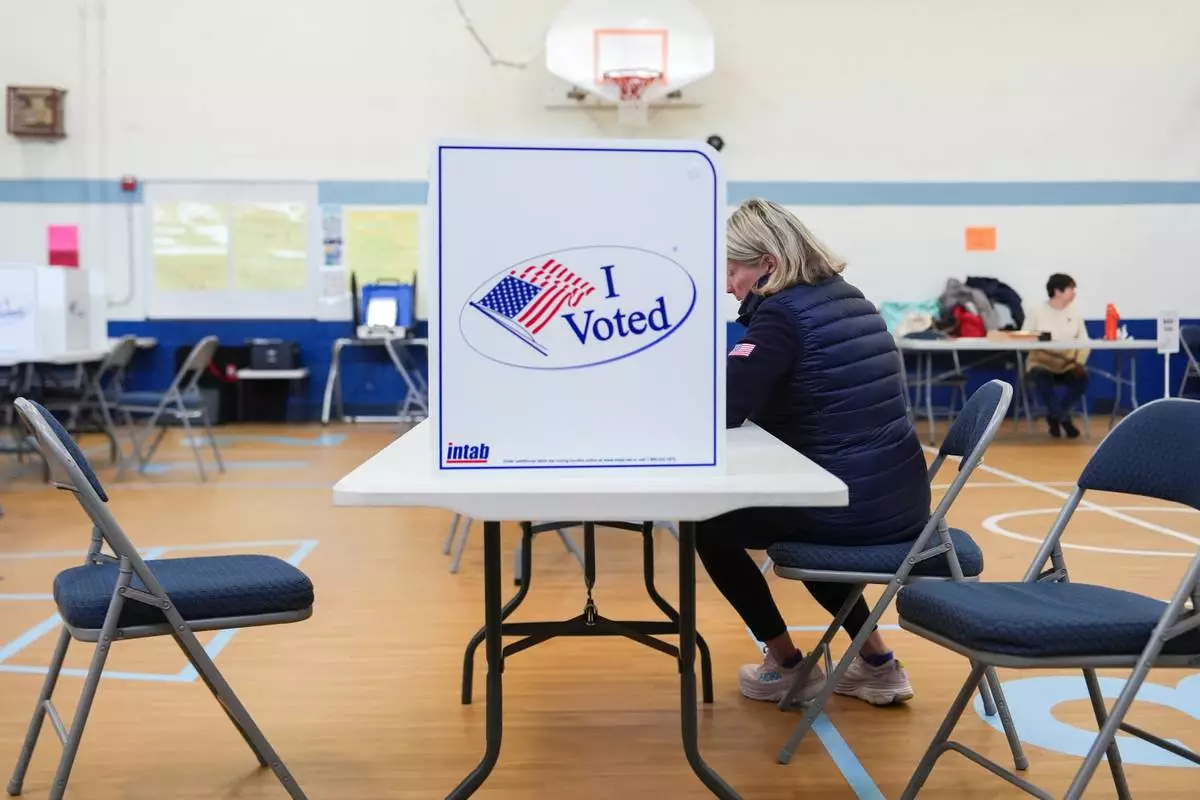
A person votes in the Virginia redistricting referendum at Lyles-Crouch Traditional Academy, Tuesday, April 21, 2026, in Alexandria, Va. (AP Photo/Julia Demaree Nikhinson)
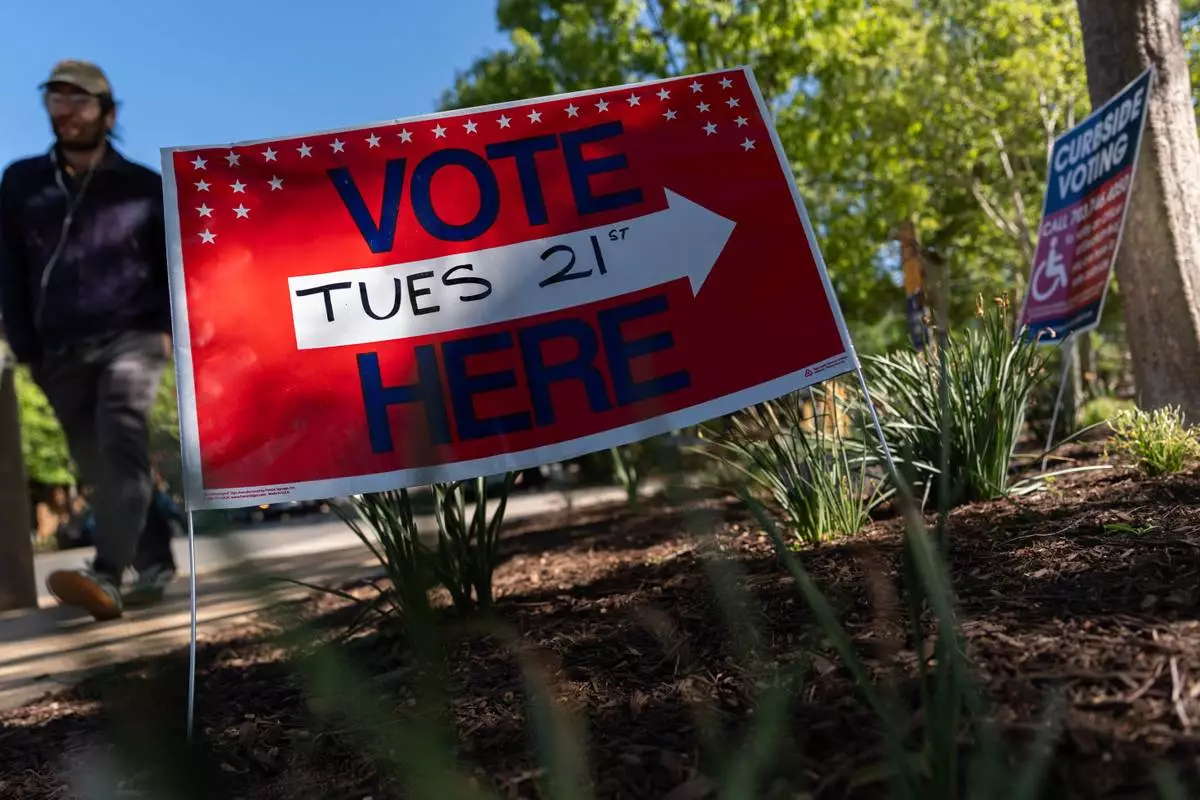
A person walks to vote in the Virginia redistricting referendum at Lyles-Crouch Traditional Academy, Tuesday, April 21, 2026, in Alexandria, Va. (AP Photo/Julia Demaree Nikhinson)