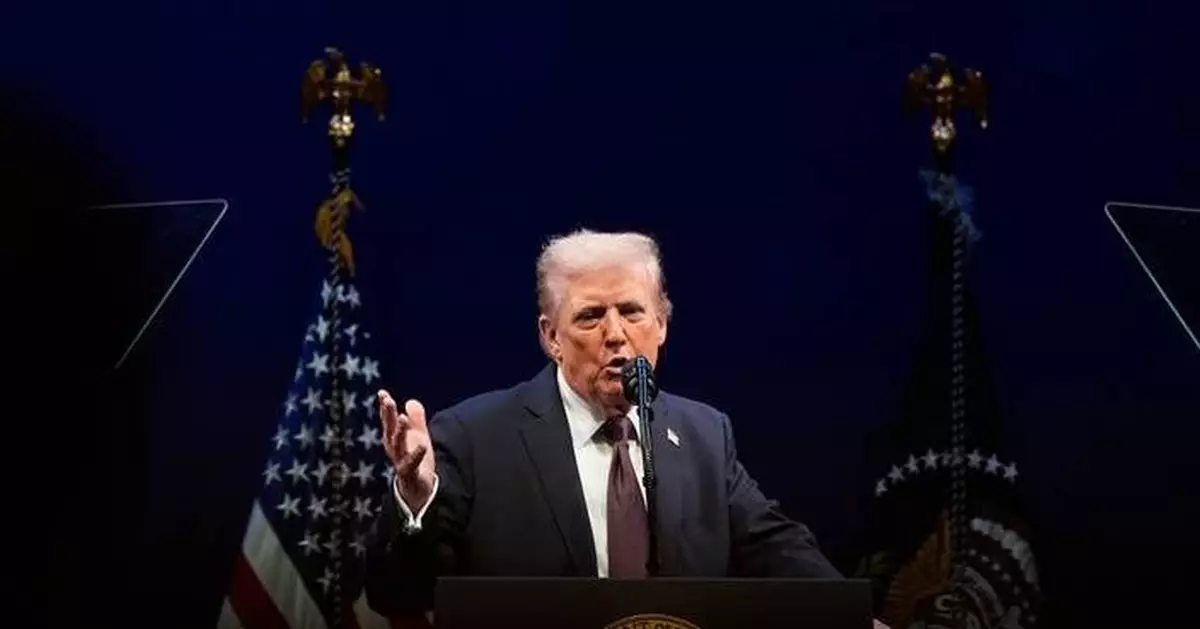
President Donald Trump and many of his leading Christian supporters and top Republicans are taking part this week in a marathon reading of the Bible in an America 250-themed event billed as encouraging a “return to the spiritual foundation that has shaped our country.”
The America Reads the Bible event — with each participant reading a passage aloud — is being livestreamed this week from the Museum of the Bible in Washington and other locations. It is slated to feature a video of Trump on Tuesday evening reading a passage that called for national repentance in ancient Israel — words that have been used prominently for decades by those promoting the belief that America has been and should be a Christian nation.
The Bible is “indelibly woven into our national identity and way of life,” Trump said in a statement commemorating the event. The statement cited historical figures such as the Puritan leader John Winthrop as “imploring his fellow Christian settlers to stand as a beacon of faith for all the world to see.”
Critics say the event has a highly partisan list of participants and is part of a larger project to connect America's upcoming 250th birthday with a Christian nationalist vision that portrays the nation's founding as essentially Christian, something many historians dispute. White Christians, particularly evangelicals, have been crucial to Trump's electoral base.
The list of participants — which overwhelmingly includes Republican politicians and Christian supporters of Trump — shows it to be “very much a right-wing MAGA, Christian nationalist effort," said Brian Kaylor, author of “The Bible According to Christian Nationalists: Exploiting Scripture for Political Power,” referring to Trump’s “Make America Great Again” movement.
“If they wanted this to be a unifying American project, there would have been a whole lot more attention to getting political diversity and ideological diversity,” added Kaylor, president and editor-in-chief of Word&Way, a progressive site covering faith and politics.
Historian Jemar Tisby, whose books have challenged what he says is enduring Christian complicity in racism, criticized the event on Facebook: "You cannot quote the Bible while justifying violence, war and exclusion.”
Bunni Pounds, founder of Christians Engaged, said that reading the Bible alone isn't enough. “Faith without works is dead,” she said, adding: “We need the word first to bring faith into our life.”
The Bible event comes just a week after Trump drew rare criticism from his evangelical supporters for circulating a social media meme in which a white-robed Trump appeared as a Jesus-like healer surrounded by patriotic symbols. Trump removed the image from his Truth Social site while insisting he was depicted as a doctor, not Jesus.
It also comes shortly after Trump's high-profile clash with the U.S.-born Pope Leo XIV over the Iran war.
Other high-ranking officials have been or will be reading biblical passages in person or by video. They include Cabinet officials such as Defense Secretary Pete Hegseth and Secretary of State Marco Rubio as well as House Speaker Mike Johnson and several other Republican members of Congress. Prominent evangelical supporters of Trump who are participating include evangelist Franklin Graham, pastor Jack Graham and pastor Paula White-Cain, who heads Trump's White House Faith Office.
Pounds said that the organization invited Democratic members of Congress as well as leaders of some denominations that might be considered progressive but that they didn’t accept.
Each speaker is taking a turn in the ongoing reading of the 66 books of the Bible as recognized by Protestants. Jews recognize the Hebrew portion of the Bible that Christians call the Old Testament but not the New Testament books centered on Jesus, while Catholics and Orthodox recognize additional books of the Bible that are not included in this reading. The event does include some Catholic representation, including the president of CatholicVote, which endorsed Trump in 2024.
The event involves a comprehensive reading of the entire Bible, from the famous verses ("Let my people go," "The Lord is my shepherd") to the obscure. Passages range from the creation of the world to bloody battles and apocalyptic destruction, from exhortations to love of God, neighbor and the needy to passages telling of Jesus' life, death and resurrection.
The event organizer is Christians Engaged, a nonprofit whose stated mission includes “discipling Americans on biblical worldview and their responsibilities to pray, vote and engage.”
Trump's appearance will be from the Oval Office, where he will read from the seventh chapter of 2 Chronicles, set during King Solomon's dedication of the temple in ancient Jerusalem. In it, God promises forgiveness if a future generation rebels then repents: "If my people, which are called by my name, shall humble themselves, and pray, and seek my face, and turn from their wicked ways; then will I hear from heaven, and will forgive their sin, and will heal their land.”
The verse has long been quoted at many conservative Christian rallies and political events such as the 2024 Republican National Convention.
Pounds noted that the Chronicles passage has for decades been a major theme at annual National Day of Prayer events and that organizers invited Trump to read from it. “It’s a powerful statement that he decided to read that passage,” she said.
The Bible-reading marathon comes just weeks before a May 17 event called a “National Jubilee of Prayer, Praise, and Thanksgiving,” to be held on the National Mall. It's the climactic event of “America Prays,” a project Trump announced last year in conjunction with America 250, calling for prayer for the country and to “rededicate ourselves to one nation under God."
Several of the groups and individuals involved in America Prays are also participating in this week’s Bible reading event.
Associated Press religion coverage receives support through the AP’s collaboration with The Conversation US, with funding from Lilly Endowment Inc. The AP is solely responsible for this content.
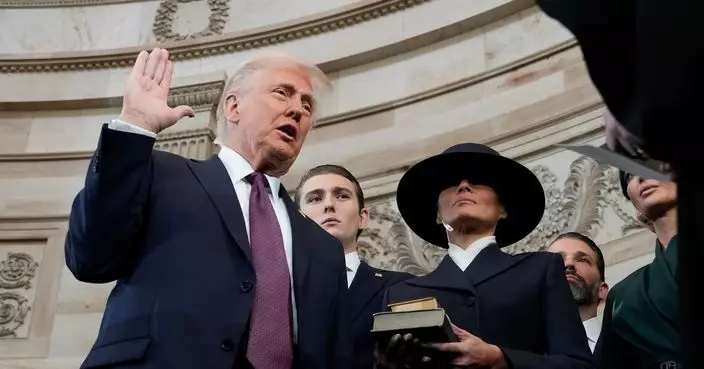
FILE - Donald Trump is sworn in as the 47th president of the United States by Chief Justice John Roberts as Melania Trump holds the Bible during the 60th Presidential Inauguration in the Rotunda of the U.S. Capitol in Washington, Jan. 20, 2025. (AP Photo/Morry Gash, Pool, File)
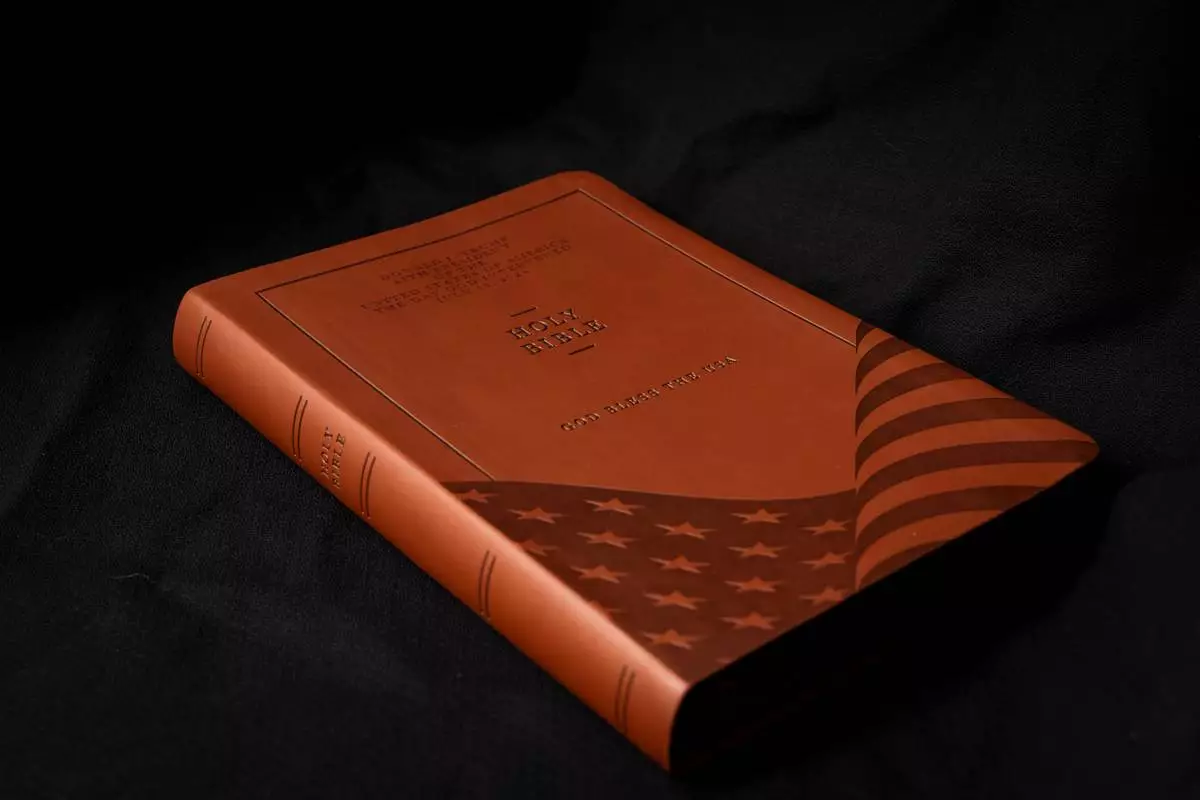
FILE - The front cover of Republican presidential nominee former President Donald Trump's "God Bless the USA" Bible in Washington, Oct. 8, 2024. (AP Photo/Ben Curtis, File)
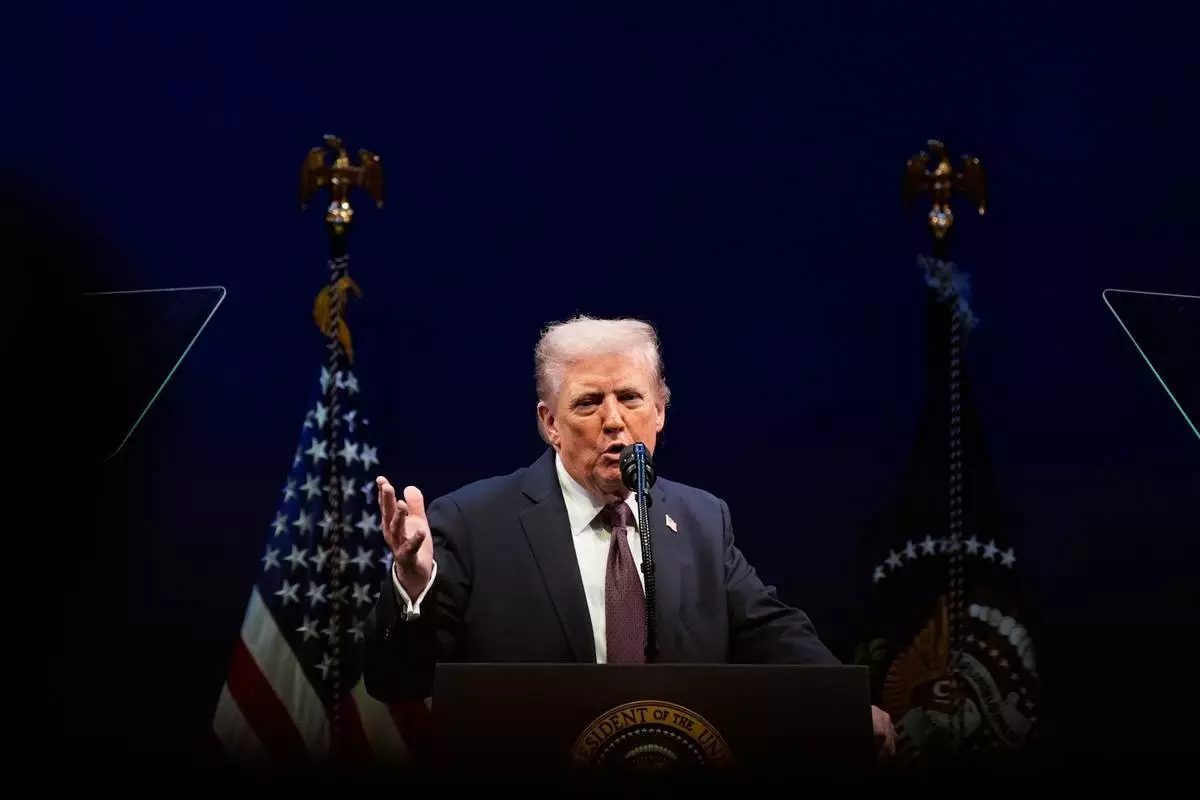
FILE - President Donald Trump speaks at a hearing of the Religious Liberty Commission at the Museum of the Bible, Sept. 8, 2025, in Washington. (AP Photo/Alex Brandon, File)
MALABO, Equatorial Guinea (AP) — Pope Leo XIV arrived Tuesday in Equatorial Guinea for the final leg of his four-nation African journey, a country that presents perhaps the most diplomatically delicate challenge of this trip and his young papacy.
Adoring crowds lined the road from the airport into town, cheering the first pope to visit since St. John Paul II came in 1982. Leo, wearing his formal red mozzetta cape, thrilled the flag-waving masses by arriving at the presidential palace in his open-sided popemobile.
“There is a lot of joy today because we waited 44 years for the pope to come, after the visit of John Paul II,” said Diosdao Marques, a senior Catholic official in the country. “It’s a blessing for the country, we hope many things will change and we will deepen our faith.”
The former Spanish colony on Africa’s western coast is run by Africa’s longest-serving president, Teodoro Obiang Nguema Mbasogo, 83. He has been in power since 1979 and is accused of widespread corruption and authoritarianism.
The discovery of offshore oil in the mid-1990s transformed Equatorial Guinea’s economy virtually overnight, with oil now accounting for almost half of its GDP and more than 90% of exports, according to the African Development Bank.
Yet more than half of the country’s nearly 2 million people live in poverty. And rights groups including Human Rights Watch — as well as court cases in France and Spain — have documented how revenues have enriched the ruling Obiang family rather than the broader population.
Leo has shown he won't mince words on this maiden African journey as pope, and the church’s teaching on the scourge of social inequity and corruption is clear. If Leo’s stop in Cameroon was any indication, the pope's messaging in Equatorial Guinea might be just as sharp.
Upon arriving in Yaounde, Cameroon, last week, Leo met with President Paul Biya, at 93 the world’s oldest leader. Like Obiang, Biya has also been in power for decades — since 1982 — and like Obiang, he’s accused of presiding over an authoritarian government.
Leo didn’t hold back as he stood next to Biya and delivered his arrival speech in the presidential palace.
“In order for peace and justice to prevail, the chains of corruption — which disfigure authority and strip it of its credibility — must be broken,” Leo said. “Hearts must be set free from an idolatrous thirst for profit.”
Equatorial Guinea is officially a secular country, but the Catholic Church is at the center of its political and social systems.
Church leaders “are very much interconnected intrinsically with the government,” said Tutu Alicante, a U.S.-based activist who runs the EG Justice rights group. “Part of it is the fear the government has instilled in everyone, including the church, and part of it is the monetary gains that the church derives from this government.”
The Rev. Fortunatus Nwachukwu, No. 2 in the Vatican’s missionary evangelization office, said the Catholic Church is present in difficult civil spaces and knows how to operate in them to carry out its mission.
“Should the church go to war against the government? Surely no,” Nwatchukwu said. “Should the church swallow everything as if it were normal? No. The church has to continue preaching justice, always in defense of life, human dignity and the common good.”
That is particularly challenging in Equatorial Guinea, which with about 75% of its population Catholic is one of the most Catholic countries in Africa.
But it’s also one of the most oppressed. In addition to official corruption, the country’s government also faces rampant accusations of harassment, arrest and intimidation of political opponents, critics and journalists.
It has consistently ranked among the bottom 10 countries in Transparency International’s annual corruption perception index, though the government has in recent years taken some steps to improve the situation, said Transparency International’s regional advisor for Africa, Samuel Kaninda.
The government passed an anti-corruption law and is working to fund an anti-corruption commission. But the only way such measures will be effective is if the commission is truly independent to investigate and the judiciary is independent as well, he said.
Kaninda said he hoped the pope’s visit would draw attention to such shortcomings, and give the people of Equatorial Guinea hope. Even if the government exploits the visit to signal a papal endorsement of its rule, historically pope trips to even authoritarian regimes have ended up as a net positive experience for the people, he said.
“The risk is there, but at the same time, we see more of the opportunity to shed more light on a lot more that is happening there,” he said.
Juliana Bopabote Lopete, a mother of 11 visiting Malabo from a village two hours away to see the pope, was wearing a new dress she said she bought for the occasion, with the pope’s face printed on the traditional fabric.
“Today is a big celebration,” she said, as her friends and her husband sang, played tambourines and swayed next to her. “You need a special outfit.”
At the very least, the first papal visit since St. John Paul II came in 1982 is giving seamstress Tumi Carine lots of business, as she makes dresses with fabric stamped with Leo’s image.
“The coming of the pope brought us many customers,” Carine said. “ We are really grateful for the coming of the pope, so, we are really happy.”
Leo has a packed schedule in Equatorial Guinea. He will meet with Obiang and then delivers two sets of remarks: A speech to government authorities and diplomats, and then another speech at the national university.
In addition to celebrating Masses, he’ll visit a psychiatric hospital and a prison and will meet with young people and their families. Before leaving Thursday, he’ll pray at a memorial to victims of a 2021 blast at a military barracks in Bata that killed more than 100 people. The explosions were blamed on the negligent handling of dynamite in a barracks close to residential areas.
Associated Press writer Monika Pronczuk in Malabo, Equatorial Guinea and Ope Adetayo in Lagos, Nigeria, contributed to the reporting.
Associated Press religion coverage receives support through the AP’s collaboration with The Conversation US, with funding from Lilly Endowment Inc. The AP is solely responsible for this content.
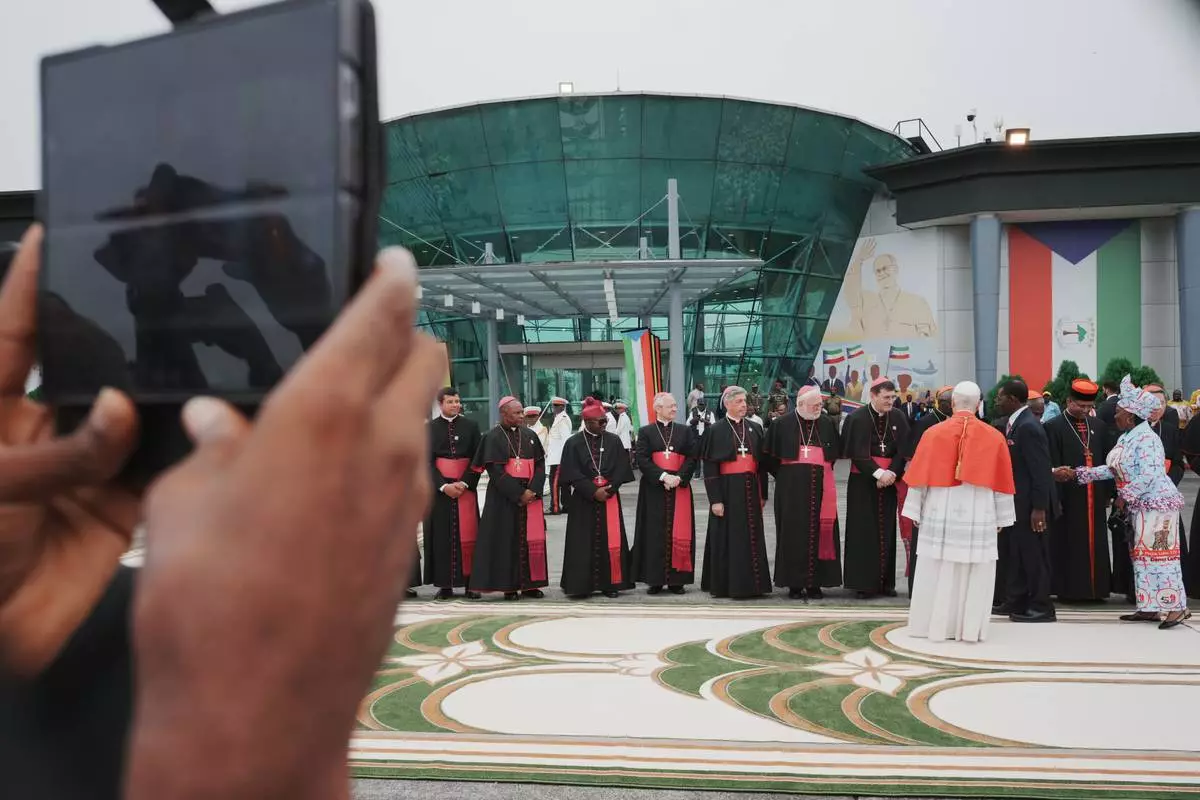
Pope Leo XIV is welcomed by Equatorial Guinea's President Teodoro Obiang Nguema Mbasogo, fifth from right, and his wife, second from right, Constancia Mangue de Obiang, upon his arrival at Malabo International Airport in Malabo, Equatorial Guinea, Tuesday, April 21, 2026, on the ninth day of his 11-day pastoral visit to Africa. (AP Photo/Andrew Medichini)
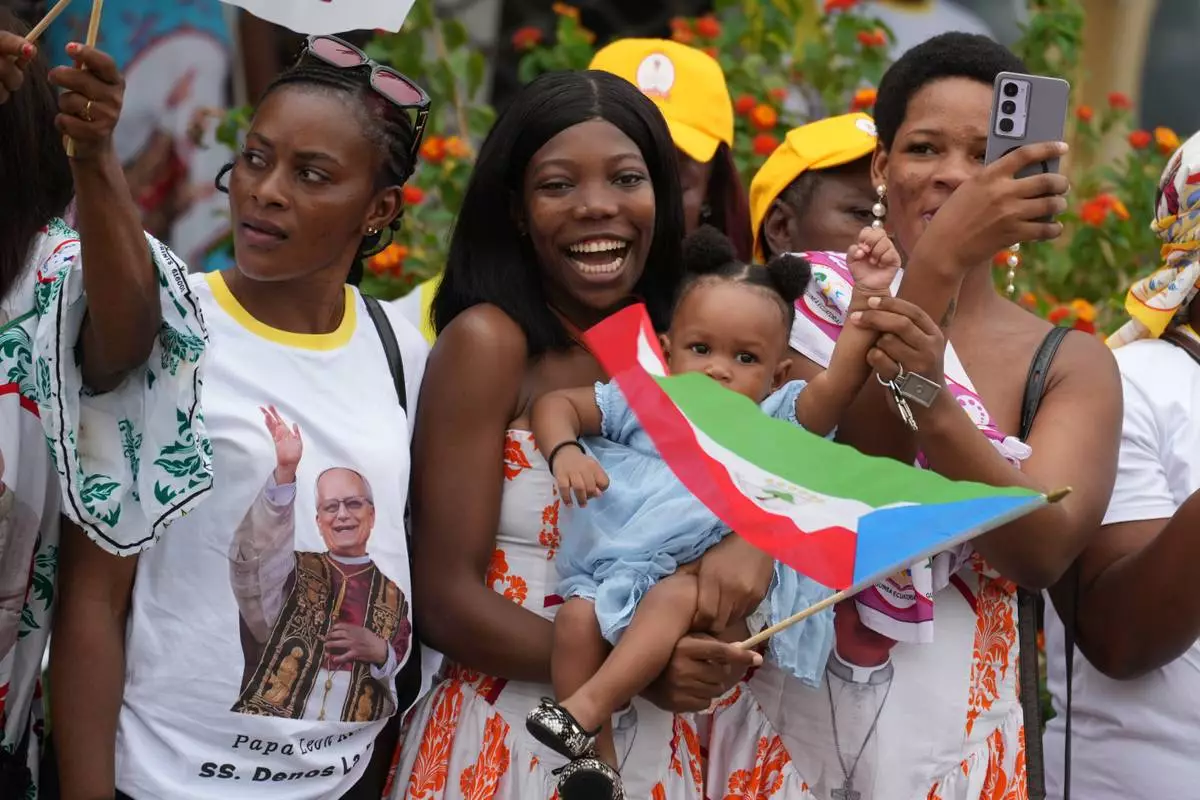
People wait for Pope Leo XIV in Malabo, Equatorial Guinea, Tuesday, April 21, 2026, on the ninth day of his 11-day pastoral visit to Africa. (AP Photo/Andrew Medichini)
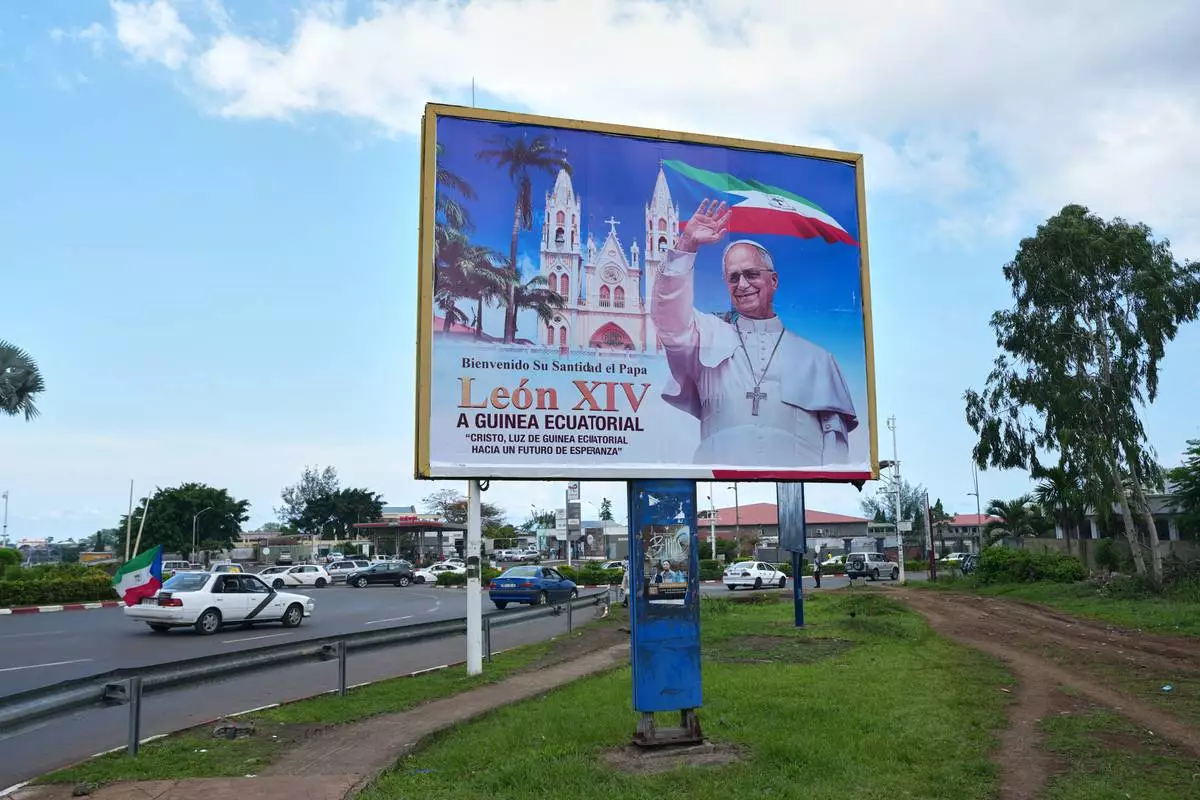
A billboard featuring Pope Leo XIV is seen ahead of his visit in Malabo, Equatorial Guinea, Friday, April 17, 2026. (AP Photo/Misper Apawu)
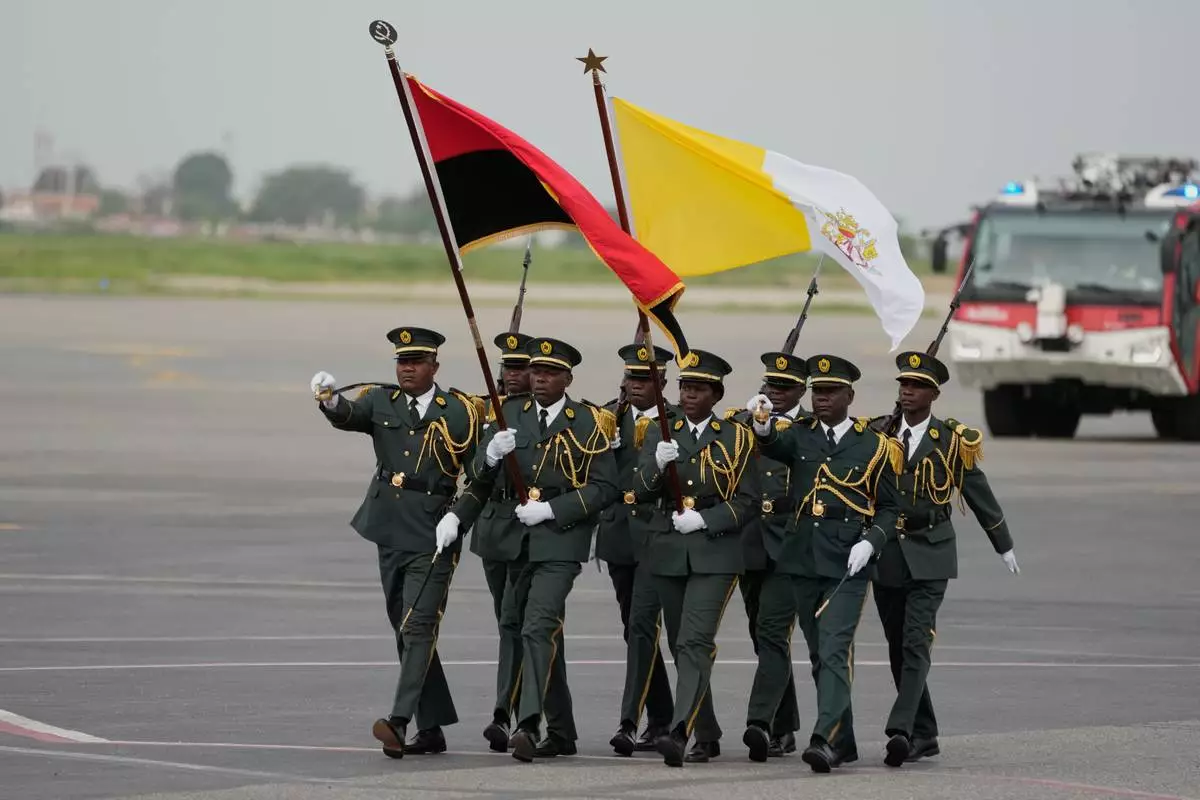
Soldiers march carrying the Vatican flag, right, and Angolan flag prior to Pope Leo XIV's departure for Equatorial Guinea, at the airport in Luanda, Angola, Tuesday, April 21, 2026. (AP Photo/Themba Hadebe)
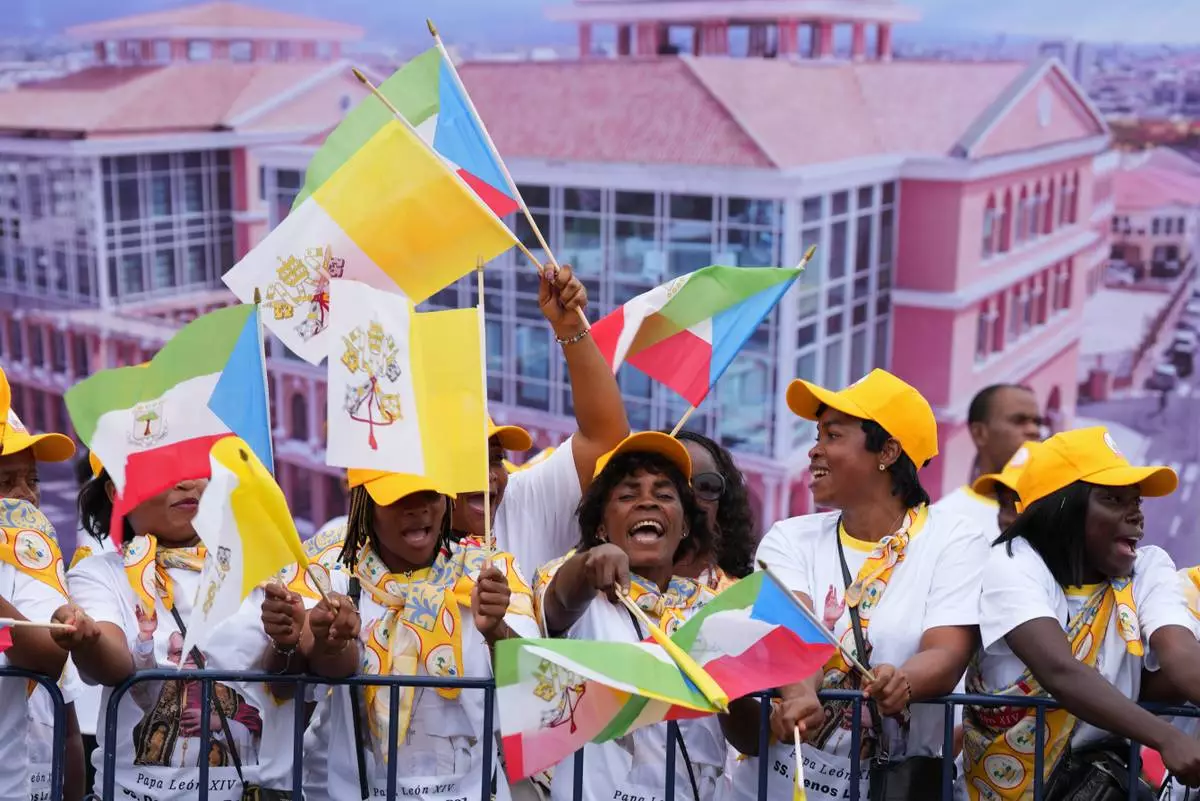
Faithful wait for the arrival of Pope Leo XIV at the airport in Malabo, Equatorial Guinea, Tuesday, April 21, 2026. (AP Photo/Misper Apawu)
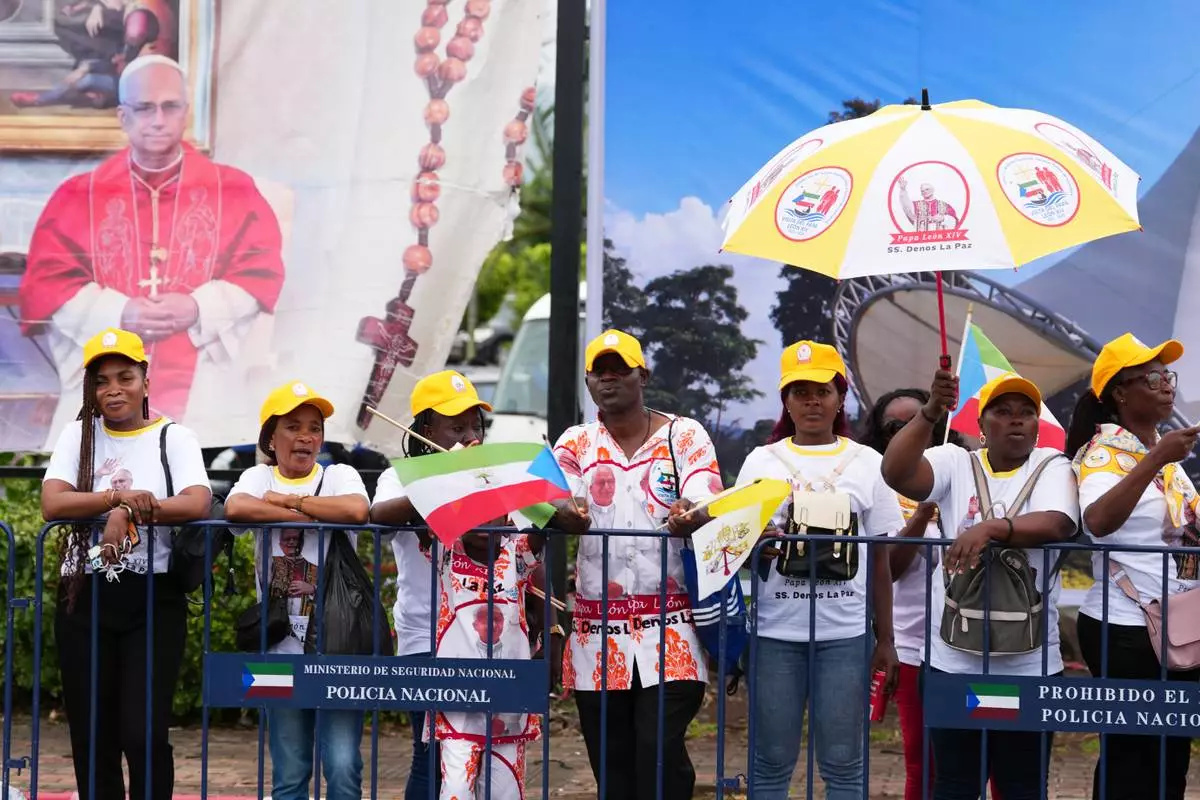
Faithful wait for the arrival of Pope Leo XIV at the airport in Malabo, Equatorial Guinea, Tuesday, April 21, 2026. (AP Photo/Misper Apawu)
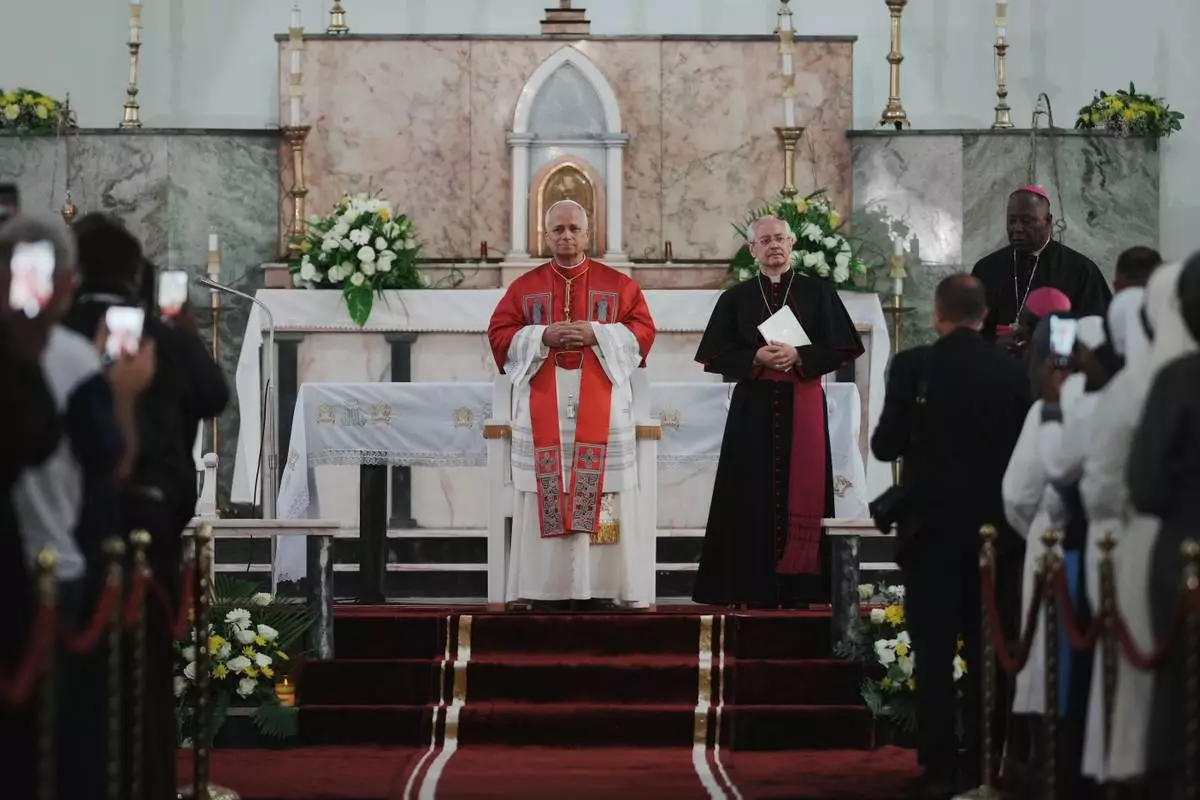
Pope Leo XIV arrives at the Parish of Our Lady of Fatima in Luanda, Angola, for a meeting with bishops, priests, consecrated men and women, and pastoral workers Monday, April 20, 2026, on the eighth day of an 11-day apostolic journey to Africa (AP Photo/Andrew Medichini)
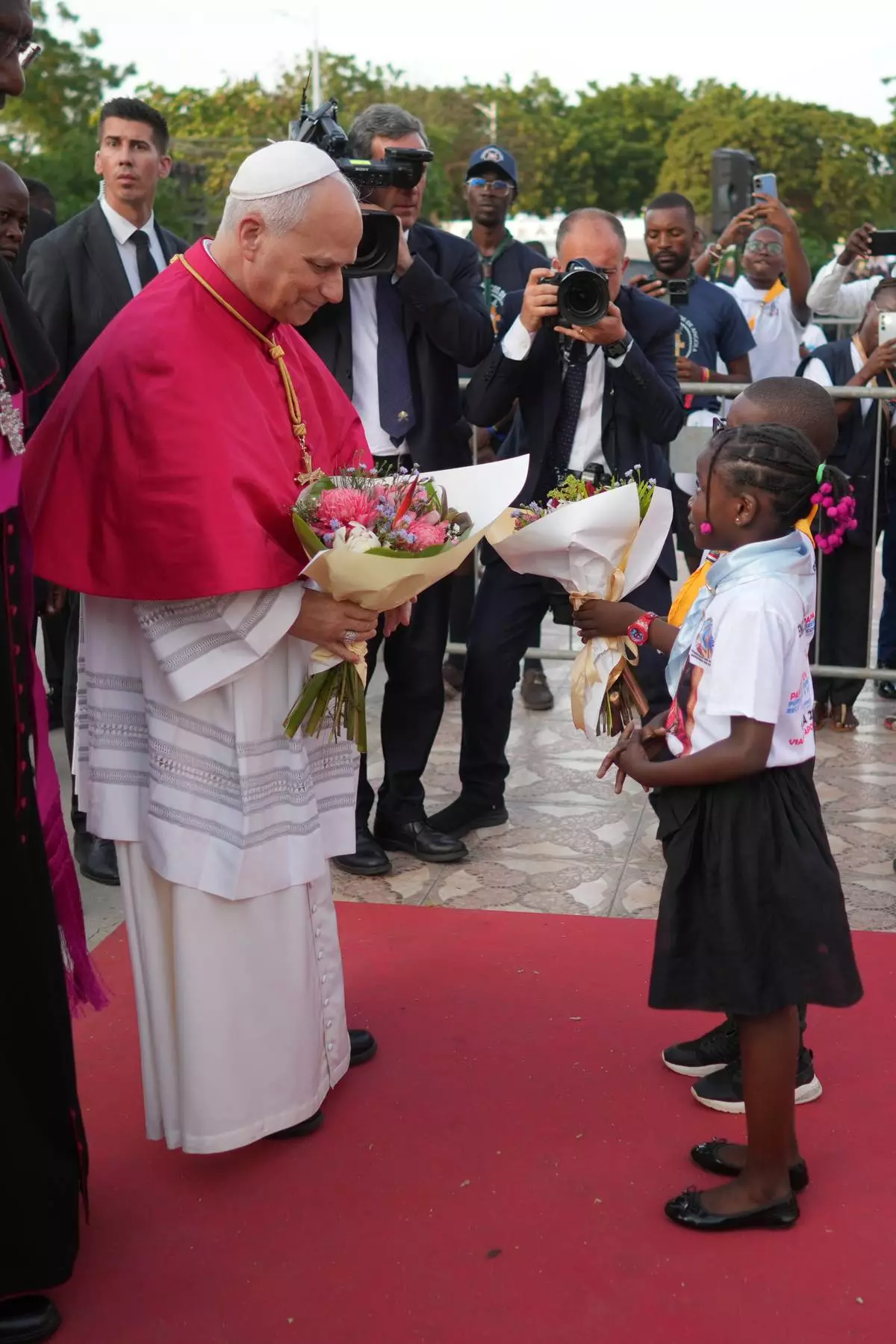
Pope Leo XIV arrives at the Parish of Our Lady of Fatima in Luanda, Angola, for a meeting with bishops, priests, consecrated men and women, and pastoral workers Monday, April 20, 2026, on the eighth day of an 11-day apostolic journey to Africa (AP Photo/Andrew Medichini)
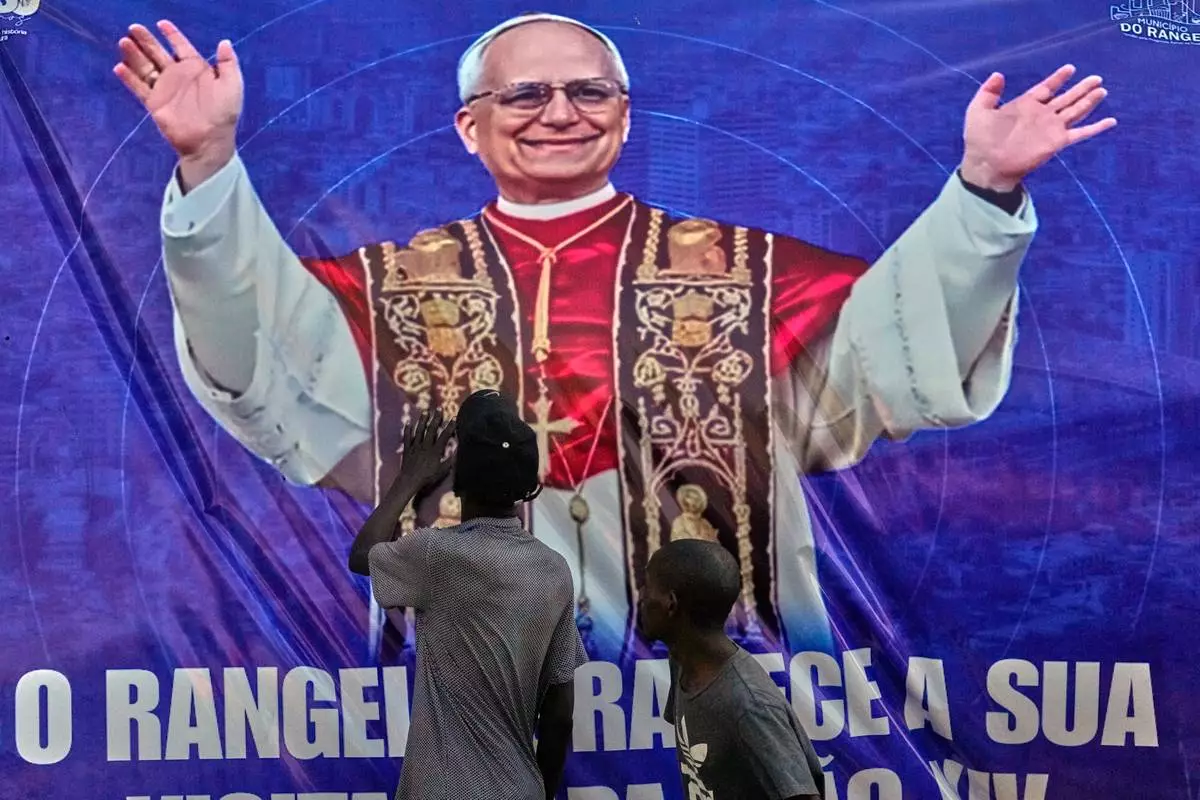
People touch a banner bearing an image of Pope Leo XIV in Luanda, Angola, Monday, April 20, 2026. (AP Photo/Themba Hadebe)
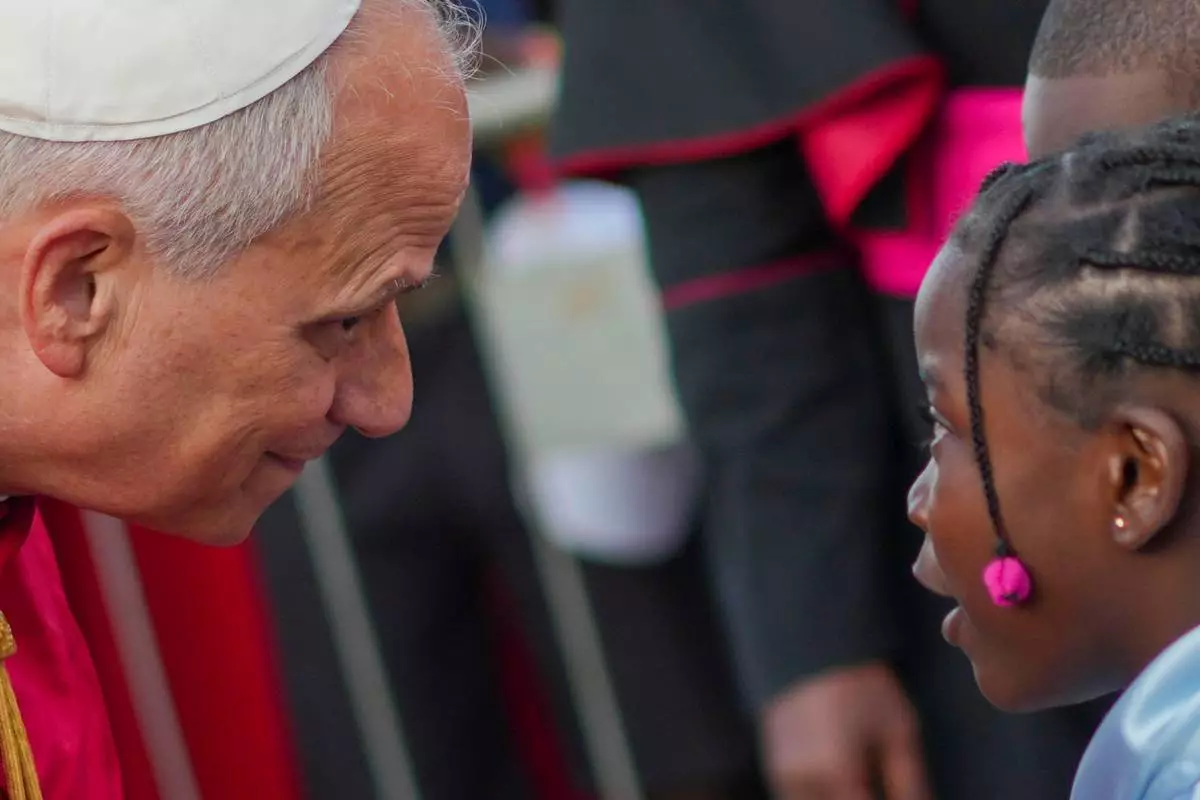
Pope Leo XIV listens to a girl as he arrives at the Parish of Our Lady of Fatima in Luanda, Angola, for a meeting with bishops, priests, consecrated men and women, and pastoral workers Monday, April 20, 2026, on the eighth day of an 11-day apostolic journey to Africa (AP Photo/Andrew Medichini)