SAN JOSE, Calif.--(BUSINESS WIRE)--Apr 21, 2026--
KIOXIA America, Inc. today announced KIOXIA EG7 Series solid state drives (SSDs), the company’s first client solution to adopt KIOXIA’s BiCS FLASH™ generation 8 4-bit-per-cell, quadruple-level cell (QLC) technology. The QLC-based KIOXIA EG7 Series delivers identical performance as TLC-based solutions 1, enabling better total cost of ownership 2 (TCO) for value-oriented slim laptops, as well as commercial and consumer notebooks and desktops.
This press release features multimedia. View the full release here: https://www.businesswire.com/news/home/20260421384424/en/
KIOXIA EG7 Series SSDs bring the performance and power efficiency advantages 3 of KIOXIA BiCS FLASH™ generation 8 QLC 3D flash memory to common computing workloads for PC OEMs. The new drives deliver random read and write performance of up to 1,000 KIOPS, sequential read speeds of up to 7,000 MB/s, and sequential write speeds of up to 6,200 MB/s.
The KIOXIA EG7 Series incorporates NVMe™ 2.0d specification support, giving PC OEMs greater flexibility in system design and device management. The drives are offered in M.2 Type 2230, Type 2242, and Type 2280 form factors, enabling broader compatibility across diverse system configurations and space constraints.
Positioned within KIOXIA’s value-oriented client SSD portfolio, the DRAM-less KIOXIA EG7 Series leverages mature Host Memory Buffer (HMB) technology, utilizing a portion of system memory to help improve TCO and power consumption 4 while maintaining responsive performance.
Additional features include:
“QLC technology continues to expand what’s possible in client storage by delivering compelling value without compromising user experience,” said Neville Ichhaporia, senior vice president and general manager of the SSD business unit, KIOXIA America, Inc. “With the EG7 Series, we’re enabling PC OEMs to bring high-performance, power-efficient storage to a broader range of systems at a more accessible price point.”
The KIOXIA EG7 Series is currently sampling with select PC OEM customers, with systems equipped with the SSD expected to begin shipping in the second quarter of 2026.
For more information, please visit www.kioxia.com, and follow the company on X, formerly known as Twitter and LinkedIn®.
About KIOXIA America, Inc.
KIOXIA America, Inc. is the U.S.-based subsidiary of KIOXIA Corporation, a leading worldwide supplier of flash memory and solid-state drives (SSDs). From the invention of flash memory to today’s breakthrough BiCS FLASH™ 3D technology, KIOXIA continues to pioneer innovative memory, SSD and software solutions that enrich people’s lives and expand society’s horizons. The company’s innovative 3D flash memory technology, BiCS FLASH, is shaping the future of storage in high-density applications, including advanced smartphones, PCs, automotive systems, data centers and generative AI systems. For more information, please visit KIOXIA.com.
©2026 KIOXIA America, Inc. All rights reserved. Information in this press release, including product pricing and specifications, content of services, and contact information is current and believed to be accurate on the date of the announcement, but is subject to change without prior notice. Technical and application information contained here is subject to the most recent applicable KIOXIA product specifications.
Notes:
1 Compared to KIOXIA BG7 Series SSD published specifications
2 QLC-based products cost less per GB with the same performance which can help reduce TCO. Subject to change.
3 Compared to KIOXIA BiCS FLASH™ generation 5 flash memory
4 Compared to KIOXIA XG Series SSD (contains DRAM) pricing and published specifications. Subject to change.
5 Availability of the SED model line-up may vary by region.
Definition of SSD capacity: Kioxia Corporation defines a kilobyte (KB) as 1,000 bytes, a megabyte (MB) as 1,000,000 bytes, a gigabyte (GB) as 1,000,000,000 bytes, a terabyte (TB) as 1,000,000,000,000 bytes, and a kibibyte (KiB) is 1,024 bytes. A computer operating system, however, reports storage capacity using powers of 2 for the definition of 1GB = 2^30 bytes = 1,073,741,824 bytes and 1TB = 2^40 bytes = 1,099,511,627,776 bytes and therefore shows less storage capacity. Available storage capacity (including examples of various media files) will vary based on file size, formatting, settings, software and operating system, and/or pre-installed software applications, or media content. Actual formatted capacity may vary.
Read and write speed may vary depending on the host device, read and write conditions, and file size.
IOPS: Input Output Per Second (or the number of I/O operations per second)
NVMe is a registered or unregistered mark of NVM Express, Inc. in the United States and other countries.
PCIe is a registered trademark of PCI-SIG.
LinkedIn is a trademark of LinkedIn Corporation and its affiliates in the United States and/or other countries
Company names, product names, and service names may be trademarks of third-party companies.

QLC-based KIOXIA EG7 Series SSDs deliver identical performance as TLC-based solutions, enabling better TCO for value-oriented slim laptops, as well as commercial and consumer notebooks and desktops.
Virginia voters approved a mid-decade redistricting plan Tuesday that could boost Democrats’ chances of winning four additional U.S. House seats in November’s midterm elections that will decide control of the closely divided Congress.
The constitutional amendment backed by voters bypasses a bipartisan redistricting commission to allow the use of new districts drawn by Virginia’s Democratic-led General Assembly. But the public vote may not be the final word. The state Supreme Court is considering whether the plan is illegal in a case that could make the referendum results meaningless.
The Virginia redistricting referendum marked a setback for President Donald Trump, who kicked off a national redistricting battle last year by urging Republican officials in Texas to redraw districts. The goal was to help Republicans win more seats in the November elections and hold on to a narrow House majority in the face of political headwinds that typically favor the party out of power during midterm elections.
But the Virginia redistricting referendum could help nullify Republican gains elsewhere.
“Virginia just changed the trajectory of the 2026 midterms,” Democratic state House Speaker Don Scott said in a celebratory statement. “At a moment when Trump and his allies are trying to lock in power before voters have a say, Virginians stepped up and leveled the playing field for the entire country.”
The redistricting in Texas led to a burst of redistricting nationwide. So far, Republicans believe they can win up to nine more House seats in newly redrawn districts in Texas, Missouri, North Carolina and Ohio. Democrats think they can win up to five more seats in California, where voters approved a similar mid-decade redistricting effort last November, and one more seat under new court-imposed districts in Utah.
Democrats hope to offset the rest of that gap in Virginia, where they decisively flipped 13 seats in the state House and won back the governor’s office last year.
But the back-and-forth battle is continuing in Florida, where the Republican-led Legislature is to convene April 28 for a special session that could result in more favorable congressional districts for Republicans.
The campaign over Virginia’s redistricting referendum focused heavily on fairness.
Republicans argued that it was unfair to gerrymander Virginia’s districts to Democrats’ advantage. But Democrats argued that they were creating a fairer election landscape nationally by counteracting Republican gerrymandering elsewhere.
Matt Wallace, of Alexandria, said he voted for the Democratic redistricting amendment “to help balance the scales a bit until things get back to normal.”
But Ruth Ann McCartney, who voted in the town of South Hill just a few miles north of the North Carolina border, said she cast her ballot against the amendment.
“I look at it more as we don’t have the population as northern Virginia,” she said. “And as a rural area, we just need to be heard.”
In Virginia, Democrats currently hold six of the 11 U.S. House seats under districts that were imposed by the state Supreme Court in 2021 after a bipartisan commission failed to agree on a map based on the latest census data.
The new plan could help Democrats win as many as 10 seats. Five seats are anchored in the Democratic stronghold of northern Virginia, including one stretching out like a lobster to consume Republican-leaning rural areas. Revisions to four other districts across Richmond, southern Virginia and Hampton Roads dilute the voting power of conservative blocs in those areas. And a reshaped district in parts of western Virginia lumps together three Democratic-leaning college towns to offset other Republican voters.
Democrats portrayed the Virginia redistricting as a response to Trump. It is “pushing back against what other states have done in trying to stack the deck for Donald Trump in those congressional elections,” Democratic Gov. Abigail Spanberger said during an online rally last week.
Ads for the “yes to redistricting” campaign featuring former President Barack Obama flooded the airwaves.
But opponents of the redistricting also distributed campaign materials citing statements from Obama and Spanberger, who had both criticized gerrymandering in the past.
Congressional redistricting typically is done once a decade after each census.
In 2020, Virginia voters approved a constitutional amendment meant to diminish political gamesmanship by shifting redistricting responsibilities away from the legislature.
But lawmakers endorsed a new constitutional amendment allowing mid-decade redistricting last fall, then passed it again in January as part of a two-step process that requires an intervening election in order for an amendment to be placed on the ballot. The measure allows lawmakers to redistrict until returning the task to a bipartisan commission after the 2030 census.
In February, they passed a new U.S. House map to take effect pending the outcome of the redistricting referendum.
Republicans have filed multiple legal challenges against the redistricting effort.
A Tazewell County judge ruled that the redistricting push was illegal for several reasons. Circuit Court Judge Jack Hurley Jr. said lawmakers failed to follow their own rules for adding the redistricting amendment to a special session. He ruled that their initial vote failed to occur before the public began casting ballots in last year’s general election and thus didn’t count toward the two-step process. And he ruled that the state failed to publish the amendment three months before that election, as required by law.
If the state Supreme Court agrees with the lower court, the referendum results could be rendered moot.
Associated Press writers Allen G. Breed in South Hill, Virginia, Gary Fields in Alexandria, Virginia, and Lisa Mascaro in Washington contributed to this report.

"I Voted" stickers are laid out on a table at Lyles-Crouch Traditional Academy on election day for the Virginia redistricting referendum, Tuesday, April 21, 2026, in Alexandria, Va. (AP Photo/Julia Demaree Nikhinson)
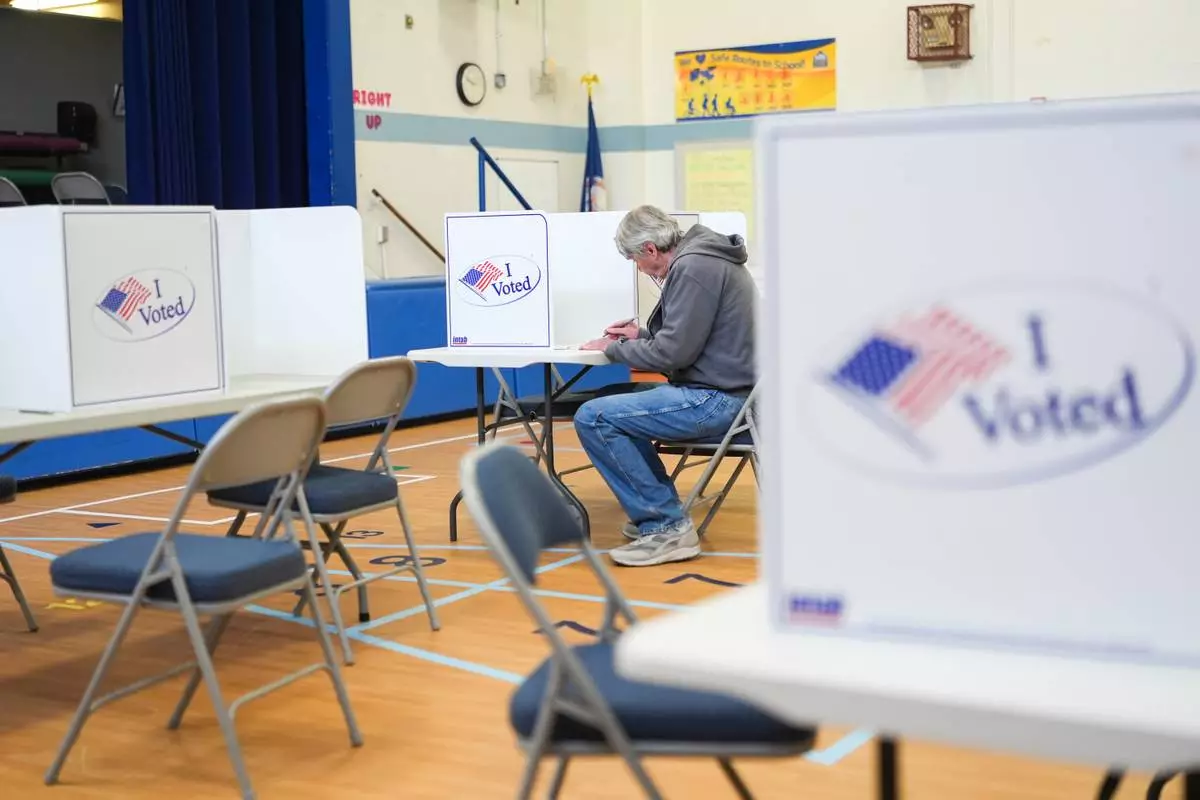
A person votes in the Virginia redistricting referendum at Lyles-Crouch Traditional Academy, Tuesday, April 21, 2026, in Alexandria, Va. (AP Photo/Julia Demaree Nikhinson)
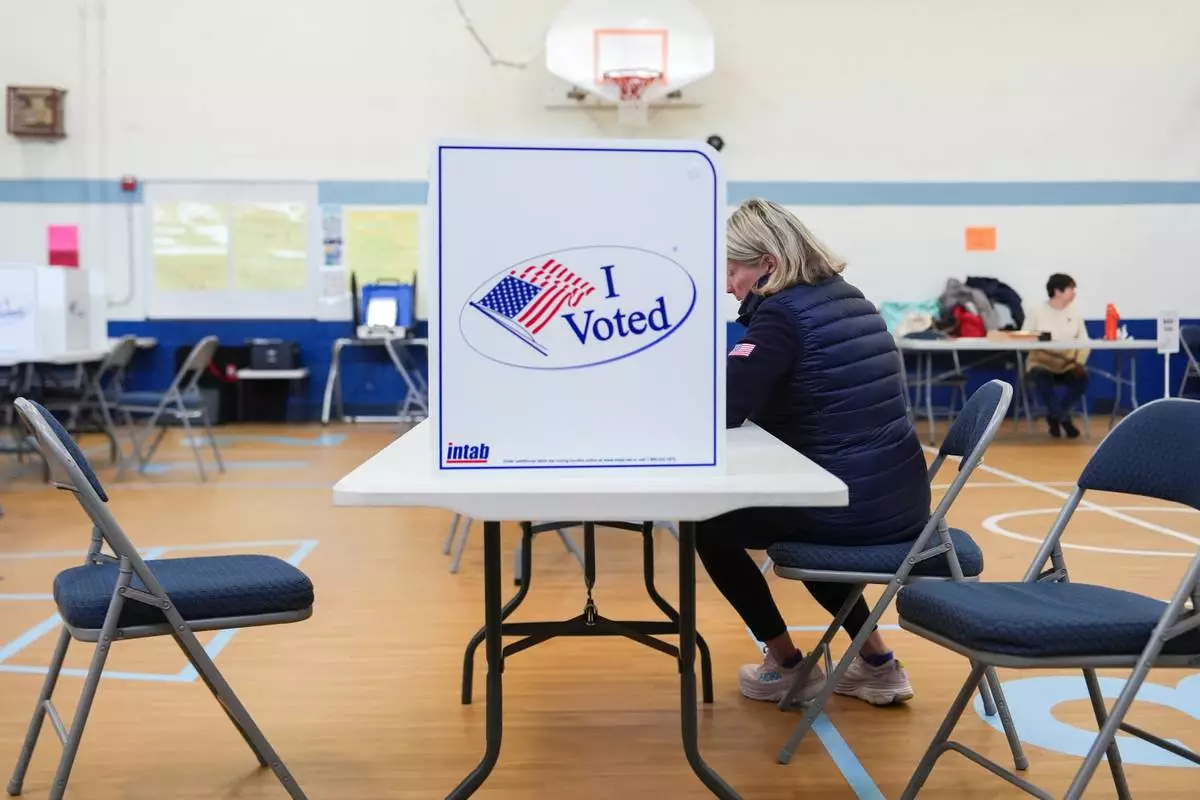
A person votes in the Virginia redistricting referendum at Lyles-Crouch Traditional Academy, Tuesday, April 21, 2026, in Alexandria, Va. (AP Photo/Julia Demaree Nikhinson)
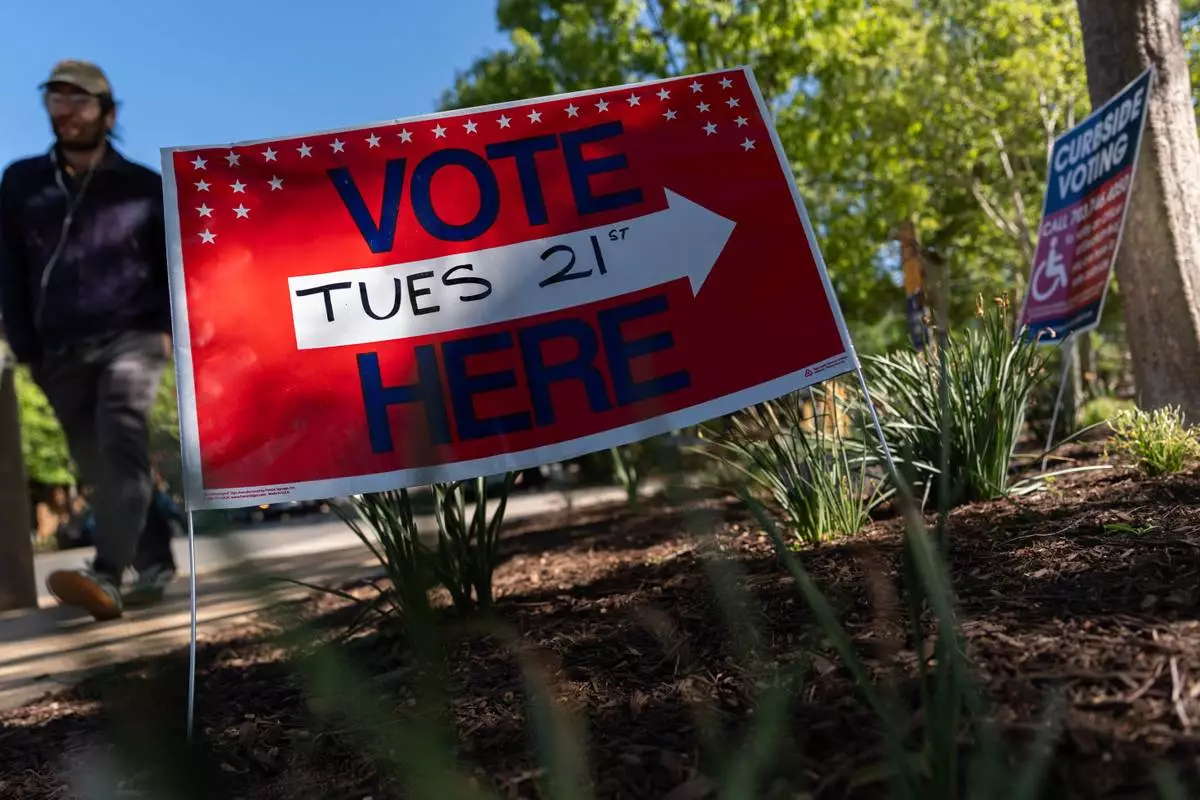
A person walks to vote in the Virginia redistricting referendum at Lyles-Crouch Traditional Academy, Tuesday, April 21, 2026, in Alexandria, Va. (AP Photo/Julia Demaree Nikhinson)