ST. PETERSBURG, Fla. (AP) — Elly De La Cruz hit two of Cincinnati's five home runs, rookie Sal Stewart added three RBIs to reach 24 on the season and the Reds scored the first nine runs to cruise to a 12-6 victory over the Tampa Bay Rays on Tuesday night.
De La Cruz, who went 3 for 6 with five RBIs, hit a two-run homer to begin the scoring in the first inning and he added a solo shot in the ninth for his eighth of the season to make it 12-2. It was De La Cruz’s sixth career multihomer game, passing Pete Rose for the most in Reds history by a switch-hitter.
Click to Gallery
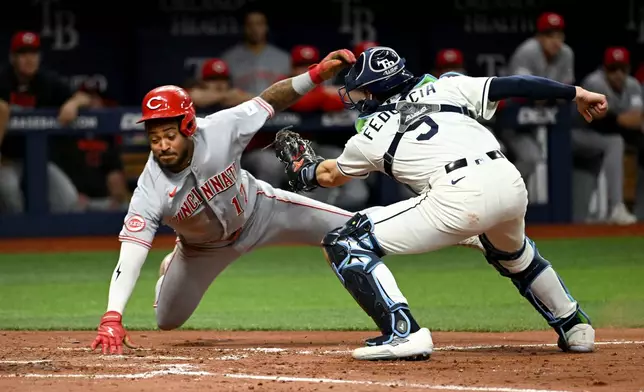
Cincinnati Reds' Dane Myers (17) avoids the tag from Tampa Bay Rays catcher Hunter Feduccia (9) as he scores during the sixth inning of a baseball game Tuesday, April 21, 2026, in St. Petersburg, Fla. (AP Photo/Jason Behnken)
Cincinnati Reds' Sal Stewart drives in two runs with his sixth inning single during a baseball game against the Tampa Bay Rays Tuesday, April 21, 2026, in St. Petersburg, Fla. (AP Photo/Jason Behnken)
Cincinnati Reds' Elly de la Cruz hits a two run home run during the first inning of a baseball game against the Tampa Bay Rays Tuesday, April 21, 2026, in St. Petersburg, Fla. (AP Photo/Jason Behnken)
Cincinnati Reds' Elly de la Cruz (44) and third base coach Willie Harris celebrate de la Cruz's two run home run during the first inning of a baseball game against the Tampa Bay Rays Tuesday, April 21, 2026, in St. Petersburg, Fla. (AP Photo/Jason Behnken)
Stewart drove in two runs on a single to center field in the sixth for a 9-0 lead and he added a sacrifice fly in the seventh. He's tied with Houston's Yordan Alvarez for the major league lead with 24 RBIs.
Cincinnati (16-8) has won five straight for its best start after 24 games since the 2006 team began 17-7. The Reds are eight games over .500 for the first time since early August of 2023.
Chase Burns (2-1) struck out eight in 5 2/3 innings, allowing only two runs on Jonathan Aranda’s homer in the sixth. The Reds had not allowed a home run in their previous six games.
Tampa Bay starter Steven Matz (3-1) only lasted three innings after permitting four runs.
Ke’Bryan Hayes, Dane Myers and Spencer Steer each hit a solo home run in the first five innings for Cincinnati. Myers finished with four runs scored.
Hayes, who entered 4 for 56, drove a shot over the wall in right field for his first extra-base hit of the season and Myers followed with his first home run for the Reds.
The Rays have lost four of their last five games.
Cincinnati goes for a series sweep on Wednesday with LHP Brandon Williamson on the mound against Tampa Bay RHP Nick Martinez.
AP MLB: https://apnews.com/hub/mlb

Cincinnati Reds' Dane Myers (17) avoids the tag from Tampa Bay Rays catcher Hunter Feduccia (9) as he scores during the sixth inning of a baseball game Tuesday, April 21, 2026, in St. Petersburg, Fla. (AP Photo/Jason Behnken)

Cincinnati Reds' Sal Stewart drives in two runs with his sixth inning single during a baseball game against the Tampa Bay Rays Tuesday, April 21, 2026, in St. Petersburg, Fla. (AP Photo/Jason Behnken)

Cincinnati Reds' Elly de la Cruz hits a two run home run during the first inning of a baseball game against the Tampa Bay Rays Tuesday, April 21, 2026, in St. Petersburg, Fla. (AP Photo/Jason Behnken)

Cincinnati Reds' Elly de la Cruz (44) and third base coach Willie Harris celebrate de la Cruz's two run home run during the first inning of a baseball game against the Tampa Bay Rays Tuesday, April 21, 2026, in St. Petersburg, Fla. (AP Photo/Jason Behnken)
The battlefield is narrowing and the timeline is tightening in a congressional redistricting contest among states seeking a partisan advantage ahead of the November midterm elections.
Virginia voters on Tuesday approved a constitutional amendment authorizing a Democratic redistricting plan that could help the party win several additional House seats in this year’s elections. Next up could be Florida, where lawmakers are to begin a special session April 28 for a Republican attempt at congressional redistricting.
Voting districts typically are redrawn once a decade, after each census. But President Donald Trump triggered an unusual round of mid-decade redistricting last year when he urged Texas Republicans to redraw House districts to give the GOP an edge in the midterm elections. California Democrats reciprocated, and redistricting efforts soon cascaded across states.
So far, Republicans believe they could win up to nine additional seats in states where they have redrawn congressional districts while Democrats think they could gain up to 10 seats elsewhere because of redistricting. But that presumes past voting patterns hold in November. And that’s uncertain, especially since the party in power typically loses seats in the midterms and Trump faces negative approval ratings in polls.
Democrats need to gain just a few seats in November to wrest control of the House from Republicans, potentially allowing them to obstruct Trump’s agenda.
Current map: eight Democrats, 20 Republicans
Proposed map: Republican Gov. Ron DeSantis has called a special legislative session to begin April 28 on congressional redistricting. Republicans haven't yet publicly released a specific plan.
Challenges: The state constitution says districts cannot be drawn with intent to favor or disfavor a political party or incumbent.
New U.S. House districts have been adopted in seven states since last summer. Five took up redistricting voluntarily, one was required to by its state constitution and another did so under court order.
Current map: 13 Democrats, 25 Republicans
New map: Republican Gov. Greg Abbott signed a revised House map into law last August that could help Republicans win five additional seats.
Challenges: The U.S. Supreme Court in December cleared the way for the new districts to be used in this year’s elections. It put on hold a lower-court ruling that blocked the new map because it was “racially gerrymandered.”
Current map: 43 Democrats, nine Republicans
New map: Voters in November approved revised House districts drawn by the Democratic-led Legislature that could help Democrats win five additional seats.
Challenges: The U.S. Supreme Court in February allowed the new districts to be used in this year’s elections. It denied an appeal from Republicans and the Department of Justice, which claimed the districts impermissibly favor Hispanic voters.
Current map: two Democrats, six Republicans
New map: Republican Gov. Mike Kehoe signed a revised House map into law last September that could help Republicans win an additional seat.
Challenges: A Cole County judge ruled the new map is in effect as election officials work to determine whether a referendum petition seeking a statewide vote complies with constitutional criteria and contains enough valid petition signatures. The Missouri Supreme Court rejected a lawsuit claiming mid-decade redistricting is illegal. It's scheduled to hear arguments in May on claims the new districts violate compactness requirements and should be placed on hold pending the potential referendum.
Current map: four Democrats, 10 Republicans
New map: The Republican-led General Assembly gave final approval in October to revised districts that could help Republicans win an additional seat.
Challenges: A federal court panel in November denied a request to block the revised districts from being used in the midterm elections.
Current map: five Democrats, 10 Republicans
New map: A bipartisan panel composed primarily of Republicans voted in October to approve revised House districts that improve Republicans’ chances of winning two additional seats.
Challenges: None. The state constitution required new districts before the 2026 election, because Republicans had approved the prior map without sufficient Democratic support after the last census.
Current map: no Democrats, four Republicans
New map: A judge in November imposed revised House districts that could help Democrats win a seat. The court ruled that lawmakers had circumvented anti-gerrymandering standards passed by voters when adopting the prior map.
Challenges: A federal court panel and the state Supreme Court, in February, each rejected Republican challenges to the judicial map selection.
Current map: six Democrats, five Republicans
New map: Voters approved a constitutional amendment authorizing new U.S. House districts backed by Democrats that could help the party win up to four additional seats.
Challenges: The state Supreme Court allowed the referendum to proceed, but it has yet to rule whether the effort is legal. The court is considering an appeal of a Tazewell County judge’s ruling that the amendment is invalid because lawmakers violated their own rules while passing it.
Governors, lawmakers or partisan officials pushed for congressional redistricting in numerous states. In at least five states, those efforts gained some initial traction but ultimately fell short in either the legislature or court.
Current map: seven Democrats, one Republican
Proposed map: The Democratic-led House in February passed a redistricting plan backed by Democratic Gov. Wes Moore that could help Democrats win an additional seat.
Challenges: The legislative session ended in April without the Democratic-led Senate voting on the redistricting plan. The state Senate president said there were concerns it could backfire on Democrats.
Current map: 19 Democrats, seven Republicans
Proposed map: A judge in January ordered a state commission to draw new boundaries for the only congressional district in New York City represented by a Republican, ruling it unconstitutionally dilutes the votes of Black and Hispanic residents.
Challenges: The U.S. Supreme Court in March granted Republicans' request to halt the judge’s order, leaving the existing district lines in place for the 2026 election.
Current map: two Democrats, seven Republicans
Proposed map: The Republican-led House passed a redistricting plan in December that would have improved Republicans’ chances of winning two additional seats.
Challenges: Despite pressure from Trump to adopt the new map, the Republican-led Senate rejected it in a bipartisan vote on Dec. 11.
Current map: one Democrat, three Republicans
Proposed map: Some Republican lawmakers mounted an attempt to take up congressional redistricting.
Challenges: Lawmakers dropped a petition drive for a special session on congressional redistricting in November, after failing to gain enough support.
Current map: 14 Democrats, three Republicans
Proposed map: The Democratic Congressional Campaign Committee in October proposed a new U.S. House map that would improve Democrats’ chances of winning an additional seat.
Challenges: The Democratic-led General Assembly declined to take up redistricting, citing concerns about the effect on representation for Black residents.

A mug holds pens at the Culpeper County Voter Registration office during the early voting period in the Virginia redistricting referendum, Friday, April 3, 2026, in Culpeper, Va. (AP Photo/Julia Demaree Nikhinson)

A sign supporting the Virginia redistricting referendum stands among flowers Friday, April 3, 2026, in Madison, Va. (AP Photo/Julia Demaree Nikhinson)
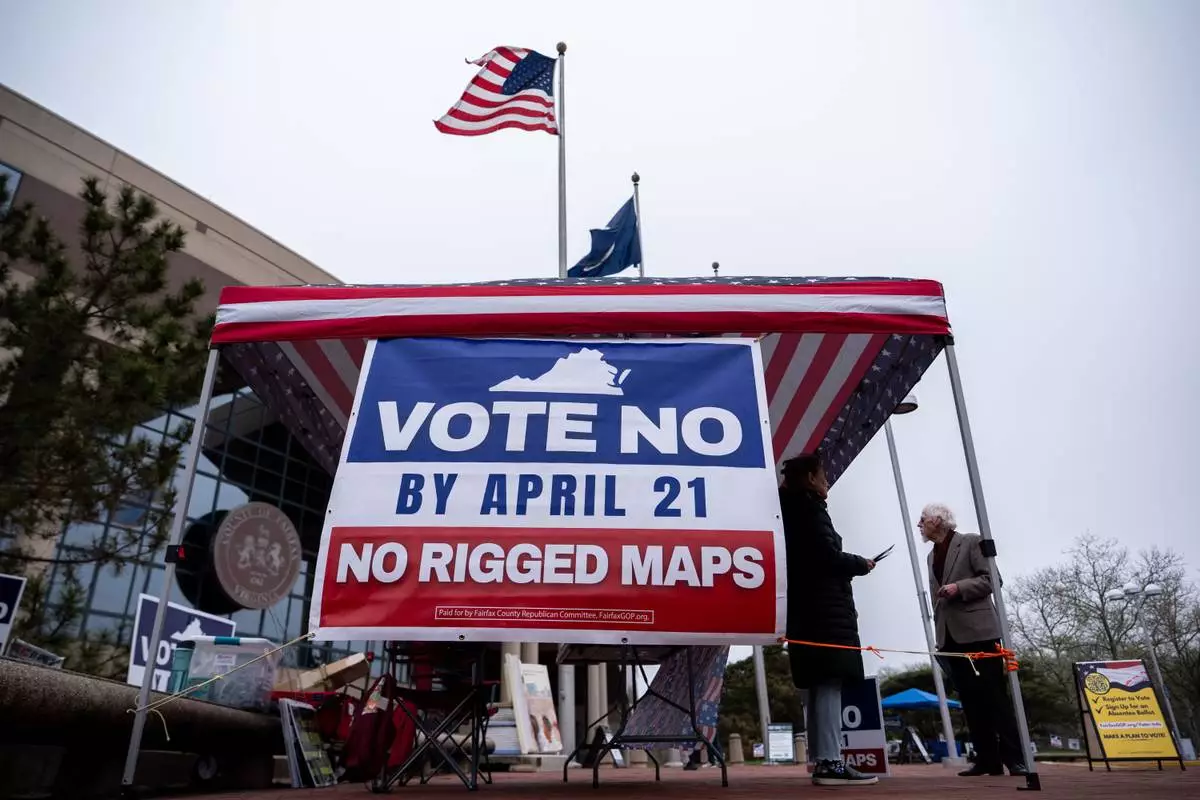
Fairfax County Republican Committee members Harry Lowcock and Esmat Mostafaeithe wait to talk voters outside the Fairfax County Government Center during early voting for the Virginia redistricting referendum Friday, April 3, 2026, in Fairfax, Va. (AP Photo/Julia Demaree Nikhinson)
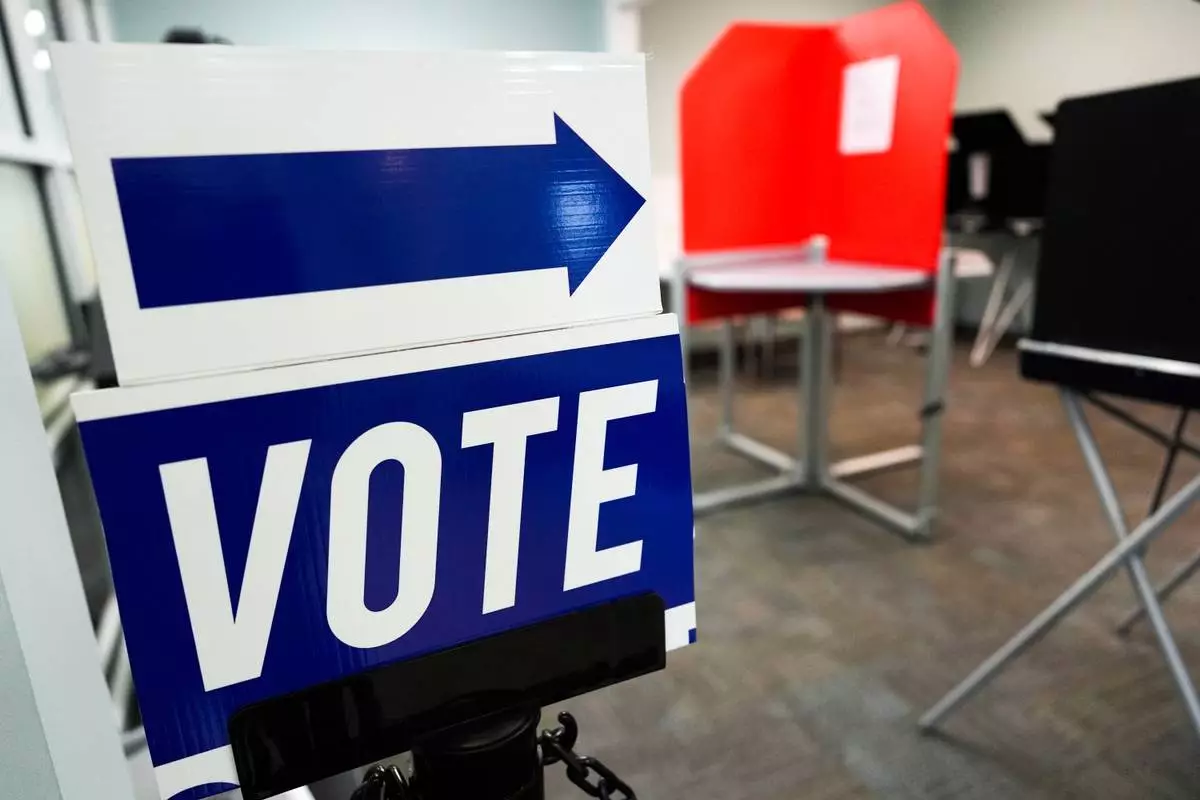
Voting booths are seen at the Culpeper County Voter Registration office during the early voting period for the Virginia redistricting referendum Friday, April 3, 2026, in Culpeper, Va. (AP Photo/Julia Demaree Nikhinson)