NEW YORK (AP) — Dave Mason — the co-founder of the psychedelic British band Traffic, songwriter behind classic rock hits “Feelin’ Alright” and “Hole in My Shoe," and Rock & Roll Hall of Famer — died Sunday at his home in Gardnerville, Nevada. He was 79.
His death was confirmed by Mason's publicist Melissa Dragich. A cause was not immediately revealed. He had canceled his remaining tour dates last summer and announced his retirement months later, citing health issues stemming from an infection for “closing the curtain on 60 remarkable years of rock n’ roll.”
Mason was born May 10, 1946, in Worcester, England, and founded Traffic in 1967 with singer/multi-instrumentalist Steve Winwood, drummer Jim Capaldi and keyboardist/saxophonist Chris Wood. The psychedelic band became celebrated for its pioneering and inventive spirit, along with Mason's songwriting and intricate guitar solos.
Mason wrote and performed many of Traffic's biggest singles. And even though “Feelin' Alright?” was not an immediate hit, it became one thereafter, covered by the likes of Joe Cocker, the Jackson 5, Gladys Knight, Paul Weller and Grand Funk Railroad.
Mason's relationship with the band was tenuous; he left and returned multiple times. In 1969, he launched a solo career that resulted in three albums certified gold by the Recording Industry Association of America (1970’s “Alone Together,” which produced his hit "Only You Know and I Know," 1974’s “Dave Mason” and 1978’s “Mariposa de Oro”) as well as one platinum title: 1977’s “Let It Flow.”
In addition, Mason played on a number of all-star sessions, The Rolling Stones’ “Beggars Banquet,” George Harrison’s “All Things Must Pass,” Paul McCartney and Wings’ “Venus and Mars" and Jimi Hendrix’s “Electric Ladyland” among them.
Mason was inducted into the Rock & Roll Hall of Fame in 2004 for his work with Traffic. His old bandmate shared a tribute to him Wednesday.
“Dave was part of Traffic during its earliest chapter, and played an important role in shaping the band’s sound and identity during that time," Winwood wrote on Instagram. "His songwriting, musicianship and distinctive spirit helped create music that has lasted far beyond its era, and continues to mean so much to listeners around the world.”
"Those years remain a special part of the band’s story, and Dave’s contribution to them is not forgotten. His place in that history will always be remembered, and through the music, his presence endures. At this sad time, our thoughts are with his family, his friends, and all those who loved him and his music,” Winwood wrote.
Survivors include his wife Winifred Wilson, daughter Danielle, nephew John Leonard, niece Michelle Leonard and his brothers in law, Sloan Wilson and Walton Wilson.

FILE - Dave Mason performs at City Winery in Chicago on Feb. 21, 2023. (Photo by Rob Grabowski/Invision/AP)

FILE - Dave Mason performs at City Winery in Chicago on Feb. 21, 2023. (Photo by Rob Grabowski/Invision/AP)
U.S. President Donald Trump said the United States was indefinitely extending its ceasefire with Iran as a new round of peace talks was on hold.
Pakistan had planned to host a second round of talks, but the White House suspended Vice President JD Vance’s planned trip to Islamabad as Iran rebuffed efforts to restart negotiations. Iran acknowledged the ceasefire extension but didn't say Tehran was ready to attend a new round of talks to end the war, state television reported Wednesday.
Meanwhile, Iran’s semiofficial news agencies are reporting that the paramilitary Revolutionary Guard has attacked a third ship Wednesday in the Strait of Hormuz, throwing into question efforts to end the war. Nour News, Fars and Mehr all reported the attack by the Guard on a vessel called the Euphoria. They said the vessel had become “stranded” on the Iranian coast, without elaborating. The Guard has seized the other two ships that were attacked, Iranian state television separately reported.
Here is the latest:
The management company of a container ship that was fired upon in the Strait of Hormuz early Wednesday says the Liberian-registered Epaminondas was “approached and fired upon by a manned gunboat” while transiting the strait about 20 nautical miles off the coast of Oman.
The Technomar company said all crew were “safe and accounted for” and no injuries were reported, but that preliminary inspections indicated the ship’s bridge had been damaged.
“Technomar remains in close contact with the crew and relevant authorities. Our priority remains the safety and well-being of our crew as we work with all relevant stakeholders to ensure their continued safety and investigate the incident,” the company said. It did not provide further details, but said more information would be released “when there are material developments.”
Sadri Haghshenas spends her days selling borek — a layered, savory pastry — at a shop in Istanbul, but her mind is on her daughter in Tehran.
The family had to send her home to Iran after they ran into difficulties renewing her visa, despite fears that a shaky ceasefire could soon collapse.
For years, short-term residency permits have allowed tens of thousands of Iranians to pursue economic opportunities and enjoy relative stability in neighboring Turkey. But it’s a precarious situation, and the war has raised the stakes.
“I swear, I cry every day,” Haghshenas said, raising her hands from behind the counter of the pastry shop. “There is no life in my country, there is no life here, what shall I do?”
Turkey hasn't seen an influx of refugees, as most Iranians have sought safety within their country. Many who've crossed the land border were transiting to other countries where they have citizenship or residency.
▶ Read more
The strike targeted a vehicle in the town of Tayri on Wednesday, according to Lebanon’s state-run National News Agency.
No further details on the identities of the victims were immediately available.
The Israeli military did not immediately comment on the attack.
The strike comes despite a 10-day ceasefire that went into effect Friday. Since then, several Israeli strikes have been reported, while Hezbollah has claimed a couple of attacks since Tuesday.
On Saturday, a U.N. peacekeeping force in southern Lebanon came under attack with small arms fire leaving one French peacekeeper dead and three others wounded, two of them seriously.
French President Emmanuel Macron posted on X that a wounded soldier, who was repatriated Tuesday from Lebanon “where he had been seriously wounded by Hezbollah fighters, died this morning from his injuries.”
Hezbollah had denied is was behind the attack.
“We entered the negotiations in good faith and with seriousness, but the negotiating party (the United States) has shown disregard and lack of good faith,” Iran’s foreign ministry spokesperson, Esmaeil Baqaei, said Wednesday, according to Iran’s State TV.
A second round of negotiations, expected in Pakistan’s capital later this week, has not yet been confirmed. On Tuesday, President Trump extended a ceasefire with Iran indefinitely, leaving the next steps for resuming talks unclear.
“Iran has not yet decided whether it will participate in the new round of peace negotiations with the United States scheduled for later this week,” Baqaei said.
GE Vernova, Boston Scientific and Boeing are leading the U.S. stock market toward another record after joining the list of companies reporting fatter profits for the start of the year than analysts expected.
But caution is still hanging over Wall Street on Wednesday, and oil prices are also rising on uncertainty about what will happen in the war with Iran.
The S&P 500 climbed 0.7% and was on track to top its all-time high set Friday. The Dow Jones Industrial Average added 360 points and the Nasdaq composite gained 0.9%. The price for a barrel of Brent crude oil briefly topped $100.
▶ Read more
Talking about the repercussions of the Iran war, the head of the International Energy Agency said Wednesday that “we are facing the biggest energy crisis in the history.”
IEA Executive Director Fatih Birol said at the Petersberg Climate Dialogue in Berlin that what ”we lost in the this war is much bigger than all the crises put together in terms of oil and gas. Plus, plus, there are vital commodities that we are losing — petrochemicals, fertilizers, helium, sulfur.”
However, Birol also pointed out that “there will be a major response to this crisis as well” and that “it is now the job of the governments to design their energy policies in terms of industrial sector, while keeping the competitiveness of the existing industries, preparing the next steps for the tomorrow’s industries.”
He said he also expects that “there will be a similar response in all parts of the economy, car manufacturing industry, electric industry and in the industry sector.”
“And this is a wonderful opportunity,” he added.
The Israeli military said it intercepted around 40 Israeli civilians that attempted to enter Syria on Wednesday afternoon. The military said the civilians gathered at the border and then were able to infiltrate several hundred meters into the Israeli-military controlled buffer zone in Syria before being returned to Israel and taken into police custody.
The Israeli media identified the infiltrators as part of the right-wing group “Pioneers of Bashan,” which calls for establishing Jewish settlements in Lebanon and Syria.
The group added in a statement that its attack on the post in the southern village of Bayada on Wednesday came in retaliation for Israeli violations of the 10-day ceasefire that went into effect Friday.
The Israeli military said Hezbollah is violating the ceasefire adding that the Iran-backed group launched “a hostile aircraft” toward Israeli soldiers operating in the area of southern Lebanon.
The military said the aircraft was intercepted by Israel’s air force and did not cross into Israel.
It might be hard to imagine the Iran war weighing on stuffed toys with names like Snuggle Glove, Bizzikins and Wobblies, but even plush playthings aren’t immune when oil shipments from the Middle East are constrained.
Like many soft toys, the creatures developed by a manufacturer in Fort Lauderdale, Florida, are made with polyester and acrylic, synthetic fibers derived from petroleum. Three weeks after the war started, suppliers in China notified Aleni Brands that getting the materials already was costing them 10% to 15% more, CEO Ricardo Venegas said.
“I think this situation demonstrates how much oil permeates throughout our system, and we can’t get away from it,” said Venegas, who founded Aleni Brands last year and is in the process of adding product lines. “Who would have thought that the price of a toy would have a direct relationship with oil?”
It’s not just toys. Petrochemicals derived from oil and natural gas go into making more than 6,000 consumer products, according to the U.S. Department of Energy.
▶ Read more
President Joseph Aoun’s comments on Wednesday came a day before a second meeting is scheduled to take place in Washington between the Lebanese and Israeli ambassadors.
Aoun said in comments released by his office that preparations are ongoing for negotiations between Lebanon and Israel.
He said the aim of the future talks is to “fully” stop Israeli attacks, withdrawal of Israeli troops from Lebanon, release of Lebanese prisoners in Israel, deployment of Lebanese troops along the border and beginning the reconstruction process.
Aoun said the support to Lebanon that was promised by U.S. President Donald Trump and other countries “provided us with an opportunity that we must not miss, as it may not come again.”
The latest Israel-Hezbollah war was halted by a 10-day ceasefire that went into effect Friday.
A semiofficial news agency close to Iran’s paramilitary Revolutionary Guard again raised the idea Wednesday that Gulf Arab states remained vulnerable to having their undersea data cables being cut in the Strait of Hormuz.
The report by the Tasnim news agency suggested that “simultaneous damage to several major cables — whether through accidents or deliberate action — could trigger severe outages across the Persian Gulf.”
Multiple cables run through the strait. Already, the region has faced outages after undersea cables were cut multiple times in the Red Sea. Yemen’s Iranian-backed Houthi rebels had threatened cables in the past.
With uncertainty over whether the ceasefire lasts, residents of Tehran say they are anxious about what comes next.
“Last night my family all stayed awake, waiting for the clock to show 3:30 a.m. and see who really has the upper hand,” said Reza Tehrani, a 34-year-old resident of Tehran.
Tehrani said Trump is making a series of false claims, including that Iran will give up its enriched uranium. “It’s obvious that he will eventually take his warships back and nothing will happen. We will win, rest assured,” he said.
One resident voiced frustration with the uncertainty.
“We should know where we stand. Is it going to be a ceasefire, peace or the war is going to continue?” said Tehran resident Mashallah Mohammad Sadegh, 59. “The way things currently are, one doesn’t know what to do.”
The European Union’s top energy official is warning that the massive energy crisis sparked by the U.S.-Israeli war on Iran is set to hit prices for months, even years, to come.
EU Energy Commissioner Dan Jørgensen said Wednesday that “this is not a short-term, small increase in prices. This is a crisis that is probably as serious as the 1973 and the 2022 crises combined.”
Jørgensen says the war is costing Europe around 500 million euros ($600 million) each day and that “we are looking into some very difficult months, or maybe even years” ahead. “Even in a best-case scenario, it’s still bad,” he told reporters.
Iran’s Foreign Ministry spokesperson Esmail Baghaei acknowledged the ceasefire extension in comments reported Wednesday by Iranian state television.
Baghaei did not specifically say Tehran was ready to attend a new round of talks with the United States in Islamabad.
“Diplomacy is a tool for securing national interests and security, and whenever we reach the conclusion that the necessary and reasonable conditions exist to use this tool to achieve national interests and to consolidate the achievements of the Iranian nation in thwarting the enemies’ malicious objectives, we will take action,” he reportedly said.
The Oslo-based Iran Human Rights said an emergency doctor, Golnar Naraqi, and an Iranian citizen of the Bahai faith, Venus Hossein Nejad, have been out on bail since late March.
The two women were arrested separately during the January anti-government protests. The protests across Iran were met with a bloody crackdown that left thousands killed and arrested.
In a social media post Tuesday, U.S. President Donald Trump reposted a photo of six women and two teen girls that a conservative activist said are facing prosecution by the Iranian government.
Iran’s judiciary swiftly responded, saying some of the women have already been released without naming them. It said none of them face the death sentence. Internet restrictions have limited the flow of information out of Iran.
Rights groups say at least two of the other women still in detention are facing charges that carry the death sentence. There have been multiple executions during the war against alleged spies and protesters, mostly accused of links to Israel.
Iran’s paramilitary Revolutionary Guard has attacked a third ship Wednesday in the Strait of Hormuz, semiofficial Iranian news agencies reported.
Nour News, Fars and Mehr all reported the attack by the Guard on a vessel called the Euphoria. They said the vessel had become “stranded” on the Iranian coast, without elaborating.
The Guard has seized the other two ships that were attacked, Iranian state television separately reported.
Two ships earlier attacked Wednesday by Iran’s paramilitary Revolutionary Guard now are in the force’s custody and are being taken to Iran, Iranian state television reported.
It identified the vessels as the MSC Francesca and the Epaminondas. The ship’s owners could not be immediately reached for comment.
The seizures represent an Iranian escalation after the U.S. earlier seized two Iranian vessels as ceasefire talks were due to take place in Islamabad.
The Guard said in a statement the ships “allegedly operated without authorization, repeatedly violated regulations, manipulated navigational aid systems and sought to covertly exit the Strait of Hormuz, endangering maritime security.”
The strait had been considered an international waterway open to all before the war, even though it sits in Iranian and Omani territorial waters.
Israeli Foreign Minister Gideon Saar called on Lebanon to work with Israel to disarm the Iranian-backed militant group Hezbollah ahead of negotiations in Washington on Thursday.
The meeting follows a similar gathering last week in Washington, and is the first time in decades the two countries are speaking directly.
“We don’t have any serious disagreements with Lebanon. There are a few minor border disputes that can be solved,” Saar said during Independence Day remarks to Israel’s diplomatic corps.
“The obstacle to peace and normalization between the countries is one: Hezbollah,” he said, adding that Lebanon could have “a future of sovereignty, independence and freedom from the Iranian occupation.”
Israel’s military has currently established a buffer zone stretching around 10 kilometers (6 miles) into southern Lebanon to remove the threat of short-range rockets and anti-tank missiles toward northern Israel.
An independent Islamabad-based analyst, Syed Mohammad Ali, says U.S. President Donald Trump has apparently concluded that a blockade of Iranian ports is a more effective way to pressure Iran’s already fragile economy than the continued use of force.
“As far as Trump’s war strategy is concerned, this blockade appears to be less expensive and more effective,” he said Wednesday.
Ali said prospects for a second round of talks between the United States and Iran have not faded, as Pakistan, with support from regional countries, continues efforts to prevent the collapse of negotiations.
He said securing an extension of the ceasefire for an indefinite period from Trump is an achievement for Pakistan.
China said after the announcement of an extension of the ceasefire that it is “imperative” to keep the conflict from reigniting.
Chinese Foreign Ministry spokesperson Guo Jiakun said Wednesday that the current situation in the Middle East is at “a critical stage.” He said China “is ready” to work with the international community to maintain peace, following four principles President Xi Jinping proposed a few days earlier, including peaceful coexistence and adherence to international law.
“It’s imperative to prevent the recurrence of the conflict with utmost efforts,” he said.
The United States must end its blockade on Iran as a prerequisite for any further ceasefire talks in Islamabad, an Iranian diplomat said Wednesday.
Mojtaba Ferdousi Pour, the head of the Iranian mission in Egypt, told The Associated Press that communications with Pakistani mediators are underway “to implement Iran’s conditions.”
“We won’t negotiate under threat,” he said. “We won’t go to Islamabad before the lifting of the blockade.”
He accused the U.S. of using the ceasefire to build up more forces for a possible resumption of military action against the Islamic Republic.
“Behind the scenes, they say something, but in public, they say and do something else,” he said.
Pakistan’s top political and military leadership has worked to prevent talks from collapsing and to persuade the U.S. to extend the ceasefire over the past 24 hours, officials said Wednesday.
Two Pakistani officials told The Associated Press that authorities will keep security arrangements in place in Islamabad in case U.S. and Iranian delegations ultimately arrive.
Pakistan is also still waiting to hear from Tehran on when it will send a delegation for a second round, the officials said, speaking on condition of anonymity because they were not authorized to talk to the media.
In Islamabad, police and troops remained on alert along key roads, manning checkpoints.
Residents were forced to take longer routes as authorities restricted access to parts of the city.
“We have not received any instructions to remove these barricades,” said police officer Mohammad Aslam as he directed commuters to turn back and use alternative routes.
— By Munir Ahmed
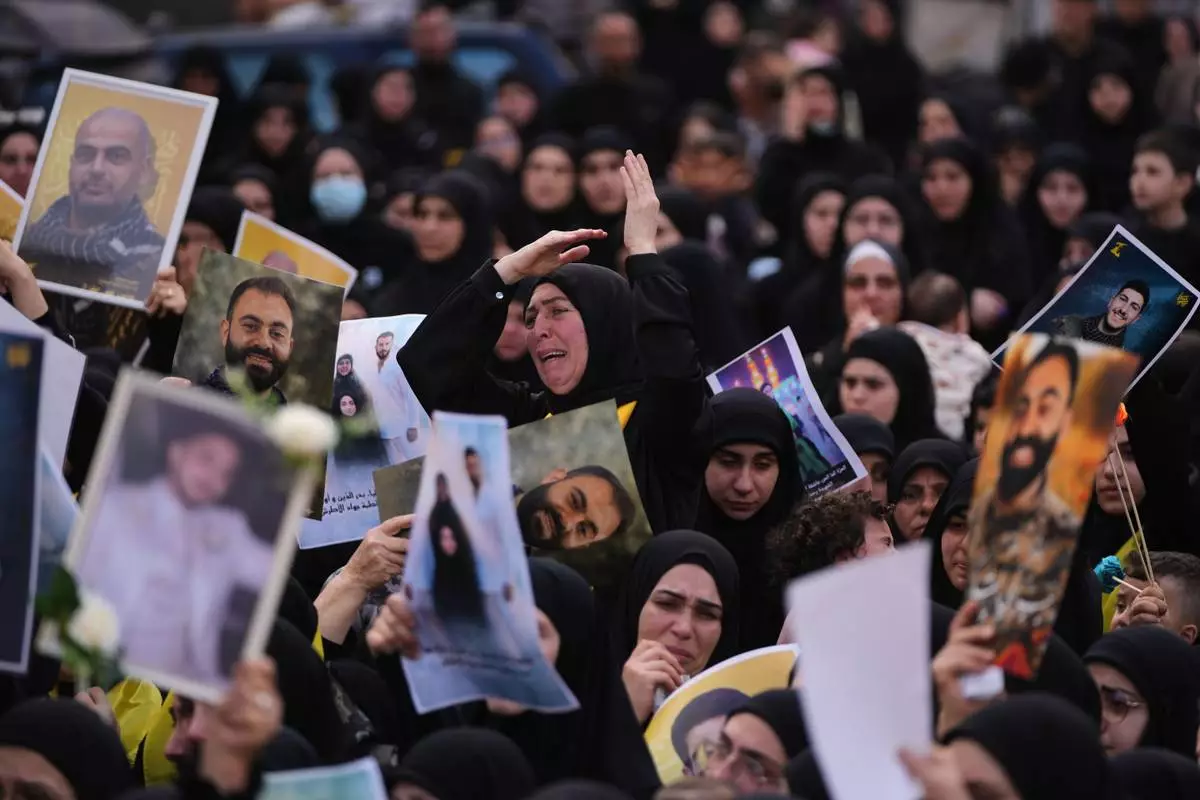
A woman mourns as other hold portraits of Hezbollah fighters, who were killed before the ceasefire in the war between Hezbollah and Israel, during a mass funeral procession in the southern village of Kfar Sir, Lebanon, Tuesday, April 21, 2026. (AP Photo/Hassan Ammar)
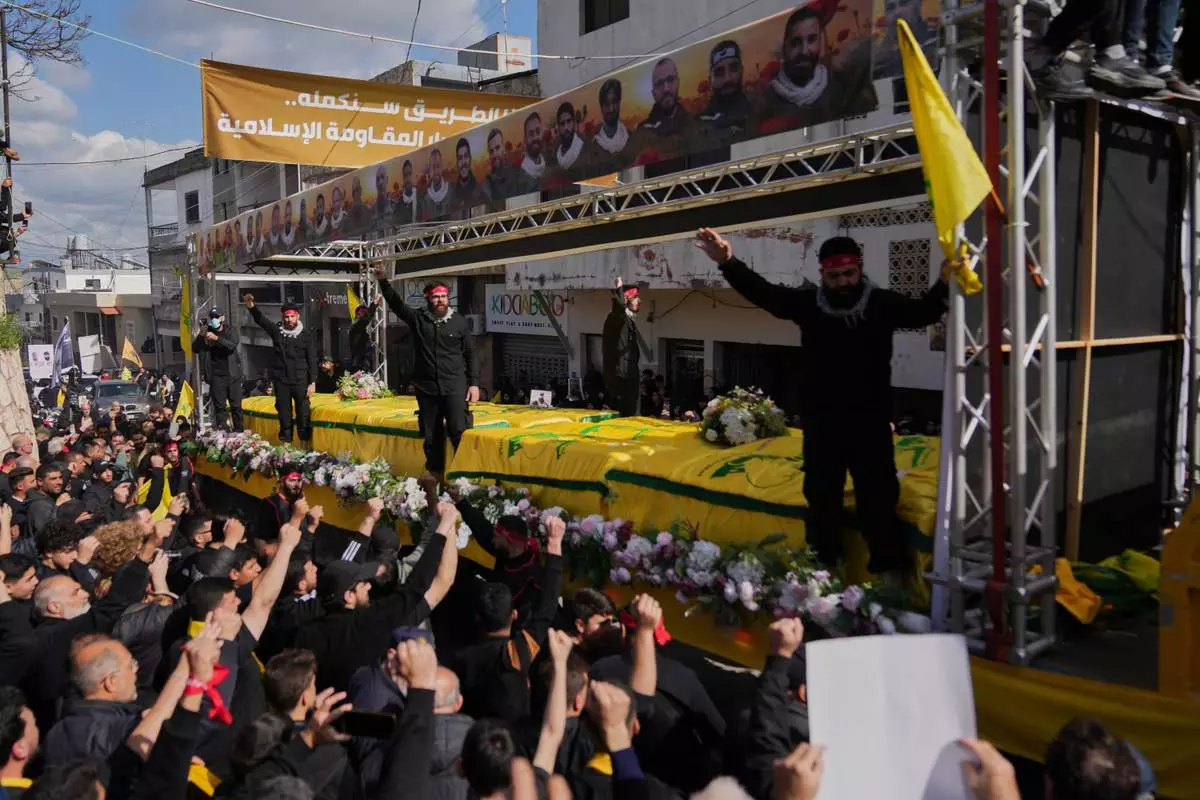
Coffins of Hezbollah fighters killed before the ceasefire in the war between Hezbollah and Israel are carried on a truck past mourners during a mass funeral procession in the southern village of Kfar Sir, Lebanon, Tuesday, April 21, 2026. (AP Photo/Hassan Ammar)
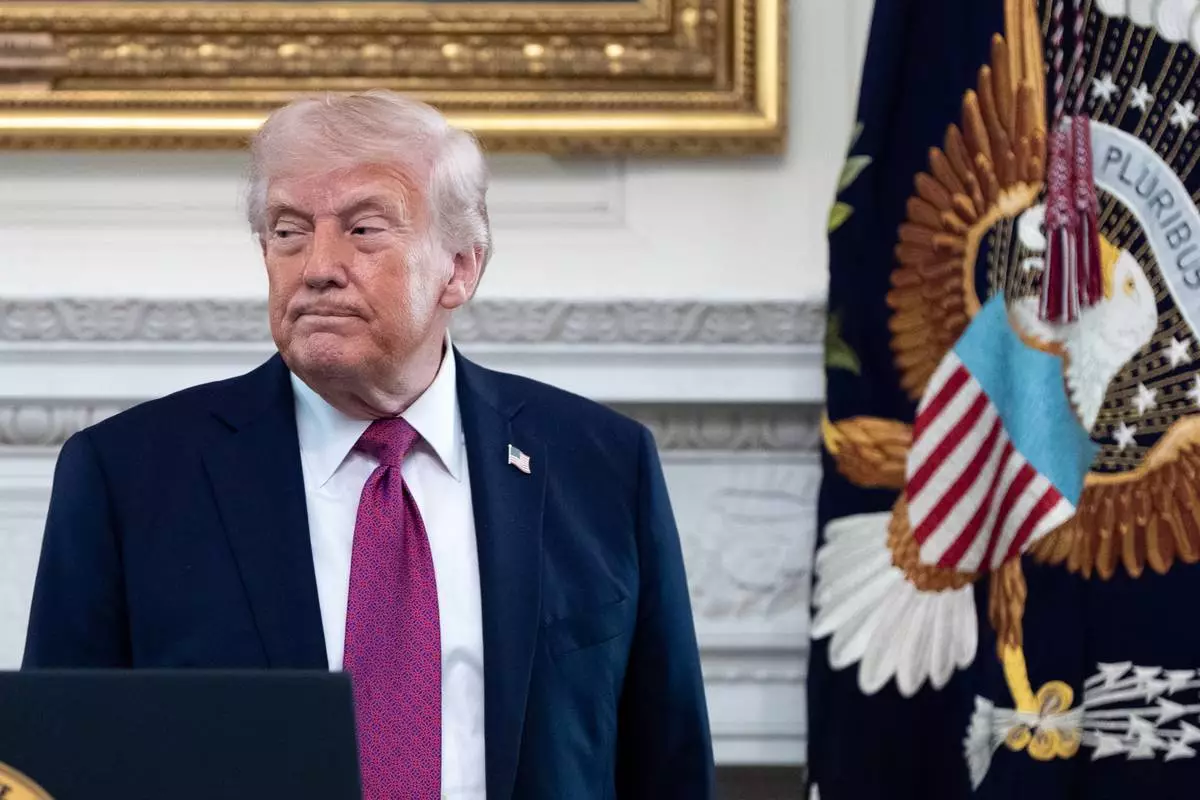
President Donald Trump departs after speaking at an event for NCAA national champions in the State Dining Room of the White House, Tuesday, April 21, 2026, in Washington. (AP Photo/Alex Brandon)
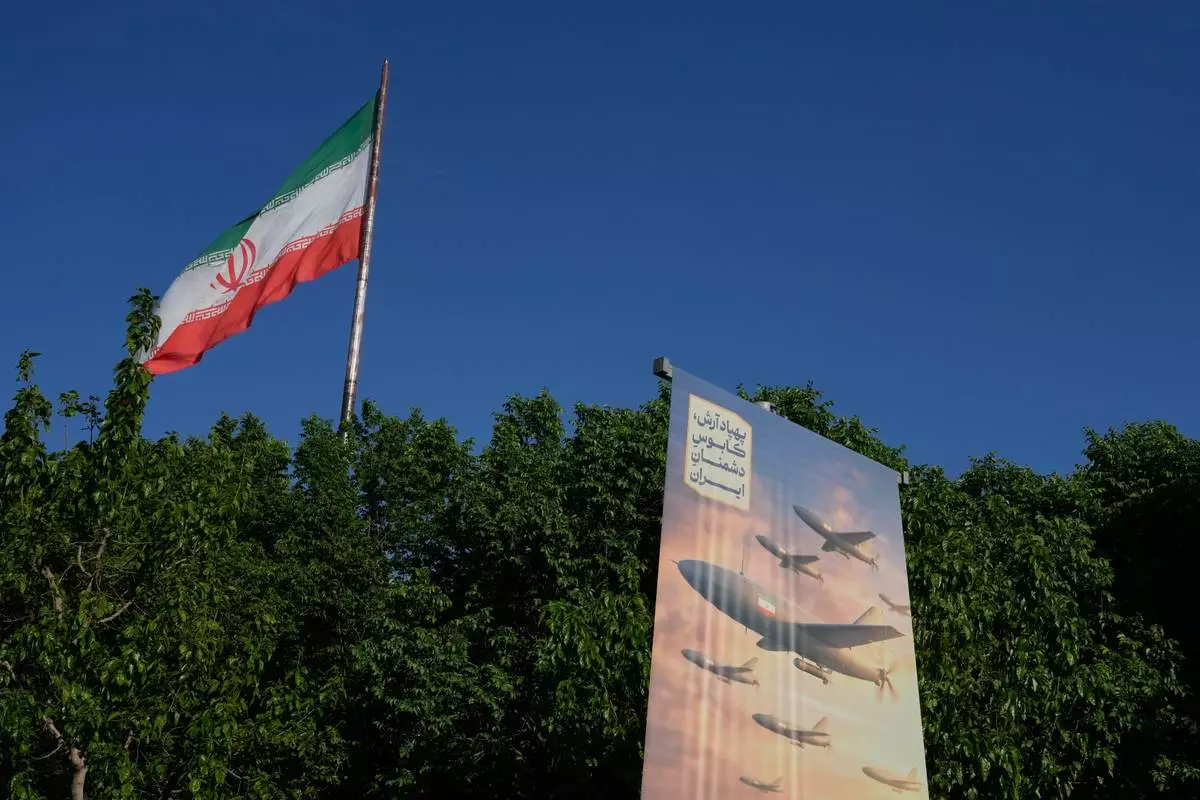
A banner shows a graphic depicting Iranian-built drones with a sign in Farsi that reads: "Arash drone is the nightmare for Iran's enemies," as an Iranian flag waves at left, in Tehran, Iran, Tuesday, April 21, 2026. (AP Photo/Vahid Salemi)
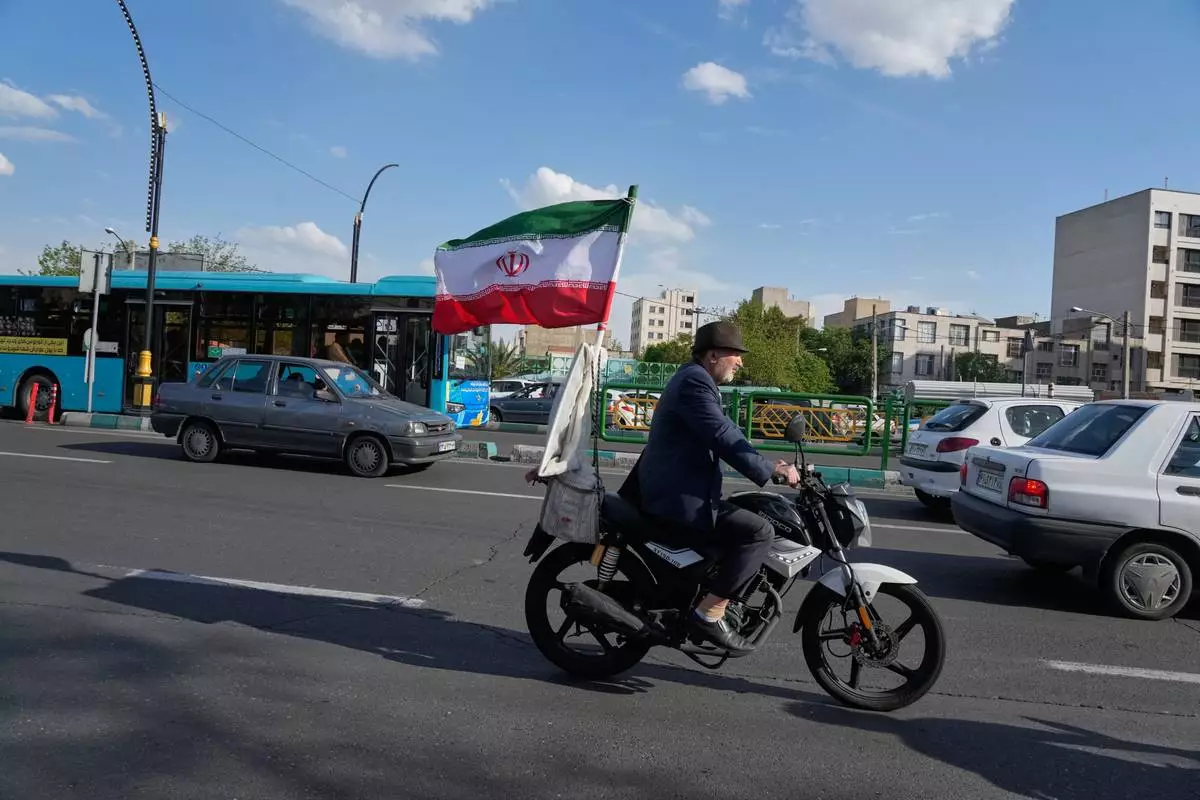
A man rides his motorbike that is adorned with an Iranian national flag, in southern Tehran, Iran, Tuesday, April 21, 2026. (AP Photo/Vahid Salemi)