LOS ALTOS, Calif.--(BUSINESS WIRE)--Apr 23, 2026--
Bidgely's premier energy intelligence conference, EmPOWER AI, will be held May 12-14 in New York City to unite utility leaders, energy researchers and technology experts around artificial intelligence (AI) in the energy sector. Hosted by OG&E with sessions led by Alabama Power, Eversource, NV Energy, PSEG Long Island, Xcel Energy and more, EmPOWER AI 2026 will highlight how utilities are moving beyond AI experimentation toward enterprise-wide scalability.
This press release features multimedia. View the full release here: https://www.businesswire.com/news/home/20260423237253/en/
Each year, Bidgely unveils the latest advancements in its AI and machine learning platform technology. EmPOWER AI 2026 will showcase new agentic AI capabilities purpose-built to turn every smart meter signal into a personalized customer conversation at scale.
"Hosting EmPOWER AI allows us to foster the high-level collaboration necessary to navigate a complex energy transition," said Kirby Brinlee, Director of Customer Experience at OG&E. "As we shift from the 'what-if' of technology to the 'how-to' of implementation, sharing operational success stories helps the entire industry move faster and with greater confidence."
Real World Results, At Scale
EmPOWER AI 2026 will feature a distinguished lineup of voices and sessions anchored in real-world deployment, examining what utilities have built, the trade-offs they navigated and the genuine requirements for scaling AI within a regulated environment.
"The utility sector is reaching a critical inflection point where data silos are no longer sustainable. Breaking down these barriers requires a deep commitment to cross-industry research and radical collaboration,” added Gaia Gallotti, Research Director, IDC. “When tech innovators and utility leaders build on a shared foundation of data, we move past incremental fixes and begin to engineer the truly resilient infrastructure the future demands.”
Speakers include:
Session topics include:
Implementing purpose-built, energy vertical AI into the daily operations of utilities is driving the outcomes necessary to advance a more resilient, affordable energy future while simultaneously addressing the needs of today—escalating costs, rising regulatory complexity, electrification planning and capital pressure.
“As grid pressures intensify and evolve, so has the technology designed to manage them,” said Abhay Gupta, CEO of Bidgely. “The systems and solutions we showcase have been built alongside utilities, with results from active deployments proving enterprise-wide AI is both secure and scalable. EmPOWER AI is where AI vision meets implementation reality.”
Registration for EmPOWER AI 2026 is now open. For more information, visit: www.bidgely.com/empower-ai/.
About Bidgely
Bidgely is the pioneer of AI-powered energy intelligence, transforming raw meter data into high-definition insights for global utilities. Serving over 50 million homes, the company’s UtilityAI™ Platform leverages 19 foundational patents to optimize grid visibility, call center operations, and personalized customer engagement. Recognized by Fast Company as a "Top 10 Most Innovative Applied AI" company, Bidgely integrates precision energy analytics with horizontal AI ecosystems like Microsoft Copilot and AWS to modernize the grid with premises-level accuracy. www.bidgely.com | bidgely.com/blog

This year's EmPOWER AI conference will demonstrate how utilities move from AI experimentation to enterprise-wide scalability with Bidgely's UtilityAI.
BEIRUT (AP) — Spread across a hillside of southern Lebanon, the tiny village of Beit Lif had been almost entirely flattened. Once home to a few thousand people, nearly every house had been reduced to piles of concrete by Israeli military demolitions.
“They were demolishing it gradually until they reached the main square and now, as you can see, there are no more houses,” said Hassan Sweidan, a resident of a neighboring village looking across at Beit Lif — about 4 kilometers (2.5 miles) north of Lebanon’s border with Israel — from a nearby hill.
Since agreeing last week to a ceasefire with Hezbollah, the Israeli army has been leveling neighborhoods in towns and villages near the Lebanese-Israeli border. The military says it destroys buildings that were used as outposts by the Iran-backed militant group.
But in many cases, like Beit Lif, the demolition is almost complete. The wide scale of destruction has Lebanese officials and residents increasingly worried that large numbers of people displaced by the latest war will have nowhere to return if the fragile truce holds.
Because of security concerns and limited access, neither U.N. peacekeepers nor Lebanese officials have been able to conduct a detailed survey of the villages where demolitions are taking place. But observers have described entire residential neighborhoods in multiple villages being systematically destroyed.
The demolitions mirror what has happened in the Gaza Strip, where Israeli bulldozers and controlled explosions have almost entirely razed the city of Rafah and other towns under Israeli control. There, Israel says it is removing structures used by Hamas.
Lebanese officials plan to raise the issue of widespread demolitions on Thursday when they hold ceasefire talks with their Israeli counterparts in Washington — part of the first direct negotiations between the two countries in decades.
On March 2, two days after the U.S. and Israel launched the war with Iran, Hezbollah entered the fray by firing missiles into northern Israel. The group had been under pressure by the Lebanese government to disarm following its previous war with Israel in 2024, but refused to do so.
Israel responded with an intense bombing campaign and ground invasion of Lebanon that prompted hundreds of thousands of people to flee the southern part of the country. The fighting has killed around 2,300 people in Lebanon, including hundreds of women and children.
The fighting was mostly halted by a 10-day ceasefire that began Friday. But both sides have carried out strikes since then. Hezbollah has justified its attacks in part by pointing to the Israeli military’s destruction of houses.
Israeli officials have said they intend to occupy parts of southern Lebanon, and the military has issued maps of a “forward defense line” that extends several miles into Lebanon and encompasses dozens of villages whose residents have not been allowed to return.
Following the announcement of the ceasefire, Israeli Defense Minister Israel Katz said this area had been "cleared of terrorists and weapons and is empty of citizens, and will continue to be cleared of terrorists' infrastructure, including the destruction of houses in Lebanese villages that border (Israel) and have become terrorists outposts in every sense.”
After the ceasefire went into effect, Sweidan returned to check on his home in the southern Lebanese village of Yater. It is still intact.
Because Sweidan's village overlooks neighboring Beit Lif, he has been able to observe Israeli army operations there. Despite damage from Israeli airstrikes during the war, most of Beit Lif was still standing on the first day of the ceasefire, he said.
But on the second day, Israeli forces arrived with bulldozers, jackhammers and tanks.
“We would come each day to see how much of the village was demolished," he said.
Tilak Pokharel, a spokesperson for the U.N. peacekeeping force in southern Lebanon known as UNIFIL, said that peacekeepers “have observed demolitions taking place in several areas” since the truce.
The Israeli military said in a statement that the target of the demolition work is Hezbollah, not Lebanon or its civilians, and that it "operates in accordance with international law and does not destroy civilian property unless required by imperative military necessity.”
There was already widespread destruction in border areas after the previous Israel-Hezbollah war in 2024. Some homeowners could afford repairs, but there was no large-scale reconstruction.
Demolition also took place during the most recent war. Photographs taken on April 12 by AP from the towns of Menara and Misgav Am in northern Israel show excavators and bulldozers destroying homes on the Lebanese side of the border.
Lebanon’s state-run National News Agency reported Wednesday that Israeli bulldozers were destroying neighborhoods, roads and infrastructure in the town of Khiam, a battleground in the Israel-Hezbollah fighting, “in a scene that suggests an attempt to completely erase the town’s identity.”
The news agency also reported “systematic bombing operations" Wednesday affecting residential neighborhoods in the city of Bint Jbeil — another flashpoint in the fighting — and in the villages of Beit Lif, Shamaa, Tair Harfa and Hanine.
Hezbollah said Tuesday it had launched drone and rocket attacks, the first since the ceasefire, in response to Israeli “attacks on civilians and the destruction of their homes and villages in southern Lebanon.”
As Lebanese officials scramble to keep the ceasefire in place, President Joseph Aoun said in a statement that “halting Israel’s demolition operations in southern villages and towns” is something Lebanese ambassadors in the United States will raise with their Israeli counterparts during ceasefire talks on Thursday.
The talks were expected to focus on a potential extension of the 10-day truce and establishing a framework for future talks aimed at a lasting a peace between the two countries.
This story has been updated to correct that UNIFIL is a U.N. peacekeeping force, not a U.S. peacekeeping force.
Associated Press journalists Malak Harb in Beirut and Melanie Lidman in Jerusalem contributed.
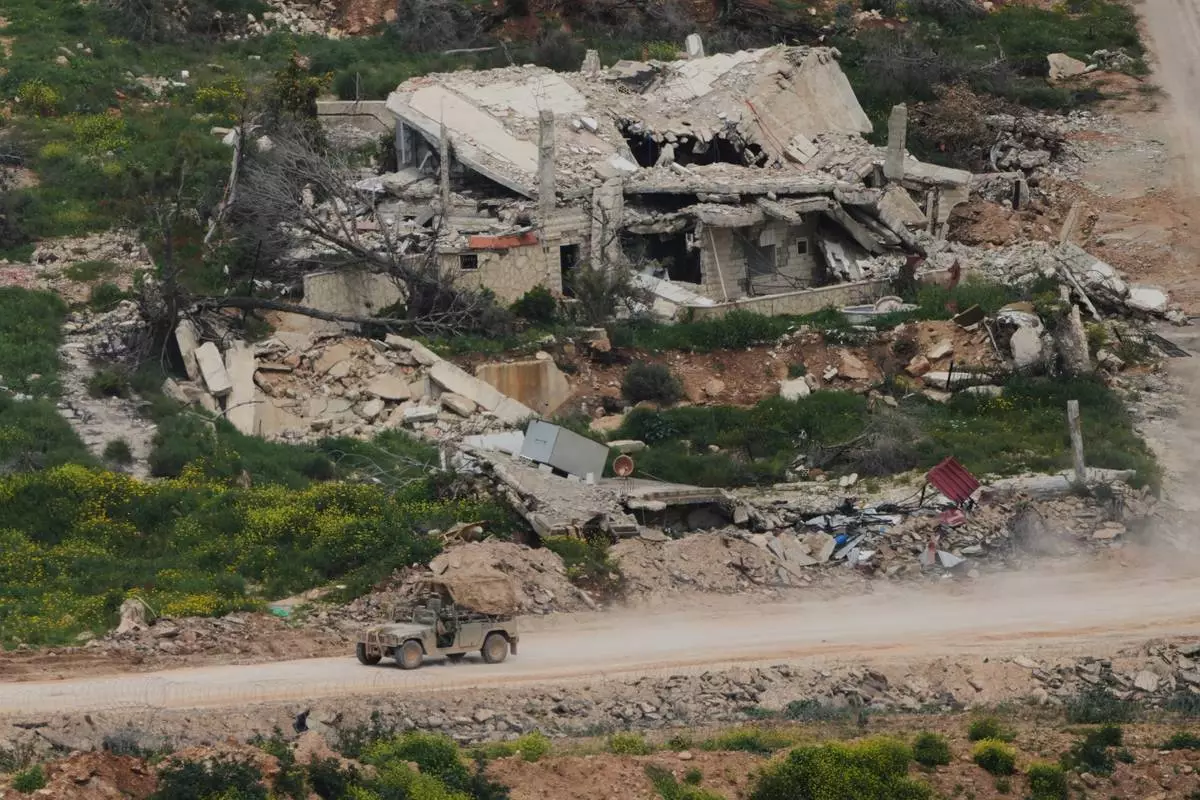
Israeli soldiers drive through southern Lebanon, as seen from northern Israel, Wednesday, April 15, 2026. (AP Photo/Ariel Schalit)
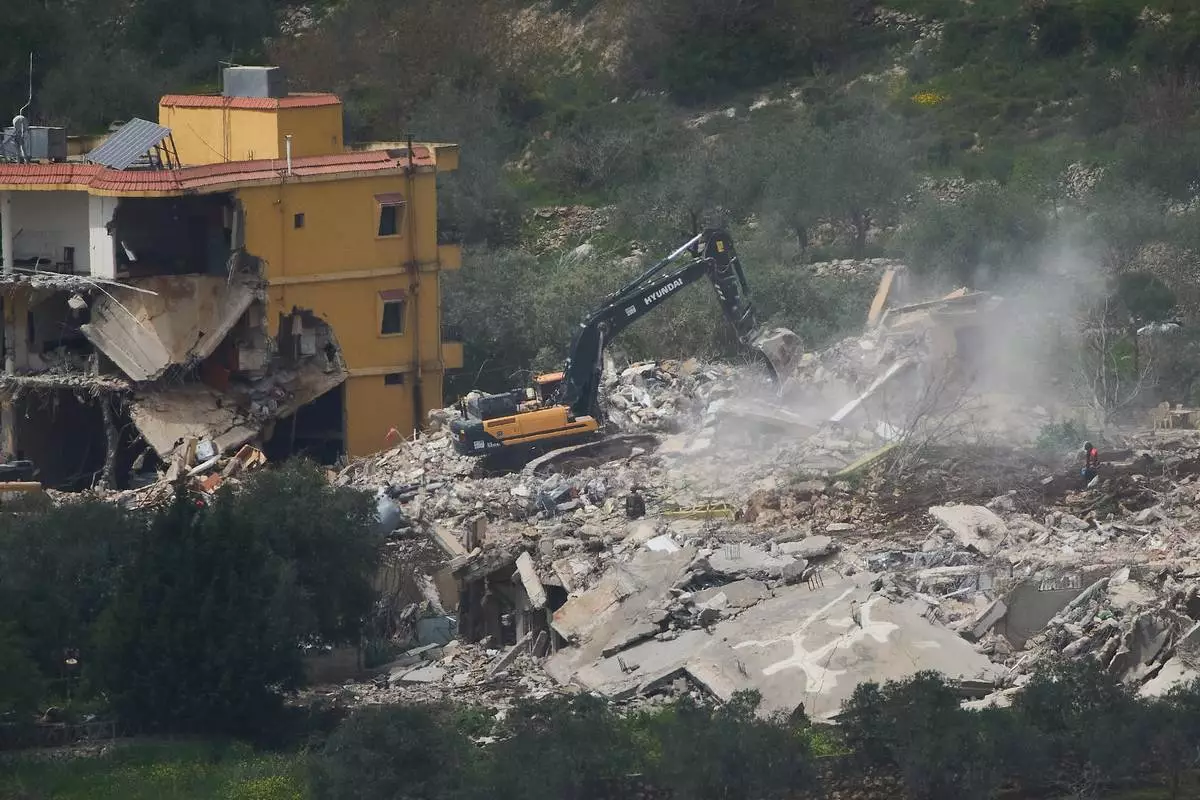
Israeli bulldozers demolish homes in southern Lebanon, as seen from northern Israel, Sunday, April 12, 2026. (AP Photo/Ariel Schalit)
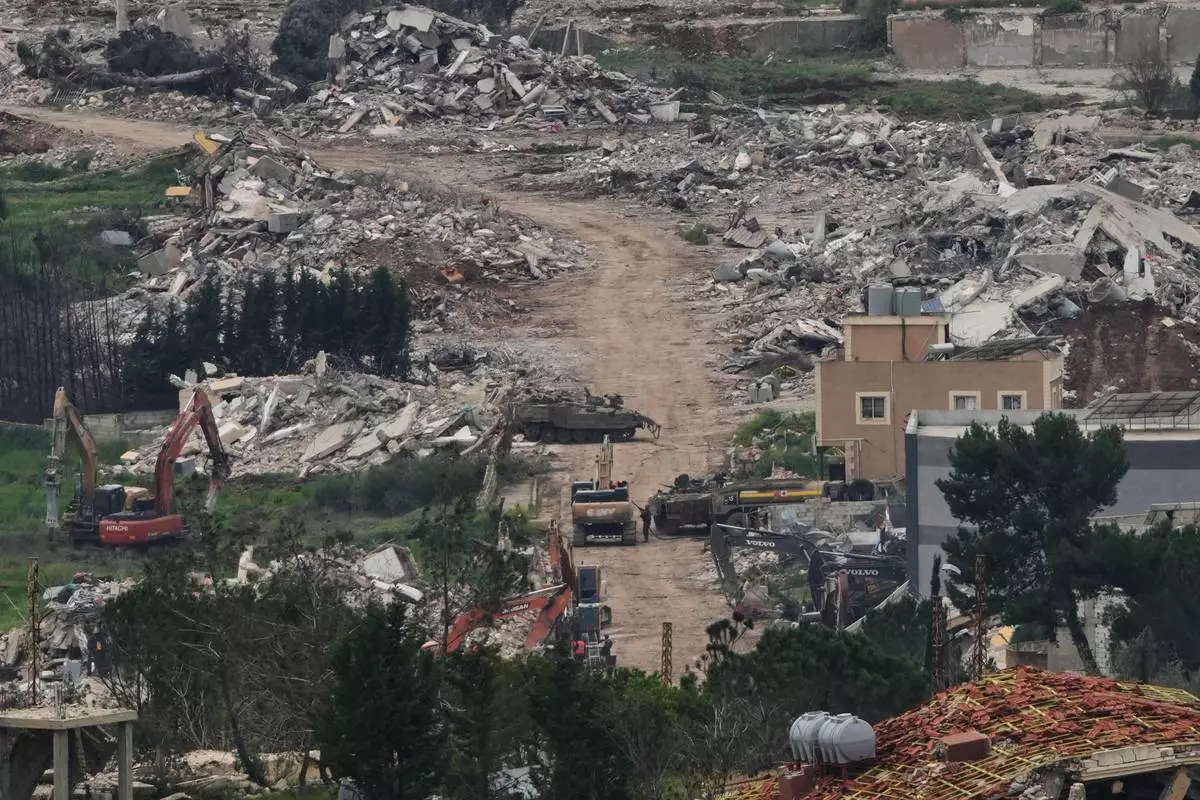
Israeli army vehicles and bulldozers operate in southern Lebanon, as seen from northern Israel, Wednesday, April 15, 2026. (AP Photo/Ariel Schalit)
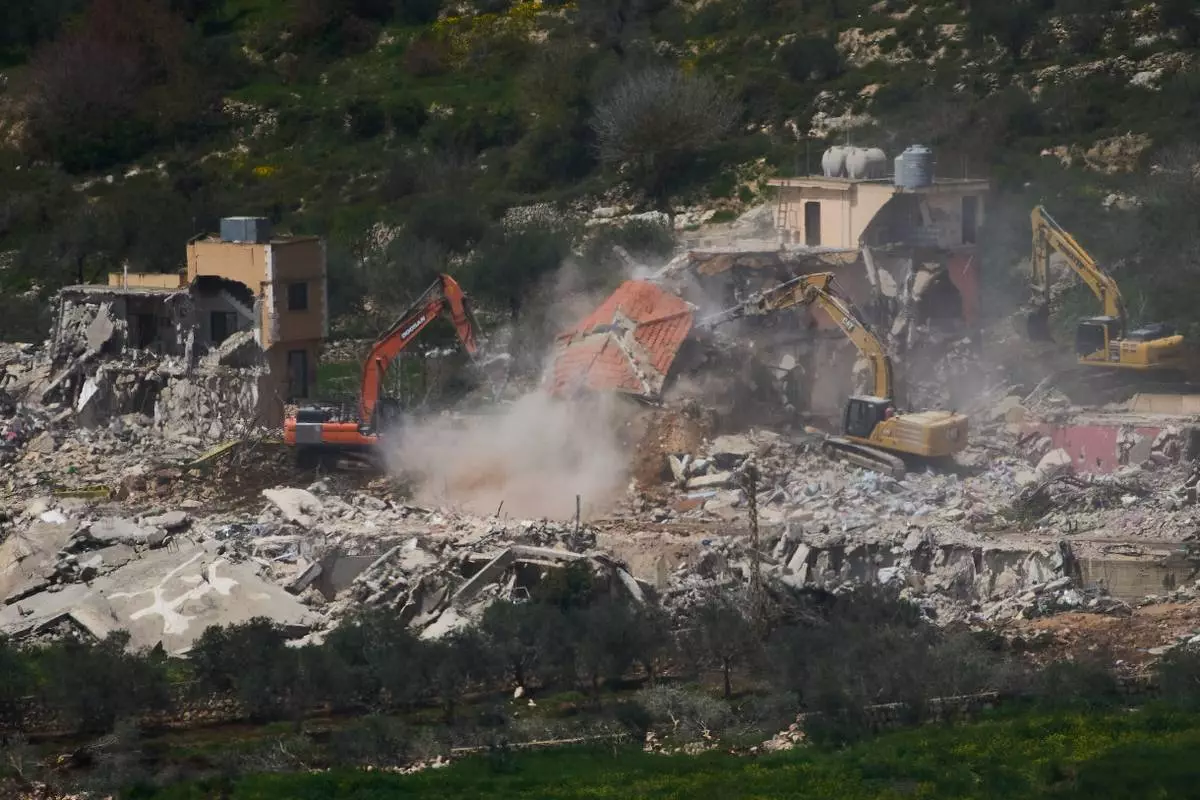
Israeli bulldozers demolish homes in southern Lebanon, as seen from northern Israel, Sunday, April 12, 2026. (AP Photo/Ariel Schalit)
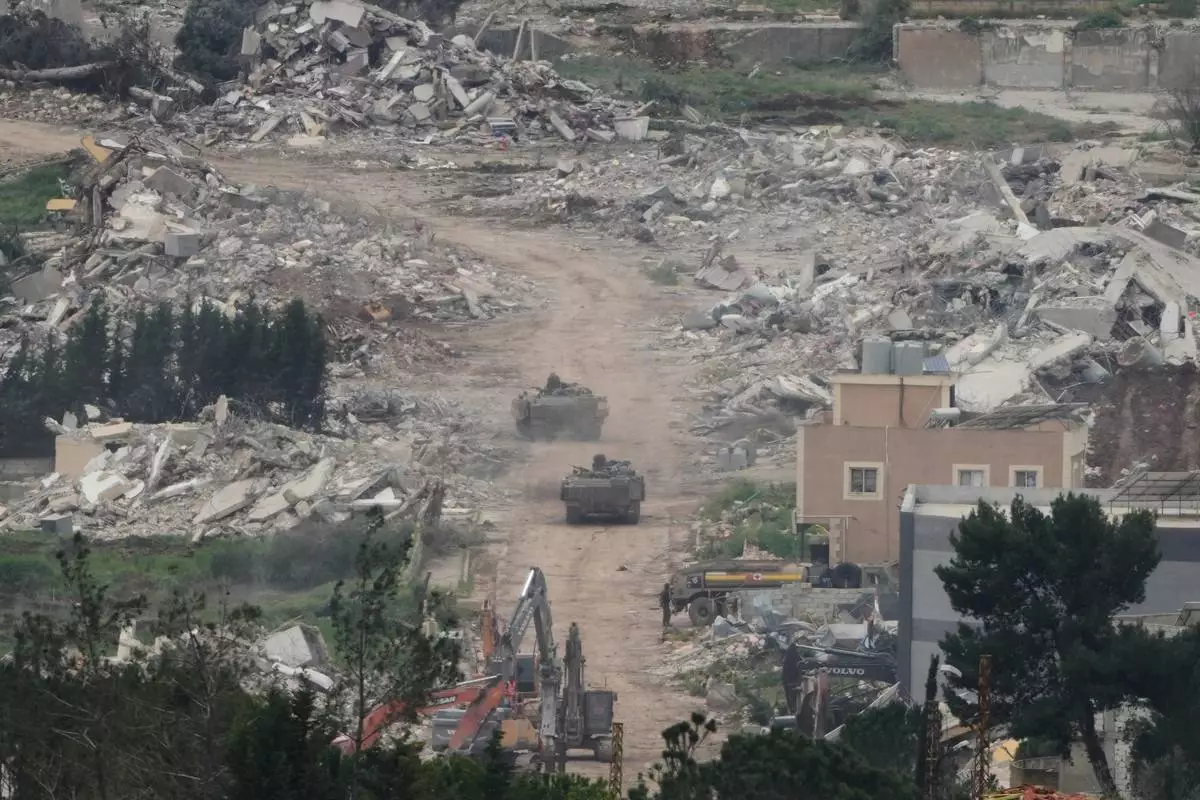
Israeli army vehicles and bulldozers operate in southern Lebanon, as seen from northern Israel, Wednesday, April 15, 2026. (AP Photo/Ariel Schalit)