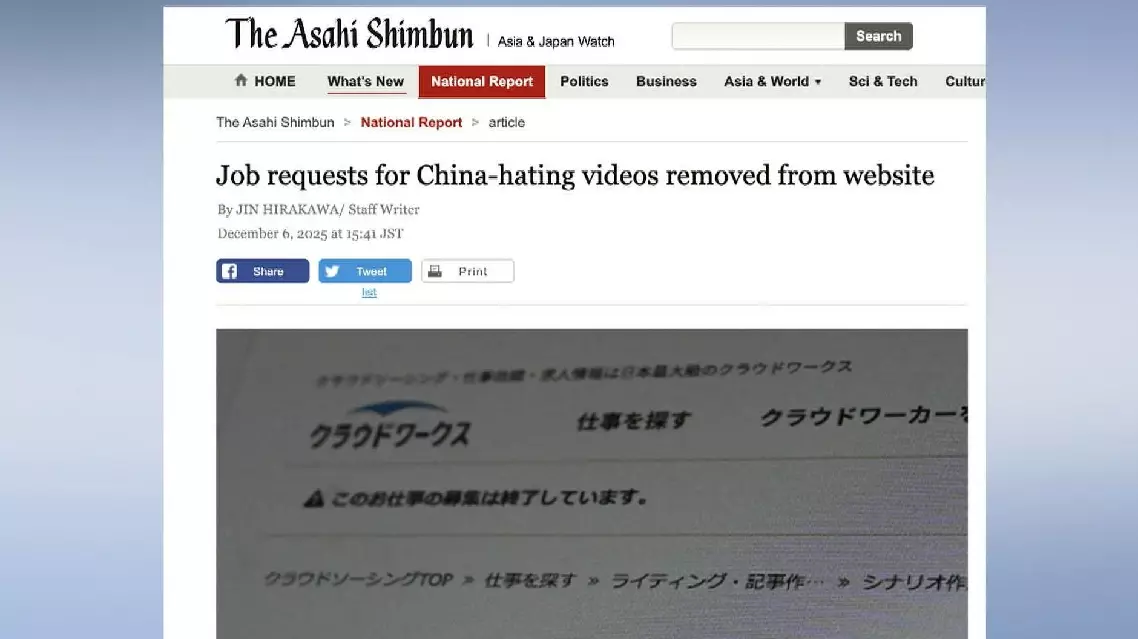
Some Japanese creators are using artificial intelligence (AI) to mass-produce anti-China videos as a lucrative way to profit, according to Japanese media outlet Asahi Shimbun.
Inflammatory video clips that maliciously vilify Chinese people, such as "Chinese people vandalizing cherry blossoms" and "Chinese students expelled for snatching an elderly person's cane," are spreading across Japanese video platforms.
According to the report, Japanese video creators take orders via freelance platforms to produce fictional scripts depicting so-called "disruptive behaviors" of the Chinese people that end in self-inflicted consequences, with detailed operational guidelines provided.
By entering simple prompts into AI tools, users can generate highly provocative, defamatory videos within minutes. Many clips lack clear labels distinguishing real events from fictional plots, and some reach hundreds of thousands of views. Meanwhile, embedded advertising allows creators to earn revenue based on view counts.
Job recruitment notices for such work explicitly require applicants to be pro-Japanese and anti-China.
One elderly Japanese man in his 60s, a former government official, now makes a living producing anti-China videos. He told the Asahi Shimbun that the price of an anti-China video is as high as about 1,000 yen, adding that such clips also boast higher completion rates, bringing "steady monthly earnings of up to 600,000 yen."
Admitting that he has never visited China or interacted with Chinese citizens, the man said he simply "dislikes the Chinese people," which fuels his content creation.
A young office worker in his 20s runs this work as a side hustle. He said that he originally focused on videos praising Japan, but saw a sharp rise in orders for China-critical content starting last autumn.
The shift coincided with strained China-Japan ties following Japanese Prime Minister Sanae Takaichi's remarks on China's Taiwan region. According to reports, the freelance platform has since hidden related recruitment postings from public view.
Shinichi Yamaguchi, a professor at the International University of Japan, said the trend stems from structural flaws in the "attention economy," which means content that stokes negative emotions attracts far more views and generates more advertising revenue.
Feelings such as anger and resentment easily capture public attention, and hatred targeting specific nations or groups proves especially engaging for online audiences, he said.
Lyu Chao, director of the Institute of American and East Asian Studies at Liaoning University, emphasized in an interview with Global Times that the industrial chain of AI-generated anti-China videos is not an isolated online chaos but a product of the interplay between Japan's political environment and social sentiment.
Lyu said Takaichi's erroneous remarks on China's Taiwan region have not only worsened Sino-Japanese ties but also set a bad example of so-called "political correctness," adding that this bears a disturbing historical resemblance to the manipulation of public opinion in Japanese society before World War II.
He warned that AI has lowered the threshold for manufacturing hatred while magnifying its harm. Mass-produced fake videos can make technology become an accelerator of systemic stigmatization, often disguised as news or true stories to deliberately manipulate public perception, he said.
Left unchecked, this harmful trend will poison the foundation of Japanese society's understanding of China, hinder bilateral relations, and severely damage Japan's international reputation in the long run, Lyu said.
AI-generated anti-China videos form profit chain in Japan