Iran’s top diplomat is expected to travel to Pakistan by this weekend for talks, two Pakistani officials told The Associated Press on Friday, raising hopes for revived negotiations in the Iran-U.S. war.
The officials did not provide further details and spoke on condition of anonymity because they were not authorized to speak to the media. Iran did not immediately acknowledge Araghchi’s trip.
Also, U.S. President Donald Trump says Israel and Lebanon have agreed to extend a ceasefire between Israel and Hezbollah by three weeks after talks at the White House on Thursday. The meeting was the second high-level negotiation between the two countries since last week. The initial 10-day ceasefire, which took effect last Friday, had been due to expire Monday.
Here is the latest:
The crews of all three merchant vessels seized by the U.S. military over the past week are still in U.S. custody, Gen. Dan Caine said at a briefing Friday.
“We will continue to conduct similar maritime interdiction actions and activities in the Pacific and Indian Oceans against Iranian ships and vessels of the Dark Fleet,” Caine said.
Caine also said the crew of the Tousca, the first merchant ship seized by U.S. forces Sunday, “repeatedly ignored U.S. warnings” over a six-hour period. Caine said this behavior prompted the crew of the Navy destroyer following the ship to fire five warning shots.
“The vessel and her crew continued to ignore warnings and, after exhausting all other measures, CENTCOM authorized disabling fire against the Tousca,” Caine said. Then, according to Caine, the destroyer disabled the ship’s engine by firing nine inert rounds from the destroyer’s 5-inch guns “precisely into the engine room and engine space on board the Tousca.”
“Not surprisingly, the vessel then reported issues with their engine, went dead in the water and began to comply with U.S. directions,” Caine added.
The U.S. secretary of defense suggested traditional U.S. allies in Europe are “freeriding” and being disloyal by not using their own forces to open the Strait of Hormuz that’s been closed because of President Trump’s Iran war.
“We are not counting on Europe, but they need the Strait of Hormuz much more than we do,” Hegseth insisted. He mocked a recent European confab, saying U.S. allies “might want to start doing less talking” instead of holding “a fancy conference” and “a silly conference.”
Iran’s maneuver to choke off the strait has disrupted global energy supplies — especially in Europe, where many leaders remain frustrated. French President Emmanuel Macron said at one point that the U.S. can’t complain about a lack of support “in an operation they chose to undertake alone.”
Hegseth’s broadsides echo Trump’s swipes that other nations should “Go get your own oil!” and “start learning how to fight for yourself.”
IRNA said Iranian Foreign Minister Abbas Araghchi also would go to Oman and Russia.
The trip to Pakistan comes as officials there have been trying to get the United States and Iran to a second round of ceasefire negotiations.
The IRNA report said Araghchi’s trip, beginning Friday, is focused on “bilateral consultations and discussions on ongoing regional developments, as well as the latest situation surrounding the imposed war by the United States and Israel against Iran.”
Speaking to reporters Friday at the Pentagon, Hegseth said the U.S. blockade of Iranian shipping will continue “as long as it takes” to accomplish America’s “bold and dangerous” mission to end Iran’s threat to global security.
U.S. officials say that so far the blockade has turned back 34 ships, but ship-tracking data shows Iran has still been to move some of its sanctioned oil.
Lloyd’s List Intelligence said “a steady flow of shadow fleet traffic” has passed in and out of the Persian Gulf, including 11 tankers with Iranian cargo that have left the Gulf of Oman outside the strait since April 13.
The maritime intelligence firm Windward said this week that Iranian traffic continues to flow “via deception.”
Iranians are able to evade the blockade by faking tracking data and by traveling through Pakistani territorial waters.
The Israeli army’s statement Friday regarding the village of Deir Aames came hours after U.S. President Donald Trump said Israel and Lebanon have agreed to extend a ceasefire between Israel and Hezbollah by three weeks.
The military said the militant group Hezbollah is using Deir Aames to launch attacks against Israel.
The military said residents of the village should move 1,000 meters outside Deir Aames.
The group said the Hermes 450 drone was shot down with a surface-to-air missile Friday over the outskirts of southern port city of Tyre.
Hezbollah said it was in retaliation for Israeli violation of Lebanese air space.
There was no immediate comment from the Israeli military.
Pakistani Prime Minister Shehbaz Sharif’s message Friday came as the world marked the International Day of Multilateralism and Diplomacy for Peace.
In the message, Sharif said Pakistan remains guided by the principles of the United Nations Charter amid growing global security challenges and will continue to promote diplomacy to advance regional and international peace.
He also highlighted Pakistan’s ongoing mediation efforts, saying they’re rooted in a commitment to cooperation and conflict resolution.
Ukrainian President Volodymyr Zelenskyy arrived in Saudi Arabia on Friday for talks on potential agreements covering energy, infrastructure and security, he said in a post on Telegram.
Zelenskyy is set to meet with Crown Prince Mohammed bin Salman.
“Yesterday, at a meeting with European leaders, we secured financial guarantees for our stability,” Zelenskyy posted, referring to a crucial 90 billion-euro loan approved by European leaders. “Today we are developing agreements with Saudi Arabia in the fields of security, energy and infrastructure.”
The visit is his second trip to Saudi Arabia in a month, following a late-March visit focused on air defense technology.
The White House said that Trump issued a 90-day extension to the Jones Act waiver, making it easier for non-American vessels to transport oil and natural gas in the wake of the Iran War.
Trump first announced a 60-day waiver in mid-March and the move has been seen as helping to stabilize energy prices and making it easier for more ships to travel to the U.S. following the effective closure of the Strait of Hormuz.
The post on social media by a White House press aide said: “New data compiled since the initial waiver was issued revealed that significantly more supply was able to reach U.S. ports faster.”
Two Pakistani officials told The Associated Press on Friday about the visit by Iranian Foreign Minister Abbas Araghchi. They declined to provide any other details, other than to say he would be accompanied by a small government delegation and could arrive as soon as Friday.
Pakistan has been trying to restart ceasefire talks between Iran and the United States.
The officials spoke on condition of anonymity because they were not authorized to speak to the media.
Iran did not immediately acknowledge Araghchi’s trip.
The U.N. peacekeeping force deployed in southern Lebanon, or UNIFIL, says Corporal Rico Pramudia, 31, died at a Beirut hospital after he was critically wounded following a projectile explosion in his base in Adchit al-Qusayr, southern Lebanon, on March 29.
The attack in Adchit al-Qusayr also killed an Indonesian peacekeeper.
Two other Indonesian peacekeepers were also killed in southern Lebanon shortly after.
Kuwait says explosive drones launched from Iraq have struck two sites on the northern land border Friday morning.
The Kuwait army said on X that the drones caused material damage, but that there were no reports of casualties.
A weeklong, lockdown-like security clampdown in Pakistan’s capital Islamabad and nearby Rawalpindi has sparked frustration among residents, who urged authorities to ease restrictions so they can resume normal commutes.
Roads leading into Islamabad’s heavily guarded Red Zone have appeared deserted at times, with concrete barricades, barbed wire and security personnel dominating normally busy corridors. The absence of routine traffic has added to a sense of disruption in the twin cities.
“We were happy that Pakistan is hosting these talks to end the war between America and Iran. But now almost a week has passed, and it takes me one to two hours instead of 30 minutes, depending on traffic, to reach home from Islamabad to Rawalpindi,” said Sher Khan, a lift operator at a shopping plaza.
There is still no official word on exactly when the talks will take place.
Authorities have deployed thousands of police and paramilitary troops since last weekend.
While Pakistan is still trying to secure Iran’s participation, there has been no confirmation yet on when Tehran will send its delegation. The visit by the U.S. delegation is also on hold.
Some residents in Beirut believe south Lebanon should be included in a ceasefire between Israel and militant group Hezbollah.
They said a deal will not be sustainable without a lasting truce between Iran and the United States.
“It is not related to Hezbollah and Israel, but to Iran and the US. If they reach an agreement, the whole of the Middle East will be calm, but if not, there will be escalation in Lebanon and the rest of the world,” Joe Ghafari said.
Diala Ammar said it is “unfair” for the south to stay at war while the rest of the country “lives normally.”
Israeli forces occupying a strip of territory extending several miles into southern Lebanon have continued strikes, while Hezbollah has attacked Israeli forces there.
Pakistan completed repayment of $3.45 billion in deposits to the United Arab Emirates, returning a final $1 billion tranche, Pakistan’s central bank said Friday.
Pakistan had to arrange $3 billion in fresh financing from Saudi Arabia to support its foreign reserves.
The UAE placed the deposits with Pakistan in 2018 to bolster foreign exchange reserves.
The repayment comes weeks after the UAE asked Pakistan to return the funds without publicly explaining the reason for the abrupt request.
Media reports in Pakistan suggested the UAE’s request was linked to geopolitical differences over regional developments, though the government in Islamabad has downplayed such claims, maintaining that bilateral ties remain strong..
Iran’s top diplomat has called Pakistani officials over the ceasefire in the war with the United States and Israel.
A statement Friday said Iranian Foreign Minister Abbas Araghchi spoke with Pakistan’s Foreign Minister Ishaq Dar and Field Marshal Asim Munir, Pakistan’s army chief.
Araghchi’s statement said the men spoke about “regional developments and issues related to the ceasefire,” without elaborating.
Hours later, a statement on behalf of Dar acknowledged the call, saying “both sides exchanged views on regional developments, the ceasefire, and ongoing diplomatic efforts being pursued by Islamabad in the context of U.S.-Iran engagement.”
Pakistan has been trying to get American and Iranian officials back to the negotiating table in Islamabad, where they had hoped to have talks earlier this week that didn’t materialize.
European Union foreign policy chief Kaja Kallas said peace negotiations between the United States and Iran are at risk of forging a “weaker” agreement than one struck a decade ago.
“If the talks are only about the nuclear (issue) and there are no nuclear experts around the table, then we will end up with an agreement that is weaker than the JCPoA was,” Kallas said Friday in Cyprus, referring to a 2015 deal struck during the Obama administration that Trump pulled the U.S. out of in 2018.
Kallas said if negotiators do not table Iran’s “missile programs, their support to proxies, and also hybrid and cyber activities in Europe” there is a possibility “we will end up with a more dangerous Iran.”
A medical aid convoy left Turkey headed for Iran, an official told Turkey’s state-run Anadolu news agency on Friday.
The six trucks departed Van in eastern Turkey to pass through the Gurbulak border crossing, Van Health Director Muhammed Tosun said.
“The materials include medicines and medical supplies,” Tosun said.
“We previously sent three trucks. With today’s trucks, a total of nine trucks of aid materials will have been delivered to our Iranian colleagues to serve their citizens,” he said.

Zainab, the sister of Lebanese journalist Amal Khalil, who was killed on Wednesday in an Israeli airstrike, hugs her helmet as she mourns over her coffin in the village of Baysariyeh, southern Lebanon, Thursday, April 23, 2026. (AP Photo/Mohammed Zaatari)
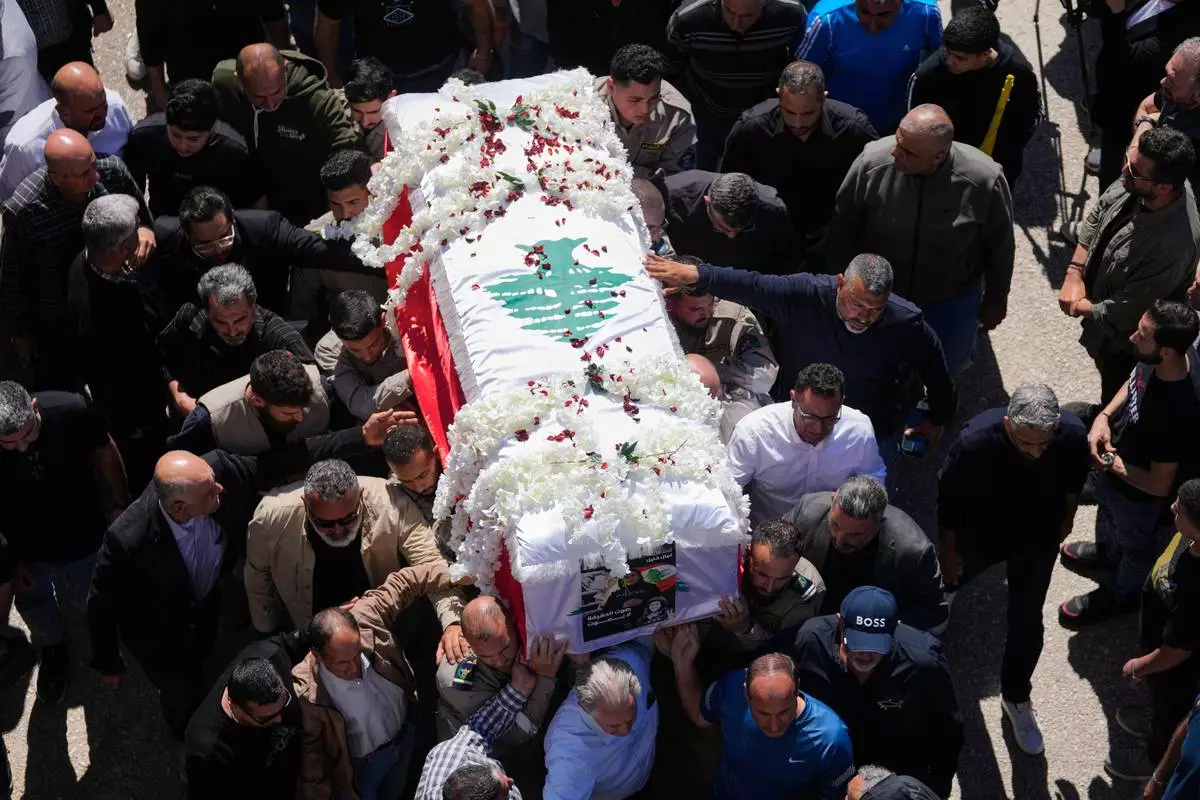
Mourners carry the coffin of Lebanese journalist Amal Khalil, who was killed Wednesday in an Israeli airstrike, during her funeral procession in the village of Baysariyeh in southern Lebanon on Thursday, April 23, 2026. (AP Photo/Mohammed Zaatari)
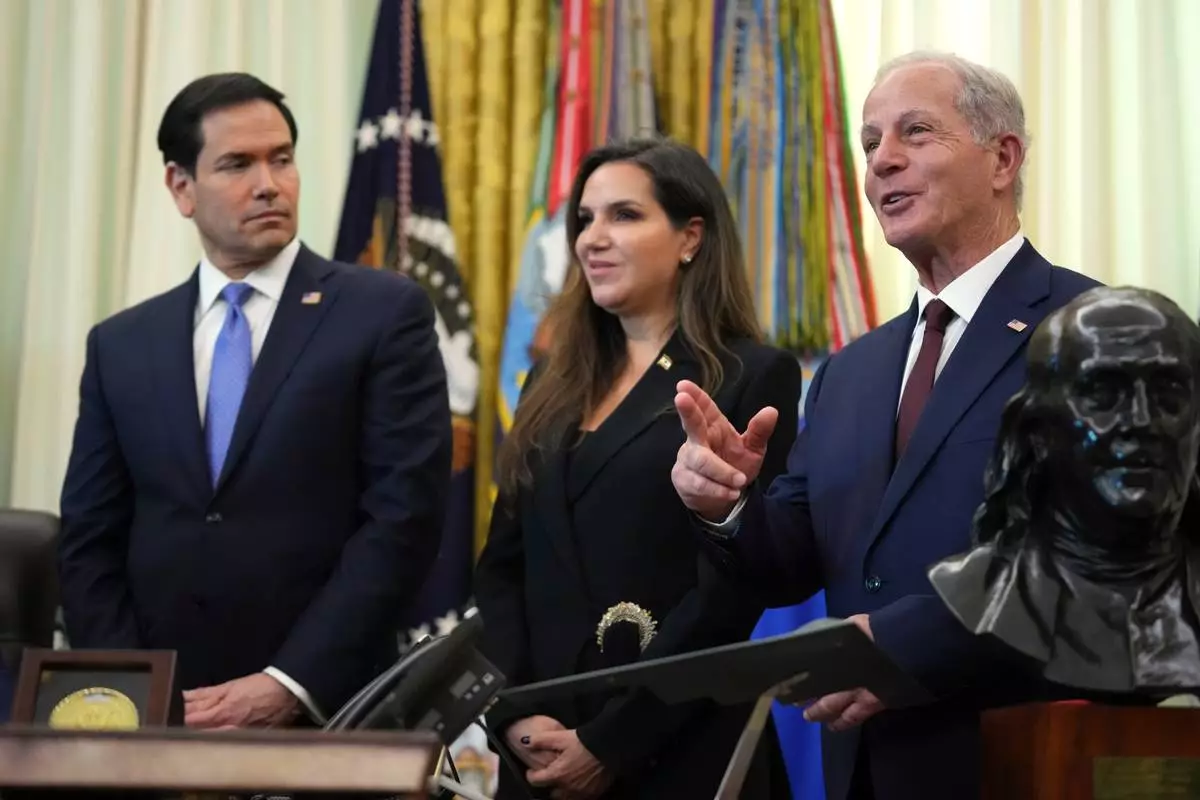
U.S. Ambassador to Lebanon Michel Issa, right, speaks as Secretary of State Marco Rubio and Lebanese Ambassador to the U.S. Nada Hamadeh Moawad, listen during a meeting between the ambassadors of Israel and Lebanon in the Oval Office at the White House, Thursday, April 23, 2026, in Washington. (AP Photo/Mark Schiefelbein)
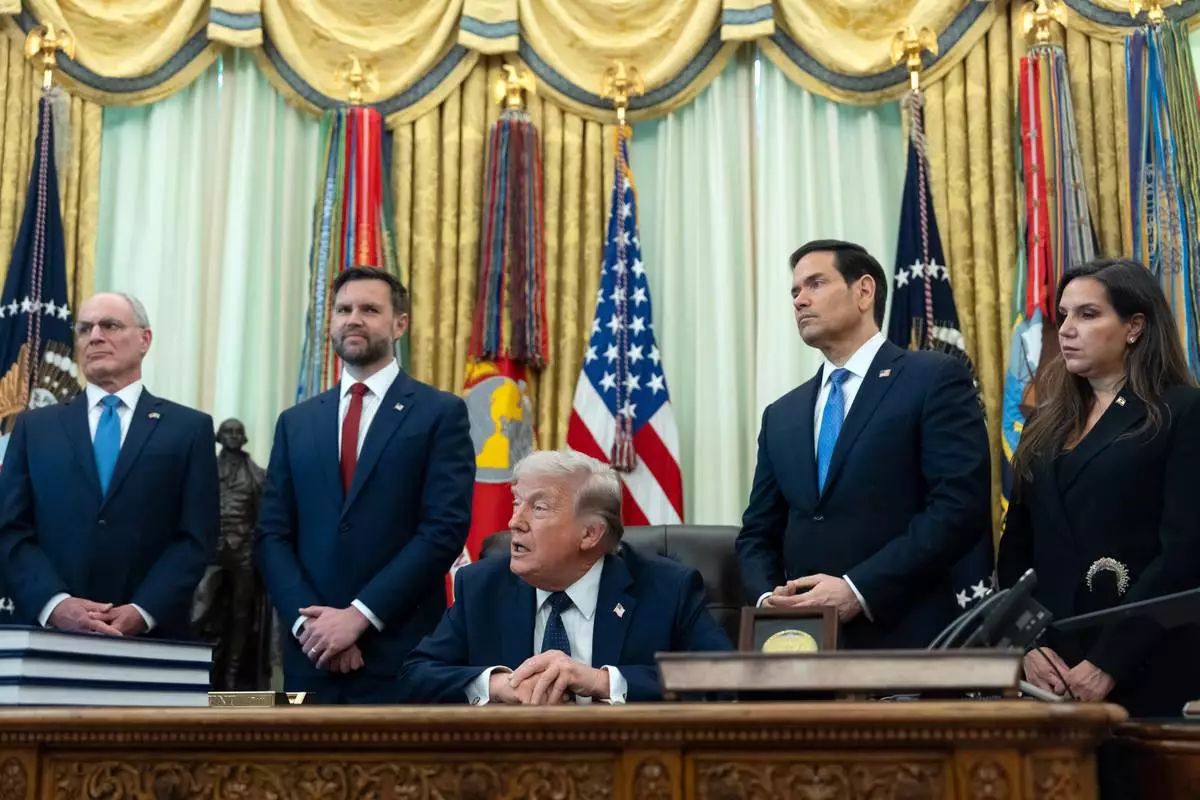
From left, Israeli Ambassador to the U.S. Yechiel Leiter, Vice President JD Vance, Secretary of State Marco Rubio, and Lebanese Ambassador to the U.S. Nada Hamadeh Moawad, listen to President Donald Trump speak in the Oval Office at the White House, Thursday, April 23, 2026, in Washington. (AP Photo/Mark Schiefelbein)
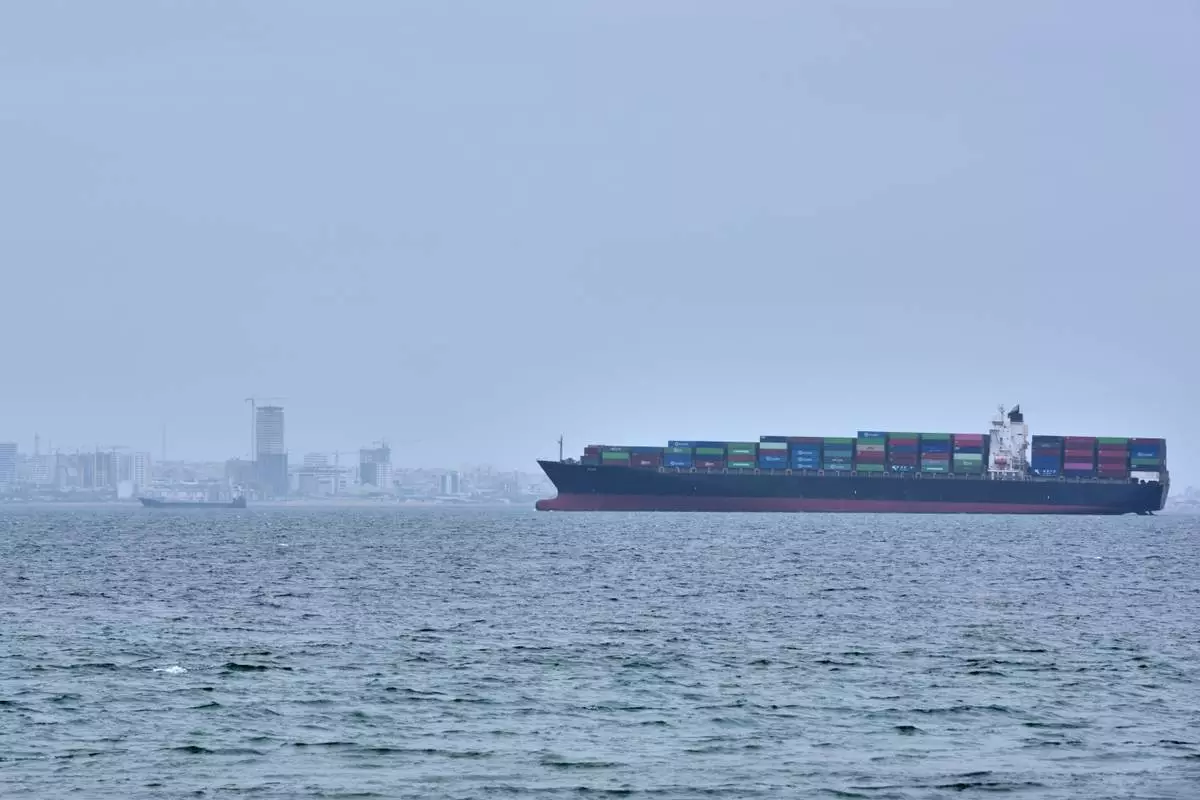
A container ship is seen in the Strait of Hormuz off the coast of Qeshm Island, Iran, Saturday, April 18, 2026. (AP Photo/Asghar Besharati)