A few small changes to how you store fruits and vegetables can have big benefits for the planet – and your wallet.
From herbs that wilt in days to berries that seem to mold even faster, what we toss in the trash often has less to do with what we buy than how we store it at home.
A lot of that spoilage happens because of moisture and temperature.
From a scientific perspective, produce doesn’t just go bad — it breaks down under specific conditions. Plants, like humans, carry natural microflora, a diverse community of microscopic organisms.
“This could be bacteria, yeast, molds, things like that,” said Amanda Deering, associate professor of produce food safety at Purdue University.
Here are a few small changes that can extend the life of food by days.
Washing produce before storing it can leave water that bacteria, yeast and mold need to grow.
Experts recommend waiting to wash fruits and vegetables until just before eating, and keeping them as dry as possible in the fridge meanwhile. Adding a paper towel can absorb dampness in containers of berries or leafy greens.
Food experts also warn that cutting up fruits and vegetables before storing them can reduce their shelf life.
“The big one is washing it and cutting it before storing it. This, of course, can leave a lot of excess moisture behind,” said Abbey Sharp, registered dietitian. “It speeds up spoilage because you’re cutting into those cell walls.”
At room temperature, microscopic organisms grow faster. Keeping food in the fridge can slow that process, Deering said, but how you pack your fridge also matters. Overcrowding it can block airflow and make it harder to keep temperatures consistent.
Different foods have different needs.
Herbs last longer when treated like flowers, trimmed and placed in water, while harder herbs can be wrapped in a damp towel and stored in the fridge. Root vegetables like carrots can be kept in water to maintain crispiness. Separating leafy tops can extend the shelf life of carrots and beets.
Where you store produce can affect both how it tastes and how it lasts. The texture and flavor of tomatoes, for example, are best preserved at room temperature, even if refrigeration can slow their spoilage, said Deering.
Whole garlic should be kept in a cool ventilated space, while cut or peeled garlic belongs in the fridge.
Potatoes and onions are best stored outside the fridge in a cool, dark, well-ventilated place, like a pantry or cabinet, but they shouldn’t be kept together.
“You want to keep them away from one another because they actually can make each other spoil faster,” said Sharp.
Mixing fruits at different stages of ripeness also can shorten shelf lives. As fruits ripen, they release ethylene gas, a natural compound that speeds up the ripening process in nearby produce. So storing very ripe bananas next to greener ones or alongside other fruits can cause everything around them to ripen and spoil more quickly, Deering said.
Confusion about what’s actually safe to eat also drives food waste.
The FDA estimates that confusion over food labels accounts for about 20% of consumer food waste, as many people misinterpret the "purchase-by" dates as indicators of safety. Other food gets trashed when it doesn't look perfect, according to Sharp, who notes that “a little ugly is not the same as unsafe.”
When fruits and vegetables wilt, soften or become slightly discolored, they may not taste as fresh in certain recipes, but that doesn't mean they're spoiled. A limp carrot or a slightly soft celery stalk, for example, can still be safe to eat, especially when cooked, Sharp said.
“Produce that is like a little bit wilted or like a little soft or a little less crisp is often more a quality issue. It’s not necessarily a food safety issue,” said Sharp.
Signals that food should be thrown away are more distinct, like visible mold, slime, leaking liquid or a strong unpleasant odor — clear indications that produce has broken down beyond the point of safe consumption, according to Sharp.
Throwing away food also discards the results of all the resources used to grow, transport and store it. But small habits can make a big difference, like buying what you need, using items before they sit too long, and freezing produce like berries or bananas before it goes bad.
“Household food waste represents probably the largest portion of food waste when we look at it across the whole supply chain,” said Pete Pearson, a vice president at World Wildlife Fund.
And that waste also produces a potent greenhouse gas that harms the planet long after discarded food leaves the kitchen.
“When food enters landfills, it’s essentially buried in a non-oxygen environment where it breaks down and creates bacteria and methane emissions,” said Pearson.
But because people interact with food every day, even small shifts can add up, depleting fewer resources across the broader food system.
“It’s these small changes over millions and millions of people that can make a huge difference,” said Pearson.
The Associated Press’ climate and environmental coverage receives financial support from multiple private foundations. AP is solely responsible for all content. Find AP’s standards for working with philanthropies, a list of supporters and funded coverage areas at AP.org.

FILE - Asparagus stocks are displayed at a market Dec. 11, 2025, in Salem, N.H. (AP Photo/Charles Krupa. File)

FILE - A farmer rests his hands on vegetables at a market June 15, 2023, in Manchester, N.H. (AP Photo/Charles Krupa, File)
Iran’s state-run IRNA news agency confirmed Friday that Iranian Foreign Minister Abbas Araghchi was heading to Pakistan for talks and will also stop in Oman and Russia.
The trip to Pakistan comes as officials there have been trying to get the United States and Iran to a second round of ceasefire negotiations. The report said the trip, beginning Friday, is focused on “ongoing regional developments” and the US-Iran war.
Also, U.S. President Donald Trump says Israel and Lebanon have agreed to extend a ceasefire between Israel and Hezbollah by three weeks after talks at the White House on Thursday. The meeting was the second high-level negotiation between the two countries since last week. The initial 10-day ceasefire, which took effect last Friday, had been due to expire Monday.
Here is the latest:
It’s his first public acknowledgment of the diagnosis.
He said that roughly a year and a half ago he had prostate surgery. Then two and a half months ago, his doctors discovered and treated a small tumor at Jerusalem’s Hadassah Hospital with radiation therapy. That was not announced at the time.
“I requested to delay its publication by two months so that it would not be released at the height of the war” against Iran, the 76-year-old Israeli leader said, to prevent “more false propaganda against Israel.”
He said he was healthy and called the tumor a “minor medical issue.”
Netanyahu’s health was the subject of speculation during the early weeks of the war with Iran as fake, AI-generated images circulated suggesting he had died, including on Iranian state media.
▶ Read more
That’s according to the Panama Canal Authority.
While passage through the waterway usually comes at a flat rate via reservations, companies without reservations can cross by paying an additional fee in an auction for slots, which are awarded to the highest bidder rather than waiting for days off the coast of Panama City.
That price has ballooned in recent weeks as Iran and the United States have bottlenecked the key shipping route, the Strait of Hormuz, and demand for those slots has skyrocketed. Ships have increasingly traveled through the Panama Canal as shipments are rerouted and buyers purchase from other countries to avoid commerce through the now-treacherous Middle Eastern waterway.
“With all the bombings, the missiles, the drones ... companies are saying it’s safer and less expensive to cross through the Panama Canal,” said Rodrigo Noriega, a lawyer and analyst in Panama City. “All of this is affecting global supply chains.”
▶ Read more
“The same is true in Lebanon: We have begun a process to achieve a historic peace between Israel and Lebanon, and it is clear to us that Hezbollah is trying to sabotage this,” Israeli Prime Minister Benjamin Netanyahu said Friday in a video statement released by his office. He was referring to direct negotiations underway between the two countries — which don’t have formal diplomatic relations — for the first time in decades.
The Israeli military said it hit sites from which rockets were launched toward the town of Shtula a day earlier.
The strikes targeted the town of Deir Aames, which is outside the border area in Lebanon that Israeli forces have declared a buffer zone and continued to occupy since a 10-day truce was implemented last week. Earlier Friday, the Israeli military issued a warning for residents of Deir Aames to leave.
U.S. President Donald Trump on Thursday announced a three-week extension to the Israel-Hezbollah truce, but both sides have continued to fire at each other.
In a Telegram post Friday, Zelenskyy said his meeting with Crown Prince Mohammed bin Salman was productive and that both countries are developing a strategic security agreement.
The agreement includes three elements, he said: exporting Ukraine’s defense expertise and capabilities, expanding energy cooperation, and strengthening food security.
“We are working together to strengthen our nations and partners. We have defined tasks for our teams and I expect their prompt and full implementation,” he said.
Saudi Arabia, along with other Mideast countries, has been targeted by missile and drone attacks from Iran since the war began.
Iranian Foreign Minister Abbas Araghchi said in a social media post that the purpose of his upcoming tour to Islamabad, Pakistan; Muscat, Oman; and Moscow is to “closely coordinate with our partners on bilateral matters and consult on regional developments.”
Araghchi’s comments didn’t address any possible resumption of talks with the U.S., but Pakistani officials have been intensifying efforts in recent weeks to get the U.S. and Iran to a second round of ceasefire negotiations.
Ali Fayyadh said in comments Friday that the ceasefire between Israel and Hezbollah that was extended for three weeks the day before has no meaning as long as Israel continues its attacks, targeted killings and strikes on Lebanese villages.
Since the 10-day ceasefire went into effect last Friday it has been repeatedly violated by both sides.
Fayyadh said every Israeli attack against any Lebanese target, regardless of its nature, gives his group that right to respond appropriately.
He added that any ceasefire that doesn’t constitute a prelude to an Israeli withdrawal from Lebanese territory affirms the Lebanese people’s “inalienable and final right to resist” the occupation and expel it from our land in order to restore full Lebanese sovereignty.
President Joseph Aoun’s comments Friday came during a visit to the Mediterranean island of Cyprus where he’s a guest at the European Union summit.
Aoun said in a speech that “Lebanon’s stability is part of the region’s stability.”
He added that Lebanon refuses to be a bargaining chip in regional conflicts. He was apparently referring to Iran, which has put a permanent ceasefire between Israel and the militant Hezbollah group on top of its list in talks with the U.S..
Aoun said Lebanon, like other countries in the region, “places great importance on de-escalation, stability, and peace.”
Aoun used World Bank figures, saying the Israel-Hezbollah was has caused damage worth $1.4 billion to Lebanon’s infrastructure and that 38,000 housing units were destroyed.
He said 150,000 people in Lebanon are without homes.
Today, offering escorts in the Strait of Hormuz wouldn’t be so easy. Military technology has advanced since the “Tanker war.”
The U.S. hasn’t defined the same clear, narrow goals in this war as it did in the 1980s. And it’s not clear international shippers would feel safe even with an American Navy escort given it’s a combatant now.
The U.S. Navy has long been familiar with the small boat tactics deployed by Iran’s paramilitary Revolutionary Guard, which has adapted to international sanctions blocking its ability to access military vessels by using smaller civilian ships for military purposes.
For years, the Guard has used vessels the size of small commercial fishing boats to shadow American aircraft carriers whenever they pass through the strait. Instead of bearing fishing poles, most have Soviet-era heavy machine guns bolted to their bows with a small rocket launcher atop.
Using those small boats, Iran seized two cargo ships this week.
▶ Read more
A surge for Intel following a blowout profit report is leading technology stocks higher, while oil prices keep swinging in the wait for what’s next with the Iran war.
The S&P 500 rose 0.2% early Friday and pulled near its all-time high set Wednesday. The Dow Jones Industrial Average slipped 74 points, while the Nasdaq composite jumped a market-leading 0.7%.
The price for a barrel of Brent crude to be delivered in June was down 0.4% at $104.67 after yo-yoing between roughly $103 and $107.
European stock markets were modestly lower and Asian markets closed mixed.
▶ Read more
In a statement in Islamabad, the foreign ministry said Lavrov appreciated Pakistan’s “constructive role” in facilitating dialogue between Iran and the United States.
Dar reaffirmed Islamabad’s commitment to supporting efforts that promote dialogue and diplomacy to resolve disputes, it said.
Both sides agreed to remain in contact, it added.
The army said in a statement Friday that a remotely piloted aircraft was downed in southern Lebanon following the launch of a small surface-to-air missile by the militant group Hezbollah.
The military said the incident is under review.
The statement came after Hezbollah said it shot down an Israeli Hermes 450 drone over the outskirts of the southern city of Tyre.
Malaysian Prime Minister Anwar Ibrahim said Friday that his government is in talks with Iran to allow two Malaysian-owned tankers carrying fuel supplies to pass through.
The vessels have exited the Strait of Hormuz but face severe restrictions despite earlier clearance given by the Iranian government, he was cited as saying by the national Bernama news agency. He didn’t provide further details.
One Malaysian vessel has earlier reached home and another is expected to enter Malaysian waters soon, he said. Another is stranded at port due to technical problems, he added.
Hegseth told reporters at the Pentagon on Friday that the military is prepared to deal with any Iranian ships that “recklessly and irresponsibly” lay more mines.
But he said he wouldn’t speculate on reports that it will likely take six months to clear mines in the strait. The Associated Press reported that the Pentagon gave that timeline in a classified briefing to lawmakers this week.
Hegseth was responding to statements from President Trump who said Thursday that he has ordered the military to “ shoot and kill ” small Iranian boats deploying mines.
Hegseth said the U.S. is confident it can clear any mines it identifies “and would encourage other countries to be a part of such an effort as well.”
And it didn’t respond to questions on whether the U.S. would send a delegation.
The crews of all three merchant vessels seized by the U.S. military over the past week are still in U.S. custody, Gen. Dan Caine said at a briefing Friday.
“We will continue to conduct similar maritime interdiction actions and activities in the Pacific and Indian Oceans against Iranian ships and vessels of the Dark Fleet,” Caine said.
Caine also said the crew of the Tousca, the first merchant ship seized by U.S. forces Sunday, “repeatedly ignored U.S. warnings” over a six-hour period. Caine said this behavior prompted the crew of the Navy destroyer following the ship to fire five warning shots.
“The vessel and her crew continued to ignore warnings and, after exhausting all other measures, CENTCOM authorized disabling fire against the Tousca,” Caine said. Then, according to Caine, the destroyer disabled the ship’s engine by firing nine inert rounds from the destroyer’s 5-inch guns “precisely into the engine room and engine space on board the Tousca.”
“Not surprisingly, the vessel then reported issues with their engine, went dead in the water and began to comply with U.S. directions,” Caine added.
The U.S. secretary of defense suggested traditional U.S. allies in Europe are “free-riding” and being disloyal by not using their own forces to open the Strait of Hormuz that’s been closed because of President Trump’s Iran war.
“We are not counting on Europe, but they need the Strait of Hormuz much more than we do,” Hegseth insisted. He mocked a recent European confab, saying U.S. allies “might want to start doing less talking” instead of holding “a fancy conference” and “a silly conference.”
Iran’s maneuver to choke off the strait has disrupted global energy supplies — especially in Europe, where many leaders remain frustrated. French President Emmanuel Macron said at one point that the U.S. can’t complain about a lack of support “in an operation they chose to undertake alone.”
Hegseth’s broadsides echo Trump’s swipes that other nations should “Go get your own oil!” and “start learning how to fight for yourself.”
IRNA said Iranian Foreign Minister Abbas Araghchi also would go to Oman and Russia.
The trip to Pakistan comes as officials there have been trying to get the United States and Iran to a second round of ceasefire negotiations.
The IRNA report said Araghchi’s trip, beginning Friday, is focused on “bilateral consultations and discussions on ongoing regional developments, as well as the latest situation surrounding the imposed war by the United States and Israel against Iran.”
Speaking to reporters Friday at the Pentagon, Hegseth said the U.S. blockade of Iranian shipping will continue “as long as it takes” to accomplish America’s “bold and dangerous” mission to end Iran’s threat to global security.
U.S. officials say that so far the blockade has turned back 34 ships, but ship-tracking data shows Iran has still been to move some of its sanctioned oil.
Lloyd’s List Intelligence said “a steady flow of shadow fleet traffic” has passed in and out of the Persian Gulf, including 11 tankers with Iranian cargo that have left the Gulf of Oman outside the strait since April 13.
The maritime intelligence firm Windward said this week that Iranian traffic continues to flow “via deception.”
Iranians are able to evade the blockade by faking tracking data and by traveling through Pakistani territorial waters.
The Israeli army’s statement Friday regarding the village of Deir Aames came hours after U.S. President Donald Trump said Israel and Lebanon have agreed to extend a ceasefire between Israel and Hezbollah by three weeks.
The military said the militant group Hezbollah is using Deir Aames to launch attacks against Israel.
The military said residents of the village should move 1,000 meters outside Deir Aames.
The group said the Hermes 450 drone was shot down with a surface-to-air missile Friday over the outskirts of southern port city of Tyre.
Hezbollah said it was in retaliation for Israeli violation of Lebanese air space.
There was no immediate comment from the Israeli military.
Pakistani Prime Minister Shehbaz Sharif’s message Friday came as the world marked the International Day of Multilateralism and Diplomacy for Peace.
In the message, Sharif said Pakistan remains guided by the principles of the United Nations Charter amid growing global security challenges and will continue to promote diplomacy to advance regional and international peace.
He also highlighted Pakistan’s ongoing mediation efforts, saying they’re rooted in a commitment to cooperation and conflict resolution.
Ukrainian President Volodymyr Zelenskyy arrived in Saudi Arabia on Friday for talks on potential agreements covering energy, infrastructure and security, he said in a post on Telegram.
Zelenskyy is set to meet with Crown Prince Mohammed bin Salman.
“Yesterday, at a meeting with European leaders, we secured financial guarantees for our stability,” Zelenskyy posted, referring to a crucial 90 billion-euro loan approved by European leaders. “Today we are developing agreements with Saudi Arabia in the fields of security, energy and infrastructure.”
The visit is his second trip to Saudi Arabia in a month, following a late-March visit focused on air defense technology.
The White House said that Trump issued a 90-day extension to the Jones Act waiver, making it easier for non-American vessels to transport oil and natural gas in the wake of the Iran War.
Trump first announced a 60-day waiver in mid-March and the move has been seen as helping to stabilize energy prices and making it easier for more ships to travel to the U.S. following the effective closure of the Strait of Hormuz.
The post on social media by a White House press aide said: “New data compiled since the initial waiver was issued revealed that significantly more supply was able to reach U.S. ports faster.”
Two Pakistani officials told The Associated Press on Friday about the visit by Iranian Foreign Minister Abbas Araghchi. They declined to provide any other details, other than to say he would be accompanied by a small government delegation and could arrive as soon as Friday.
Pakistan has been trying to restart ceasefire talks between Iran and the United States.
The officials spoke on condition of anonymity because they were not authorized to speak to the media.
Iran did not immediately acknowledge Araghchi’s trip.
The U.N. peacekeeping force deployed in southern Lebanon, or UNIFIL, says Corporal Rico Pramudia, 31, died at a Beirut hospital after he was critically wounded following a projectile explosion in his base in Adchit al-Qusayr, southern Lebanon, on March 29.
The attack in Adchit al-Qusayr also killed an Indonesian peacekeeper.
Two other Indonesian peacekeepers were also killed in southern Lebanon shortly after.
Kuwait says explosive drones launched from Iraq have struck two sites on the northern land border Friday morning.
The Kuwait army said on X that the drones caused material damage, but that there were no reports of casualties.

Zainab, the sister of Lebanese journalist Amal Khalil, who was killed on Wednesday in an Israeli airstrike, hugs her helmet as she mourns over her coffin in the village of Baysariyeh, southern Lebanon, Thursday, April 23, 2026. (AP Photo/Mohammed Zaatari)
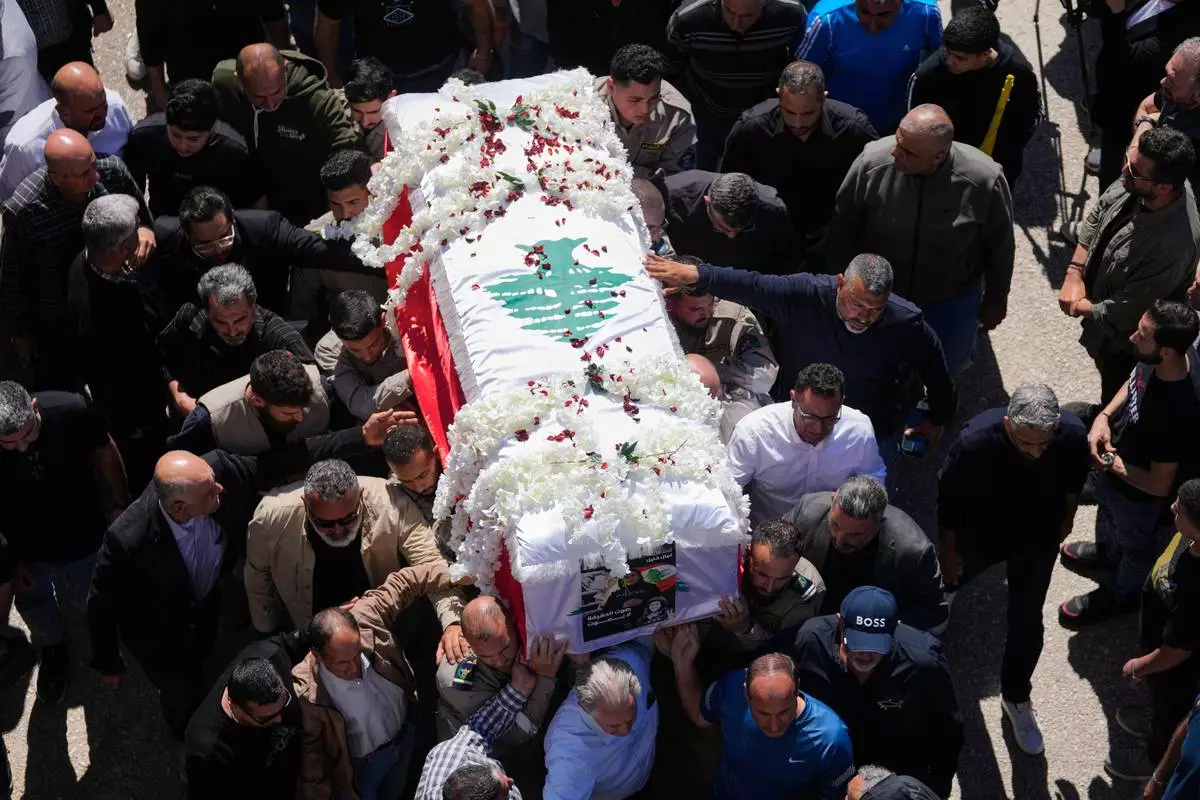
Mourners carry the coffin of Lebanese journalist Amal Khalil, who was killed Wednesday in an Israeli airstrike, during her funeral procession in the village of Baysariyeh in southern Lebanon on Thursday, April 23, 2026. (AP Photo/Mohammed Zaatari)

U.S. Ambassador to Lebanon Michel Issa, right, speaks as Secretary of State Marco Rubio and Lebanese Ambassador to the U.S. Nada Hamadeh Moawad, listen during a meeting between the ambassadors of Israel and Lebanon in the Oval Office at the White House, Thursday, April 23, 2026, in Washington. (AP Photo/Mark Schiefelbein)
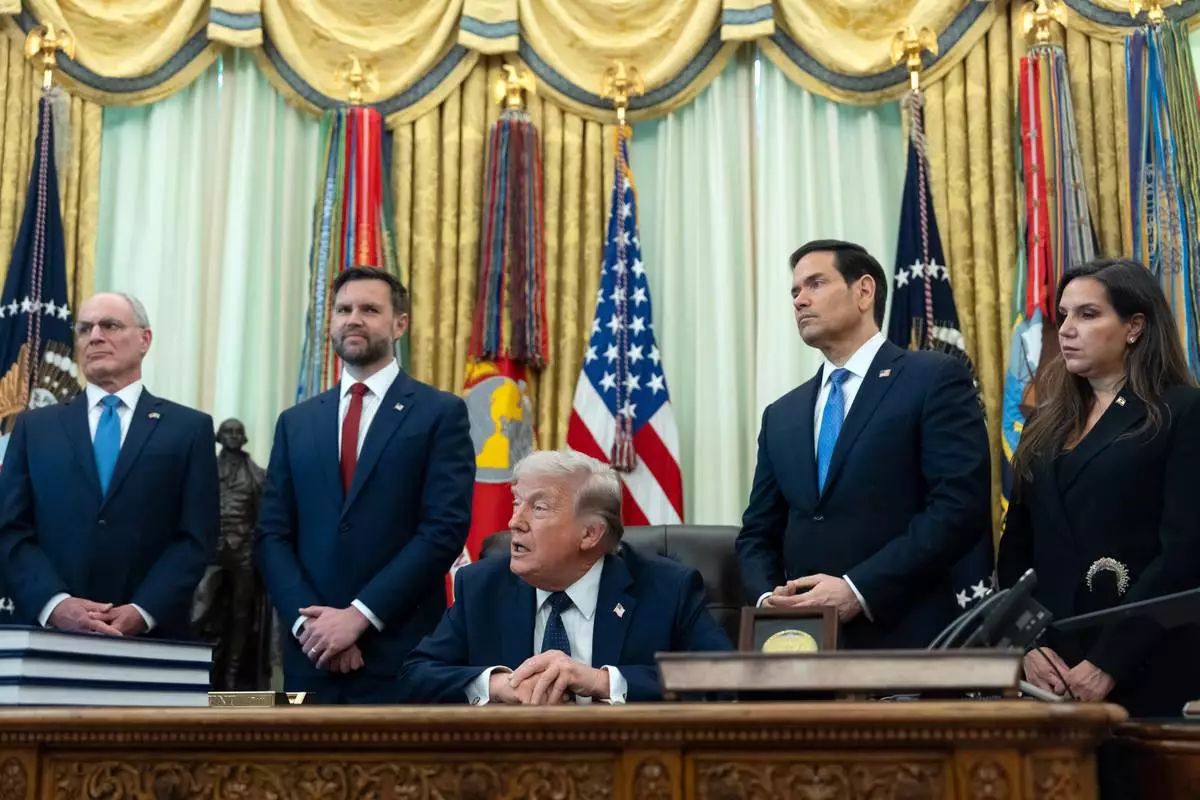
From left, Israeli Ambassador to the U.S. Yechiel Leiter, Vice President JD Vance, Secretary of State Marco Rubio, and Lebanese Ambassador to the U.S. Nada Hamadeh Moawad, listen to President Donald Trump speak in the Oval Office at the White House, Thursday, April 23, 2026, in Washington. (AP Photo/Mark Schiefelbein)
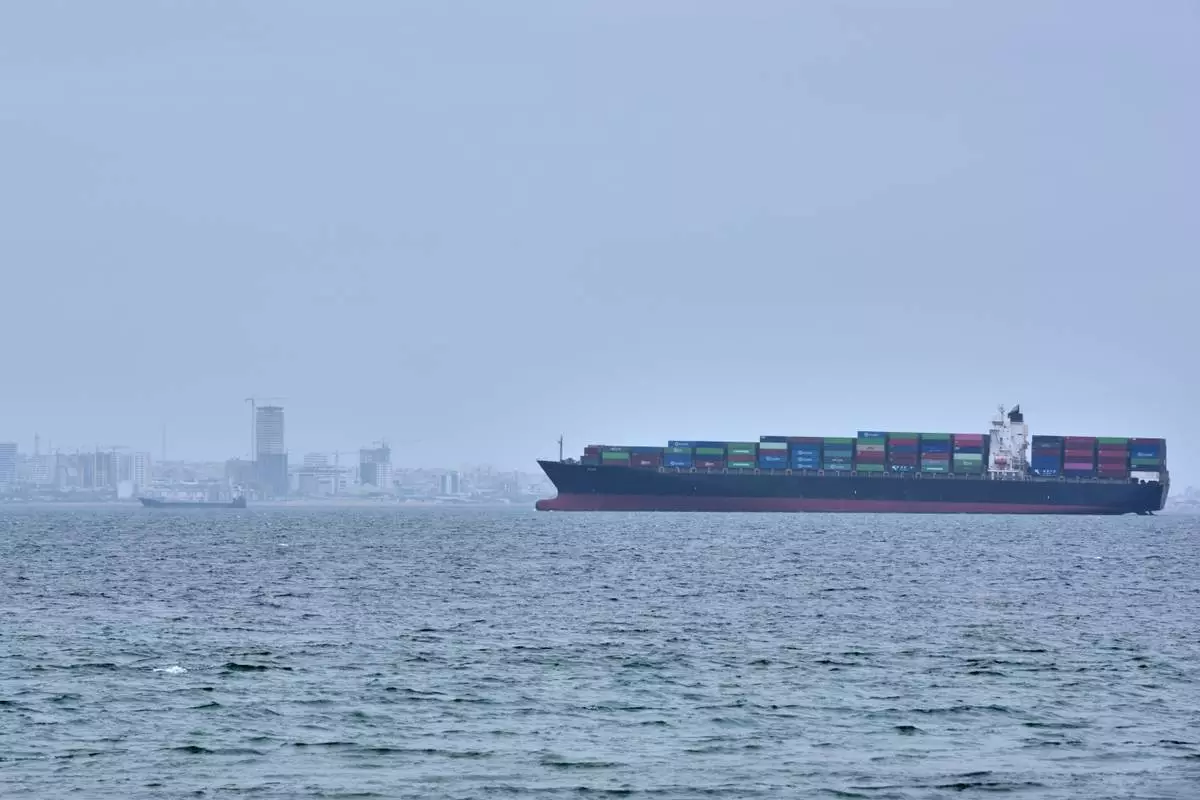
A container ship is seen in the Strait of Hormuz off the coast of Qeshm Island, Iran, Saturday, April 18, 2026. (AP Photo/Asghar Besharati)