MADRID (AP) — Two-time defending champion Carlos Alcaraz won’t attempt to defend his French Open title due to a right wrist injury.
Alcaraz posted on X on Friday that neither would he play in the preceding Italian Open in Rome, where he also won last year.
Click to Gallery
FILE - Spain's Carlos Alcaraz towels off during the final of the French Open tennis tournament against Italy's Jannik Sinner, Sunday, June 8, 2025, in Paris. (AP Photo/Aurelien Morissard, File)
FILE - Spain's Carlos Alcaraz caresses with the trophy after defeating Italy's Jannik Sinner in the final of the French Open tennis tournament, Sunday, June 8, 2025, in Paris. (AP Photo/Lindsey Wasson, File)
FILE - Spain's Carlos Alcaraz reacts during the final of the French Open tennis tournament against Italy's Jannik Sinner, Sunday, June 8, 2025, in Paris. (AP Photo/Lindsey Wasson, File)
Carlos Alcaraz poses with his Laureus World Sportsman of the Year award during the 2026 Laureus World Sports Awards ceremony in Madrid, Spain, Monday, April 20, 2026. (AP Photo/Manu Fernandez)
No. 2-ranked Alcaraz was injured at the Barcelona Open this month during his first-round win and withdrew the day after.
He pulled out of this week's Madrid Open and attended the Laureus World Sports Awards in the Spanish capital on Monday with his wrist immobilized. Alcaraz was named world sportsman of the year at the gala.
Alcaraz confirmed he was a no-go for Paris after undergoing more medical tests on Friday.
"After the results of the tests carried out today, we have decided that the most prudent thing is to be cautious and not participate in Rome and Roland Garros," he wrote on X. “It's a complicated moment for me, but I'm sure we'll come out stronger from here.”
Alcaraz started the year in sensational form, beating Novak Djokovic in the Australian Open final. That made him the youngest man ever to win all four major titles in tennis.
He has won only one title since — at Doha in February — and will be without a title in the major clay-court events. He lost the Monte Carlo final to Jannik Sinner at the start of this month and surrendered the No. 1 ranking to his Italian rival.
Last year, Alcaraz beat Sinner in the finals of the Italian Open and French Open, where he saved three match points in an epic match. Alcaraz then lost the Wimbledon final to Sinner before beating him again in the U.S. Open final.
The Italian Open starts on May 6. The French Open does so on May 18.
AP tennis: https://apnews.com/hub/tennis

FILE - Spain's Carlos Alcaraz towels off during the final of the French Open tennis tournament against Italy's Jannik Sinner, Sunday, June 8, 2025, in Paris. (AP Photo/Aurelien Morissard, File)

FILE - Spain's Carlos Alcaraz caresses with the trophy after defeating Italy's Jannik Sinner in the final of the French Open tennis tournament, Sunday, June 8, 2025, in Paris. (AP Photo/Lindsey Wasson, File)

FILE - Spain's Carlos Alcaraz reacts during the final of the French Open tennis tournament against Italy's Jannik Sinner, Sunday, June 8, 2025, in Paris. (AP Photo/Lindsey Wasson, File)

Carlos Alcaraz poses with his Laureus World Sportsman of the Year award during the 2026 Laureus World Sports Awards ceremony in Madrid, Spain, Monday, April 20, 2026. (AP Photo/Manu Fernandez)
LONDON (AP) — A proposed bill to allow terminally ill adults in England and Wales to choose to end their lives failed Friday as parliamentary time ran out following an effective filibuster by unelected lawmakers in the revising chamber that blocked the will of elected members.
Though the Terminally Ill Adults (End of Life) Bill was passed by the House of Commons last June, the House of Lords talked it out since then, stoking widespread criticism that it had overstepped the mark.
Proponents of what has been termed “ assisted dying ” — sometimes referred to as “assisted suicide” — hoped it would mark the biggest change to social policy in the U.K. since abortion was partially legalized in 1967. The bill had proposed allowing adults in England and Wales, with fewer than six months to live, to apply for an assisted death subject to the approval of two doctors and an expert panel.
But opponents in the House of Lords managed to hold up its passing by filing more than 1,200 amendments on a range of concerns, including the potential coercion of vulnerable people and a lack of safeguards for those with disabilities.
”The House of Lords scrutiny exposed this bill as ‘skeleton legislation’ riddled with gaping holes,” said Gordon Macdonald from the Care Not Killing campaign group which is opposed to a change in the law. “It is now clear that this bill was both unsafe and unworkable.”
The number of amendments is believed to be a record high for a piece of legislation that was brought forward by a backbencher rather than by the government. These so-called private members' bills can only be debated on a Friday as the government largely controls the rest of the parliamentary timetable, thereby limiting the time available.
Campaigners for assisted dying expressed their anger at the sight of unelected lawmakers holding up the will of the elected chamber. They have insisted that they intend to bring the bill back in the next parliamentary session, which begins after King Charles III outlines the government's upcoming program in a speech to both houses of Parliament on May 13.
The sponsor of the bill in the House of Lords, Charlie Falconer, said he felt “despondent” that a piece of legislation “so important to so many, has not failed on its merits, but failed as a result of procedural wrangling."
“Much more than letting ourselves down are the very many people who support the bill and who feel we have not treated them properly,” he said.
Lawmaker Kim Leadbeater, who introduced the Bill to the House of Commons in late 2024, said she was “trying to stay positive” while admitting “a real sense of sadness and sorrow today.”
She said there “will absolutely be appetite" within the Commons to bring the legislation back in the next session of parliament.
Last month, lawmakers in the Scottish Parliament rejected their own assisted dying legislation. Scotland has a semiautonomous government that has authority over many areas of policy, including health.
Assisted suicide — where patients take a lethal drink prescribed by a doctor — is legal in countries including Australia, Belgium, Canada, Luxembourg, the Netherlands, New Zealand, Portugal, Spain, Switzerland and parts of the U.S., with regulations on qualifying criteria varying by jurisdiction.

Campaigners hold a banner outside parliament in London as a proposed law to legalise assisted dying in England and Wales will run out of time on Friday, more than a year after MPs first voted in favour of it, Friday, April 24, 2026. (AP Photo/Kirsty Wigglesworth)

A campaigner holds a banner outside parliament in London as a proposed law to legalise assisted dying in England and Wales will run out of time on Friday, more than a year after MPs first voted in favour of it, Friday, April 24, 2026. (AP Photo/Kirsty Wigglesworth)

Campaigner Louise Shackleton holds a banner outside parliament in London as a proposed law to legalise assisted dying in England and Wales will run out of time on Friday, more than a year after MPs first voted in favour of it, Friday, April 24, 2026. (AP Photo/Kirsty Wigglesworth)
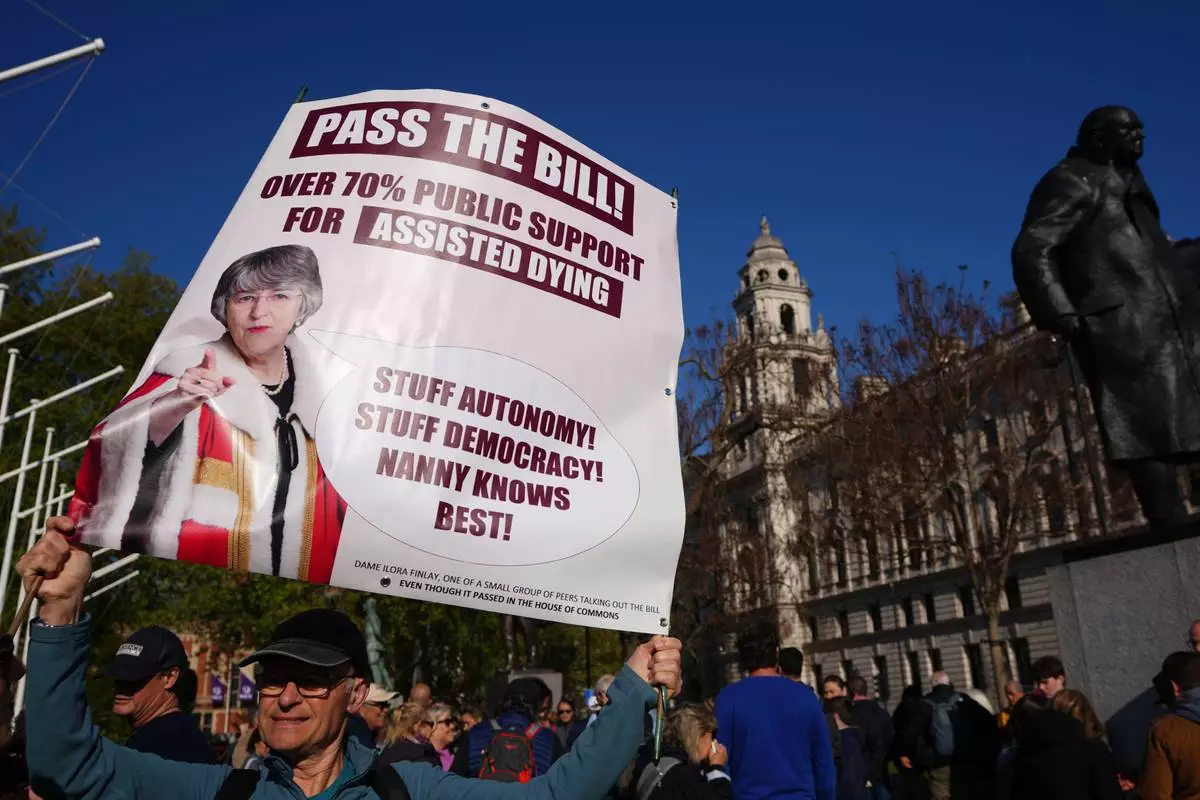
A campaigner holds a banner outside parliament in London as a proposed law to legalise assisted dying in England and Wales will run out of time on Friday, more than a year after MPs first voted in favour of it, Friday, April 24, 2026. (AP Photo/Kirsty Wigglesworth)
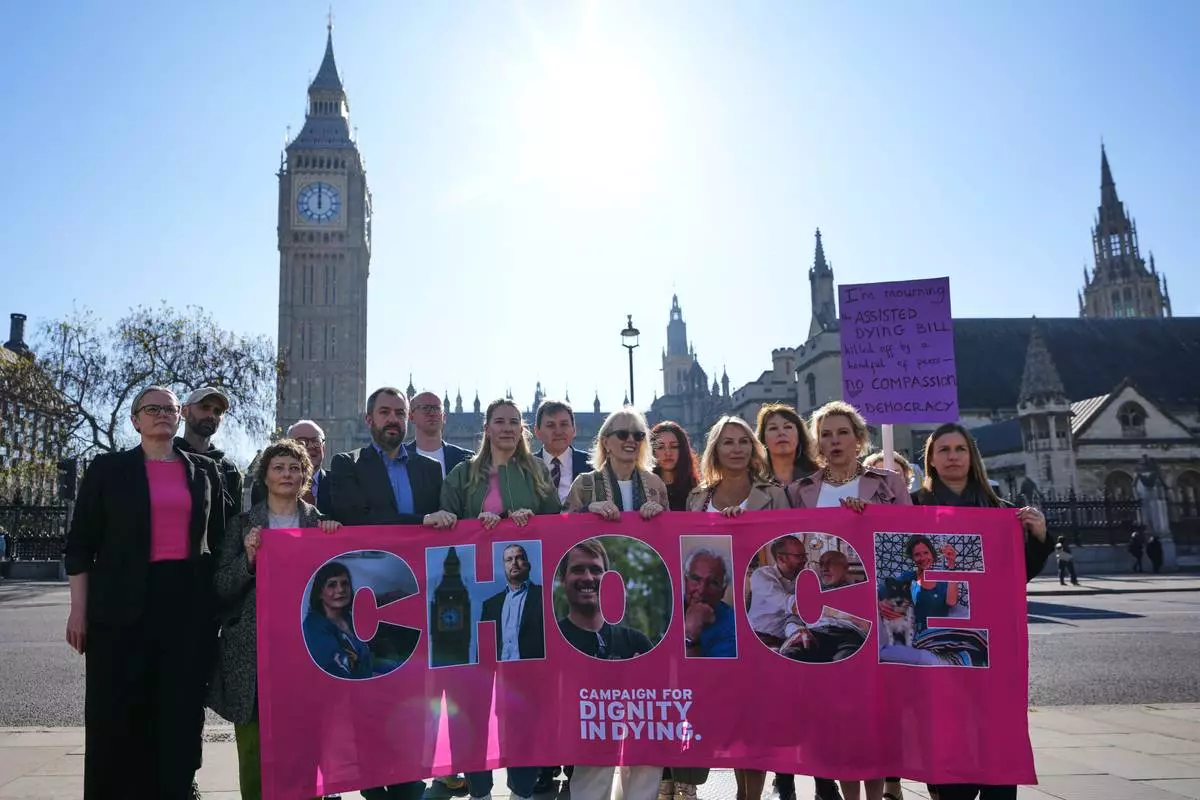
Campaigners hold a banner outside parliament in London as a proposed law to legalise assisted dying in England and Wales will run out of time on Friday, more than a year after MPs first voted in favour of it, Friday, April 24, 2026. (AP Photo/Kirsty Wigglesworth)