Skip to Content Facebook Feature Image

NFL draft in NIL era includes players taking a pay cut to go from college to the pros

Sport

NFL draft in NIL era includes players taking a pay cut to go from college to the pros
Sport

Sport

NFL draft in NIL era includes players taking a pay cut to go from college to the pros

2026-04-25 00:35 Last Updated At:00:40

JACKSONVILLE, Fla. (AP) — Philadelphia Eagles general manager Howie Roseman might do something this weekend he’s never done in his storied NFL career: draft a player who will take a pay cut by entering the league.

It won’t be the last time, either.

The minimum salary for an NFL draft pick in 2026 is slotted at $915,120. But with college revenue sharing going into effect before the 2025 season — top programs are now spending up to $20.5 million on student-athletes, with the majority earmarked for the most talented football players — there are undoubtably players who will be drafted Saturday who topped the million-dollar mark last season and will earn less in the pros.

At least in Year 1.

“So the character of those players, their passion and love of the game come to the forefront even more,” Roseman said.

Most of the players making more than $1 million in college football are quarterbacks. Indiana’s Fernando Mendoza and Alabama’s Ty Simpson were first-round draft picks, with Mendoza going No. 1 to the Las Vegas Raiders and Simpson surprisingly landing with the Los Angeles Rams at No. 13.

Mendoza’s NFL rookie deal is slotted to top $57 million, including nearly $10.5 million in 2026. Simpson’s contract will be roughly half that — $25.4 million total, including $4.6 million in the first year.

LSU's Garrett Nussmeier and Miami’s Carson Beck are projected to be the next quarterbacks selected, with both potentially coming off the board in the second or third round Friday night — and both likely earning less as NFL rookies than they made as established college starters.

Same goes for fellow QBs Drew Allar (Penn State), Taylen Green (Arkansas), Cole Payton (North Dakota State), Sawyer Robertson (Baylor), Cade Klubnik (Clemson), Joey Aguilar (Tennessee) and others.

Although revenue share payments are typically undisclosed, name, image and likeness valuations are much more public. Nearly half of the top 50 NIL valuations in 2025 belonged to QBs, according to On3, with two dozen of those over $1.5 million.

“They come in almost like pros now,” Raiders general manager John Spytek said. “I actually think it’s made it easier because you know what the guys are going to do when they have money.

“You know the ones that love the game and are about the right things, and just because they’ve got more money than we all had when we were in college, they still prepare the right way, they play the right way, they love the game, they’re there for their teammates. I think it’s kind of been a little bit illuminating to the character of who they are.”

The financial component has less of an impact on NFL decision-makers as the age issue.

Ravens general manager Eric DeCosta said this is the third consecutive year in which 18% of the team’s draft board is comprised of players at least 24 years old. That number used to be 4%, he added.

The COVID-19 pandemic caused the initial age surge. But soaring NIL payments and rev share could be the deciding force for years to come.

“That’s something that we don’t really understand fully and what that means,” DeCosta said. “I don’t think it’s a good thing, certainly. But historically we’ve tried to draft younger players when we can. That’s been something that we feel strongly (about), but now we’ve got 18% of the draft board that’s over 24 years old. So that’s going to change the way that maybe we target players.”

And some of them will be millionaires before they even sign an NFL contract.

“That’s interesting. I don’t know that it’s rooted in financial thoughts as much as you talk about age quite a bit and whether or not tread on the tires is something of note,” Jacksonville Jaguars general manager James Gladstone said. “I think most of the times the guys have a little bit more financial awareness, and that can be a really helpful tool.

“The fact that they’re not just being dumped a good chunk of cash for the first time when they enter the NFL. They now have some version of experience navigating that, and that can be a really helpful piece for sure.”

AP NFL: https://apnews.com/hub/nfl

FILE - Penn State quarterback Drew Allar (15) throws during the school's NFL football pro day, Wednesday, March 18, 2026, in State College, Pa. (AP Photo/Gene J. Puskar, File)

FILE - Penn State quarterback Drew Allar (15) throws during the school's NFL football pro day, Wednesday, March 18, 2026, in State College, Pa. (AP Photo/Gene J. Puskar, File)

FILE - Clemson quarterback Cade Klubnik runs the 40-yard dash during the school's NFL football pro day, Thursday, March 12, 2026, in Clemson, S.C.. (AP Photo/Mike Stewart, File)

FILE - Clemson quarterback Cade Klubnik runs the 40-yard dash during the school's NFL football pro day, Thursday, March 12, 2026, in Clemson, S.C.. (AP Photo/Mike Stewart, File)

FILE - Arkansas quarterback Taylen Green (08) runs a drill at the NFL football scouting combine in Indianapolis, Saturday, Feb. 28, 2026. (AP Photo/Julio Cortez, , File)

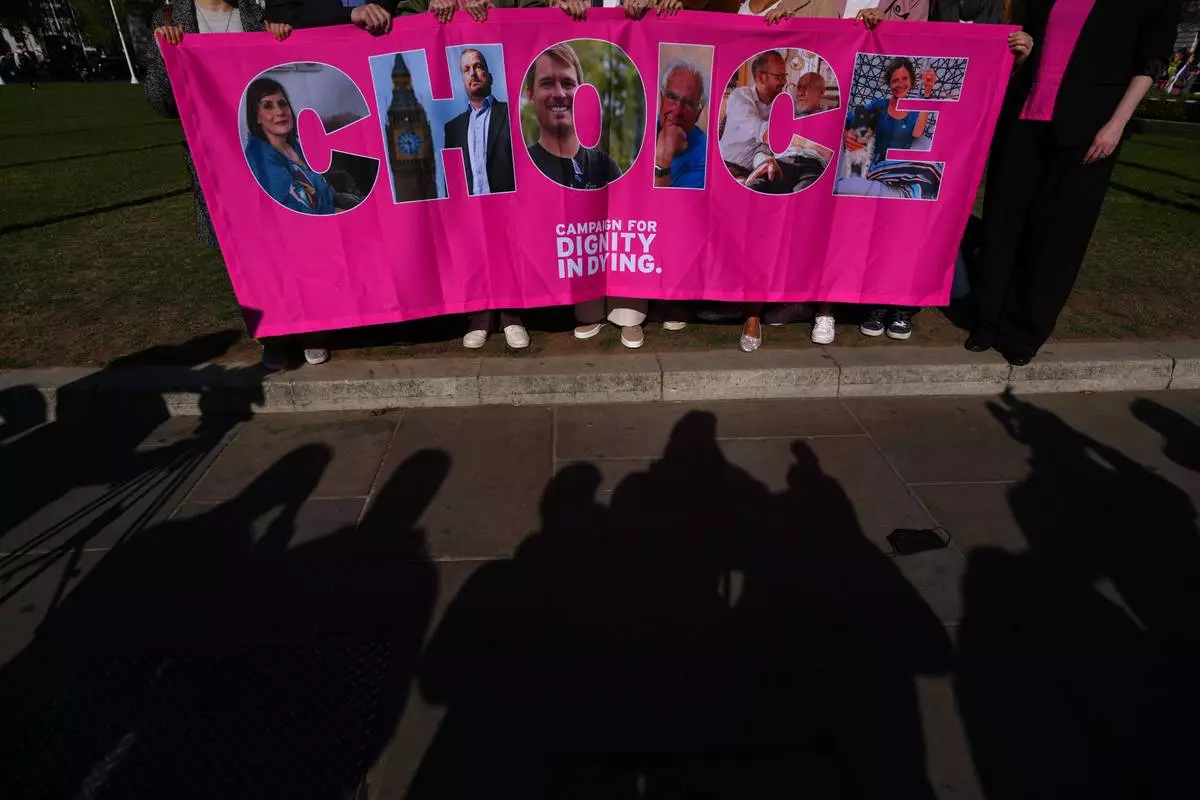
FILE - Arkansas quarterback Taylen Green (08) runs a drill at the NFL football scouting combine in Indianapolis, Saturday, Feb. 28, 2026. (AP Photo/Julio Cortez, , File)

LONDON (AP) — A proposed bill to allow terminally ill adults in England and Wales to choose to end their lives failed Friday as parliamentary time ran out following an effective filibuster by unelected lawmakers in the revising chamber that blocked the will of elected members.

Though the Terminally Ill Adults (End of Life) Bill was passed by the House of Commons last June, the House of Lords talked it out since then, stoking widespread criticism that it had overstepped the mark.

Proponents of what has been termed “ assisted dying ” — sometimes referred to as “assisted suicide” — hoped it would mark the biggest change to social policy in the U.K. since abortion was partially legalized in 1967. The bill had proposed allowing adults in England and Wales, with fewer than six months to live, to apply for an assisted death subject to the approval of two doctors and an expert panel.

But opponents in the House of Lords managed to hold up its passing by filing more than 1,200 amendments on a range of concerns, including the potential coercion of vulnerable people and a lack of safeguards for those with disabilities.

”The House of Lords scrutiny exposed this bill as ‘skeleton legislation’ riddled with gaping holes,” said Gordon Macdonald from the Care Not Killing campaign group which is opposed to a change in the law. “It is now clear that this bill was both unsafe and unworkable.”

The number of amendments is believed to be a record high for a piece of legislation that was brought forward by a backbencher rather than by the government. These so-called private members' bills can only be debated on a Friday as the government largely controls the rest of the parliamentary timetable, thereby limiting the time available.

Campaigners for assisted dying expressed their anger at the sight of unelected lawmakers holding up the will of the elected chamber. They have insisted that they intend to bring the bill back in the next parliamentary session, which begins after King Charles III outlines the government's upcoming program in a speech to both houses of Parliament on May 13.

The sponsor of the bill in the House of Lords, Charlie Falconer, said he felt “despondent” that a piece of legislation “so important to so many, has not failed on its merits, but failed as a result of procedural wrangling."

“Much more than letting ourselves down are the very many people who support the bill and who feel we have not treated them properly,” he said.

Lawmaker Kim Leadbeater, who introduced the Bill to the House of Commons in late 2024, said she was “trying to stay positive” while admitting “a real sense of sadness and sorrow today.”

She said there “will absolutely be appetite" within the Commons to bring the legislation back in the next session of parliament.

Last month, lawmakers in the Scottish Parliament rejected their own assisted dying legislation. Scotland has a semiautonomous government that has authority over many areas of policy, including health.

Assisted suicide — where patients take a lethal drink prescribed by a doctor — is legal in countries including Australia, Belgium, Canada, Luxembourg, the Netherlands, New Zealand, Portugal, Spain, Switzerland and parts of the U.S., with regulations on qualifying criteria varying by jurisdiction.

Campaigners hold a banner outside parliament in London as a proposed law to legalise assisted dying in England and Wales will run out of time on Friday, more than a year after MPs first voted in favour of it, Friday, April 24, 2026. (AP Photo/Kirsty Wigglesworth)

Campaigners hold a banner outside parliament in London as a proposed law to legalise assisted dying in England and Wales will run out of time on Friday, more than a year after MPs first voted in favour of it, Friday, April 24, 2026. (AP Photo/Kirsty Wigglesworth)

A campaigner holds a banner outside parliament in London as a proposed law to legalise assisted dying in England and Wales will run out of time on Friday, more than a year after MPs first voted in favour of it, Friday, April 24, 2026. (AP Photo/Kirsty Wigglesworth)

A campaigner holds a banner outside parliament in London as a proposed law to legalise assisted dying in England and Wales will run out of time on Friday, more than a year after MPs first voted in favour of it, Friday, April 24, 2026. (AP Photo/Kirsty Wigglesworth)

Campaigner Louise Shackleton holds a banner outside parliament in London as a proposed law to legalise assisted dying in England and Wales will run out of time on Friday, more than a year after MPs first voted in favour of it, Friday, April 24, 2026. (AP Photo/Kirsty Wigglesworth)

Campaigner Louise Shackleton holds a banner outside parliament in London as a proposed law to legalise assisted dying in England and Wales will run out of time on Friday, more than a year after MPs first voted in favour of it, Friday, April 24, 2026. (AP Photo/Kirsty Wigglesworth)

A campaigner holds a banner outside parliament in London as a proposed law to legalise assisted dying in England and Wales will run out of time on Friday, more than a year after MPs first voted in favour of it, Friday, April 24, 2026. (AP Photo/Kirsty Wigglesworth)

A campaigner holds a banner outside parliament in London as a proposed law to legalise assisted dying in England and Wales will run out of time on Friday, more than a year after MPs first voted in favour of it, Friday, April 24, 2026. (AP Photo/Kirsty Wigglesworth)

Campaigners hold a banner outside parliament in London as a proposed law to legalise assisted dying in England and Wales will run out of time on Friday, more than a year after MPs first voted in favour of it, Friday, April 24, 2026. (AP Photo/Kirsty Wigglesworth)

Campaigners hold a banner outside parliament in London as a proposed law to legalise assisted dying in England and Wales will run out of time on Friday, more than a year after MPs first voted in favour of it, Friday, April 24, 2026. (AP Photo/Kirsty Wigglesworth)

Recommended Articles