WASHINGTON (AP) — A U.S. Army major employed as a nurse on a military base near Washington, D.C., has been charged with conspiring to provide financial and tactical support to separatist fighters in his native Cameroon, according to court records unsealed earlier this week.
Maj. Kenneth Chungag, a nurse who lives and works on Fort Belvoir in Virginia, is accused of using his military training and experience to assist the Ambazonia Defense Forces in Cameroon.
Chungag is “greatly dismayed by these charges and looks forward to a timely and just resolution of the matter,” defense attorney Robert Jenkins told The Associated Press in an email Friday.
Chungag, a 50-year-old naturalized U.S. citizen, and co-defendant Mercy Akwi Ombaku were arrested Monday on federal conspiracy charges. A magistrate judge ordered their release from custody after initial court appearances in Alexandria, Virginia. Prosecutors didn’t seek their pretrial detention.
In 2020, Chungag was stationed at Fort Meade in Maryland when he first expressed interest in assisting members of the ADF, according to the FBI affidavit. In online chats with ADF members in Cameroon, Chungag falsely claimed to have combat experience in Iraq but appeared to be embellishing his military background to raise his profile in the group, the affidavit says.
Chungag is accused of plotting with Ombaku, a Maryland resident, to transfer money from the U.S. to Cameroon for the purchase of AK-47 assault rifles. Investigators believe Chungag grew disillusioned and withdrew from the organization in 2024. Later that year, FBI agents questioned him about his ADF-related activities. Investigators believe he tried to destroy incriminating evidence by deleting ADF-related messages from his phone after the FBI contacted him.
Cameroon, with a population of roughly 31 million, has been ruled by Paul Biya since 1982, making him one of Africa’s longest-serving rulers. The ADF is a separatist military organization in southern Cameroon fighting for the Anglophone region to break away from the central African country.
The separatist movement dates back to the early 1960s, when the British Southern Cameroons, a United Nations trust territory previously governed as part of Nigeria’s eastern region, was joined with Cameroon. In 2017, English-speaking separatists launched a rebellion aimed at establishing an independent state. The conflict has killed at least 6,500 people and displaced over 600,000 others, according to the Belgium-based International Crisis Group.
Pope Leo XIV on his recent Africa trip presided over a peace meeting last Thursday with community leaders in one of the two Anglophone regions. During the pope’s visit, separatist groups announced a three-day pause in fighting.
Chungag has worked as a nurse at a Fort Belvoir community hospital, according to a base spokesperson. The spokesperson referred questions about Chungag’s employment status to the medical center, which didn’t immediately respond to an email seeking comment.
Ombaku, a healthcare worker who also is a naturalized U.S. citizen born in Cameroon, is charged with conspiring with Chungag to financially support the ADF. She denied having any ADF affiliation when the FBI questioned her last July. An attorney for Ombaku, 38, of New Carrollton, Maryland, didn't immediately respond to an email seeking comment.
Fort Belvoir is located about 20 miles (32 kilometers) south of Washington along the Potomac River.
Adetayo reported from Lagos, Nigeria.

A general view of Bamenda, Cameroon, Tuesday, April 14, 2026. (AP Photo/Welba Yamo Pascal)
WASHINGTON (AP) — An appeals court on Friday blocked President Donald Trump’s executive order suspending asylum access at the southern border of the U.S., a key pillar of the Republican president’s plan to crack down on migration.
A three-judge panel from the U.S. Court of Appeals for the District of Columbia Circuit found that immigration laws give people the right to apply for asylum at the border, and the president can’t circumvent that.
The court opinion stems from action taken by Trump on Inauguration Day 2025, when he declared that the situation at the southern border constituted an invasion of America and that he was “suspending the physical entry” of migrants and their ability to seek asylum until he decides it is over.
The panel concluded that the Immigration and Nationality Act doesn’t authorize the president to remove the plaintiffs under “procedures of his own making,” allow him to suspend plaintiffs’ right to apply for asylum or curtail procedures for adjudicating their anti-torture claims.
“The power by proclamation to temporarily suspend the entry of specified foreign individuals into the United States does not contain implicit authority to override the INA’s mandatory process to summarily remove foreign individuals,” wrote Judge J. Michelle Childs, who was nominated to the bench by Democratic President Joe Biden.
“We conclude that the INA’s text, structure, and history make clear that in supplying power to suspend entry by Presidential proclamation, Congress did not intend to grant the Executive the expansive removal authority it asserts,” the opinion said.
The administration can ask the full appeals court to reconsider the ruling or go to the Supreme Court.
The order doesn’t formally take effect until after the court considers any request to reconsider.
White House press secretary Karoline Leavitt, speaking on Fox News, said she had not seen the ruling but called it “unsurprising,” blaming politically-motivated judges.
“They are not acting as true litigators of the law. They are looking at these cases from a political lens,” she said.
Leavitt said Trump was taking actions that are “completely within his powers as commander in chief.”
White House spokeswoman Abigail Jackson said the Department of Justice would seek further review of the decision. “We are sure we will be vindicated,” she wrote in an emailed statement.
The Department of Homeland Security didn’t immediately respond to a request for comment.
Advocates say the right to request asylum is enshrined in the country’s immigration law and say denying migrants that right puts people fleeing war or persecution in grave danger.
Lee Gelernt, attorney with the American Civil Liberties Union, who argued the case, said in a statement that the appellate ruling is “essential for those fleeing danger who have been denied even a hearing to present asylum claims under the Trump administration’s unlawful and inhumane executive order.”
Las Americas Immigrant Advocacy Center, one of the plaintiffs in the lawsuit, welcomed the court decision as a victory for their clients.
“Today’s DC Circuit ruling affirms that capricious actions by the President cannot supplant the rule of law in the United States,” said Nicolas Palazzo, director of advocacy and legal Services at Las Americas.
Judge Justin Walker, a Trump nominee, wrote a partial dissent. He said the law gives immigrants protections against removal to countries where they would be persecuted, but the administration can issue broad denials of asylum applications.
Walker, however, agreed with the majority that the president cannot deport migrants to countries where they will be persecuted or strip them of mandatory procedures that protect against their removal.
Judge Cornelia Pillard, who was nominated by Democratic President Barack Obama, also heard the case.
In the executive order, Trump argued that the Immigration and Nationality Act gives presidents the authority to suspend entry of any group that they find “detrimental to the interests of the United States.”
The executive order also suspended the ability of migrants to ask for asylum.
Trump’s order was another blow to asylum access in the U.S., which was severely curtailed under the Biden administration, although under Biden some pathways for protections for a limited number of asylum seekers at the southern border continued.
For Josue Martinez, a psychologist who works at a small migrant shelter in southern Mexico, the ruling marked a potential “light at the end of the tunnel” for many migrants who once hoped to seek asylum in the U.S. but ended up stuck in vulnerable conditions in Mexico.
“I hope there’s something more concrete, because we’ve heard this kind of news before: A district judge files an appeal, there’s a temporary hold, but it’s only temporary and then it’s over,” he said.
Meanwhile, migrants from Haiti, Cuba, Venezuela and other countries have struggled to make ends meet as they try to seek refuge in Mexico’s asylum system that’s all but collapsed under the weight of new strains and slashed international funds.
This week hundreds of migrants, mostly stranded migrants from Haiti, left the southern Mexican city of Tapachula on foot to seek better living conditions elsewhere in Mexico.
———
AP reporters Gary Fields in Washington, Gisela Salomon in Miami and Megan Janetsky in Mexico City contributed to this report.
This story has been corrected to show that Leavitt was speaking to Fox News, not to a press gaggle.
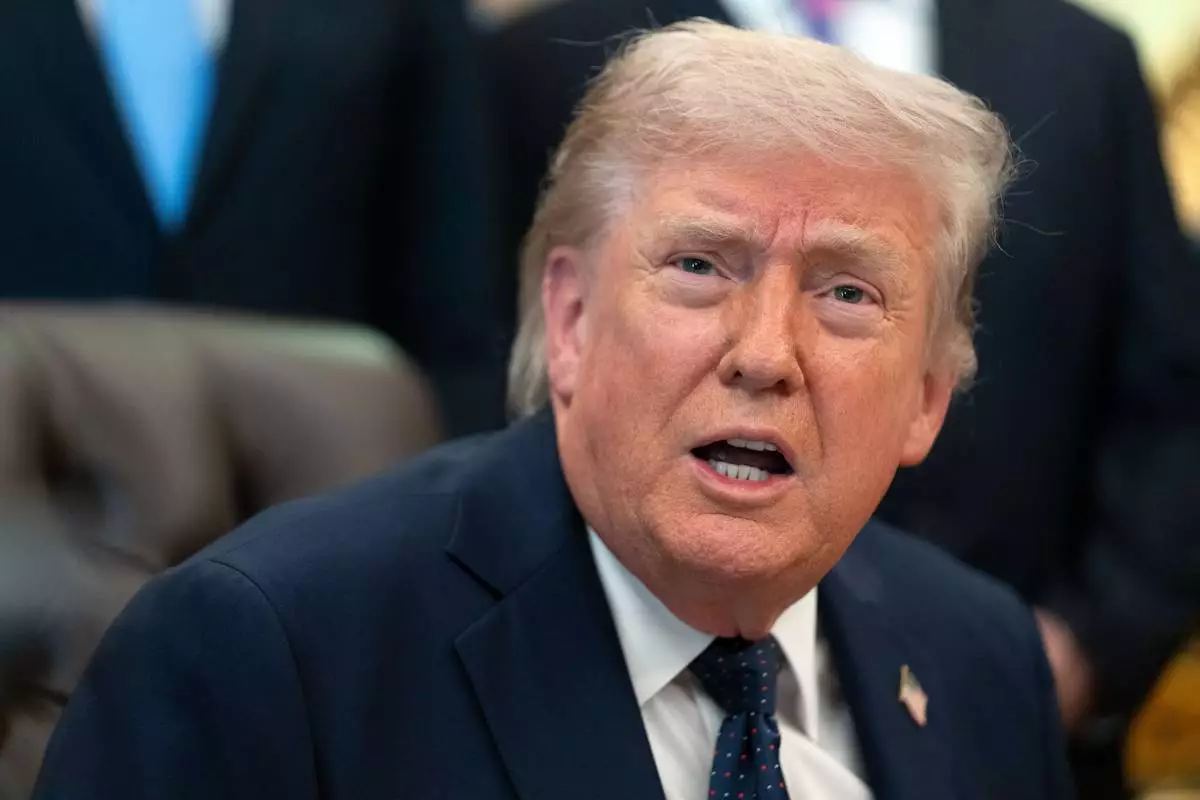
President Donald Trump speaks during an event on health care affordability in the Oval Office at the White House, Thursday, April 23, 2026, in Washington. (AP Photo/Mark Schiefelbein)