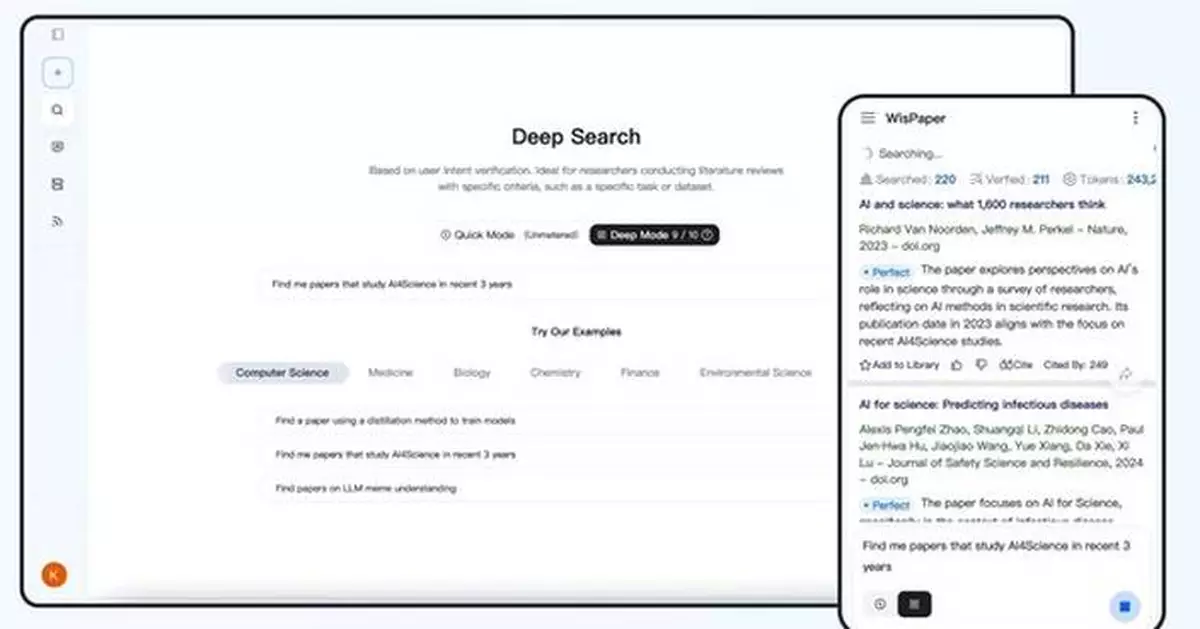
SINGAPORE, April 25, 2026 /PRNewswire/ -- WisPaper, an AI-powered academic research agent, today introduced a new approach to scientific workflows that supports concurrent research execution. The development addresses a longstanding constraint in research—the reliance on sequential, step-by-step processes—by enabling multiple lines of inquiry to progress in parallel, allowing researchers to expand both the speed and scope of exploration.
Breaking the Limits of Sequential Research
Traditional research follows a linear structure, where literature review, hypothesis formation, experimentation, and validation are carried out sequentially. This model limits researchers to advancing a single direction, as each stage requires manual effort.
WisPaper shifts this structure by reducing dependencies between stages. Tasks that once required sequencing can now proceed more independently, allowing different research threads to move forward without waiting for earlier steps.
Enabling Concurrent Exploration
With this approach, WisPaper supports a more parallel mode of research. Researchers can initiate multiple hypotheses or problem statements simultaneously, while the system advances processes such as literature analysis, experimental setup, and result generation across these directions.
This enables a higher density of exploration within the same time frame. Instead of focusing on a single hypothesis over an extended period, researchers can evaluate multiple possibilities, compare outcomes, and adjust direction more efficiently.
Redefining the Researcher's Role
As execution becomes less constrained by manual coordination, the role of the researcher shifts toward higher-level decision-making. Researchers can focus on defining questions, setting priorities, and interpreting results across multiple ongoing investigations.
This model mirrors how larger research teams operate, where parallel efforts are coordinated toward shared objectives. By enabling similar capabilities at the individual level, WisPaper expands how research can be structured and managed.
Implications for Knowledge Production
Parallel exploration introduces a different rhythm to scientific work. By allowing more research paths to be tested within a given period, it may influence how quickly new findings emerge, particularly in areas where validation is time-intensive.
As research workflows continue to evolve, approaches that balance depth with broader exploration may play an increasing role in shaping how knowledge is produced.
About WisPaper
WisPaper is an AI-powered academic research agent designed as a full-chain research accelerator. It supports literature retrieval, analysis, experiment design, execution, and paper writing within a unified workflow, helping researchers manage complex scientific tasks more efficiently across disciplines. For more information, visit http://wispaper.ai/?utm_source=news.
** This press release is distributed by PR Newswire through automated distribution system, for which the client assumes full responsibility. **
WisPaper Enables Parallel Scientific Exploration, Moving Research Beyond Sequential Workflows

XI'AN, China, April 25, 2026 /PRNewswire/ -- Taiyang News, a globally authoritative photovoltaic media outlet, officially released its April 2026 edition of the "TOP SOLAR MODULES LISTING". LONGi's EcoLife series modules (LR7-54HJD-510M), built on HIBC technology, have firmly claimed the top spot with a mass production efficiency of 25%. This milestone marks international recognition of LONGi's innovation strength in the back-contact (BC) technology pathway and ushers in a new "25%+" era for PV module efficiency.
Since 2022, Taiyang News has published its monthly "TOP SOLAR MODULES Listing," now widely recognized as an authoritative efficiency ranking in the global PV industry. The ranking imposes stringent inclusion criteria: only products that have achieved large-scale mass production, have complete technical data, and deliver conversion efficiency of ≥21.5% are considered. Moreover, all data must come from commercial products already delivered to end customers. With "real and deliverable" as its baseline, the ranking holds high industry reference value and credibility, serving as a barometer for global PV module efficiency levels. LONGi's top position proves that its HIBC products have reached the world's highest efficiency in real mass production.
Behind this achievement lies LONGi's persistent efforts in BC technology. HIBC (High-temperature/Low-temperature Hybrid Interdigitated Back-Contact) cell technology is a major innovation along LONGi's BC roadmap. It combines the high passivation performance of heterojunction (HJT) technology with the superior light utilization of the back-contact structure, achieving the world's first mass production of such modules. In April 2025, the ISFH (Institute for Solar Energy Research in Hamelin) certified LONGi's HIBC cell efficiency at 27.81%, setting a new world record for this technology and approaching the theoretical limit of single-crystalline silicon cells.
Li Zhenguo, Founder and Chief Technology Officer of LONGi, commented: "This is another peak that LONGi has reached in technological innovation, as well as another major breakthrough in our BC technology journey. We have taken PV module efficiency to a significantly higher level, fully demonstrating the high scalability of BC technology and the substantial room for further efficiency gains."
The EcoLife series modules, designed specifically for residential applications, deliver a maximum power output of up to 510W. The EcoLife series modules increase the cell-to-module area ratio from 93.2% to 95.1%, thereby significantly enhancing light absorption. To address shading issues, the modules feature a unique quasi-bypass diode structure that enables current routing. Under shading, power loss is reduced by more than 70% compared to TOPCon products, making them highly resistant to soiling and shadows. With a leading power density of 250W/m², the modules effectively solve the challenge of generating more power on limited roof areas, substantially reducing household electricity costs.
Martin Green, known as the "Father of PV" and a professor at the University of New South Wales in Australia, has praised the technology: "On the 'Solar Cell Efficiency Tables' list, LONGi's HIBC technology dominates, taking the number one spot. This is also attributable to LONGi's persistent efforts on the BC technology track."
To date, LONGi's HIBC and BC series modules have gained extensive market validation worldwide. In January 2026, the LONGi EcoLife won the German Excellence Award 2026 in the "Energy & Environment" category. The jury's citation read: "LONGi EcoLife: Higher Power Generation, Higher Safety – Modules for an Uncertain Climate Future," specifically acknowledging the product's technical leadership and application value. In February, LONGi renewed a three-year framework agreement with Energy 3000, a well-known European energy solutions provider, to continuously supply a total of 2GW of high-efficiency PV modules, focusing on HPBC 2.0 and LONGi EcoLife modules based on HIBC technology.
At present, HIBC cell technology has already achieved large-scale mass production. LONGi has built a complete BC technology matrix ranging from HPBC 2.0 to HIBC. Moving forward, LONGi will continue to drive technological innovation, further boost module efficiency and power density through its BC technology platform, deepen global market applications of high-efficiency products such as HIBC, and strive to deliver more valuable clean energy solutions to customers worldwide, contributing to the global energy transition and the realization of carbon neutrality goals.
** This press release is distributed by PR Newswire through automated distribution system, for which the client assumes full responsibility. **
LONGi EcoLife Series Module Top TaiyangNews Global Ranking, Ushering in the "25%+" Era of Photovoltaic Efficiency