KYOTO, Japan--(BUSINESS WIRE)--Apr 26, 2026--
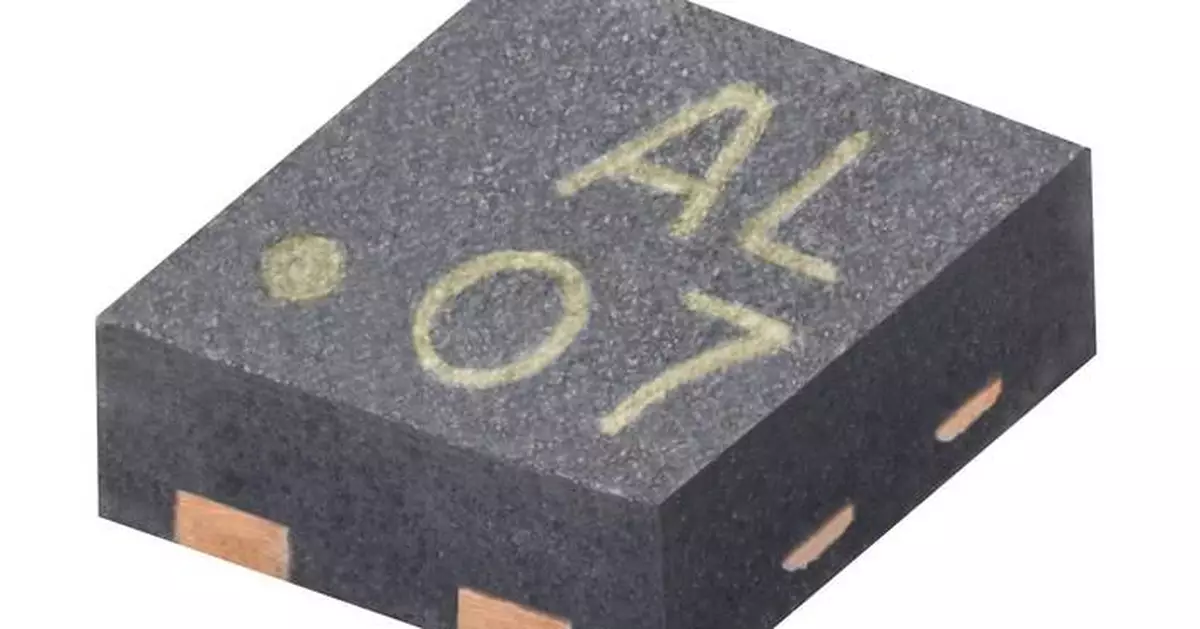
Murata Manufacturing Co., Ltd. (TOKYO: 6981) (ISIN: JP3914400001) has commenced mass production of its MRMS166R and MRMS168R anisotropic magnetoresistance (AMR) sensors for healthcare, wearable, and IoT devices. The MRMS166R is the first AMR sensor to combine an average current consumption of 20 nA with operation from a 1.2 V supply, enabling extended battery life in coin cell-powered systems.
This press release features multimedia. View the full release here: https://www.businesswire.com/news/home/20260413296947/en/
The devices are solid-state magnetic sensors used for switching applications. They detect the presence or absence of a magnetic field and generate an output signal that system logic uses to control functions such as transitions between active and sleep modes. This enables contactless switching without mechanical components, improving reliability, and supporting sealed, miniaturized designs.
Automatic switching between active and sleep modes is widely used in battery-powered devices to reduce standby power consumption and extend operating life. In healthcare, applications include capsule endoscopes and medical patches. Wearable devices, including AR glasses and wireless earbuds, as well as security-related IoT devices, such as door open/close detection systems and smart locks, also use this functionality.
These devices commonly use silver oxide coin batteries (typically 1.55 V), which impose constraints on both available capacity and operating voltage. AMR sensors used as magnetic switches must therefore minimize current consumption while maintaining stable operation at low voltage. Murata addressed these requirements through a redesign of the AMR sensor’s internal circuitry, enabling ultra-low current consumption and reliable operation down to 1.2 V. This significantly reduces battery consumption during standby operation, supporting device operation for more than two years in typical use.
Both devices are housed in a compact package measuring 1.0 × 1.0 × 0.4 mm (0.04 × 0.04 × 0.02 inches), making them suitable for space-constrained designs. The MRMS166R operates over a 1.2 to 3.6 V supply range (1.5 V typ.) with an average current consumption of 20 nA and a maximum current output of 1 mA. The MRMS168R operates over a 2.0 to 3.6 V supply range (3.0 V typ.), with an average current consumption of 80 nA and a maximum output current of 12 mA, providing higher output drive capability for devices requiring increased load current.
Murata will continue to expand its AMR sensor lineup and reduce power consumption to support longer operating times and enhanced functionality in medical, wearable, and IoT devices.
For more details on the AMR sensor lineup, including MRMS166R and MRMS168R, please visit the product page: [ MRMS166R, MRMS168R ]
For inquiries regarding these products, please Contact US.
About Murata
Murata Manufacturing Co., Ltd. is a worldwide leader in the design, manufacture and sale of ceramic-based passive electronic components & solutions, communication modules and power supply modules. Murata is committed to the development of advanced electronic materials and leading edge, multi-functional, high-density modules. The company has employees and manufacturing facilities throughout the world.
[Murata Manufacturing Co., Ltd.] AMR sensor

FRANKFURT, Germany (AP) — The European Central Bank on Thursday became the first major central bank to raise interest rates in response to the Iran war as policymakers around the world including new U.S. Federal Reserve Chair Kevin Warsh wrestle with how to confront the inflation fed by sharply higher oil prices.
The ECB’s rate-setting council raised its benchmark rate to 2.25% from 2%, where it had been for a year. The move comes ahead of rate-setting meetings next week at the Fed, the Bank of Japan, and the Bank of England.
Oil prices have risen sharply due to Iran choking off the flow of crude oil through the Strait of Hormuz, the sea passage for a fifth of the world’s oil and fuel products during normal times. Raising rates aims to dampen the consumer price inflation fed by higher costs for products made from crude such as gasoline, diesel fuel, cooking gas and heating oil.
International benchmark Bent crude was trading at around $93 per barrel on Thursday, up from around $73 on the eve of the war. That has helped push inflation to 3.2% in May in the 21 countries that use the euro currency, above the ECB’s target of 2%.
But ECB policymakers must also consider the impact of higher borrowing costs on an economy showing only mediocre growth. That has led analysts to think Thursday’s hike will be a one and done affair, aimed mainly at signaling to financial markets that the bank is determined not to get behind the curve if inflation spirals higher.
The bank's future decisions depend to a great extent on how long energy prices remain elevated and how high they go, ECB President Christine Lagarde said at a post-decision news conference. She said the bank was “well positioned to navigate the uncertainty caused by the war” and would “closely monitor the situation and follow a data-dependent and meeting-by-meeting approach.” She said the bank was “not pre-committing to a particular rate path.”
She said oil prices were expected to “lift inflation further over the summer” and that inflation was expected to remain “well above target” into the first half of next year. The Strait of Hormuz has been closed to most ship traffic for 103 days now.
Central banks in Australia and the Philippines have raises rates since the start of the war, and attention is focusing now on decisions in larger economies. For its part, the U.S. Federal Reserve is expected to keep its key interest rate unchanged when it meets next week with new chair Warsh, appointed earlier this year by President Donald Trump.
Warsh advocated for rate cuts last year and Trump repeatedly attacked Warsh’s predecessor, Jerome Powell, for not cutting borrowing costs deeply enough. Yet with inflation jumping to a three-year high as gas prices have spiked in the wake of the Iran war, even Trump and his officials have started to shift their focus more to a push to keep rates unchanged.
The Fed is likely to change the statement it issues after each meeting by removing language that had suggested that its next move would be a cut. That would open the door for a rate hike down the road. Many Fed officials have warned that if inflation doesn’t begin to cool soon, a rate hike may be necessary by the end of the year.
Raising benchmark rates influences what lenders charge throughout the economy, increasing the cost of borrowing money to buy things and thus dampening demand for goods. Higher central bank rates can send interest costs higher for home purchases, investment in new factories, and government borrowing.
The ECB may be able to get by with only one or two increases because the inflationary surge may be milder than feared, said Carsten Brzeski, global chief of macro at ING bank.
That is because consumers burned by the post-pandemic spike in inflation are in no mood to pay higher prices, leaving businesses little choice but to swallow higher energy costs: “The pass-through of higher energy and input prices to final consumption will be limited due to a lack of ability and willingness of consumers to actually pay for these higher prices,” he wrote in an emailed comment.
——
Rugaber reported from Washington.
The European Bank is pictured in Frankfurt, Germany, Tuesday, June 9, 2026. (AP Photo/Michael Probst)