Skip to Content Facebook Feature Image

Modern, intelligent production fuels motorcycle industry in Chongqing

China

China

China

Modern, intelligent production fuels motorcycle industry in Chongqing

2026-04-27 17:17 Last Updated At:04-28 00:17

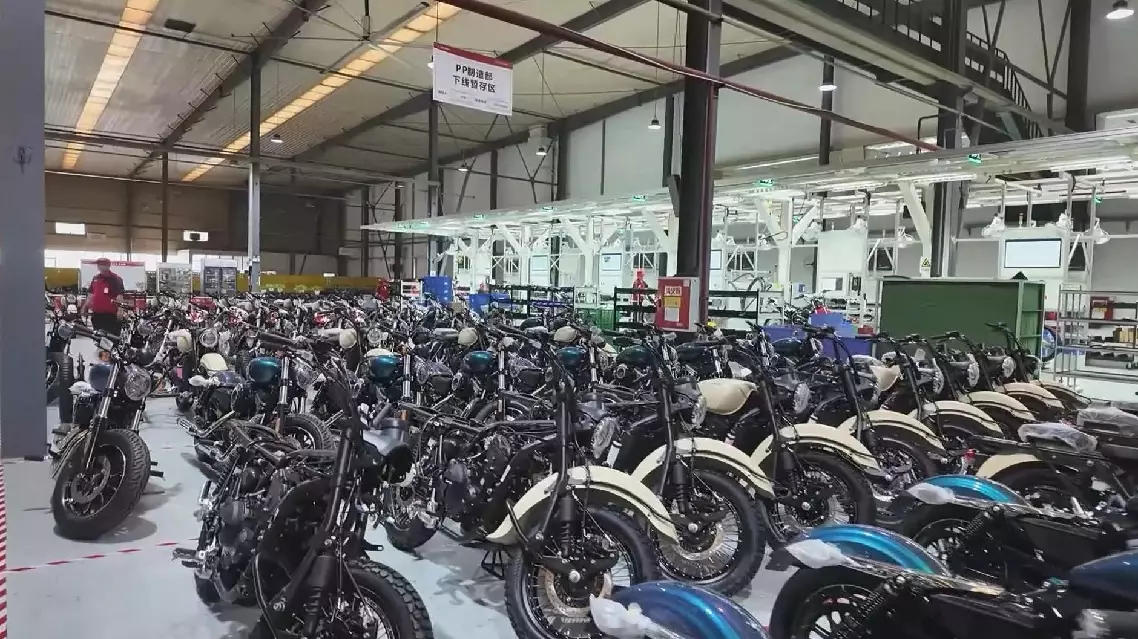
The rapid growth of modern and intelligent production capabilities has become the key to the revitalization of the motorcycle industry in southwest China’s Chongqing Municipality.

A motorcycle manufacturer in Chongqing said that their research and development process involve almost daily high-intensity extreme performance testing. In a rain-soaked testing, the vehicle traversed steep slopes, jumps and slippery surfaces, demonstrating its power, shock absorption and handling capabilities.

"This motorcycle is equipped with the latest generation of powertrain technology, boasting a torque exceeding 500 Nm. We are also developing the next generation of new products, challenging ourselves to achieve the same result using magnesium alloys, which would be more than 30 percent lighter than aluminum alloys," said Tang Yong, deputy director of the Chongqing Xinyuan Motorcycle Research Institute.

Beyond improved power, domestic manufacturers have also made breakthroughs in key engine technologies, breaking the long-standing monopoly of foreign companies.

"We specifically developed a variable valve system, breaking the long-standing foreign monopoly. Related precision components can now be manufactured with high precision, and by combining our efforts, we have formed an integrated capability in research and development," said Zhang Bin, chief engineer in innovation and technology research at the Loncin General Technology Center.

On the production side, intelligent transformation is also accelerating. Chongqing has built the first state-of-the-art intelligent factory in the motorcycle industry, with robotic arms automating assembly and a digital twin system monitoring the entire process, significantly improved production efficiency and product stability.

"This factory is the first state-of-the-art intelligent factory in the motorcycle industry in China, and it is also leading compared to its counterparts in Europe, America and Japan, which provides a stronger guarantee for the production of high-end medium and large-displacement products," said Chen Yifang, executive deputy general manager, Loncin General Power.

Currently, Chongqing has gathered more than 50 vehicle manufacturers and more than 400 upstream and downstream parts suppliers, with the local supply rate of fuel motorcycles exceeding 80 percent.

"Due to the relatively complete industry and convenient design and development, the cycle of research and development can be greatly shortened and manufacturing costs can be reduced. The typical cycle for developing a new product and putting it into production is 24 months, but in Chongqing, the cycle can be shortened to 12 to 15 months," Tang said.
Modern, intelligent production fuels motorcycle industry in Chongqing


Modern, intelligent production fuels motorcycle industry in Chongqing

Global military expenditure rose to a record 2.89 trillion U.S. dollars in 2025, marking the 11th consecutive year of growth, according to a report released by the Stockholm International Peace Research Institute (SIPRI) on Monday.

The global military burden, or military expenditure as a share of gross domestic product (GDP), rose to 2.5 percent in 2025, the highest level since 2009, SIPRI said.

Military spending increased by 2.9 percent in real terms from 2024, a sharp slowdown, however, from the 9.7 percent rise recorded the previous year.

Global military spending rose again in 2025 as states responded to another year of wars, uncertainty and geopolitical upheaval with large-scale armament drives, said a researcher with SIPRI's Military Expenditure and Arms Production Programme.

The United States remained the world's largest military spender, though its expenditure fell by 7.5 percent to 954 billion dollars in 2025. SIPRI said the decline was mainly because no new financial military assistance for Ukraine was approved during the year, in contrast to the previous three years.

SIPRI said the decline in U.S. military spending was likely to be short-lived. The director of SIPRI's Military Expenditure and Arms Production Programme said spending approved by the U.S. Congress for 2026 had risen to more than one trillion dollars and could climb further to 1.5 trillion dollars in 2027 if U.S. President Donald Trump's latest budget proposal is accepted.

Europe was the main contributor to the global increase in 2025. Military spending in the region rose by 14 percent to 864 billion dollars.

The 29 European members of the North Atlantic Treaty Organization (NATO) spent a combined 559 billion dollars in 2025. Of them, 22 had military spending of at least two percent of GDP, according to SIPRI's methodology.

Military spending by European NATO members rose faster in 2025 than at any time since 1953, reflecting European efforts to strengthen self-reliance and growing U.S. pressure for greater burden-sharing within the alliance, SIPRI said.

In the Middle East, military expenditure reached an estimated 218 billion dollars in 2025, almost unchanged from 2024. SIPRI said regional spending remained stable despite ongoing conflicts and rivalries.

In Asia and Oceania, Japan's military expenditure rose by 9.7 percent to 62.2 billion dollars, equivalent to 1.4 percent of GDP, its highest share since 1958.

SIPRI said military expenditure covers government spending on current military forces and activities, including personnel, operations, arms and equipment purchases, military construction, research and development, and central administration.

Global military spending hits record high in 2025: report

Global military spending hits record high in 2025: report

Recommended Articles