MIAMI--(BUSINESS WIRE)--Apr 27, 2026--
OpenEvidence now integrates National Comprehensive Cancer Network ® (NCCN ® ) Clinical Practice Guidelines in Oncology ( NCCN Guidelines® ) directly in answers, grounding responses in the pinnacle reference resource defining and advancing care in oncology. OpenEvidence’s collaboration with NCCN marks the beginning of a series of focused oncology-related updates to the platform—in conjunction with leading experts in oncology—to help clinicians give the best possible care to patients in one of the most challenging areas of healthcare.
This press release features multimedia. View the full release here: https://www.businesswire.com/news/home/20260427952447/en/
Oncology is inherently complex, requiring nuanced representations of staging, diagnostics, and treatment approaches that evolve rapidly with new evidence. To meet the dual need for immediate, regular updates and extreme precision in the face of complexity, NCCN assiduously maintains comprehensive clinical practice guidelines that are supported by underlying science, and are relied on by providers worldwide. These algorithms and supporting information outline the best evidence-based, expert consensus-driven recommendations for care. The integration of the NCCN Guidelines ® into OpenEvidence represents the convergence of best practices for cancer care with best-in-class clinical decision support.
The OpenEvidence oncology content from NCCN was evaluated through a rigorous NCCN quality assurance process and provides direct links to the source documents for additional context. This ensures fidelity to the NCCN Guidelines, while OpenEvidence’s secure, proprietary systems contextualize guidance within the broader body of clinical evidence—making both high-level recommendations and their underlying details accessible to oncologists across the United States. This collaboration reflects a shared commitment to clinical excellence, transparency, and continuous quality assurance.
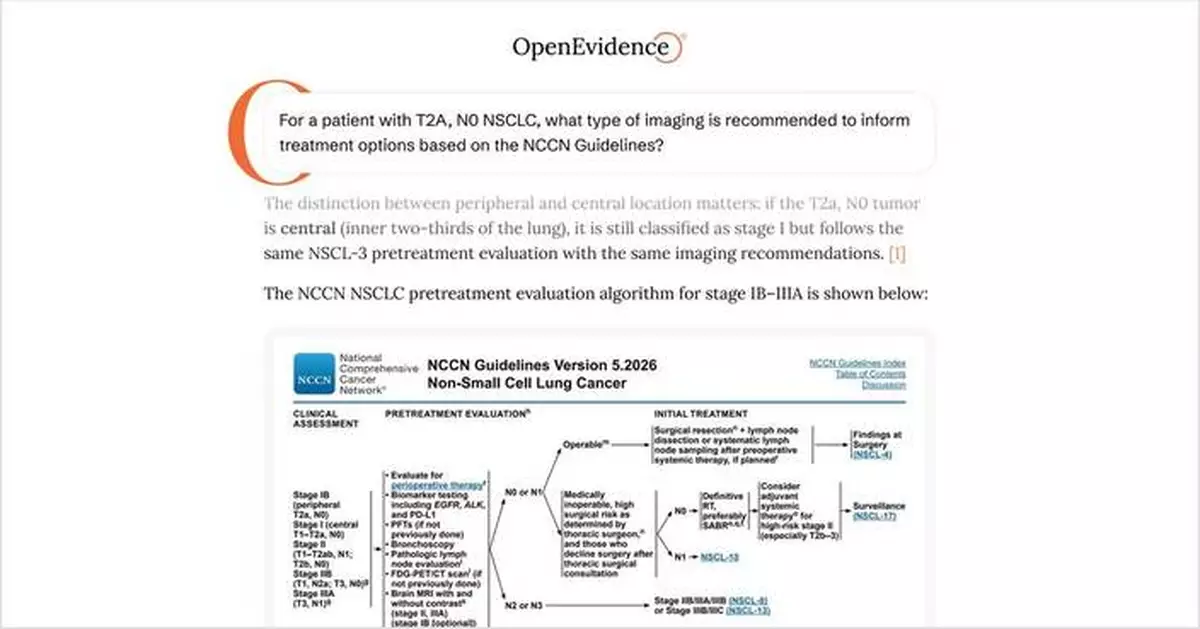
NCCN treatment algorithms incorporate staging criteria, diagnostic testing, and therapy sequencing in structured visual formats. OpenEvidence’s model interprets these frameworks in a clinically intuitive way—similar to how a physician would—so that when a clinician asks a question, the most relevant NCCN algorithm is surfaced in context, alongside peer-reviewed evidence, direct citations, and a link back to the NCCN website.
“As an oncologist, the NCCN Guidelines have always been central to how I care for patients, and I am aware of the extraordinary rigor, review, and consensus-building that goes into them. Leading this collaboration and working with the NCCN scientists for quality assurance to make the critical information rapidly accessible has been a dream for me since medical school,” said Travis Zack, MD, PhD, Chief Medical Officer at OpenEvidence.
“In community oncology, you’re often the only oncologist in the building, covering every tumor type. I reference the NCCN Guidelines all the time, but manually combing through them and tracing decision trees could take a lot of effort and time. This integration gives me back valuable time, which I can now spend double-clicking into the primary literature and counseling my patients,” said Samyukta Mullangi, MD, practicing medical oncologist and Vice President at OpenEvidence.
The NCCN Guidelines form a bedrock of oncologic decision-making, and share expertise and best practices across every practice setting. OpenEvidence is honored to incorporate them in close collaboration with NCCN, with a rigorous and iterative quality assessment process that ensures that oncologists have the best-in-class tools they need at their fingertips, whenever they need them.
About OpenEvidence
OpenEvidence is the most widely used medical AI platform among U.S. physicians and is trusted by hundreds of thousands of verified clinicians to make high-stakes clinical decisions at the point of care with answers that are sourced, cited, and grounded in peer-reviewed medical literature. OpenEvidence was founded with the mission to organize and expand the world's collective medical knowledge. Learn more at openevidence.com.
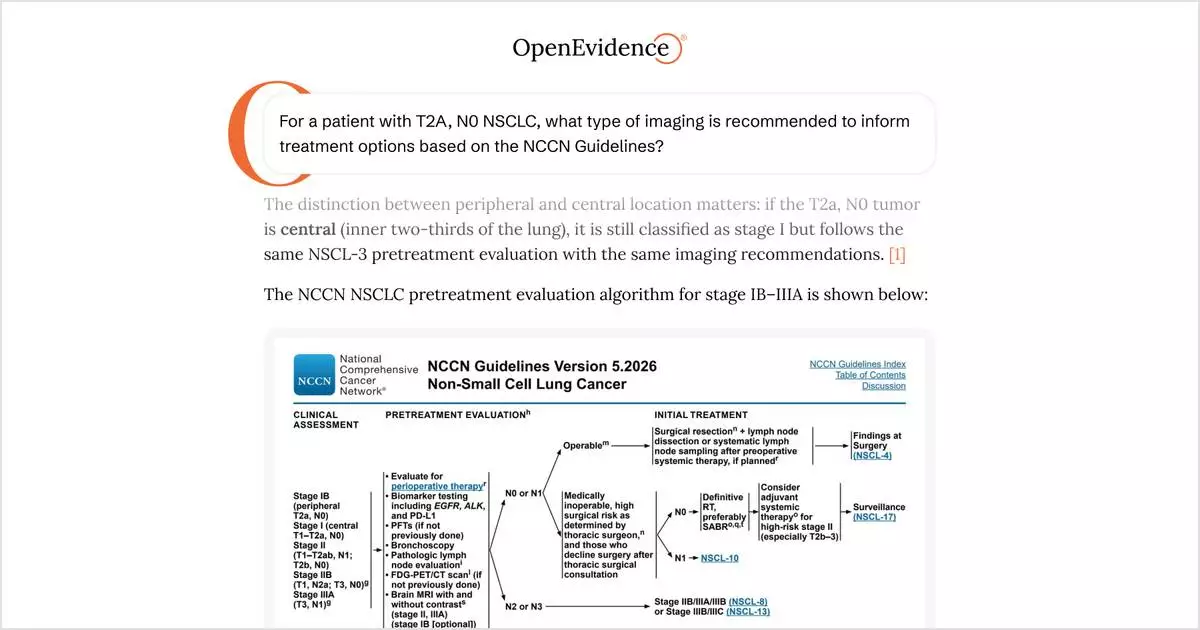
OpenEvidence’s model interprets NCCN frameworks in a clinically intuitive way so that when a clinician asks a question, the most relevant NCCN algorithm is surfaced in context, alongside peer-reviewed evidence, direct citations, and a link back to the NCCN website.